Origin of Magnetic field A current (or moving charge) experience a - - PowerPoint PPT Presentation

origin of magnetic field
SMART_READER_LITE
LIVE PREVIEW

Origin of Magnetic field A current (or moving charge) experience a - - PowerPoint PPT Presentation

Origin of Magnetic field A current (or moving charge) experience a magnetic force when it is in a magnetic field. The magnetic field is the result of another current (or moving charge). If electric field describes the interaction between two


slide-1
SLIDE 1

Origin of Magnetic field

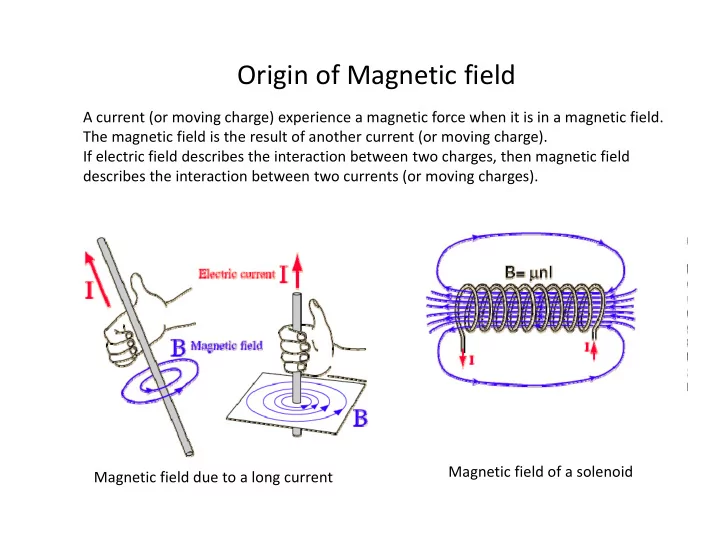
A current (or moving charge) experience a magnetic force when it is in a magnetic field. The magnetic field is the result of another current (or moving charge). If electric field describes the interaction between two charges, then magnetic field describes the interaction between two currents (or moving charges). Magnetic field due to a long current Magnetic field of a solenoid

slide-2
SLIDE 2

Properties of field lines I

  • 1. To visualize the electric field, we draw field
  • lines. When we put a positive test charge in the

electric field, the force acting on it will be tangent to the field line at that point. The magnitude of the force will be proportional to the density of field lines at that point.

+q F (weaker) +q F (stronger) magnetic field Small bar magnet magnetic field magnetic field electric field

slide-3
SLIDE 3

Properties of field lines II

  • 2. Electric field lines are continuous lines only

terminate at charges or at infinity.

  • 3. When an electric field line terminate at

charges, it always comes out from a positive charge, or getting into a negative charge.

  • 4. Field lines never cross each other.

magnetic field

slide-4
SLIDE 4

Consequences of non-existence of magnetic charge (monopole)

  • 1. Field lines terminate at point charges, so magnetic

field lines either terminate at infinity, or form loops.

N S Actually

  • 2. Gauss’s Law:

A d B Q A d E

enclosed

   

 

    

Electric field Magnetic field

slide-5
SLIDE 5

Maxwell’s Equations

Maxwell’s equations describe all the properties of electric and magnetic fields and there are four equations in it: Integral form Differential form (optional)

Name of equation

1st Equation Electric Gauss’s Law 2nd Equation Magnetic Gauss’s Law 3rd Equation 4th Equation

enclosed

Q A d E  

   A d B  

    E     B    

Not yet Not yet

Lorentz force equation is not part of Maxwell’s equations. It describes what happens when charges are put in an electric or magnetic fields:

) B v E (q F       

slide-6
SLIDE 6

Class 32. Biot-Savart Law

slide-7
SLIDE 7

Biot‐Savart Law

r r s d 4 I

  • r

r r ˆ s d 4 I B d

3 2

          

Magnetic field at point P due to the infinitesimal element ds: Magnetic field due to the whole wire:

r r ˆ s d 4 I B

2 wire

      

0 is a constant called permeability of free space: 0 = 410‐7 TmA‐1 In the calculation of magnetic field, Biot‐ Savart Law play the same role as the Coulomb’s Law in electric field.

slide-8
SLIDE 8

Magnetic Field at the Center of a Circular Current Loop

 

R 2 I B 2 R 4 I R 4 I d R 4 I d R 4 I B d R 4 I R Rd 4 I B d Rd ds R ds 4 I r r ˆ s d 4 I B d

2 2 2 2 2 2

                       

  

             

 

    

r ˆ P I R ds d P I