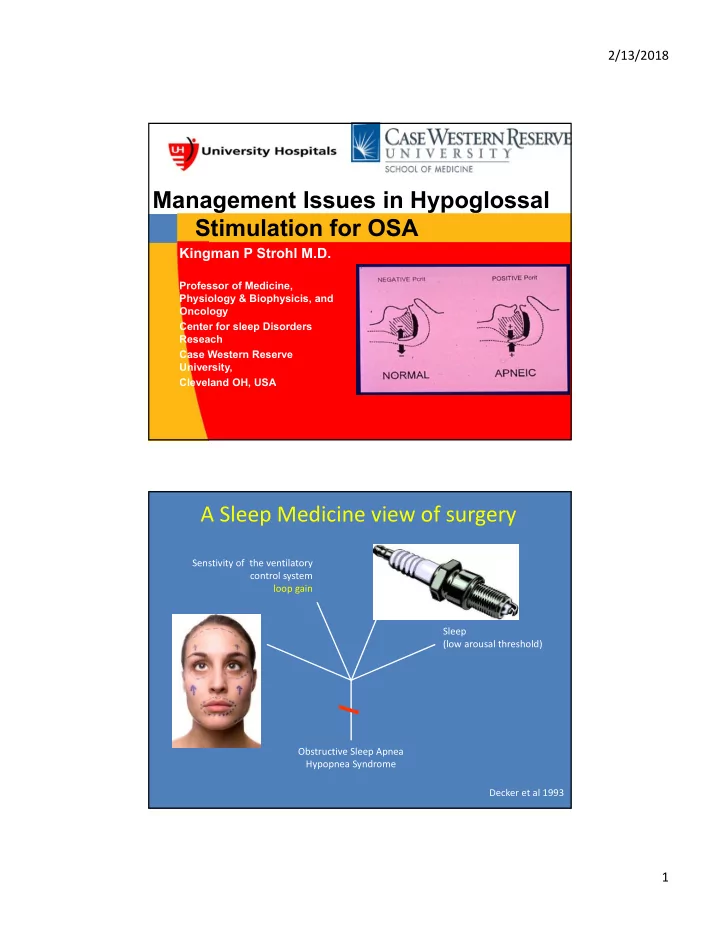
Management Issues in Hypoglossal Stimulation for OSA Kingman P - - PDF document

management issues in hypoglossal stimulation for osa
SMART_READER_LITE
LIVE PREVIEW

Management Issues in Hypoglossal Stimulation for OSA Kingman P - - PDF document

2/13/2018 Management Issues in Hypoglossal Stimulation for OSA Kingman P Strohl M.D. Professor of Medicine, Physiology & Biophysicis, and Oncology Center for sleep Disorders Reseach Case Western Reserve University, Cleveland OH, USA


slide-1
SLIDE 1

2/13/2018 1

Management Issues in Hypoglossal Stimulation for OSA

Kingman P Strohl M.D.

Professor of Medicine, Physiology & Biophysicis, and Oncology Center for sleep Disorders Reseach Case Western Reserve University, Cleveland OH, USA

A Sleep Medicine view of surgery

Obstructive Sleep Apnea Hypopnea Syndrome Anatomy (small, collapsible upper airway) CPAP Oral Appliance, etc. Anatomic Surgery Pharyngeal muscle activation (low gain and reflex response) Sleep (low arousal threshold) Senstivity of the ventilatory control system loop gain Decker et al 1993

slide-2
SLIDE 2

2/13/2018 2

Disclosures

Inspire Medical

– Site PI for the STAR Trial, and Inspire Post‐Approval and Registry Studies – Consultant on FDA application

NIH and VA research Awards on Causes and Consequences of Sleep Apnea Galvani Bioelectronics (Consultant) Sommetrics (Consultant and Research Support)

4

Hypoglossal Stimulation is a somewhat predictable treatment option for some……. Who:

  • Have moderate to severe OSA
  • Struggle to get consistent benefit from CPAP
  • Have a compatible airway anatomy profile
  • Have a body mass index (BMI) <35, ideally <32

A team is best to determine if this invasive, non-anatomic therapy is right at this time for any given patient.

  • Success is dependent upon its action to reduce the

closing pressure of upper airway.

  • In our hands, best success is when it opens the

retropharyngeal space.

Summary

slide-3
SLIDE 3

2/13/2018 3

Therapy Process

Routine Follow-ups

CPAP Profile Anatomy check Sleep Study Profile DISE

(Drug-Induced Sleep Endoscopy)

Typically

  • utpatient

Assessment Implant Follow Up Therapy activation Therapy

  • ptimization

Follow up

Assessment for Neural Stimulation

Obstructive Sleep Apnea Hypopnea Consequences (AHI 20‐60) Anatomy Office and DISE examination do not appear to be limiting factors. Pharyngeal muscle activation (low gain and reflex response) Sleep ????? Insomnia and OSA (low arousal threshold) Senstivity of the ventilatory control system <25% Central or Mixed Apneas Rx: Neurostimulation Decker et al 1993

??

slide-4
SLIDE 4

2/13/2018 4

Insurance/Cost Considerations

  • Inspire therapy is FDA approved.

Currently, the therapy is being reviewed by insurance companies on a patient-by- patient basis.

  • The first step is to see if a patient qualifies

for the therapy and then the work with the patient and/or an insurance company on the Inspire implant.

UAS Therapy Process

Routine Follow-ups

CPAP Profile Anatomy check Sleep Study Profile ENT and DISE

(Drug-Induced Sleep Endoscopy)

Assessment Implant Follow Up Therapy activation Therapy

  • ptimization

Follow up

slide-5
SLIDE 5

2/13/2018 5

Sleep Medicine

  • Inclusion/exclusion criteria needs
  • CPAP/oral appliance and documentation of

attempts, reasons, and face validity of non‐use (HNS is not a choice therapy) ………….. then

  • Explanation of the purpose and manner of

therapy including follow‐up

  • Restate the patient goals and assess

committment

  • Include some documentation by the patient of

why they need it.

Post‐Implant Management

Implant Activation Phase Titration Phase Long‐term

1 month post‐op 2 month post‐op

  • Thresholds

6 months and Annually*

Post‐op check @ 1 week Office Visit:

  • Stimulation

Thresholds Home Use:

  • Acclimatization

* In‐lab tuning PSG 2‐6 months

  • Stimulation

Across states and positions Office Visit:

  • Battery
  • Usage
  • Thresholds
  • Therapy

Adjustment

  • HST in many cases

are considered

slide-6
SLIDE 6

2/13/2018 6

Final Thoughts: Patient Cost, Physician Roles, Volume

Routine Follow-ups

Eligibility visit

(1 of 5 move forward)

Anatomy visit* Sleep Study Profile DISE*

(Drug-Induced Sleep Endoscopy)

Typically Outpatient * Assessment Implant Follow Up Therapy activation Therapy

  • ptimization

Follow up

Often a stopping point

Checklist for a Center: Build a Team

Health Economics

  • Cost of Inspire vs. alternate therapies
  • Cost vs. non-treatment
  • Hospital economics
  • Physician economics
  • Reimbursement
  • Coding

Assessment and Implant

  • Surgical techniques
  • Device follow-up and programming
  • Post operative complications

Practice & Patient Mgmt

  • Patient selection
  • Clinical trials - best practices
  • Medical management after implant
  • Psychological issues

OSA Common Knowledge Sleep

  • Incidence/ prevalence/demographics
  • Disease pathophysiology
  • Outcomes of untreated OSA
  • Inspire Mechanisms of Action

Inspire vs. Alternative Therapies

  • Efficacy
  • Safety profiles
  • Patient selection
  • Patient preference

Clinical Evidence

  • Reduction AHI/ODI (%)
  • Safety Profile
  • Effect on Co-morbidities/mortality
  • QOL/ADL
slide-7
SLIDE 7

2/13/2018 7

Question 1

What is the operational need to establish upper airway stimulation as on option for OSA?

  • 1. A committed surgeon
  • 2. A sleep laboratory that can focus on higher

levels of recording and analysis

  • 3. Research level sleep medicine group
  • 4. Both 1 and 2
  • 5. All factors

Question 1

What is the operational need to establish upper airway stimulation as on option for OSA?

  • 1. A committed surgeon
  • 2. A sleep laboratory that can focus on higher

levels of recording and analysis

  • 3. Research level sleep medicine group
  • 4. Both 1 and 2
  • 5. All factors
slide-8
SLIDE 8

2/13/2018 8

Question 2

What is the hardest issue in the assessment of a patient who really wants hypoglossal stimulation?

  • 1. Cost
  • 2. Defining CPAP failure
  • 3. Organizing DISE
  • 4. Scoring the PSG for eligibility
  • 5. Physical examination

Question 2

What is the hardest issue in the assessment of a patient who really wants hypoglossal stimulation?

  • 1. Cost
  • 2. Defining CPAP failure
  • 3. Organizing DISE
  • 4. Scoring the PSG for eligibility
  • 5. Physical examination
slide-9
SLIDE 9

2/13/2018 9

Question 3

What statement about management planning is true?

  • 1. The hospital will not be worried about the

cost.

  • 2. The cost to the patient is more than they

ever expected.

  • 3. The routines in the ENT and Sleep Medicine

sections for this therapy will mesh perfectly.

Question 3

What statement about management planning is true?

  • 1. The hospital will not be worried about the

cost.

  • 2. The cost to the patient is more than they

ever expected.

  • 3. The routines in the ENT and Sleep Medicine

sections for this therapy will mesh perfectly.