
SLIDE 1
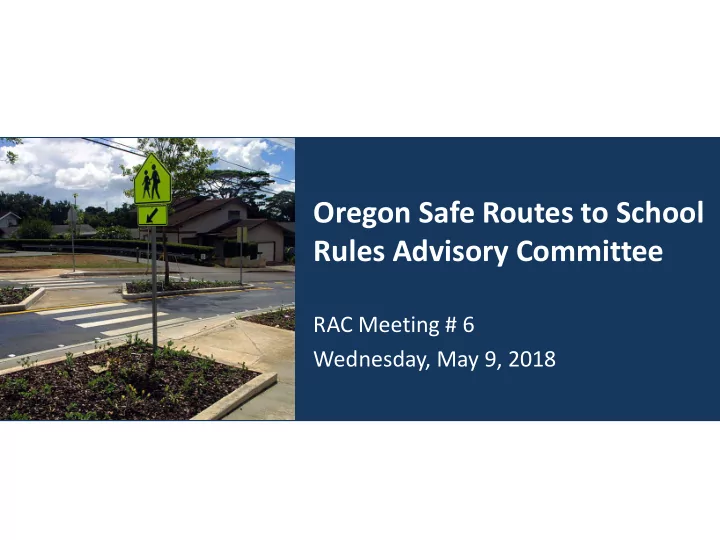
Oregon Safe Routes to School Rules Advisory Committee
RAC Meeting # 6 Wednesday, May 9, 2018
Oregon Safe Routes to School Rules Advisory Committee RAC Meeting # - - PowerPoint PPT Presentation
Oregon Safe Routes to School Rules Advisory Committee RAC Meeting # 6 Wednesday, May 9, 2018 Welcome Goals for this meeting: Provide input on program structure. Work toward opening program Fall 2018 Review and debrief all the
Oregon Safe Routes to School Rules Advisory Committee
RAC Meeting # 6 Wednesday, May 9, 2018
Goals for this meeting:
structure.
Fall 2018
work we’ve accomplished.
Meeting #1 – November 20th, 2017
Charge of committee. Discuss program success, goals, priorities and performance measures.
Meeting #2 – December 13th, 2017
Finalize vision, review values and discuss program design options that align with values and outcomes.
Meeting #3 – January 16, 2018
Review definitions. Review draft program design recommendations. Review criteria, eligibility, funding targets and carve-outs, etc.
Meeting #4 – February 13, 2018
Review and draft rule amendments for OTC discussion. OTC – March 15th, 2018 Bring draft rules to OTC for approval to release for public review.
Meeting #5 – April 3rd, 2018
Review draft rule, discuss criteria, eligibility, solicitation process, etc. Comment Period May 1, 2018 Open 21 day rulemaking public comment period. Promotion of draft rules. 1 public hearing. Meeting #6- May 9th, 2018 Discuss and provide input for program guidance Public Hearing May 15th, 2019 Public hearing in Salem to gather additional public comment. Meeting #7- June 6, 2018 If needed OTC July 19, 2018 Review public comment. Approve OAR or request additional action.
RAC Outreach
Portland Bureau of Transportation Central Lane MPO Metropolitan Policy Committee City of Seaside Public Works Director Blue Zones, The Dalles Multnomah County Central Lane MPO Transportation Policy Committee Oregon Safe Routes to School Network Blue Zones, Community project Eugene/Springfield Safe Routes to School Coordinators Lane County Area Commission on Transportation City of Gresham Blue Zones Umpqua City of Eugene Bethel, Eugene 4J, and Springfield school districts; SRTS Coordinators Association of Oregon Counties (AOC) Blue Zones, Klamath Falls Multnomah County Street Trust Lane County Area Commission on Transportation (LCACT) Grants Pass, Blue Zones East Portland/Gresham Oregon School of the Deaf Glendale School Board and Mayor Kaiser Permanente Oregon Legislature House Transportation Policy Committee ODOT Highway Management Team Clackamas County and school districts South West Area Commission on Transportation (SWACT) Association of Oregon Counties’ Transportation Steering Committee City of Gaston and School District Rouge Valley Area Commission on Transportation (RVACT) ODOT Highway Management Oregon Senator Lee Beyer The Dalles: Blue Zones Team (includes School principals and City staff) Central Oregon Area Commission on Transportation (COACT) Multnomah County Bend Accessibility Advisory Committee (pending) Hood River: Hood River Valley Residents Committee and School District Oregon Transportation Safety Committee (OTSC) City of Gresham Bend/LaPine School District Dufur Elementary School Community Connections, La Grande Portland Bureau of Transportation internal discussions Redmond School District Mosier School District City of Seaside Transportation Committee Klamath County, Commute Options City of Seaside Transportation Advisory Committee North Oregon Coast City Managers Oregon Department of Education, School Wellness
Nov
Values and Outcomes
Dec
Program Design Ideas
Jan
Narrow Program Design
Feb
Recommend Draft Rules March Update to OTC April High level guidance OAR filed and public comment
RAC Values
Geographic Equity
Social Equity Safety Health
Communication, Coordination, and Collaboration
Maximize Resources
Review what we’ve done OAR/Public Comment update Dig into more program guidance Review and debrief RAC accomplishments
RAC agreement on recommended program high level guidance High-level Guidance Creation
Timeline for first round Program descriptions Criteria to evaluate projectsRAC agreement on recommended OAR language OAR update
Add Definitions Add Program Descriptions Revise Advisory Committee Minor Revision of Non- Infrastructure Program Add Infrastructure Program: How Funds are Divided and EligibilityDetermine goals for program rules and guidance
What we’ve done…
Submitted to Secretary of State Public Comment Period and Public Hearing
discuss
lanes to bikeways
the first competitive cycle.
the 40% local match
RAC meets to discuss potential substantive changes
Small changes are made if needed, are in line with RAC values, and don’t change the intent of the rule. Comments are recorded and shared with the OTC on July 19, 2018. Update OAR, may resubmit to S.O.S.
Annual allocation FY 19-20=
2018= 8.3M 2019= 10M
2020= 10M 2021= 10M 2022= 10M
2023= 15M 2024= 15M
Min/Max Competitive
Minimum funding request = $60K Maximum funding request= $2M
Minimum funding request= N/A Maximum funding request= $500K
July 23, 2018: Solicitation Starts August 31, 2018: Letter of Intent Due October 15, 2018: Application due September-November: Staff review December 2018 –January 2019: SRTS Advisory Committee makes recommendation February 21, 2019: Oregon Transportation Commission considers approval of project list March 2019 - 2024: Agreements signed and projects built.
Targets
Focus area
Tile I schools
Highest Priority
Priority Safety Corridors Elementary/Middle schools Project Readiness
Medium Weight Priorities
Proximity to Schools (1/2 mile) Benefits to Multiple Schools Complete Existing Routes
Low Weight Priorities
Connection with education and encouragement programs
Staff Recommendation
Rolling applications starting in Spring 2018 Program Manager screen for eligibility and weighted criteria SRAC or SRAC sub-committee review applications for approval in a timely manner SRAC determines how to incorporate targets into decisions
Nov
Values and Outcomes
Dec
Program Design Ideas
Jan
Narrow Program Design
Feb
Recommend Draft Rules March Update to OTC April High level guidance /OAR to SoS
Public Comment Period Open!
Geographic Equity
Rural and small areas are able to compete for funds Funds are dispersed across a geographically diverse landscape to communities
Social Equity
Underserved or economically depressed areas (including Title I Schools) are identified and addressed The biking and walking built-environment around schools is open to all people, communities, and cultures
Safety
There are no more student fatalities or serious injuries (Vision Zero is realized) Policy and design reflect a high standard of safety near schools Children feel safer walking or biking to school Issues are proactively addressed, rather than waiting for a crash to occur The most unsafe areas are addressed
Health
Complete routes near schools encourage physical activity More kids walk and bike to school
Communication, Coordination, and Collaboration
Communities are involved in decision making and project prioritization School districts are engaged Interagency collaboration occurs (e.g. between roadway agency and school) Projects are selected using a public and transparent process Legislature sees this as a good use of funds SRTS infrastructure and non-infrastructure programs are aligned and support one another
Maximize resources
Funds are leveraged to make SRTS dollars stretch further Projects are scoped as accurately as possible and cost over-runs are minimal Scoping and project delivery are streamlined Projects get built and funds are allocated in a timely fashion
Key Considerations
Streamlining proposals Prioritize communities with NI programs Clarify how ODOT will compete with local jurisdictions.
Comments on OAR referring to Guidance
How will Rapid Response work? How will Project Planning Assistance work?
Program Policy and Design Discussion
Prioritize: equity, safety, rural, leverage Create Technical Assistance/Project Planning Program Develop steps for project selection and delivery Link between IN and NI Prioritize existing routes
exist?
Rule Public Review
RAC
review
(May 15th)
Program Policy
RAC
Comments
policy
Finalize Rule and Program
Application materials
and review program policy
May June July
Conduct Outreach
Advisory Committee
workshops
Solicit Proposals
review
Select Projects
Committee workshop
Projects
Aug Sep Oct Nov Jan ’19
Did you see your values reflected in this discussion and recommendations?
Overall, how was your experience as a RAC member? Parting Thoughts: Words of wisdom for the SRAC?
Location: CCBI June 6, 2018 1-4 p.m.