
SLIDE 1
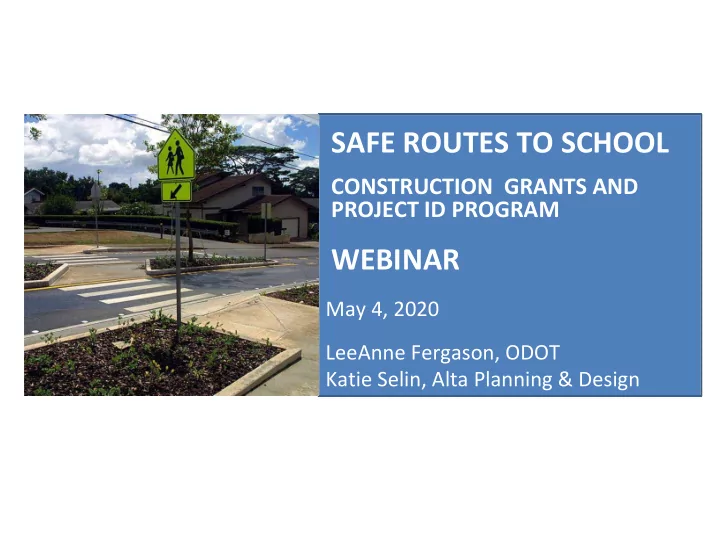
SAFE ROUTES TO SCHOOL
CONSTRUCTION GRANTS AND PROJECT ID PROGRAM
WEBINAR
May 4, 2020 LeeAnne Fergason, ODOT Katie Selin, Alta Planning & Design
SAFE ROUTES TO SCHOOL CONSTRUCTION GRANTS AND PROJECT ID PROGRAM - - PowerPoint PPT Presentation
SAFE ROUTES TO SCHOOL CONSTRUCTION GRANTS AND PROJECT ID PROGRAM WEBINAR May 4, 2020 LeeAnne Fergason, ODOT Katie Selin, Alta Planning & Design Youre in the right place! This is the Safe Routes to School Webinar. May the Jokes Be
SAFE ROUTES TO SCHOOL
CONSTRUCTION GRANTS AND PROJECT ID PROGRAM
WEBINAR
May 4, 2020 LeeAnne Fergason, ODOT Katie Selin, Alta Planning & Design
father? (extra points if you get as annoyed with me as she did about this joke when we were kids)
chopsticks?
Write your guesses in the chat box! Answers will be revealed at the end of the webinar. Correct/funnier guessers get bragging-rights forever.
You’re in the right place! This is the Safe Routes to School Webinar.
What is Safe Routes to School? Funding for Safe Routes to School The SRTS Construction Program Tips for developing a good proposal Q and A
What is Safe Routes to School?
The 6 E’s of SRTS
Education Encouragement Enforcement Evaluation Equity
Engineering
Program details
agencies, community-based
Heidi Manlove, ODOT- SRTS Program Manager, Transportation Safety Division, heidi.manlove@odot.state.or.us
ODOT Safe Routes to school Non- Infrastructure Program
HB 2017
SRTS Fund
SRTS Fund (ORS 184.740)
SRTS Regulations
2005 regulations (ORS 737-025)
Advisory Committee
Key dates:
April 1: MATERIALS ARE ONLINE June 15:
LETTER OF INTENT DUE
August 31: APPLICATION DUE
SRTS Construction Program Overview
Annual allocation
2020= 10M 2021= 10M 2022= 10M
2023= 15M 2024= 15M 10M annually, increasing to 15M in 2023
Breakdown by Program for 2021-2022: Total $30 Million
COMPETITIVE GRANT $26,250,000
87.5 percent or greater, will used in a competition to build street safety projects
RAPID RESPONSE GRANT $3,000,000
Up to 10 percent of funds will be used for urgent needs and safety issues
PROJECT ID Planning Assistance $750,000
Up to 2.5 percent of funds will be used by ODOT to help communities identify projects and create a local SRTS Plan.
Description Timeline Eligibility Process
You will get A Safe Routes to
School Plan ODOT’s consultant to do the work on behalf of the jurisdiction.
Your Responsibility School community and
road authority work together. Create a Project Management Team
PLANNING ASSISTANCE DESCRIPTION
HTTPS://WWW.YOUTUBE.COM/WATCH?V=- H22FYNIYFS&FEATURE=YOUTU.BE
PLANNING ASSISTANCE TIMELINE
2020
April 1-June 15: Optional LOI. June 1-August 31: Application September: Applications scored November: ODOT Notifies communities
Key dates:
April 1:
MATERIALS ARE ONLINE
June 15:
Optional: LETTER OF INTENT DUE
August 31:
APPLICATION DUE
PLANNING ASSISTANCE ELIGIBILITY
Eligible Entities:
School Districts Publically-funded agencies Cities Counties Transit districts Tribes Any other road authority
Prioritized communities:
Safety- high risk factors Equity- low income population Ability- No capacity to plan locally All partners must participate.
PLANNING ASSISTANCE PROCESS
21 week process ends in SRTS Plan completed and locally adopted
Timeline Eligibility Match Project Selection Project Delivery
$26 million
April 1- June 15: Letter of Intent June 1- August 31: Application September- October: Staff review October: SRTS Advisory Committee makes recommendation December: Project list is presented to the Oregon Transportation Commission January 2021-2025: Agreements signed and projects built.
Key dates:
April 1:
MATERIALS ARE ONLINE
June 15: LETTER
OF INTENT DUE
August 31:
APPLICATION DUE
COMPETITIVE GRANT PROGRAM TIMELINE
Cities Counties ODOT Tribes Transit Districts Other Road Authorities
ELIGIBILITY: WHO CAN APPLY?
Address a barrier to students walking and rolling to school Support of the School District or School Within one mile of a school On a public road right of way Local cash match requirement Commitment to Outreach Aligned with a plan Minimum $60K Maximum $2 Million
PROJECT ELIGIBILITY
Work with the school community to choose needed project Letter of Support required
Support of the School District or School
https://geo.maps.arcgis.com/apps/webappviewer/index.html?id=33d00a3d7181433d85abfce78b8ae879
Within one mile of a school
Is public ROW
Publically owned land: Surface, shoulders, ditches, other drainage facilities in the border between the ditches. To be purchased References in a plan as the site of a future road
Is not public ROW
School property Private property Off- street path
On a public road right of way
Address a barrier
to students walking and rolling to school
Pedestrian Install Crosswalk
Markings and Advance Pedestrian Warning Signs Install Curb Ramps and Extensions Install Median Refuge Island Install sidewalk Install Raised Median with Marked Crosswalk
Pedestrian /Bicycle
Provide Intersection Illumination (Bike & Pedestrian) Convert 4-Lane Roadway to 3-Lane Roadway with Center Turn Lane Install Advance Pedestrian or Bicycle Warning Signs
Bicycle
Install Bike Box at Conflict Points Install Cycle Tracks Install Bike Lanes and buffered bike lanes
Signal
Install Bike or Pedestrian Signal Install Urban Leading Pedestrian or Bicycle Interval Install Pedestrian Countdown Timer(s) Install No Pedestrian Phase Feature with Flashing Yellow Arrow
Beacon
Install Pedestrian Hybrid Beacon Install Rectangular Rapid Flashing Beacon with or without Median Install Rectangular Rapid Flashing Beacon
Minimum $60K Maximum $2 Million
PAVING
Commitment to Outreach
Applicants are required to get a letter of support and commitment from school/school district. Applicant and school
must commit to completing an awareness and safety outreach campaign at a minimum level because…
Aligned with a plan
Examples Safe Routes to School
Plan Safe Routes to School Action Plan Transportation System Plan Any other locally adopted plan
Cash match
project costs.
The school is located in a city with a population
The project reduces hazards within a Priority Safety Corridor
The school site qualifies as a Title I School (school where 40% or more students are eligible for free/reduced lunch.
40% cash match required
Local cash match requirement
Definition of Cash Match
“Cash Match” is actual funds provided by the applicant that are reasonable, necessary and directly related to the Project and funded by the applicant. Actual funds may be considered up to five years prior* to the project application deadline. Education and outreach efforts at the school do not constitute cash match.
Local cash match requirement
Local cash match requirement
Title I Schools
“Priority Safety Corridor” is a project in an area with high- risk factors.
Either the posted or 85th percentile speed is 40 miles per hour
Two or more of the followin g exist:
speed limit 30 miles per hour or greater; more than 2 lanes or a crossing distance greater than 30 feet; 12,000 or greater annual average daily traffic; has a demonstrated history of crashes related to school traffic.
Local cash match requirement
Priority Safety Corridor
LOI- REQUIRED Due June 15
project descriptions
Application- Due August 31
LETTER OF INTENT AND APPLICATION
SRTS Advisory Committee
Advisory to OTC and ODOT 18 members Representative Types Appointed by ODOT Director Project Criteria and Selection Consult with OTSC and OBPAC
PROJECT SELECTION COMMITTEE
Step 1: Eligibility Criteria
1 The project description does not appear to address identified problem / barrier(s) for children biking and walking to school OAR 737-025-0092(1)(a)(B) and OAR 737- 025-0092(1)(a)(C) 2 The project scope and project description appear to be significantly out of alignment OAR 737-025-0092(1)(a)(C) 3 The applicants must check all of the additional criteria set by statute and the Safe Routes to School Advisory Committee regarding a commitment to outreach, the project aligning with an adopted plan, within one mile of a school, school support, and support of all road authorities involved. 4 A ground conditions review was conducted and a potential issue was identified OAR 737-025-0092(1)(a)(B) 5 An issue was identified at some point during the review of the application that needs to be discussed
Step 2: Scoring
Priority Area Categories Sub-categories Focus Area Equity Free Reduced Lunch rate 10-19% 15 195 20-29% 35 30-39% 55 40-49% 80 50-59% 100 60-69% 120 70-79% 140 80-89% 160 90-100% 180 Other vulnerability assessment data points Ever English Learner (students learning English as a second language) rate is above state average (23%) 5 Non-white student rate is above state average (35%) 5 Chronic Absenteeism is above state average (20%) 5
Heavily Weighted Readiness High risk Right of Way 0-20 80 Public Process* 0-20 Environmental 0-20 Lower risk Storm water 0-7 Utilities 0-7 Design 0-6 Safety Bicyclist or Pedestrian crash between 6am and 9pm Non-serious injury or serious injury 7 120 fatality 20 Speed (use 85 percentile if available, posted speed if not.) 30 mph 7 35 mph + 20 Lanes or crossing distance from curb to curb 3 lanes, or greater than 30 feet 7 4 lanes + or greater than 40ft crossing 20 Average Annual Daily Traffic 3000-5,999 7 6000+ 20 Priority Safety Corridor 40
Heavily Weighted School TypePre-kindergarten to 8th grade or any combo 90 90 Moderately Weighted Proximity to School 1/2 mile or less 5 15 1/4 mile or less 15
Total: 500
Step 3: Safe Routes to School Advisory Committee Review and Recommendation
In addition to the scoring criteria and eligibility criteria, projects will go through final process with the Safe Routes to School Advisory Committee before recommendation to the Oregon Transportation Commission. This set of priority lenses a will be used to assess projects in the 100% list and 150% list in the 2021- 2022 Safe Routes to School Competitive Construction Grant Cycle. Maximum Award- Each applicant can only receive $2 million total if they have multiple applications in the 100% list. For example, an applicant may have multiple applications in the 100% list, however only applications adding up to a maximum of $2 million will be selected for funding. In regards to ODOT, applicant refers to each ODOT region. For example, ODOT Region 1 is an applicant, ODOT Region 2 is another applicant, etc. New Applicants- If two or more applicants' scores are close and located near the funding cut line, the Committee may use whether the applicants received a competitive grant last cycle as a way to determine who gets funded this cycle except if the project is substantially complete. For example, the Committee may decide to fund a new applicant as opposed to an applicant that received funds in 2019 and if the project is still not substantially complete. Cost Effectiveness- If two or more applicants’ scores are close and are located near the funding cut line, the Committee may use cost effectiveness as a way to determine what applicant gets funded. For example, the Committee may decide to fund several small projects (for example, under $500,000 with timeline of 18 months completion) instead of one large project (for example, over $ 1 million).
High level guidance:
Begin to expend funds ASAP, at least by 2 years Competed in 5 years Reimbursement grant* Quarterly progress reports Must incorporate outreach
PROJECT DELIVERY
Request maximum
Timely
Proof required Urgent, time sensitive Urgent safety need
Recent crash with moderate or serious injury or fatal involving a bicyclist or pedestrian with cost effective fix.
RAPID RESPONSE SPECIFIC ELIGIBILITY
RAPID RESPONSE SELECTION PROCESS
Ongoing
Applicants submit letter of intent and applications on a rolling basis. A subcommittee of the Safe Routes to School Advisory Committee of 3-5 will make project recommendations on a rolling basis. Oregon Transportation Commission approves projects.
Competitive Grant Rapid Response and Project ID Programs
Key dates:
April 1:
MATERIALS ARE ONLINE
June 15: LETTER
OF INTENT DUE
August 31:
APPLICTION DUE
Additional resources:
Regional Traffic Safety Coordinator
Region 1: Tiana Tozer Region 2: Nicole Charlson Region 3: Rosalee Senger Region 4: Vanessa Robinson Region 5: Billie-Jo Deal
Regional Active Transportation Liaisons
Region 1: Maria Sipin Region 2: Jenna Berman Region 3: Jenna Marmon Region 4: Chris Cheng Region 5: Teresa Penninger
Oregon’s Safe Routes to School site: https://www.oregonsaferoutes.org/ Learn who your local SRTS Coordinator is!
ODOT’s SRTS SRTS Network Local and regional SRTS
1)Google ODOT SRTS and sign up for ODOT updates! 1)Google Oregon SRTS and sign up for Network updates!
Key websites :
Oregon School Report Card https://www.ode.state.or.us/data/reportc ard/reports.aspx ODOT Safe Routes to School page/ Resources Safe Routes application mapping tool
https://geo.maps.arcgis.com/apps/webappviewer/index.ht ml?id=33d00a3d7181433d85abfce78b8ae879
ODOT funded projects
https://geo.maps.arcgis.com/apps/Cascade/index. html?appid=2474dc46e79144b695827682368f60 b8
Oregon Safe Routes to School page https://www.oregonsaferoutes.org/
Meeting the local cash match requirement:
Can be matched by local, state, or federal funds Define a larger project where funding for
from the Safe Routes to School fund. Oregon Transportation Infrastructure Bank http://www.oregon.gov/ODOT/About/Page s/Financial-Information.aspx. Community Development Block Grants (HUD), Community Facility Grants (USDA Rural Dev)
SRTS $ Existing Project
Expanded (SRTS) Project
Match
Existing Project
Expanded (SRTS) Project
SRTS $ Match
City of Pendleton/ Pendleton School District: already using their plan to tackle smaller challenges and preparing for the SRTS grants.
Pendleton School District SRTS Campus Improvements
Rapid Implementation in the City of Pendleton
City of Eagle Point/ Eagle Point School District: great example of an approach for citywide PIPs with multiple schools.
SRTS Suggested Routes and Priority Network
Days Creek Charter School/ Douglas County: unincorporated community, limited ped/bike infrastructure on a county highway.
City of Stayton/ North Santiam School District: busy, congested crossing with hundreds of students walking and biking.
Interactive Public Web Map to gather community input on challenges and
Interactive PDF Review Site to gather community input the final SRTS Plan for each community.
Key designs:
FHWA Bicycle and Pedestrian Guide Small Town and Rural Multi-modal Design Guide ODOT Bicycle and Pedestrian Guide ODOT Blueprint for Urban Design AASHTO bicycle and pedestrian guides NACTO Urban Bikeway Design Counter measure tool: http://www.pedbikesafe.org/
Crossing the Street
enhancements
improvements
Walking Along the Street
Slowing Down Traffic
Other
PAVING
Types of Crossing Treatments
Marked Crosswalk (with signs and illumination)
Median Refuge Island Curb Extensions
Advanced signs & stop bars
Rectangular Rapid Flashing Beacon (RRB)
Pedestrian Signal Raised Crosswalk Median Island Ped Hybrid Beacon
Sidewalk Best Practices: Shortest Route
Sidewalk Best Practices: Shy Distance
Sidewalk Best Practices: No meandering
Sidewalk Best Practices: Starting or Ending
Shoulder, Bike Lane, Buffered Bike Lane, Shared Lane Bikeway, Bike Boulevard, Neighborhood Greenway Separated Bike Lane, Protected Bike Lane, Cycle Track Side Path, Shared-Use Path, Shared-Use Trail, Multi- Use Path Multi-Use Trail,
BUD Figure 3-7
VOLUME
VEHICLES PER DAY
20 25 30 35 40 45 50 55
SPEED
MILES PER HOUR
10K 9K 8K 7K 6K 5K 4K 3K 2K 1K
Tier 1
Separated Bikeway See Table 3-7 for separation options
Tier 2
Bicycle Lane (Buffer Pref.) See Table 3-7 for buffer considerations
Tier 3
Shared Lane
Bicycle Lane See Table 3-7
Bicycle Best Practices: How to choose?
BUD Table 3-7
Urban Context Tier 1 –Separated Bikeway Delineation options in the bicycle/street buffer zone Tier 2 Bicycle Facility Tier 3 Bicycle Facility Traditional Downtown Parking, raised island, flexible delineator posts, rigid bollards, parking stops, planters, bio-swale Evaluate Bicycle Lane Buffer Evaluate Bike Lane vs Shared Lane Urban Mix Parking, raised island, flexible delineator posts, parking stops, planters, bio-swale Evaluate Bicycle Lane Buffer Evaluate Bike Lane vs Shared Lane Commercial Corridor Raised island, flexible delineator posts, concrete barrier, guardrail, bio-swale, ditch Evaluate Bicycle Lane Buffer Evaluate Bike Lane vs Shared Lane Residential Corridor Raised island, flexible delineator posts, concrete barrier, guardrail, bio-swale, ditch Evaluate Bicycle Lane Buffer Evaluate Bike Lane vs Shared Lane Suburban Fringe Raised island, flexible delineator posts, concrete barrier, guardrail, bio-swale, ditch Bike Lane or wide
Buffer. Evaluate Bike Lane vs Shared Lane Rural Community Parking, raised island, flexible delineator posts, planters, concrete barrier, guardrail, bio-swale, ditch Bike Lane or wide
Buffer Evaluate Bike Lane vs Shared Lane
Bicycle Best Practices: How to choose?
…it works like a shared use path, not a separated bike lane.
Bicycle Best Practices: How to separate from traffic?
Flexible Delineator Posts
Bicycle Best Practices: How to separate from traffic?
A: It is a play on the phrase “May the Force be with you” which is a popular farewell in Star Wars. Fans substitute 4th for Force for “May the 4th be with you.”
A: An Elevator (Ella Vader)
A: “Use the forks, Luke”
A: On the Dark Side.
A: They always file single to hide their numbers.
Nice work! Bragging-rights forever.
Contact: LeeAnne Fergason ODOT SRTS Program Manager LeeAnne.Fergason@odot. state.or.us (503) 986-5805 Katie Selin Senior Planner Alta Planning + Design
katieselin@altaplanning.com