
SLIDE 1
OpenCRVS
An open and standards based solution for CRVS
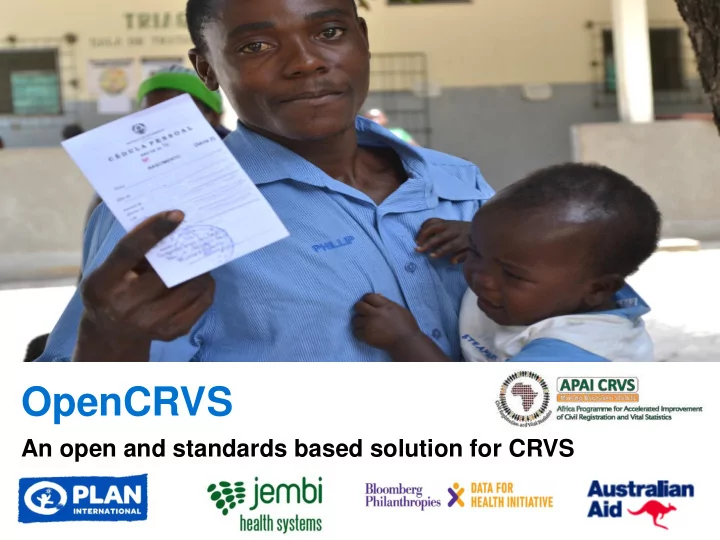
OpenCRVS An open and standards based solution for CRVS CRVS systems - - PowerPoint PPT Presentation
OpenCRVS An open and standards based solution for CRVS CRVS systems are not delivering on their promise to extend coverage, automate processes and share data: Under-investment in foundational registers Vendor lock-in and high maintenance
An open and standards based solution for CRVS
CRVS systems are not delivering on their promise to extend coverage, automate processes and share data:
OpenCRVS
A standards based, freely available CRVS platform, designed by and for civil registrars, promoting interoperability and a rights-based approach
Free No license costs and no ties to software vendors. Standards-based Conforms to UN CRVS and ICT standards Data enabled Leverages data for performance management, audit and tracking Configurable Meets country specific needs & regulations Interoperable With health, National ID and other eGov systems Safe & Secure Data protection and confidentiality at the core of the design Simple & Accessible Procedures designed for ease of use for Civil Registration staff and citizens
Respecting the…
and performs active registration, recognizing that it can be difficult to reach civil registration offices in remote areas
documentation on a tablet
checks and certification printing is integrated into OpenCRVS
set targets at National, regional and district levels, enabling location based performance management and case tracking
statistical analysis and reporting at the NSO
requirements
We still have much to do:
autopsy
country contexts
An “Agile” approach allows us to continuously design, develop and test with citizens and registrars. In this way, we can be confident that the solution and user experience will perform well in the field
Edward Duffus, Plan International
@eduffus edward.duffus@plan-international.org
Having an open-source code base has the following key benefits:
engineers
submit a notification document to a FHIR server
descibes a way of transmitting a clinical document around a particular context.
specification release and is a simpler option to the standards currently specified in OpenHIE 1.0 spec.
For the development of OpenCRVS, nothing is held in higher regard than the personal data security of citizens. Security features will be developed and maintained at many levels including:
demand, audited on a per-client basis, subject to a 1 hour time limit, recorded for audit and easily revoked.
authenticated and transmitted with the request. Authentication returns a list of API “claims” that can be controlled by user role. This means that the architecture prohibits unauthenticated users of specific levels to perform tasks requiring greater security clearance.
renewed by LetsEncrypt
identifiable information is encrypted in the database and structured. All encryption and database secret keys / leases will be managed by Hashicorp
secrets.
keys conform to the above management approach e.g. Hashicorp Vault.
UIN
National Population Register Foundational Identity Registers Civil Registry ID Card Register
Life event data Voter Registration Health Social Welfare Internal Security Finance Immigration
Functional Applications of Identity National Statistics
Appendix 1: Data Integrity within the Foundational Identity Registers