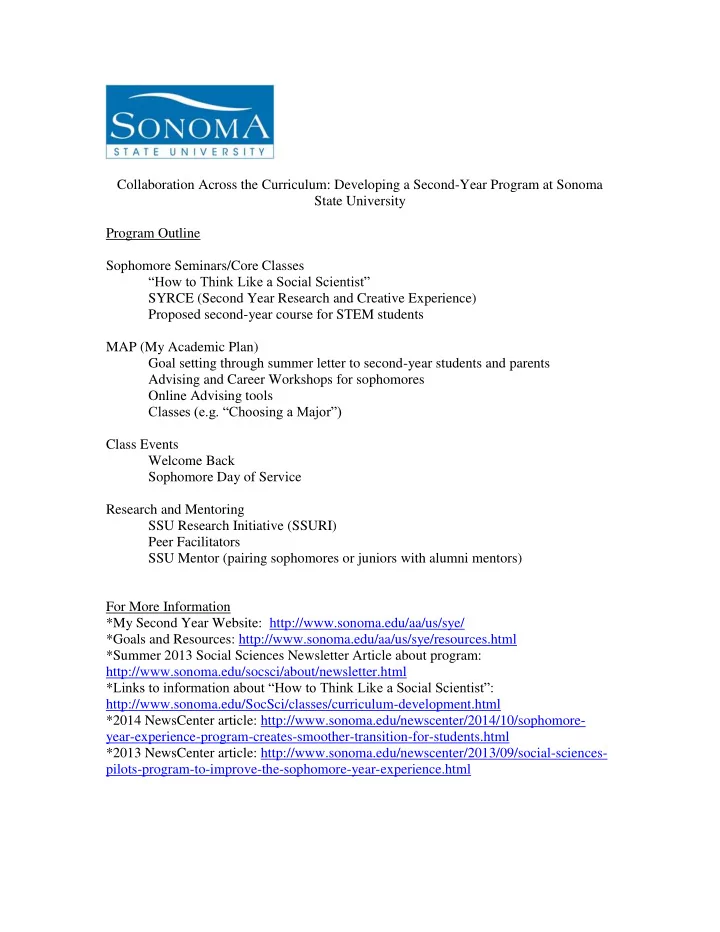
SLIDE 1
7 Lessons from Developing SSU’s Sophomore Year Experience (SYE) Program Faculty Leadership – Bottom Up: Our SYE happened, not at the behest of administrators nor as result of student services initiatives, but rather because faculty took the lead. The most involved faculty have been fully tenured and mid-career, able take the risk and invest the extra time and energy needed to make the program sustainable. In addition, these faculty drew on their roles in campus governance and connections all over campus to create a wider collaboration. Finally, faculty concerns for students and enthusiasm for teaching helped put seminars and classes at the core of the program. Partner with Administration: This program could not have happened without administrative support from the outset. Administrators were quick to support the idea with encouragement, suggestions, and seed money. SSU administrators continue to encourage schools and departments to develop their own approaches to sophomore learning, rather than imposing a centralized model. Collaborate with stakeholders and talk to everyone! Both formal and informal collaboration formed the heart of the program. Some of the best ideas came from hallway and “water cooler” conversations. Faculty talked to faculty; faculty and administrators met at campus retreats; student services professionals and faculty chatted after committee meetings; advisors talked to students; friends talked to friends. The ad hoc SYE committee included volunteers from every department in the School of Social Sciences, librarians, residential life staff, campus advisors, and the AVP of Undergraduate Studies. Collaboration continues at many levels as the program expands campuswide. Involve students: Through focus groups, informal conversations, meetings with peer advisors, and formal assessment, we have invited student feedback about the developing
- program. In addition, peer facilitators work as part of the teaching team for the courses,
and student researchers have been instrumental in developing and implementing the sophomore satisfaction survey, “Track the Pack.” Begin and end with data: We looked at campus data, but also ran our own focus groups. We built assessment into every component of the program. And we are running a longitudinal sophomore satisfaction survey over the next four years. Start small: By trying things out (as experimental or pilot programs), assessing them from the first, and creating a modular program that permits easy expansion, we have developed a program that is both successful at the small scale and easy to expand as interest and resources permit. Do your own thing, but don’t reinvent the wheel: We almost made this mistake. At first, faculty on the SYE development committee focused on our own understandings of what such a program should do. But connecting both with published articles on the sophomore experience and other campuses’ SYE programs as well as with folks on our
- wn campus who were already steeped in sophomore programming issues, we were able