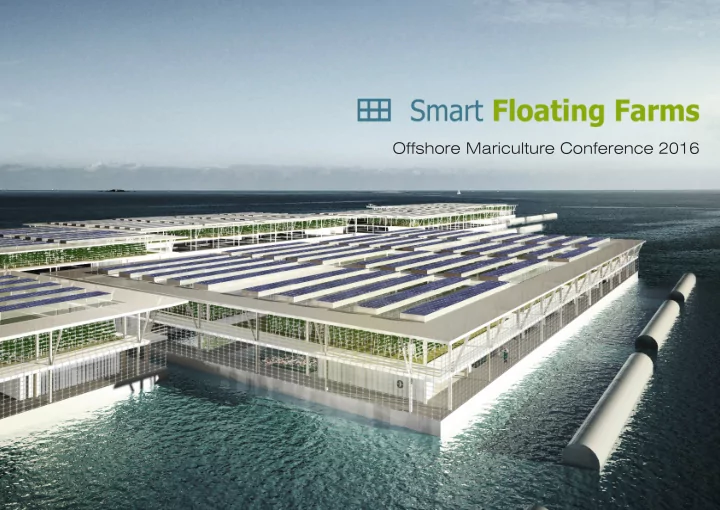
SLIDE 1 Offshore Mariculture Conference 2016
SLIDE 2
2050= 9.3 Billion people
We have destroyed land and produced Climate change
SLIDE 3
Consuming resources and arable land...On the other hand, we have plenty of water space that we could transform into a productive tissue...
SLIDE 4
since out of 35 world Megacities have a physical access to water (seas, lakes or rivers)
25
SLIDE 5 FROM IMPORTER-CONSUMER LOCAL PRODUCERS / QUALITY CONTROLLERS
%imports
Direct
(SFF)
SLIDE 6 Why?
- Megacities fast growing pace & population
- By 2030, food demand is predicted to increase by
50%(70% by 2050) - United Nations
- Increased wealth and shifting diets
- Avoid huge amount of food imports + reducing food
mileage(i.e US imports 90% of consumed seafood, Gulf region 90% or Singapore imports 90%(AVA)
- Limited land availability(land scarce) and land
premium prices
- A more controlled, cleaner and sustainable farming
aquaculture high volume production and aquaponics
- Year-round high yield production, not depending
- n external/weather conditions
- Guarantee local food quality control
SLIDE 7
Inspired by the traditional Fish Farms grid confjguration
SLIDE 8
View of a cluster formed by 6 modules of the project, a productive arrangement
SLIDE 9
A combination of different existing technologies available in the market into a single Floating farm module
SLIDE 10
SLIDE 11
Roof level Photovoltaic / CSP solar power plant. towards self-suffjciency
SLIDE 12
Middle Level Crops-Production
SLIDE 13 Lettuce Artichokes Onions Rasperberries Balis Sage Groupers Chinese Asparagus Peas Watermelon Arugula Tarragon Seabass Xiao Bai Cai Beans Radishes Strawberries Chervil Thyme Snappers Bayam Beats Rhubarb Blueberries Chives Rosemary Milkfish Cai Xin Brussels sprouts Bell peppers Dill Gai Lan Cucumbers Lemon grass Nai Bai Eggplant Mache Cabbage Leeks Majoram Peppermint Kang Kong (Water spinach) Spinach) Broccoliinach) Tomatoesnach) Blackberriesch) Corianderach) Tuskfishnach)
Leafy Greens Vegetables Fruits Herbs Fish
Some Products examples for a potential Market
(Crops type could vary according to the project geographical location)
SLIDE 14
Lower level Fish Farms
In optimal conditions, one single module of 200 X 350 m footprint could annually produce 8.152 tons of fresh vegetables and 1.703 tons of fjsh. The project has a positive NPV and payback periods of around 6-8 years. Aim of an Integrated Multi-Trophic Aquaculture (IMTA)
SLIDE 15 Maybe this can be a small contribution to the overall problem, but in my thinking
- ther complementary ways to traditional
ways of production need to be tested, the sooner the better.
SLIDE 16
“Learn from yesterday, live for today, hope for tomorrow. The important thing is not to stop questioning” Albert Einstein
SLIDE 17
www.smartfmoatingfarms.com