
SLIDE 1
NHOEP SPRING CONFERENCE 2015
PERMITTING, ZONING & INTERCONNECTION
OF RESIDENTIAL SOLAR PV IN NH
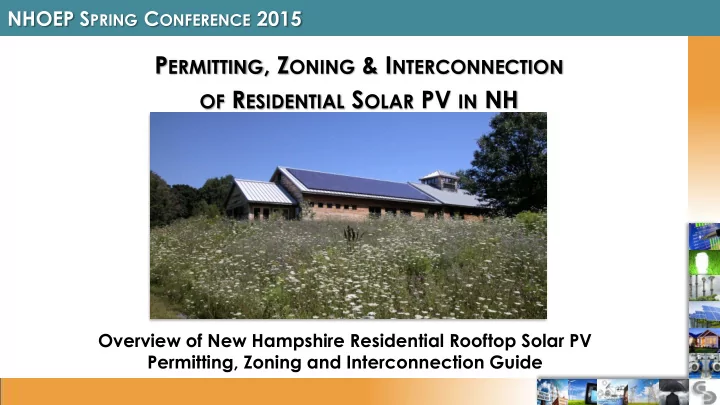
Overview of New Hampshire Residential Rooftop Solar PV Permitting, Zoning and Interconnection Guide
OF R ESIDENTIAL S OLAR PV IN NH Overview of New Hampshire - - PowerPoint PPT Presentation
NHOEP S PRING C ONFERENCE 2015 P ERMITTING , Z ONING & I NTERCONNECTION OF R ESIDENTIAL S OLAR PV IN NH Overview of New Hampshire Residential Rooftop Solar PV Permitting, Zoning and Interconnection Guide T OPICS TO BE C OVERED Project
NHOEP SPRING CONFERENCE 2015
OF RESIDENTIAL SOLAR PV IN NH
Overview of New Hampshire Residential Rooftop Solar PV Permitting, Zoning and Interconnection Guide
Project Background NH Residential Rooftop Solar PV Permitting, Zoning and
Interconnection Guide
Purpose and process
Review of Guide
Review of checklists and technical appendices
Insights from the field
Questions and Observations from Participants
2
RESIDENTIAL ROOFTOP SOLAR PV
Rooftop Solar Challenge II – US DOE grant
PV installations
NH focus:
3
RESIDENTIAL ROOFTOP SOLAR PV
Purpose and Process of Guide
development
for municipalities, installers and others, to help them reduce soft costs for residential solar PV.
collection, researched best practices, studied and adapted regionally- developed resources.
4
New Hampshire Residential Rooftop Solar PV Permitting, Zoning and Interconnection Guide January 2015
5
Example of Project Soft Costs:
Here is an example of the soft costs incurred for one professional installation. These figures were provided by a New Hampshire solar PV installer and show how the permitting and inspection costs may play out in a New Hampshire community with value-based permitting – they are not meant to be representative of typical permitting costs for residential solar PV systems in the State. Sample Permit Costs for a $20,000 residential rooftop array: $200 Building Permit ($10 per $1,000) $100 Electrical Permit ($5 per $1,000) $500 Structural Analysis and Professional Engineer’s (PE) stamp $150 Installer Office labor (compiling and submitting permit materials) $300 Installer Labor costs (Licensed professional required to pick up permit in person, and return for final inspection) $1,250 in associated permitting costs = 6.25% of project cost.
1.
Make information available for municipalities, residents, installers, and utilities
2.
Simplify permit application, submission, review and inspection processes
3.
Understand utility interconnection requirements
4.
Pursue training and other resources
Available for download at http://www.nh.gov/oep/
6
TABLE OF CONTENTS
Acknowledgements and Disclaimers........................................................................................................................................................ I. Introduction ................................................................................................................................................................ Potential benefits of utilizing the resources in this Guide ................................................................................................ Process steps ........................................................................................................................................................................................ Guide results and resources ................................................................................................................................................................ II. Current Laws, Regulations and Codes that Impact Rooftop Solar PV .............................................................................................. Laws, Regulations, Codes and Zoning ................................................................................................................................ 1. New Hampshire Building Code Requirements ................................................................................................ 2. Planning and Zoning Laws................................................................................................................................ 3. Homeowners Association Restrictions ................................................................................................................................ 4. Solar Access Laws ................................................................................................................................................................ 5. Relevant State Policies ........................................................................................................................................................... 6. Zoning Regulations ................................................................................................................................................................ Current Municipal Permits & Fees ....................................................................................................................................................... 1. Permits ................................................................................................................................................................ 2. Fees ....................................................................................................................................................................................... 3. Potential Permitting Barriers ................................................................................................................................ 4. Zoning ................................................................................................................................................................ Utility Interconnection Rules .............................................................................................................................................................. III. Residential Rooftop Solar PV Strategies................................................................................................................................ Make Permitting Information Available ................................................................................................................................ 1. Review and document the existing permitting process ................................................................................................ 2. Provide resources on Municipal websites ........................................................................................................................... Simplify Permit Application, Submission, Review and Inspection Processes ..................................................................................... 1. Permit Application ............................................................................................................................................................... 2. Permit Submission ............................................................................................................................................................... 3. Review and Inspection Processes ................................................................................................................................ Understand NH’s Residential Solar PV Electric Utility Interconnection Requirements ................................................................ Pursue Training and Other Resources ................................................................................................................................
RESIDENTIAL ROOFTOP SOLAR PV
7
* As with any significant purchase, shop around when considering purchasing a solar PV system. Gather as much information as possible, check contractor references and
quotes.
LAWS, REGULATIONS, CODES AND ZONING
Renewable Portfolio Standard
(RPS)
Net Metering Group Net Metering NH State Building Codes
8
LAWS, REGULATIONS, CODES AND ZONING
9
No standard application or fee for obtaining a permit to install solar PV
Each of New Hampshire’s 234 municipalities have their
including:
permit fee.
construction cost.
LAWS, REGULATIONS, CODES AND ZONING
10
Zoning
Solar Access Laws
solar access – Including Chapter 53-F, 477:49-51, and 674:2III(n)
the time of subdivision, but can be incorporated into solar setbacks for new structures.
Homeowners Associations
RESIDENTIAL ROOFTOP SOLAR PV STRATEGIES
11
Make Permitting Information Available
process.
Resources include:
Attachment Detail
RESIDENTIAL ROOFTOP SOLAR PV
12
Purpose: Clearly communicate the steps required by a municipality for an applicant to receive authorization to install a residential solar PV system
Permit Checklist:
Defines Permit Application Type & Fees Defines required supporting documentation, such as:
Attachment and/or Mounting Details
Permit Submission Process including hours open & contact information Process for scheduling an inspection including contact information
13 [Insert Town/City Name] The Town/City of (Insert Name) encourages the installation of renewable energy systems through a clear and predictable permitting process outlined in this checklist. The permit application form and associated materials can be found at www.InsertTownWebsite.gov. The required elements for permit applications for solar PV installations are detailed below. Permit Process: The point of contact for solar PV permits is (Insert Name), and can be contacted at (Insert Contact Information). The applicant (owner or system installer on behalf of owner) must complete the following steps: Complete a (insert type of permit) permit application (available at www.InsertTownWebsite.gov). Assemble supporting documents including:
Associated Costs: Insert cost of permit, indicate when fee is due and accepted methods of payment Submit permit materials by:
After receiving a permit, the applicant may proceed with installation of the solar PV system. All permits must be posted in a visible location as instructed. Once the system installation is complete, please contact (Insert Name or title, and phone number or prefer method of communication) to schedule an inspection.
Note - The purpose of a project permit checklist is to clearly communicate the steps that must be completed by an applicant to receive approval to install a residential solar PV system. The checklist should reflect the regulatory process in place in your community, points of contact, and associated costs. The sample checklist below is based on the sample permit available in this Guide (Appendix B). This sample checklist serves only as an example, and should be adjusted to the process in your community.
Sample Municipal Residential Solar PV Permit Checklist
RESIDENTIAL ROOFTOP SOLAR PV
14
Property and Property Owner information Additional Information
Registered Design Professional
Solar PV System information
RESIDENTIAL ROOFTOP SOLAR PV
15
Electrical Description
RESIDENTIAL ROOFTOP SOLAR PV
16
Attachments to Application
Manufacturer
Owner’s Certification
Sample Residential Solar PV Permit Application Pg. 1 Towns Will Modify & Adopt Individually
17
RESIDENTIAL ROOFTOP SOLAR PV
18
User Qualifications – applicable projects and users Visibility Requirements – guidelines for viewing
Anchorage to Structure – only for projects
RESIDENTIAL ROOFTOP SOLAR PV (CONTINUED)
19
Structural Information
Structural Evaluation
Structural Review Worksheet Conclusion
Registered Design Professional
Sample DRAFT Residential Solar PV Structural Review Worksheet Pg. 1
20 Usage Guide for the Structural Review Worksheet
Disclaimer: This sample worksheet is for informational purposes only and may not be used to satisfy municipal permitting or review requirements unless customized and expressly adopted for such use by the permitting municipality. The State of New Hampshire and the authors of this worksheet assume no responsibility for the use or misuse of the information contained in this sample worksheet and expressly disclaim liability for any damage, injury, loss, or expense arising from the use or misuse of the information contained in this sample
state and federal laws and regulations.
User Qualifications for the Structural Review Worksheet
Users of this worksheet should have demonstrable knowledge of typical residential roof framing systems. A number of certification programs may be acceptable evidence of qualifications, if approved by the local jurisdiction, for example: Registered Design Professional (Professional Engineer or Architect) Licensed Home Inspector Engineer-in-Training (EIT) North American Board of Certified Energy Practitioners (NABCEP) PV Installation Professional certification Other approved certifications that require training in structural inspection of residential framing systems.
Visibility Requirements:
Worksheet users must be able to view the roof framing to evaluate its strength. Enough of the framing must be exposed to be able to determine at a minimum: Rafter size and spacing Ridge board versus ridge beam Configuration of rafter cross-ties (e.g. attic floor, collar ties), including size and spacing Existence of framing irregularities (e.g. skylights, dormers) in the vicinity of the proposed PV panels Type of roof sheathing (e.g. plywood, oriented strand board (OSB), straight board sheathing) If the framing is concealed by finishes, such as in spaces with cathedral ceilings, a Registered Design Professional should investigate the framing and review the proposed installation. Openings may be required in the finishes to
Anchorage to Structure
Use of this worksheet is contingent upon fastening the PV system directly to the rafters. If the installer wishes to attach to the sheathing between the rafters, a registered design professional should evaluate the proposed design and confirm the available sheathing capacity. If the sheathing alone is not adequate to resist downward gravity and wind uplift forces, the addition of blocking between the rafters at the attachment locations may be a possible This Structural Review Worksheet can be used to evaluate the integrity of a roof’s framing for a proposed solar PV system. To use this Worksheet in an official capacity, you will need permission from the municipal building department. It is not intended to serve as a permit application but could be used as part of a permit application at the jurisdiction’s discretion. The Worksheet identifies structural conditions in a home’s roof framing that may raise concerns with the installation of solar PV, including increased dead load and wind uplift. This worksheet only applies to installations that meet the following basic criteria, as well as the more detailed criteria below and elsewhere in the Worksheet:
21
Key items to be aware of when navigating through the New Hampshire utility’s electrical interconnection process include:
The process is simple, but important. Don’t wait until mid-installation to start.
Homes with multiple meters, or sub-meters cannot be combined under a single “net meter.”
Visible disconnect switch and labeling is required. These requirements are in addition to a recent (2014) National Energy Code requirement for a rapid disconnect switch that must be located on the rooftop within 6 feet of the PV system.
Certificate of Completion must be signed by a town designee or electrician.
Properly permitted, installed and inspected systems should not be “energized” until a “net meter” is installed by the interconnecting utility. Without a “net meter”, all generation from the PV system that is fed back into the utility grid will be recorded as energy usage at the home, instead of as an offset to the homes actual energy usage.
Under certain circumstances, the existing transformer serving a home’s load where a PV system is installed may need to be upgraded to maintain grid system reliability. Such replacement is typically performed at the customer/homeowner’s expense.
FOR RESIDENTIAL ROOFTOP SOLAR PV
Make information available for
municipalities, residents, installers, and utilities
Simplify permit application,
submission, review and inspection processes
Understand utility interconnection
requirements
Pursue training and other
resources
22
Guide document posted on OEP website
23
We would like to provide
some time to address questions from the participants.
Other comments or
24
Richard Minard (richard.minard@nh.gov)
Scott Albert (scott.albert@gdsassociates.com)
Steve Whitman (steve@resilienceplanning.net)
25