Objectives Scenario One To gain an approach for the patient with - - PDF document

objectives scenario one
SMART_READER_LITE
LIVE PREVIEW

Objectives Scenario One To gain an approach for the patient with - - PDF document

I have no potential or actual conflicts of interest to declare Things That Make Your INR Go Hmmm: Pearls From An Emergency Pharmacist Dawn Dalen, BSP, ACPR, PharmD Clinical Practice Leader Pharmacy Central Okanagan Clinical Pharmacy


slide-1
SLIDE 1

1

Things That Make Your INR Go Hmmm: Pearls From An Emergency Pharmacist

Dawn Dalen, BSP, ACPR, PharmD Clinical Practice Leader – Pharmacy – Central Okanagan Clinical Pharmacy Specialist – Emergency Medicine Interior Health Authority Clinical Assistant Professor, U.B.C Faculty of Pharmaceutical Sciences June 15, 2011

I have no potential or actual conflicts of interest to declare

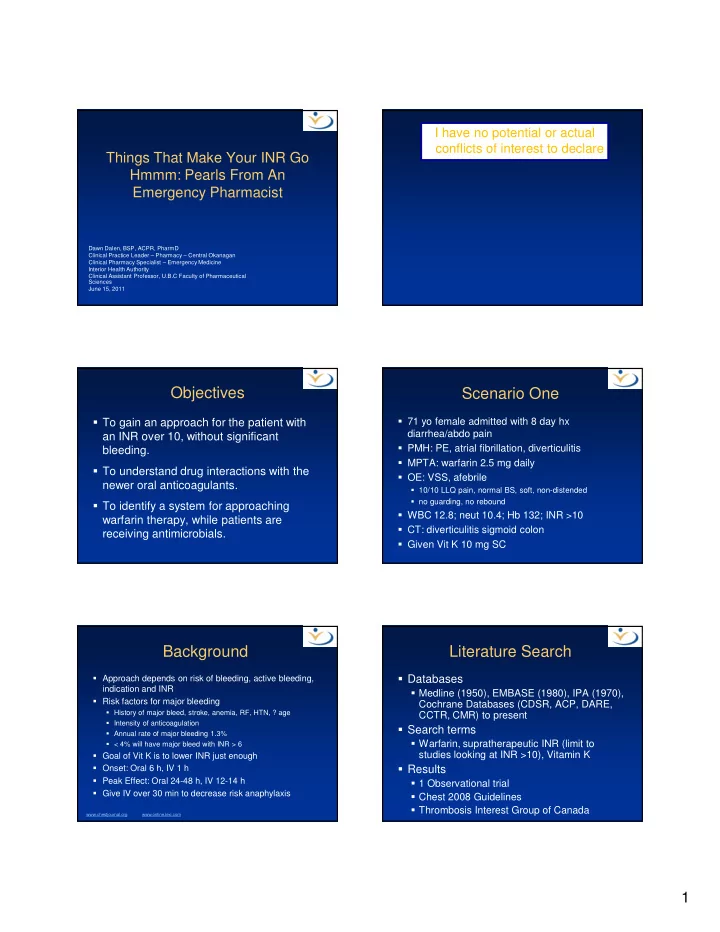
Objectives

To gain an approach for the patient with an INR over 10, without significant bleeding. To understand drug interactions with the newer oral anticoagulants. To identify a system for approaching warfarin therapy, while patients are receiving antimicrobials.

Scenario One

71 yo female admitted with 8 day hx diarrhea/abdo pain PMH: PE, atrial fibrillation, diverticulitis MPTA: warfarin 2.5 mg daily OE: VSS, afebrile

10/10 LLQ pain, normal BS, soft, non-distended no guarding, no rebound

WBC 12.8; neut 10.4; Hb 132; INR >10 CT: diverticulitis sigmoid colon Given Vit K 10 mg SC

Background

Approach depends on risk of bleeding, active bleeding, indication and INR Risk factors for major bleeding

History of major bleed, stroke, anemia, RF, HTN, ? age Intensity of anticoagulation Annual rate of major bleeding 1.3% < 4% will have major bleed with INR > 6

Goal of Vit K is to lower INR just enough Onset: Oral 6 h, IV 1 h Peak Effect: Oral 24-48 h, IV 12-14 h Give IV over 30 min to decrease risk anaphylaxis

www.chestjournal.org www.online.lexi.com

Literature Search

Databases

Medline (1950), EMBASE (1980), IPA (1970), Cochrane Databases (CDSR, ACP, DARE, CCTR, CMR) to present

Search terms

Warfarin, supratherapeutic INR (limit to studies looking at INR >10), Vitamin K

Results

1 Observational trial Chest 2008 Guidelines Thrombosis Interest Group of Canada

slide-2
SLIDE 2

2

Gunther,et al

Objective

Observational trial to determine if low dose Vitamin K alters bleeding in those with INR >10

Primary outcome

Major Bleeding at day 3

Intervention

(both warfarin held)

Same day return: Vitamin K 2 mg po (n=51) Could not return: No Vitamin K (n=25)

Inclusion

Outpatient with INR >10 and no bleeding

Exclusion

Bleeding, possible bleeding, prosthetic valve

Thromb Res 2004;113:205-9.

Gunther,et al

Thromb Res 2004;113:205-9.

Gunther,et al

No Vitamin K

2 minor - epistaxis 1 hematemesis – admitted 46.7% had INR > 5 at day 3

Vitamin K

1 minor - gum bleeding 11.1% had INR > 5 at day 3

Thromb Res 2004;113:205-9.

CHEST 2008

  • M

www.chestjournal.org

CHEST 2008

  • M

www.chestjournal.org

CHEST 2008

  • M

www.chestjournal.org

slide-3
SLIDE 3

3

CHEST 2008

  • M

www.chestjournal.org

TIGC

  • INR > 10 without bleeding

– Correct cause – Withhold at least 2 doses and check INR 24 hrs – Consider restart at lower dose – Vitamin K 2.5 – 5 mg po – Can be treated as outpatient if no bleeding

  • Based on consensus due to lack of

evidence

http://www.tigc.org/clinical-guides/Managing-warfarin-associated-coagulopathy.aspx

Our Patient

Investigate the cause Hold warfarin Vitamin K 2.5 – 5 mg po INR in 48 hours, unless bleeding occurs May require bridging with UFH drip Piperacillin/tazobactam 3.375 g IV q6h

Scenario Two

  • 72 yo male with R visual field defect at home
  • PMH: stroke, afib, seizures
  • HPI:
  • Seizure 3 weeks prior
  • Carbamazepine level 13 (400 mg am & 200 mg pm)
  • Phenytoin 300 mg bid added
  • Dabigatran 150 mg bid two weeks prior as difficulty

with INR

  • Also taking esomeprazole 20 mg daily
  • VSS, vision normal, no focal weakness
  • Labs: Ptt 26, INR 1.0
  • CT: old L parietal & old cerebellar infarct

http://www.thelancetstudent.com/2010/11/16/the-lancet-seminar-antiphosholipid-syndrome/ http://www.thelancetstudent.com/2010/11/16/the-lancet-seminar-antiphosholipid-syndrome/

slide-4
SLIDE 4

4

Background - Dabigatran

Competitive, reversible, thrombin inhibitor May elevate PTT & PT Kinetics:

Absorbed in low gastric pH Hydrolyzed by liver to active form Glucuronidation in liver & 80% elimination via kidney T ½ = 12-17 hours Elderly (dose reduction if > 75 years) Renal failure (not if CrCl <30)

Dose:

Afib – 150 mg po bid Ortho - 220 mg po daily for 10 days (TNK) or 28-35 days (THR)

www.online.lexi.com

Background - Rivaroxaban

Competitive inhibitor of factor Xa May elevate PTT & PT – not sensitive Kinetics:

Metabolized in liver via CYP 3A4, 3A5, & 2J2 33% eliminated in urine unchanged T ½ = 5-9 hours

Prolonged in elderly Not recommended with CrCl < 30 ml/min

Dose:

Ortho – 10 mg po daily for 14 days (TKR) or 35 days (THR)

www.online.lexi.com

Literature Search

Databases

Medline (1950), EMBASE (1980), IPA (1970), Cochrane Databases (CDSR, ACP, DARE, CCTR, CMR) to present

Search terms

Rivaroxaban, Xarelto, Dabigatran, Pradax, Drug Interaction

Results

No peer reviewed publications Monograph Lexi-Drugs Health Canada Adverse Drug Reaction Database

Dabigatran

Increased Dabigatran (53-240%)

P-glycoprotein inhibitors

Amiodarone, azoles, carvedilol, clarithromycin, cyclosporine, dipyridamole, dronedarone, erythromycin, grapefruit juice, progesterone, propranolol, quinine, tacrolimus, tamoxifen, verapamil

Increased bleeding with Dabigatran

Other anticoagulants, antiplatelets, NSAIDs, herbal products

www.online.lexi.com

Dabigatran

Decreased Absorption ( 40%)

Antacids, H2RA, PPI

Decreased Dabigatran ( 66%)

P-glycoprotein inducers

Carbamazepine, dexamethasone, prazosin, rifampin, St. John’s wort, trazodone

www.online.lexi.com

Rivaroxaban

Increased Rivaroxaban

CYP 3A4 and p-glycoprotein inhibitors - avoid

Amiodarone, azoles, clarithromycin, cyclosporine, dronedarone, erythromycin, grapefruit juice, isoniazid, quinine, tacrolimus, verapamil, voriconazole

Increased bleeding with Rivaroxaban

Other anticoagulants, antiplatelets, NSAIDs, herbal products

www.online.lexi.com

slide-5
SLIDE 5

5

Rivaroxaban

Decreased Rivaroxaban

CYP 3A4 inducers (over 50% )

Carbamazepine, dexamethasone,

  • xcarbazepine, phenytoin, rifampin

www.online.lexi.com

Health Canada

Dabigatran Rivaroxaban

Number of Reports 28 123 Related to Thrombosis 10 44 Related to Bleeding 7 37 Potential Interaction 4 13 Interaction Details 1 Bleed

  • on other

anticoagulant 1 Thrombosis

  • on PPI

2 Hepatitis

  • on atorvastatin

13 Bleed

  • on other

anticoagulant/antiplatelet

  • 1 on amiodarone
  • 1 on simvastatin

http://www.hc-sc.gc.ca/dhp-mps/medeff/databasdon/index-eng.php

Our Patient

Was on a PPI & carbamazepine

Both decrease dabigatran

Likely cause?

Ptt & INR normal

Plan:

Restart warfarin Carbamazepine 400 mg bid & d/c phenytoin

Newer is not always better

Limited safety information No reversal agents

Scenario Three

82 yo female with CC weak, confused HPI:

Urgency, frequency 4d ago - GP started septra Now feeling unwell, confused

PMH: afib, HTN, dementia MPTA:

Warfarin 2 mg po daily Bisoprolol 2.5 mg po daily

OE: BP 100/60; HR 96; temp 38.0 Labs: WBC 12.0; neut 10.2; INR 4.5 Urinalysis: leukocytes & nitrite positive

Background

Most common interaction Mechanism:

Inhibition of CYP 2C9, 1A2 or 3A4 Elimination of Vit K producing bacteria in GI tract Displacement of VKA bound to protein

Risk GI bleeding

Septra - OR 1.68 Fluconazole - OR 2.09

Effect on INR

1-3 days clarithromycin, norfloxacin, trimethoprim >3 days amoxicillin, doxycycline, septra

www.chestjournal.org Clin Pharmacol Ther 2008;84(5):581-88. Thromb Haemost 2002;88:705-10.

M

Holbrook et al. Arch Int Med 2005;165:1095-1106.

slide-6
SLIDE 6

6

Literature Search

Databases

Medline (1950), EMBASE (1980), IPA (1970), Cochrane Databases (CDSR, ACP, DARE, CCTR, CMR) to present

Search terms

Warfarin, supratherapeutic INR, antibiotic, drug interaction

Results

1 Observational trial

Ahmed,et al

Objective

Determine role of dose reduction when antibiotics are prescribed

Primary outcome

INR value within 7 days

Intervention

10-20% dose reduction in warfarin dose (n=18) vs. no dose adjustment (n=22)

Inclusion

  • Patients receiving septra or levofloxacin (7

days min.)

  • On antibiotic for <48 hours at study

enrollment

  • Stable INR x 6 weeks

Exclusion

No other antibiotic within 4 weeks

Ahmed , et al. J Thromb Thrombolysis 2008;26(1);44-8.

Ahmed,et al Ahmed,et al Ahmed,et al

Septra

No sub-therapeutic INR in either group

Levofloxacin

4 sub-therapeutic INR (1.8-1.9) in DR group

Ahmed , et al. J Thromb Thrombolysis 2008;26(1);44-8.

Our Patient

Hold at least one dose of warfarin

Repeat INR in 24 h Once INR in therapeutic range restart at reduced dose

No Vit K necessary – no active bleeding Ceftriaxone 1 g IV daily until C&S back Next time

10-20% empiric dose reduction for warfarin?

slide-7
SLIDE 7

7

References

  • Ansell et al. Chest 2008;133:160S-198S
  • Crowther et al. Managing warfarin associated coagulopathy.

TIGC 2008. Available: http://www.tigc.org/clinical- guides/Managing-warfarin-associated-coagulopathy.aspx [Accessed May 19, 2011].

  • Lexi Online 2011. Dabigatran Monograph.

Available:www.online.lexi.com[Accessed May 18, 2011].

  • Lexi Online 2011. Rivaroxaban Monograph.

Available:www.online.lexi.com[Accessed May 18, 2011].

  • Health Canada 2011. Adverse Drug Reaction Database.

Available:http://www.hc-sc.gc.ca/dhp- mps/medeff/databasdon/index-eng.php[Accessed May 17, 2011].

  • Gunther et al. Low dose oral vitamin K is safe and effective for
  • utpatient management of patients with INR>10. Thromb Res

2004;113:205-9.

References

  • Schelleman et al. Warfarin - fluroquinolones, sulfonamides, or

azole antifungals interactions and the risk of hospitalization for gastrointestinal bleeding. Clin Pharmacol Ther 2008;84(5):581-88.

  • Visser et al. Over anticoagulation associated with combined

use of antibacterial drugs and acenocoumarol or phenprocoumon anticoagulants. Thromb Haemost 2002;88:705-10.

  • Holbrook et al. Systematic overview of warfarin and it’s food

and drug interactions. Arch Int Med 2005;165:1095-1106.

  • Raebel et al. Warfarin monitoring in ambulatory older

individuals receiving antimicrobial therapy. Pharmacother 2005;25(8):1055-61.

  • Ahmed et al. Impact of preemptive warfarin dose reduction on

anticoagulation after initiation of trimethoprim- sulfamethoxazole or levofloxacin. J Thromb Thrombolysis 2008;26(1);44-8.