VTE Initiate treatment with low molecular weight heparin Yes - - PDF document

vte initiate treatment with low molecular weight heparin
SMART_READER_LITE
LIVE PREVIEW

VTE Initiate treatment with low molecular weight heparin Yes - - PDF document

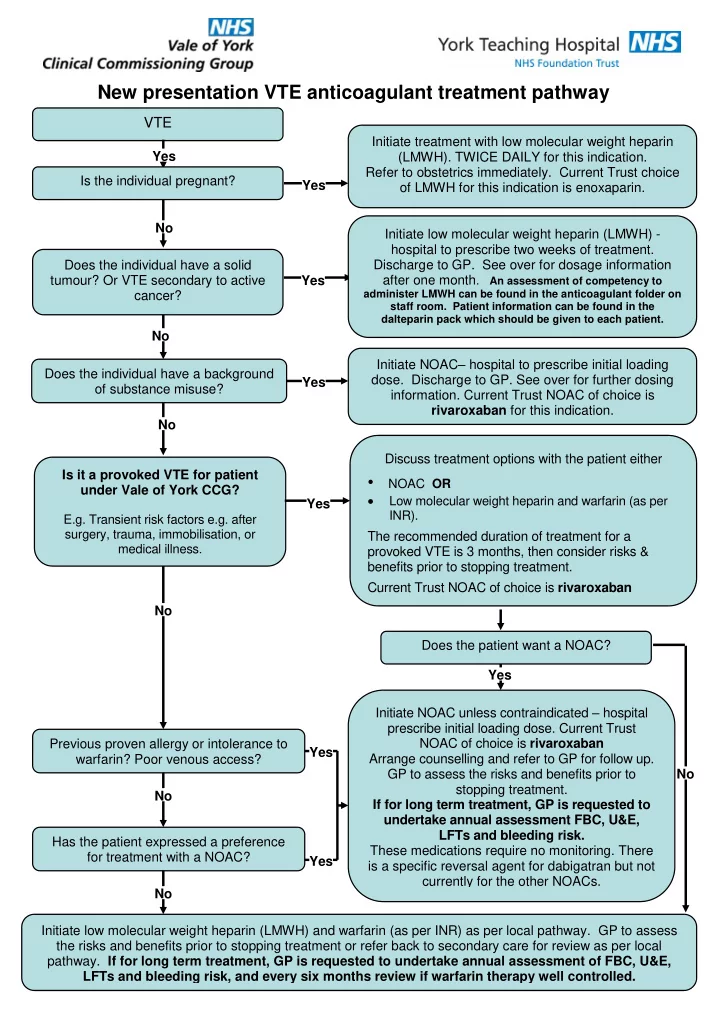
New presentation VTE anticoagulant treatment pathway VTE Initiate treatment with low molecular weight heparin Yes (LMWH). TWICE DAILY for this indication. Refer to obstetrics immediately. Current Trust choice Is the individual pregnant? Yes


slide-1
SLIDE 1

New presentation VTE anticoagulant treatment pathway

VTE

Does the individual have a background

  • f substance misuse?

Previous proven allergy or intolerance to warfarin? Poor venous access? Is it a provoked VTE for patient under Vale of York CCG? E.g. Transient risk factors e.g. after surgery, trauma, immobilisation, or medical illness. Does the patient want a NOAC? Initiate NOAC– hospital to prescribe initial loading

  • dose. Discharge to GP. See over for further dosing
  • information. Current Trust NOAC of choice is

rivaroxaban for this indication. Yes No No No No No No Yes Yes Yes Yes Yes Initiate low molecular weight heparin (LMWH) - hospital to prescribe two weeks of treatment. Discharge to GP. See over for dosage information after one month. An assessment of competency to

administer LMWH can be found in the anticoagulant folder on staff room. Patient information can be found in the dalteparin pack which should be given to each patient.

Initiate treatment with low molecular weight heparin (LMWH). TWICE DAILY for this indication. Refer to obstetrics immediately. Current Trust choice

  • f LMWH for this indication is enoxaparin.

Discuss treatment options with the patient either

  • NOAC OR

 Low molecular weight heparin and warfarin (as per INR). The recommended duration of treatment for a provoked VTE is 3 months, then consider risks & benefits prior to stopping treatment. Current Trust NOAC of choice is rivaroxaban Is the individual pregnant? Does the individual have a solid tumour? Or VTE secondary to active cancer? Initiate low molecular weight heparin (LMWH) and warfarin (as per INR) as per local pathway. GP to assess the risks and benefits prior to stopping treatment or refer back to secondary care for review as per local

  • pathway. If for long term treatment, GP is requested to undertake annual assessment of FBC, U&E,

LFTs and bleeding risk, and every six months review if warfarin therapy well controlled. Has the patient expressed a preference for treatment with a NOAC? Yes Yes No Initiate NOAC unless contraindicated – hospital prescribe initial loading dose. Current Trust NOAC of choice is rivaroxaban Arrange counselling and refer to GP for follow up. GP to assess the risks and benefits prior to stopping treatment. If for long term treatment, GP is requested to undertake annual assessment FBC, U&E, LFTs and bleeding risk. These medications require no monitoring. There is a specific reversal agent for dabigatran but not currently for the other NOACs.

slide-2
SLIDE 2

The prescriber must provide an alert card to each patient prescribed anticoagulants. Those prescribed warfarin should be issued with the yellow anticoagulant booklet. DVT/PE DOSING RECOMMENDATIONS: Provoked VTE : Short-term treatment (3 months) is recommended for those with transient risk factors such as recent surgery and trauma. After 3 months the GP or consultant should reassess and discuss with the patient the risks and benefits of continuing treatment. Unprovoked VTE : For patients with permanent risk factors or idiopathic (unprovoked) VTE if their risk of VTE recurrence is high and there is no additional risk of major bleeding consider longer treatment. Discuss with the patient the benefits and risks of extending their treatment. Seek advice from haematology if unsure.

RENAL FUNCTION

APIXABAN DOSE DABIGATRAN DOSE EDOXABAN DOSE RIVAROXABAN DOSE

Normal or mild renal impairment Creatinine clearance >50 mL/minute 10mg twice daily for 1 week then 5mg twice daily for 3 months then review If for long term treatment for prevention of VTE, continue 5mg twice daily for six months in total, then use maintainance dose 2.5mg twice daily. LMWH alone for at least the first 5 days then 150mg twice daily for 3 months then review For patients aged over 80, or on verapamil the recommended dose is 110mg BD. For patients aged between 75 -80, those with gastritis or GORD or at increased risk of bleeding consider 110mg BD **However, for VTE the recommendation for 110 mg BD is based on pharmacokinetic and pharmacodynamic analyses and has not been studied in this clinical setting. LMWH alone for at least the first 5 days then 60mg ONCE daily for at least 3 months then review. Dose should be reduced to 30mg once daily with one of more of the following:  CrCl 15- 50mL/min  Body weight under 60kg  Concomitant use of P-glycoprotein (P-gp) inhibitors: ciclosporin, dronedarone, erythromycin, or ketoconazole. Initial loading dose 15 mg twice daily with food for 3 weeks then 20 mg once daily with food for 3 months then review. Moderate to severe renal impairment Creatinine clearance 15- 49mL/minute Dose as above, but use with caution. Limited clinical data indicate that apixaban plasma concentrations are increased in patients with severe renal impairment (creatinine clearance 15-29 mL/min) which may lead to an increased bleeding risk. CrCl 30 – 49mL/min : The recommended dose is 150 mg capsule twice daily. However, for patients with high risk of bleeding, a dose reduction to 110 mg twice daily should be

  • considered. Close clinical surveillance is

recommended in patients with renal

  • impairment. See** above

Contraindicated if CrCl is < 30mL/min CrCl 15 -50 mL/min dose reduced to 30mg once daily Dose as above but use with caution. A reduction of dose to 15mg once daily following initial loading dose should be considered if assessed risk of bleeding

  • utweighs risk of recurrent DVT and PE.

Limited clinical data indicate that plasma concentrations are significantly increased for patients with severe renal impairment (CrCl 15-29mL/min) CrCl <15 mL/minute Not recommended Contraindicated if CrCl is < 30mL/min Not recommended Not recommended

EXTENDED TREATMENT OF DALTEPARIN IN PATIENTS WITH SOLID TUMOURS (GFR>30ml/min) Dalteparin & tinzaparin are both licensed for extended treatment of VTE and prevention of its recurrence in patients with solid tumours. However, British Committee for Standards in Haematology recommends LMWH for all patients with cancer associated VTE. http://onlinelibrary.wiley.com/doi/10.1111/j.1365-2141.2011.08753.x/full

Patient Weight Dalteparin dose (units) ONCE daily for 1 month Then dose (units) ONCE daily from month 2 onwards

40-45kg 7500 units 7500 units 46-56kg 10,000 units 7500 units 57-68kg 12,500 units 10,000 units 69-82kg 15,000 units 12,500 units 83-98kg 18,000 units 15,000 units 99kg and greater 18,000 units 18,000 units

Version number: 3 Author: Jayne Knights Check by: Jane Crewe Date active: June 2016 Next Review Due: June 2018 Approved by: Drug & Therapeutics Committee, Medicines Commissioning Committee

slide-3
SLIDE 3