Venous thromboembolism (VTE) VTE is the 3 rd most frequent CV - - PowerPoint PPT Presentation

venous thromboembolism vte
SMART_READER_LITE
LIVE PREVIEW

Venous thromboembolism (VTE) VTE is the 3 rd most frequent CV - - PowerPoint PPT Presentation

4/14/2016 Venous thromboembolism (VTE) VTE is the 3 rd most frequent CV disease 1 case per 1000 person-years Can Biomarkers Help to Guide Most frequent site is DVT in the legs Duration of Therapy After VTE? 1/3 of patients


slide-1
SLIDE 1

4/14/2016 1

Can Biomarkers Help to Guide Duration of Therapy After VTE?

Marlene Grenon, MD Associate Professor of Surgery University of California San Francisco UCSF Vascular Surgery Symposium 2016

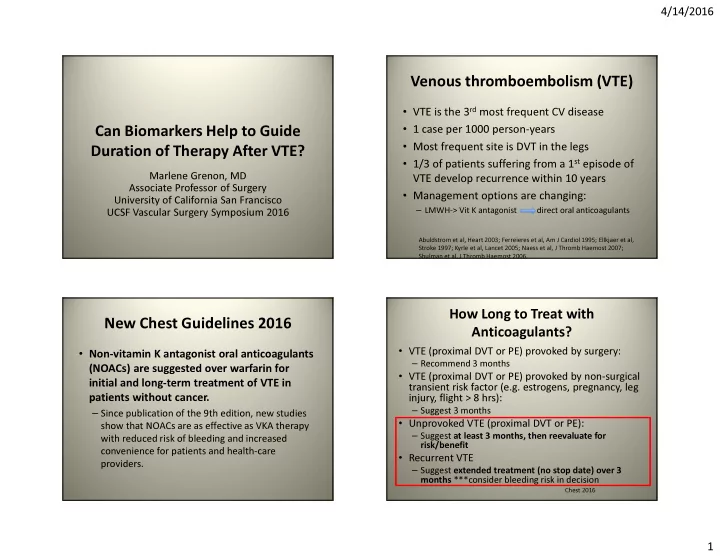
Venous thromboembolism (VTE)

  • VTE is the 3rd most frequent CV disease
  • 1 case per 1000 person-years
  • Most frequent site is DVT in the legs
  • 1/3 of patients suffering from a 1st episode of

VTE develop recurrence within 10 years

  • Management options are changing:

– LMWH-> Vit K antagonist direct oral anticoagulants

Abuldstrom et al, Heart 2003; Ferreieres et al, Am J Cardiol 1995; Ellkjaer et al, Stroke 1997; Kyrle et al, Lancet 2005; Naess et al, J Thromb Haemost 2007; Shulman et al, J Thromb Haemost 2006.

New Chest Guidelines 2016

  • Non-vitamin K antagonist oral anticoagulants

(NOACs) are suggested over warfarin for initial and long-term treatment of VTE in patients without cancer.

– Since publication of the 9th edition, new studies show that NOACs are as effective as VKA therapy with reduced risk of bleeding and increased convenience for patients and health-care providers.

How Long to Treat with Anticoagulants?

  • VTE (proximal DVT or PE) provoked by surgery:

– Recommend 3 months

  • VTE (proximal DVT or PE) provoked by non-surgical

transient risk factor (e.g. estrogens, pregnancy, leg injury, flight > 8 hrs):

– Suggest 3 months

  • Unprovoked VTE (proximal DVT or PE):

– Suggest at least 3 months, then reevaluate for risk/benefit

  • Recurrent VTE

– Suggest extended treatment (no stop date) over 3 months ***consider bleeding risk in decision

Chest 2016

slide-2
SLIDE 2

4/14/2016 2

Can Biomarkers Aid in Deciding on the Treatment Duration?

Decrease risk of VTE recurrence Decrease risk of bleeding from anticoagulation D-Dimers Endogenous Thrombin potential P-Selectin CRP and other inflammatory markers Clotting Factor VIII

D-Dimers

  • Fibrin degradation

product

– Small protein fragment present in the blood after clot degraded by fibrinolysis

  • Name because it

contains two crosslinked D fragments

  • f the fibrin protein

D-Dimers

  • For diagnosis of DVT

– Sensitivity 96% – …but low specificity (40%) and PPV (48%)

  • Associated with an increased risk of recurrent

VTE

– Relative risk 2.19, 95% CI 1.10-4.35 – At 2 years: <250 ng/ml (3.7%) vs > 250 ng/ml (11.5%)

Rectenwald et al, Thromb Haemost 2005; Wakefiled et al, Art Thromb Vasc Biol 2008 Palareti et al, NEJM 2006 PROLONG TRIAL:

  • 608 patients with first unprovoked DVT
  • D-dimer testing 1 month after the discontinuation of

anticoagulation.

– Normal d-dimer level -> not resume anticoagulation – Abnormal d-dimer level -> randomly assigned either to resume or to D/C tx – ** testing for antiphospholipid antibody + antithrombin deficiency-> if positive: excluded from further analysis

  • Study outcome:

– composite of recurrent venous thromboembolism and major bleeding

  • Average follow-up of 1.4 years
slide-3
SLIDE 3

4/14/2016 3

Palareti et al, NEJM 2006 PROLONG TRIAL: Palareti et al, NEJM 2006 PROLONG TRIAL: Patients with an abnormal d-dimer level 1 month after the discontinuation of anticoagulation have a significant incidence of recurrent venous thromboembolism, which is reduced by the resumption of anticoagulation. Palareti et al, NEJM 2006 PROLONG TRIAL: Patients with an abnormal d-dimer level 1 month after the discontinuation of anticoagulation have a significant incidence of recurrent venous thromboembolism, which is reduced by the resumption of anticoagulation.

D-Dimers may be useful in guiding the decision on duration

  • f oral anticoagulation for secondary VTE prophylaxis

Recurrence of DVT- Vienna Prediction Model

Eichinger et al, Vasc Med 2010 30% risk of recurrence over 10 years

slide-4
SLIDE 4

4/14/2016 4

Recurrence of DVT- Vienna Prediction Model

Eichinger et al, Vasc Med 2010

Recurrence of DVT- Vienna Prediction Model

Eichinger et al, Vasc Med 2010

Endogenous Thrombin Potential

  • Thrombin generation test

– thrombin potential – endogenous thrombin potential

  • Information about the

catalyst of the main reaction – transformation

  • f fibrinogen into fibrin
  • Calculates free thrombin

generation

The power of thrombin = The “man hours” of thrombin activity = The area Under the TG-curve = Endogenous Thrombin Potential (ETP)

HC Beguin, CRIM, Netherlands

slide-5
SLIDE 5

4/14/2016 5

P-Selectin

  • Member of selectin family of cell

adhesion molecules, stored in the alpha granules of platelets and Weibel- Palade bodies of ECs

  • P-Selectin receptor (PSGL-1) expressed

in platelets and mediates platelet- endothelium interaction, fibrin formation and thrombus growth

  • Important molecule in hemostasis and

thrombosis

P-Selectin

  • Elevated in acute DVT and recurrent DVT
  • LETS Study (Leiden Thrombophilia Study)

– Elevated sP-Selectin 6 months after DVT compared to controls (odds ratio 2.1, CI 1.2-3.6)

Blann et al, Vr J Haem 2000; Ay et al, Clin Chem 2007; Kyrle et al, Thromb Hemo 2007

P-Selectin

  • Elevated in acute DVT and recurrent DVT
  • LETS Study (Leiden Thrombophilia Study)

– Elevated sP-Selectin 6 months after DVT compared to controls (odds ratio 2.1, CI 1.2-3.6)

P-Selectin reflects a pro-thrombotic state but clinical applicability of measurements need to be standardized and investigated in interventional trials.

slide-6
SLIDE 6

4/14/2016 6

Inflammatory cytokines: CRP

  • Small amount of studies

CRP: sensitivity 77% specificity 66%

Reviewed in Fox et al, Thromb Hemo 2005 and Pabinger et al, Art Thromb Vasc Biol 2009

Inflammatory cytokines: Others

  • IL 1-B, IL6, IL8, IL10, IL 12p70, TNF

Reviewed in Fox et al, Thromb Hemo 2005 and Pabinger et al, Art Thromb Vasc Biol 2009

Inflammatory cytokines: Others

  • IL 1-B, IL6, IL8, IL10, IL 12p70, TNF

Reviewed in Fox et al, Thromb Hemo 2005 and Pabinger et al, Art Thromb Vasc Biol 2009

Increased inflammatory cytokines may not constitute an independent risk marker for future VTE- further research needed

Clotting Factor VIII + Other

  • Clotting Factor VIII:

– Small number of studies – Genetically determined

  • ABO blood group system

– May be predictor BUT interventional trials needed

  • Other biomarkers also needing further

investigations:

– E-Selectin – Micro-Particles

slide-7
SLIDE 7

4/14/2016 7

Conclusion

  • Can Biomarkers Help to Guide Duration of

Therapy After VTE? YES

– Ongoing data support the use of biomarkers to predict recurrence risk + guide length/modality of treatment – Most promising: D-Dimers, ETP – More data needed: P-Selectin, E-Selectin, Micro- Particles

Updated Vienna Model – time prediction