Notes Viscosity Thursday: class will begin late, 11:30am In - - PowerPoint PPT Presentation

notes viscosity
SMART_READER_LITE
LIVE PREVIEW

Notes Viscosity Thursday: class will begin late, 11:30am In - - PowerPoint PPT Presentation

Notes Viscosity Thursday: class will begin late, 11:30am In reality, nearby molecules travelling at different velocities occasionally bump into each other, transferring energy Differences in velocity reduced (damping) Measure this


slide-1
SLIDE 1

1 cs533d-term1-2005

Notes

Thursday: class will begin late, 11:30am

2 cs533d-term1-2005

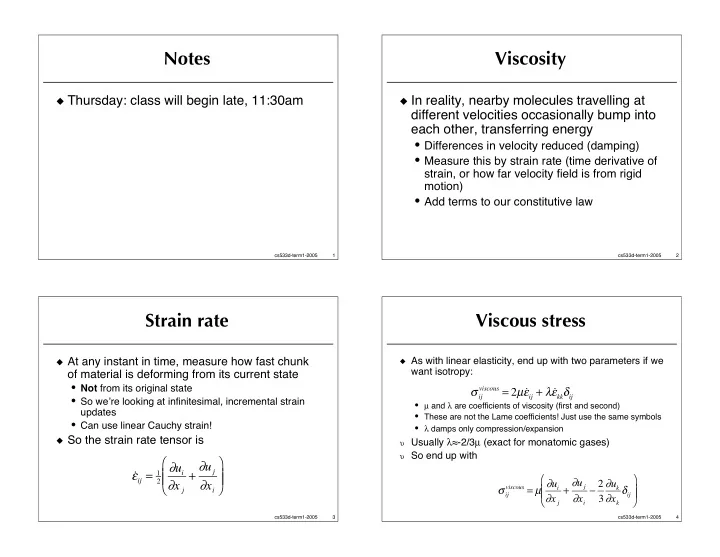
Viscosity

In reality, nearby molecules travelling at

different velocities occasionally bump into each other, transferring energy

  • Differences in velocity reduced (damping)
  • Measure this by strain rate (time derivative of

strain, or how far velocity field is from rigid motion)

  • Add terms to our constitutive law

3 cs533d-term1-2005

Strain rate

At any instant in time, measure how fast chunk

  • f material is deforming from its current state
  • Not from its original state
  • So were looking at infinitesimal, incremental strain

updates

  • Can use linear Cauchy strain!

So the strain rate tensor is

˙

  • ij = 1

2

ui x j + u j xi

  • 4

cs533d-term1-2005

Viscous stress

As with linear elasticity, end up with two parameters if we

want isotropy:

  • µ and are coefficients of viscosity (first and second)
  • These are not the Lame coefficients! Just use the same symbols
  • damps only compression/expansion

Usually -2/3µ (exact for monatomic gases) So end up with

ij

viscous = 2µ˙

  • ij + ˙
  • kkij

ij

viscous = µ ui

x j + u j xi 2 3 uk xk ij

slide-2
SLIDE 2

5 cs533d-term1-2005

Navier-Stokes

Navier-Stokes equations include the viscous

stress

Incompressible version: Often (but not always) viscosity µ is constant,

and this reduces to

  • Call =µ/ the “kinematic viscosity”

ut + u u + 1

p = g + 1 µ u + uT

( )

u = 0 ut + u u + 1

p = g + µ 2u

6 cs533d-term1-2005

Nondimensionalization

Actually go even further Select a characteristic length L

  • e.g. the width of the domain,

And a typical velocity U

  • e.g. the speed of the incoming flow

Rescale terms

  • x=x/L, u=u/U, t=tU/L, p=p/U2

so they all are dimensionless

u't +u'u'+p'= Lg U 2 + UL 2u'

7 cs533d-term1-2005

Nondimensional parameters

Re=UL/ is the Reynolds number

  • The smaller it is, the more viscosity plays a

role in the flow

  • High Reynolds numbers are hard to simulate

Fr= is the Froude number

  • The smaller it is, the more gravity plays a role

in the flow

  • Note: often can ignore gravity (pressure

gradient cancels it out)

U g L

ut + u u + p = (0,1,0) Fr2 + 1 Re 2u

8 cs533d-term1-2005

Why nondimensionalize?

Think of it as a user-interface issue It lets you focus on what parameters matter

  • If you scale your problem so nondimensional

parameters stay constant, solution scales

Code rot --- you may start off with code which

has true dimensions, but as you hack around they lose meaning

  • If youre nondimensionalized, there should be only
  • ne or two parameters to play with

Not always the way to go --- you can look up

material constants, but not e.g. Reynolds numbers

slide-3
SLIDE 3

9 cs533d-term1-2005

Other quantities

We may want to carry around auxiliary

quantities

  • E.g. temperature, the type of fluid (if we have

a mix), concentration of smoke, etc.

Use material derivative as before E.g. if quantity doesnt change, just is

transported (“advected”) around: Dq Dt = qt + u q

advection

  • = 0

10 cs533d-term1-2005

Boundary conditions

Inviscid flow:

  • Solid wall: u•n=0
  • Free surface: p=0 (or atmospheric pressure)
  • Moving solid wall: u•n=uwall•n

Also enforced in-flow/out-flow

  • Between two fluids: u1•n=u2•n and p1=p2+

Viscous flow:

  • No-slip wall: u=0
  • Other boundaries can involve coupling tangential

components of stress tensor…

Pressure/velocity coupling at boundary:

  • u•n modified by p/n

11 cs533d-term1-2005

What now?

Can numerically solve the full equations

  • Will do this later
  • Not so simple, could be expensive (3D)

Or make assumptions and simplify them,

then solve numerically

  • Simplify flow (e.g. irrotational)
  • Simplify dimensionality (e.g. go to 2D)

12 cs533d-term1-2005

Vorticity

How do we measure rotation?

  • Vorticity of a vector field (velocity) is:
  • Proportional (but not equal) to angular velocity
  • f a rigid body - off by a factor of 2

Vorticity is what makes smoke look

interesting

  • Turbulence

= u

slide-4
SLIDE 4

13 cs533d-term1-2005

Vorticity equation

Start with N-S, constant viscosity and density Take curl of whole equation Lots of terms are zero:

  • g is constant (or the potential of some field)
  • With constant density, pressure term too

Then use vector identities to simplify…

ut + u u + 1

p = g + 2u

ut + u u

( ) + 1

p = g + 2u

( )

ut + u u

( ) = 2u

ut + u

( ) u + 1

2 u2

( ) = 2 u

( )

t + u

( ) = 2

14 cs533d-term1-2005

Vorticity equation continued

Simplify with more vector identities, and assume

incompressible to get:

Important result: Kelvin Circulation Theorem

  • Roughly speaking: if =0 initially, and theres no

viscosisty, =0 forever after (following a chunk of fluid)

If fluid starts off irrotational, it will stay that way

(in many circumstances)

D Dt = u + 2

15 cs533d-term1-2005

Potential flow

If velocity is irrotational:

  • Which it often is in simple laminar flow

Then there must be a stream function (potential)

such that:

Solve for incompressibility: If u•n is known at boundary, we can solve it

u = 0

u =

= 0

16 cs533d-term1-2005

Potential in time

What if we have a free surface? Use vector identity u•u=(u)u+|u|2/2 Assume

  • incompressible (•u=0), inviscid, irrotational (u=0)
  • constant density
  • thus potential flow (u=, 2=0)

Then momentum equation simplifies

(using G=-gy for gravitational potential) ut + u

( ) u + 1

2 u 2 + 1 p = g

t + 1

2 u 2 + 1 p = G

slide-5
SLIDE 5

17 cs533d-term1-2005

Bernoulli’s equation

Every term in the simplified momentum

equation is a gradient: integrate to get

  • (Remember Bernoullis law for pressure?)

This tells us how the potential should

evolve in time

t + 1

2 u2 + p

= G

18 cs533d-term1-2005

Water waves

For small waves (no breaking), can reduce

geometry of water to 2D heightfield

Can reduce the physics to 2D also

  • How do surface waves propagate?

Plan of attack

  • Start with potential flow, Bernoullis equation
  • Write down boundary conditions at water surface
  • Simplify 3D structure to 2D

19 cs533d-term1-2005

Set up

Well take y=0 as the height of the water at

rest

H is the depth (y=-H is the sea bottom) h is the current height of the water at (x,z) Simplification: velocities very small (small

amplitude waves)

20 cs533d-term1-2005

Boundaries

At sea floor (y=-H), v=0 At sea surface (y=h0), v=ht

  • Note again - assuming very small horizontal motion

At sea surface (y=h0), p=0

  • Or atmospheric pressure, but we only care about

pressure differences

  • Use Bernoullis equation, throw out small velocity

squared term, use p=0,

y = 0

y = ht

t = gh

slide-6
SLIDE 6

21 cs533d-term1-2005

Finding a wave solution

Plug in =f(y)sin(K•(x,z)-t)

  • In other words, do a Fourier analysis in

horizontal component, assume nothing much happens in vertical

  • Solving 2=0 with boundary conditions on y

gives

  • Pressure boundary condition then gives (with

k=|K|, the magnitude of K)

= A K cosh K (y + H)

( )

sinh K H

( )

sin K (x,z) t

( ) = gktanhkH

22 cs533d-term1-2005

Dispersion relation

So the wave speed c is Notice that waves of different wave-

numbers k have different speeds

  • Separate or disperse in time

For deep water (H big, k reasonable -- not

tsunamis) tanh(kH)1

c = k = g k tanhkH c = g k

23 cs533d-term1-2005

Simulating the ocean

Far from land, a reasonable thing to do is

  • Do Fourier decomposition of initial surface

height

  • Evolve each wave according to given wave

speed (dispersion relation)

Update phase, use FFT to evaluate

How do we get the initial spectrum?

  • Measure it! (oceanography)

24 cs533d-term1-2005

Energy spectrum

Fourier decomposition of height field: “Energy” in K=(i,j) is Oceanographic measurements have found

models for expected value of S(K) (statistical description)

h(x,z,t) = ˆ h i, j,t

( )e

1 i, j

( ) x,z ( )

i, j

  • S(K) = ˆ

h (K)

2

slide-7
SLIDE 7

25 cs533d-term1-2005

Phillips Spectrum

For a “fully developed” sea

  • wind has been blowing a long time over a large area,

statistical distribution of spectrum has stabilized

The Phillips spectrum is: [Tessendorf…]

  • A is an arbitrary amplitude
  • L=|W|2/g is largest size of waves due to wind velocity

W and gravity g

  • Little l is the smallest length scale you want to model

S(K) = A 1 k 4 exp 1 kL

( )

2 kl

( )

2

  • K W

K W

  • 2

26 cs533d-term1-2005

Fourier synthesis

From the prescribed S(K), generate actual

Fourier coefficients

  • Xi is a random number with mean 0, standard

deviation 1 (Gaussian)

  • Uniform numbers from unit circles arent terrible either

Want real-valued h, so must have

  • Or give only half the coefficients to FFT routine and

specify you want real output

ˆ h K,0

( ) =

1 2 X1 + X2 1

( ) S K

( )

ˆ h (K) = ˆ h (K)

27 cs533d-term1-2005

Time evolution

Dispersion relation gives us (K) At time t, want So then coefficients at time t are

  • For j0:
  • Others: figure out from conjugacy condition (or leave

it up to real-valued FFT to fill them in)

h(x,t) = ˆ h (K,0)e

1 Kxt

( )

K=(i, j)

  • =

ˆ h (K,0)e 1te 1Kx

K=(i, j)

  • ˆ

h i, j,t

( ) = ˆ

h i, j,0

( )e 1t

28 cs533d-term1-2005

Picking parameters

Need to fix grid for Fourier synthesis

(e.g. 1024x1024 height field grid)

Grid spacing shouldnt be less than e.g. 2cm (smaller

than that - surface tension, nonlinear wave terms, etc. take over)

  • Take little l (cut-off) a few times larger

Total grid size should be greater than but still

comparable to L in Phillips spectrum (depends on wind speed and gravity)

Amplitude A shouldnt be too large

  • Assumed waves werent very steep
slide-8
SLIDE 8

29 cs533d-term1-2005

Note on FFT output

FFT takes grid of coefficients, outputs grid of

heights

Its up to you to map that grid

(0…n-1, 0…n-1) to world-space coordinates

In practice: scale by something like L/n

  • Adjust scale factor, amplitude, etc. until it looks nice

Alternatively: look up exactly what your FFT

routines computes, figure out the “true” scale factor to get world-space coordinates

30 cs533d-term1-2005

Choppy waves

See Tessendorf for more explanation Nonlinearities cause real waves to have

sharper peaks and flatter troughs than linear Fourier synthesis gives

Can manipulate height field to give this

effect

  • Distort grid with (x,z) -> (x,z)+D(x,z,t)

D(x,t) = 1 K K ˆ h K,t

( )

K

  • e 1Kx

31 cs533d-term1-2005

Choppiness problems

The distorted grid can actually tangle up

(Jacobian has negative determinant - not 1-1 anymore)

  • Can detect this, do stuff (add particles for

foam, spray?)