Cell History and Structure Quiz on Block Day January 18-19, 2016 - - PowerPoint PPT Presentation

cell history and structure quiz on block day january 18
SMART_READER_LITE
LIVE PREVIEW

Cell History and Structure Quiz on Block Day January 18-19, 2016 - - PowerPoint PPT Presentation

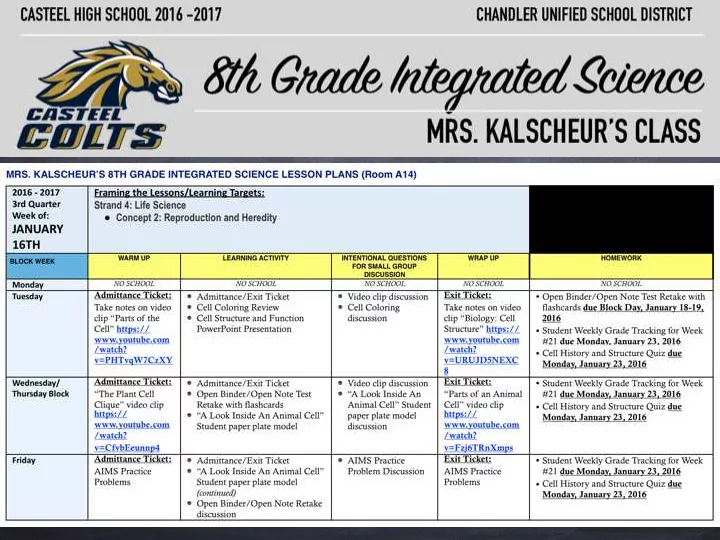
Cell History and Structure Quiz on Block Day January 18-19, 2016 Admit Ticket NOTES: Take notes on video clip Parts of the Cell https:// www.youtube.com/ watch? v=PHTvqW7CzXY Exit Ticket NOTES: Take notes on video clip Biology:


slide-1
SLIDE 1 Cell History and Structure Quiz
  • n Block Day January 18-19, 2016
slide-2
SLIDE 2

Admit Ticket

NOTES: Take notes

  • n video clip “Parts
  • f the Cell” https://

www.youtube.com/ watch? v=PHTvqW7CzXY

slide-3
SLIDE 3

Exit Ticket

http://tusdstats.tusd1.org/planning/resources/aims_samples/grade8/sci_1_g8.pdf

NOTES: Take notes

  • n video clip

“Biology: Cell Structure” https:// www.youtube.com/ watch? v=URUJD5NEXC8

slide-4
SLIDE 4

DUE TODAY

Agenda Item

HOMEWORK: Student Weekly Grade Tracking #20

http://www.powerpointhintergrund.com/uploads/new-year-ppt-background-8.jpg
slide-5
SLIDE 5

DUE BLOCK

Agenda Item

TEST RETAKE: REQUIRES FLASHCARDS (requirement online)

http://www.powerpointhintergrund.com/uploads/new-year-ppt-background-8.jpg
slide-6
SLIDE 6

OPEN BINDER/NOTE TEST RETAKE REQUIREMENT

Create flashcards for the following concepts with definitions to use on a retake of the test on 1/18/17:

  • 1. Rolling Friction
  • 2. Static Friction
  • 3. Fluid Friction
  • 4. Sliding Friction
  • 5. Newton’s 1st Law of Motion
  • 6. Newton’s 2nd Law of Motion
  • 7. Newton’s 3rd Law of Motion
  • 8. Newton’s Law of Conservation of
Momentum
  • 9. Net Force
  • 10. Balanced Force
  • 11. Unbalanced Force
  • 12. Inertia
  • 13. Displacement
  • 14. Speed
  • 15. Mass
  • 16. Velocity
  • 17. Sublimation
  • 18. Dalton’s Atomic Theory
  • 19. Anion
  • 20. Polyatomic Ion
  • 21. Polar Bond
  • 22. Cation
  • 23. Transition Metal
  • 24. Characteristics of a plant cell
  • 25. Characteristics of an animal cell
  • 26. Cell Wall
  • 27. Tissue
  • 28. Cell Membrane
  • 29. Nuclear Membrane
  • 30. Lysosome
  • 31. Ribosome
  • 32. Chromosome
  • 33. Centrosome
  • 34. Animal Vacuole
  • 35. Plant Vacuole
  • 36. Microtubule
  • 37. Mitochondria
  • 38. Cytoplasm
  • 39. Cell Vesicle
  • 40. DNA
  • 41. RNA
  • 42. Nucleolus
  • 43. Smooth Endoplasmic Reticulum
  • 44. Rough Endoplasmic Reticulum
  • 45. Cytoplasm
  • 46. Nucleoplasm
  • 47. Cilia
  • 48. Matthias Schleiden
  • 49. Theodor Schwann
  • 50. Robert Hooke
  • 51. Rudolph Virchow
  • 52. Anton Van Leuwenhoek
  • 53. Robert Brown
slide-7
SLIDE 7

DUE 1/23/17

Agenda Item

HOMEWORK: Student Weekly Grade Tracking #21

http://www.powerpointhintergrund.com/uploads/new-year-ppt-background-8.jpg
slide-8
SLIDE 8

DUE 1/23/17**

Agenda Item

QUIZ: CELL HISTORY AND STRUCTURE

http://www.powerpointhintergrund.com/uploads/new-year-ppt-background-8.jpg
slide-9
SLIDE 9

REVIEW WORKSHEETS

slide-10
SLIDE 10
slide-11
SLIDE 11
slide-12
SLIDE 12
slide-13
SLIDE 13

cell wall and chloroplasts (large vacuole)

slide-14
SLIDE 14
slide-15
SLIDE 15
slide-16
SLIDE 16
slide-17
SLIDE 17
slide-18
SLIDE 18

Cell Structure 
 & Function

http://koning.ecsu.ctstateu.edu/cell/cell.html

slide-19
SLIDE 19

Definition of Cell

A cell is the smallest unit that is capable

  • f performing life

functions.

slide-20
SLIDE 20

Examples of Cells

Amoeba Proteus Plant Stem Red Blood Cell Nerve Cell Bacteria

slide-21
SLIDE 21

Two Types of Cells

  • Prokaryotic
  • Eukaryotic
slide-22
SLIDE 22

Prokaryotic

  • Do not have

structures surrounded by membranes

  • Few internal

structures

  • One-celled
  • rganisms, Bacteria

http://library.thinkquest.org/C004535/prokaryotic_cells.html

slide-23
SLIDE 23

Eukaryotic

  • Contain organelles surrounded by membranes
  • Most living organisms

Plant Animal

http://library.thinkquest.org/C004535/eukaryotic_cells.html

slide-24
SLIDE 24

“Typical” Animal Cell

http://web.jjay.cuny.edu/~acarpi/NSC/images/cell.gif

slide-25
SLIDE 25

http://waynesword.palomar.edu/images/plant3.gif

“Typical” Plant Cell

slide-26
SLIDE 26

Cell Parts

Organelles

slide-27
SLIDE 27

Surrounding the Cell

slide-28
SLIDE 28

Cell Membrane

  • Outer membrane of cell

that controls movement in and out of the cell

  • Double layer

http://library.thinkquest.org/12413/structures.html

slide-29
SLIDE 29

Cell Wall

  • Most commonly found

in plant cells & bacteria

  • Supports & protects

cells

http://library.thinkquest.org/12413/structures.html

slide-30
SLIDE 30

Inside the Cell

slide-31
SLIDE 31

Nucleus

  • Directs cell activities
  • Separated from cytoplasm by nuclear

membrane

  • Contains genetic material - DNA
slide-32
SLIDE 32

Nuclear Membrane

  • Surrounds nucleus
  • Made of two layers
  • Openings allow

material to enter and leave nucleus

http://library.thinkquest.org/12413/structures.html

slide-33
SLIDE 33

Chromosomes

  • In nucleus
  • Made of DNA
  • Contain instructions

for traits & characteristics

http://library.thinkquest.org/12413/structures.html

slide-34
SLIDE 34

Nucleolus

  • Inside nucleus
  • Contains RNA to build

proteins

http://library.thinkquest.org/12413/structures.html

slide-35
SLIDE 35

Cytoplasm

  • Gel-like mixture
  • Surrounded by cell membrane
  • Contains hereditary material
slide-36
SLIDE 36

Endoplasmic Reticulum

  • Moves materials around in

cell

  • Smooth type: lacks

ribosomes

  • Rough type (pictured):

ribosomes embedded in surface

http://library.thinkquest.org/12413/structures.html

slide-37
SLIDE 37

Ribosomes

  • Each cell contains

thousands

  • Make proteins
  • Found on ribosomes &

floating throughout the cell

http://library.thinkquest.org/12413/structures.html

slide-38
SLIDE 38

Mitochondria

  • Produces energy through

chemical reactions – breaking down fats & carbohydrates

  • Controls level of water and
  • ther materials in cell
  • Recycles and decomposes

proteins, fats, and carbohydrates

http://library.thinkquest.org/12413/structures.html

slide-39
SLIDE 39

Golgi Bodies

  • Protein 'packaging

plant'

  • Move materials within

the cell

  • Move materials out of

the cell

http://library.thinkquest.org/12413/structures.html

slide-40
SLIDE 40

Lysosome

  • Digestive 'plant' for

proteins, fats, and carbohydrates

  • Transports undigested

material to cell membrane for removal

  • Cell breaks down if

lysosome explodes

http://library.thinkquest.org/12413/structures.html

slide-41
SLIDE 41

Vacuoles

  • Membrane-bound

sacs for storage, digestion, and waste removal

  • Contains water

solution

  • Help plants maintain

shape

http://library.thinkquest.org/12413/structures.html

slide-42
SLIDE 42

Chloroplast

  • Usually found in plant

cells

  • Contains green

chlorophyll

  • Where photosynthesis

takes place

http://library.thinkquest.org/12413/structures.html

slide-43
SLIDE 43

HAVE A WONDERFUL DAY!

http://media1.nordiclifescience.org/2014/08/dna-structure.jpg