Nonlinear System Identification of an F-16 Aircraft Using the - - PowerPoint PPT Presentation

nonlinear system identification of an f 16 aircraft using
SMART_READER_LITE
LIVE PREVIEW

Nonlinear System Identification of an F-16 Aircraft Using the - - PowerPoint PPT Presentation

Nonlinear System Identification of an F-16 Aircraft Using the Acceleration Surface Method Tiln Dossogne Jean-Philippe Nol Gaetan Kerschen Workshop on Nonlinear System Identification Benchmarks Brussels, April 24 th 2017 Design Cycle of

slide-1
SLIDE 1

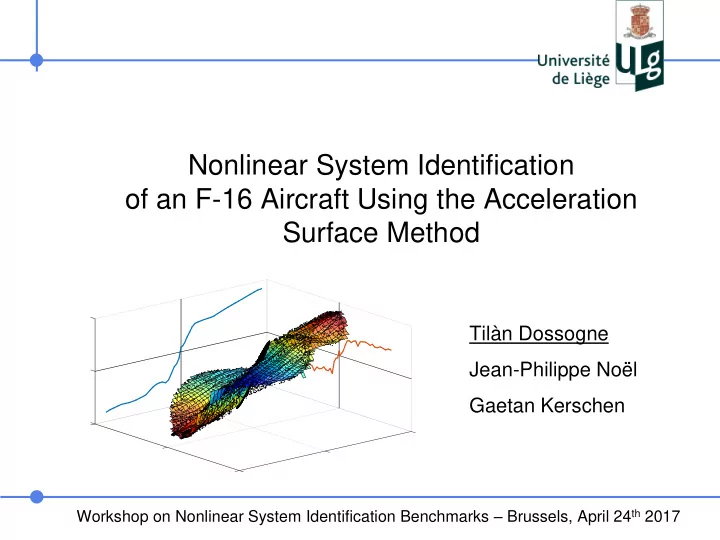
Nonlinear System Identification

  • f an F-16 Aircraft Using the Acceleration

Surface Method

Tilàn Dossogne Jean-Philippe Noël Gaetan Kerschen

Workshop on Nonlinear System Identification Benchmarks – Brussels, April 24th 2017

slide-2
SLIDE 2

2

Design Cycle of Nonlinear Engineering Structures

Measure Identify Design Understand Uncover Model

Computer-aided modelling (FEM) Structure (prototype

  • r current design)
slide-3
SLIDE 3

3

Outline

  • The Acceleration Surface Method (ASM)

Main assumptions Application to the F-16 aircraft

  • A modified Acceleration Surface Method for quantitative

estimation

Basic Principles Application to the F-16 aircraft

slide-4
SLIDE 4

4

Starting from Equations of Motion

From Newton’s second law in DOF 2: 𝑛2 ሷ 𝑦2+ 𝑙23. 𝑦2 − 𝑦3 + 𝑙12. 𝑦2 − 𝑦1 + 𝑑23. ሶ 𝑦2 − ሶ 𝑦3 + 𝑑12. ሶ 𝑦2 − ሶ 𝑦1 + 𝑔

𝑜𝑚 𝑡𝑢𝑗𝑔𝑔 𝑦2 − 𝑦1

+ 𝑔

𝑜𝑚 𝑒𝑏𝑛𝑞

ሶ 𝑦2 − ሶ 𝑦1 = 0

1 2 3

slide-5
SLIDE 5

5

Isolating the Nonlinear Force

Assessment of the nonlinear stiffness term: 𝑔

𝑜𝑚 𝑡𝑢𝑗𝑔𝑔 𝑦2 − 𝑦1

= − 𝑛2 ሷ 𝑦2 − 𝑙23. 𝑦2 − 𝑦3 − 𝑙12. 𝑦2 − 𝑦1 − 𝑑23. ሶ 𝑦2 − ሶ 𝑦3 − 𝑑12. ሶ 𝑦2 − ሶ 𝑦1 − 𝑔

𝑜𝑚 𝑒𝑏𝑛𝑞

ሶ 𝑦2 − ሶ 𝑦1

1 2 3

slide-6
SLIDE 6

6

Discarding All Unavailable Terms from Measurements Only

Assessment of the nonlinear stiffness term: 𝑔

𝑜𝑚 𝑡𝑢𝑗𝑔𝑔 𝑦2 − 𝑦1

= − 𝑛2 ሷ 𝑦2 − 𝑙23. 𝑦2 − 𝑦3 − 𝑙12. 𝑦2 − 𝑦1 − 𝑑23. ሶ 𝑦2 − ሶ 𝑦3 − 𝑑12. ሶ 𝑦2 − ሶ 𝑦1 − 𝑔

𝑜𝑚 𝑒𝑏𝑛𝑞

ሶ 𝑦2 − ሶ 𝑦1

1 2 3

Only keep data points where ሶ 𝑦2 − ሶ 𝑦1 ≈ 0

slide-7
SLIDE 7

7

Discarding All Unavailable Terms from Measurements Only

Assessment of the nonlinear stiffness term: 𝑔

𝑜𝑚 𝑡𝑢𝑗𝑔𝑔 𝑦2 − 𝑦1

≅ − 𝑛2 ሷ 𝑦2 − 𝑙23. 𝑦2 − 𝑦3 − 𝑙12. 𝑦2 − 𝑦1 − 𝑑23. ሶ 𝑦2 − ሶ 𝑦3

1 2 3

Contributions from other connections are assumed to be either small or linear

slide-8
SLIDE 8

8

Discarding All Unavailable Terms from Measurements Only

Assessment of the nonlinear stiffness term: 𝑔

𝑜𝑚 𝑡𝑢𝑗𝑔𝑔 𝑦2 − 𝑦1

≅ − 𝑛2 ሷ 𝑦2 − 𝑙12. 𝑦2 − 𝑦1

1 2 3

Linear contribution (additional slope only)

slide-9
SLIDE 9

9

Discarding All Unavailable Terms from Measurements Only

Assessment of the nonlinear stiffness term: 𝑔

𝑜𝑚 𝑡𝑢𝑗𝑔𝑔 𝑦2 − 𝑦1

≅ − 𝑛2 ሷ 𝑦2

1 2 3

Only slope affected

slide-10
SLIDE 10

10

A Simple Expression Approximates the Nonlinear Elastic Force

Assessment of the nonlinear stiffness term: 𝑔

𝑜𝑚 𝑡𝑢𝑗𝑔𝑔 𝑦2 − 𝑦1

≅ − ሷ 𝑦2

Relative Velocity ሶ 𝑦2 − ሶ 𝑦1 Relative Displacement 𝑦2 − 𝑦1 − Acceleration − ሷ 𝑦2

Cross-section around ሶ 𝑦2 − ሶ 𝑦1 = 0

slide-11
SLIDE 11

11

The Shape of the Nonlinearity Can Be Found

Assessment of the nonlinear stiffness term: 𝑔

𝑜𝑚 𝑡𝑢𝑗𝑔𝑔 𝑦2 − 𝑦1

≅ − ሷ 𝑦2

− Acceleration − ሷ 𝑦2 Relative Displacement 𝑦2 − 𝑦1

Qualitative NL stiffness curve

slide-12
SLIDE 12

12

Same Machinery Applied for the Nonlinear Damping Term

Assessment of the nonlinear damping term: 𝑔

𝑜𝑚 𝑒𝑏𝑛𝑞

ሶ 𝑦2 − ሶ 𝑦1 ≅ − ሷ 𝑦2

Relative Velocity ሶ 𝑦2 − ሶ 𝑦1 Relative Displacement 𝑦2 − 𝑦1 − Acceleration − ሷ 𝑦2

Cross-section around 𝑦2 − 𝑦1 = 0

slide-13
SLIDE 13

13

Summary of the Acceleration Surface Method Provides qualitative views of nonlinear stiffness and damping. Fast method requiring only two measured output signals. Requires Sine-sweep excitation. Assumptions:

  • Linear or negligible contributions from the surrounding

connections

  • Small damping forces around zero relative velocity
  • Only one mode responding
slide-14
SLIDE 14

14

Application to the F-16 Aircraft

Two sensors from both sides

  • f the back wing-to-payload

connection

slide-15
SLIDE 15

15

The Reference Is Taken On The Payload

Two sensors from both sides

  • f the back wing-to-payload

connection

slide-16
SLIDE 16

16

Only One Mode Is Selected At A Time

Relative velocity [m/s]

  • Acceleration [m/s²]

Relative displacement [m]

Sweep frequency [Hz]

  • Acceleration [m/s²]

Portion of the time signal around 1 mode (under a 96N sine-sweep excitation)

slide-17
SLIDE 17

17

Stiffness and Damping Are Decoupled Using Cross-sections

  • Acceleration [m/s²]

Relative velocity [m/s] Relative displacement [m]

slide-18
SLIDE 18

18

Qualitative Stiffness and Damping Curves Are Found

  • Acceleration [m/s²]

8

  • 8
  • 0.6

0.6 Relative Displacement [mm]

  • Acceleration [m/s²]

4

  • 4
  • 80

80 Relative Velocity [mm/s]

  • Acceleration [m/s²]

Stiffness curve Damping curve

slide-19
SLIDE 19

19

ASM Gives Insights About the Physical Nonlinear Mechanism

8

  • 8
  • 0.6

0.6 Relative Displacement [mm]

  • Acceleration [m/s²]

4

  • 4
  • 80

80 Relative Velocity [mm/s]

  • Acceleration [m/s²]

Stiffness curve Damping curve

Sliding connection between the wing and the payload ⇒ Opening of the connection (softening) ⇒ Impacts (hardening) ⇒ Coulomb friction

slide-20
SLIDE 20

20

Consistent Stiffness and Damping Curves

slide-21
SLIDE 21

21

Consistent Stiffness and Damping Curves

slide-22
SLIDE 22

22

Consistent Stiffness and Damping Curves

slide-23
SLIDE 23

23

Consistent Stiffness and Damping Curves

slide-24
SLIDE 24

24

Consistent Stiffness and Damping Curves

slide-25
SLIDE 25

25

Consistent Stiffness and Damping Curves

slide-26
SLIDE 26

26

Consistent Stiffness and Damping Curves

slide-27
SLIDE 27

27

Consistent Stiffness and Damping Curves

slide-28
SLIDE 28

28

Consistent Stiffness and Damping Curves

slide-29
SLIDE 29

29

Consistent Stiffness and Damping Curves

slide-30
SLIDE 30

30

Consistent Stiffness and Damping Curves

slide-31
SLIDE 31

31

Useful Information from ASM

What can be extracted from ASM curves:

  • Clearances
  • Mathematical form of the NL

(piecewise linear)

What cannot be extracted from ASM curves:

  • Nonlinear stiffness values (slopes)

8

  • 8

0.05 Relative Displacement [mm]

  • Acceleration [m/s²]

0.54

  • 0.04
  • 0.41

Can we use the ASM to extract quantitative information about the nonlinear parameters?

slide-32
SLIDE 32

32

Outline

  • The Acceleration Surface Method

Main assumptions Application to the F-16 aircraft

  • A modified Acceleration Surface Method for quantitative

estimation

Basic Principles Application to the F-16 aircraft

slide-33
SLIDE 33

33

ASM Methodology for Experimental Structures

Prototype or actual structure Measurements ASM

slide-34
SLIDE 34

34

ASM Can Also Be Applied On Numerical Results

Linear FE model Nonlinear elements Prototype or actual structure Measurements Simulations ASM ASM

slide-35
SLIDE 35

35

Similar Models Must Give Similar ASM Curves

Linear FE model Nonlinear elements Prototype or actual structure Measurements Simulations ASM ASM Qualitative estimation of the nonlinearity BUT Quantitatively comparable between each other

slide-36
SLIDE 36

36

Quantitative Nonlinear Parameters Can Be Extracted

Linear FE model Nonlinear elements Prototype or actual structure Measurements Simulations ASM ASM Qualitative estimation of the nonlinearity BUT Quantitatively comparable between each other Related to actual nonlinear parameters

slide-37
SLIDE 37

37

Optimal Nonlinear Parameters Are Found Iteratively

Linear FE model Nonlinear elements Simulations Reference ASM ASM

Optimization on the nonlinear parameters

Cost function: difference between the 2 ASM curves

slide-38
SLIDE 38

38

Finite Element Modeling of the Right Wing

Shell and beam elements Clamping at the root chord Nonlinear spring

slide-39
SLIDE 39

39

Parameters of the Nonlinear Spring Are Not Known A Priori

Shell and beam elements Clamping at the root chord Nonlinear spring

? ? ? ?

Relative Displacement Restoring Force

slide-40
SLIDE 40

40

The Procedure Is Applied to the F-16 Case

Linear FE model Nonlinear element F-16 aircraft GVT measurements Simulations ASM ASM

error > 𝜁

Error computation

slide-41
SLIDE 41

41

The Experimental Reference Solution Is Improved

Curve fitting step to simplify the error computation and decrease the number of parameters.

8

  • 8
  • 0.04
  • 0.41

0.05 Relative Displacement [mm]

  • Acceleration [m/s²]
  • 4

4 0.54

Experimental data points Curve fit

slide-42
SLIDE 42

42

Simulations Inside an Optimization Loop Are Performed

Newmark time integration for a sine-sweep excitation

  • Level: 96N
  • Frequency bounds: from 8 to 6 Hz (restricted to 1 mode)
  • Sweep rate: 1Hz/min
  • Sampling frequency: 5000Hz (finer time step for the integration)

Unconstrained Optimization

  • 5 parameters (slopes of the 5 portions)
  • Scaling
  • Cost function: err =

𝑧ASM num − 𝑧ASM ref 2

slide-43
SLIDE 43

43

Good Fit Is Obtained After Several Iterations

8

  • 8
  • 0.04
  • 0.41

0.05 Relative Displacement [mm]

  • Acceleration [m/s²]
  • 4

4 0.54

Simulation data points Reference ASM from experimental

The error is minimized between the experimental and the numerical ASM sitffness curve.

slide-44
SLIDE 44

44

Quantitative NL Parameters Are Found

Linear FE model Nonlinear element F-16 aircraft GVT measurements Simulations ASM ASM

NL parameters: [0.4 0.08 1 0.08 1.1] x 107 N/m

slide-45
SLIDE 45

45

Conclusions ASM provides a quick and intuitive way to characterize the nonlinear behavior. Using a reliable linear finite element model, the ASM can quantitavely estimate optimal nonlinear parameters. Caution must be taken regarding the selection of the mode and the reference sensors.