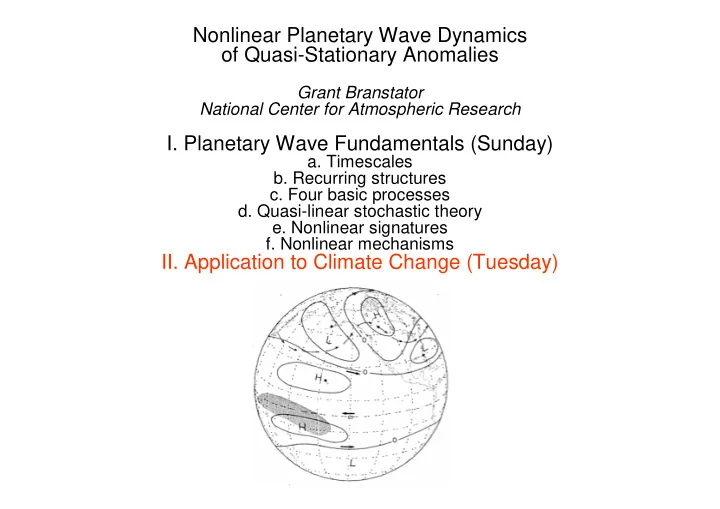
Nonlinear Planetary Wave Dynamics of Quasi-Stationary Anomalies - - PowerPoint PPT Presentation

nonlinear planetary wave dynamics of quasi stationary
SMART_READER_LITE
LIVE PREVIEW

Nonlinear Planetary Wave Dynamics of Quasi-Stationary Anomalies - - PowerPoint PPT Presentation

Nonlinear Planetary Wave Dynamics of Quasi-Stationary Anomalies Grant Branstator National Center for Atmospheric Research I. Planetary Wave Fundamentals (Sunday) a. Timescales b. Recurring structures c. Four basic processes d. Quasi-linear


slide-1
SLIDE 1

Nonlinear Planetary Wave Dynamics

  • f Quasi-Stationary Anomalies

Grant Branstator National Center for Atmospheric Research

  • I. Planetary Wave Fundamentals (Sunday)
  • a. Timescales
  • b. Recurring structures
  • c. Four basic processes
  • d. Quasi-linear stochastic theory
  • e. Nonlinear signatures
  • f. Nonlinear mechanisms
  • II. Application to Climate Change (Tuesday)
slide-2
SLIDE 2

January 300mb psi low/negative high/positive

slide-3
SLIDE 3

January 300mb psi

slide-4
SLIDE 4

T31 LFV Transient eddies

h500 Average temporal spectrum

slide-5
SLIDE 5
slide-6
SLIDE 6
slide-7
SLIDE 7
slide-8
SLIDE 8

Zonal wave number

Psi300 zonal wavenumber spectra for Nature

2 4 6 8 10 12 14

LFV synoptic

slide-9
SLIDE 9

Zonal wave number

Psi300 zonal wavenumber spectra for Nature

2 4 6 8 10 12 14

barotropic baroclinic

LFV synoptic

slide-10
SLIDE 10
slide-11
SLIDE 11

x x psi300

“Teleconnection Patterns”

slide-12
SLIDE 12

h500 EOFs Most predictable patterns for 10d forecasts

slide-13
SLIDE 13
slide-14
SLIDE 14

El Nino composite h500 anomalies

1958,1966,1973,1983,1987,1992

slide-15
SLIDE 15
slide-16
SLIDE 16
slide-17
SLIDE 17

Low frequency perturbations are: 1. Large-scale 2. On a rotating planet 3. Barotropic 4. Non-divergent in the upper tropospheric midlatitudes 5. Relatively weak compared to time mean state Therefore: Linear, barotropic vorticity dynamics should be important for understanding their behavior.

slide-18
SLIDE 18

∂ς ∂t = −r v

ψ ⋅ ∇(ς + f )

(•) = 1 T (•)dt + (•)'

T

= () + (•)' ∂ς' ∂t = −r v

ψ ⋅ ∇(ς + f ) − r

v

ψ ⋅ ∇ς' −r

v '

ψ ⋅∇(ς + f ) − r

v '

ψ ⋅∇ς'

r v

ψ ⋅ ∇(ς + f ) = −r

v '

ψ ⋅∇ς'

∂ς' ∂t = −r v

ψ ⋅ ∇ς' −r

v '

ψ ⋅∇(ς + f ) − (r

v '

ψ ⋅∇ς' −r

v '

ψ ⋅∇ς' )

∂ς' ∂t ≅ −r v

ψ ⋅ ∇ς' −r

v '

ψ ⋅∇(ς + f ) + damping + noise

Basic quasi-linear barotropic dynamics

∂ ′ ς ∂t = −[u ] ′ ς

x − ′

v β

* − r

v

# •∇ ′

ς − r ′ v •∇ ′ ς − r ′ v •∇ ′ ς

I II III IV 2Ωsinϕ

slide-19
SLIDE 19

∂ ′ ς ∂t = −r v

ψ ⋅∇ ′

ς − r ′ v

ψ ⋅∇(ς + f )

= L ′ ς Say LE = σE Then ′ ς (t) = Ee

σt = (ER + iEI )e σ Rt (cosσ I t + isinσ I t)

= e

σ Rt{ER cosσ It − EI sinσ I t}+ i{...} is a solution.

Thus, if ′ ς (t = 0) = a jE

j is real, j

then ′ ς (t) = a je

σ R

j t {

j

ER

j cosσ I jt − EI j sinσ I jt}

Linear Initial Value Problem Using Normal Mode Basis

slide-20
SLIDE 20

σ I = u

e

a − 2Ω

*

n(n +1)       m ϕ λ ς ς

ψ

d d a v a u t

e *

f ) 1 ( ) 1 ( ′ − ∂ ′ ∂ − = ∂ ′ ∂

For solid body rotation background Normal modes are spherical harmonics with frequency

m n

Y u = ue cosϕ

slide-21
SLIDE 21

Wallace and Lau (1985)

CKy CKx y u v u x u v u t v u t KE + >= ∂ ∂ ′ ′ < − > ∂ ∂ ′ − ′ < − = ∂ > ′ + ′ < ∂ = ∂ ∂ ) ( ) (

2 2 2 2

slide-22
SLIDE 22

Linear Vorticity Equation

Mean Jan 300mb Psi

slide-23
SLIDE 23

Linear Vorticity Equation

slide-24
SLIDE 24

(Branstator, 1985) (Simmons et al., 1983)

slide-25
SLIDE 25

(Simmons et al., 1983)

Fastest Growing Normal Mode

slide-26
SLIDE 26

∂ς ∂t = −r v

ψ ⋅ ∇(ς + f )

(•) = 1 T (•)dt + (•)'

T

= () + (•)' ∂ς' ∂t = −r v

ψ ⋅ ∇(ς + f ) − r

v

ψ ⋅ ∇ς' −r

v '

ψ ⋅∇(ς + f ) − r

v '

ψ ⋅∇ς'

r v

ψ ⋅ ∇(ς + f ) = −r

v '

ψ ⋅∇ς'

∂ς' ∂t = −r v

ψ ⋅ ∇ς' −r

v '

ψ ⋅∇(ς + f ) − (r

v '

ψ ⋅∇ς' −r

v '

ψ ⋅∇ς' )

∂ς' ∂t ≅ −r v

ψ ⋅ ∇ς' −r

v '

ψ ⋅∇(ς + f ) + damping + noise

Basic linear barotropic stochastic dynamics (Dymnikov, 1988)

slide-27
SLIDE 27

Variance

Stochastically Driven Linear Barotropic Vorticity Equation

slide-28
SLIDE 28

Stochastically Driven Linear Barotropic Vorticity Equation

Variance

slide-29
SLIDE 29

Gaussian PDFs

Elliptical trajectories Signatures of linear behavior: Linear Stochastic Model of Planetary Waves ∂ ′ ς ∂t = −r v •∇ ′ ς − r ′ v •∇(ς + f ) + damping + Gaussian noise

slide-30
SLIDE 30

Low pass winter h500 EOFs Projections onto EOF1&2 PDF Cheng & Wallace (1992) A G R

slide-31
SLIDE 31

10d means from 5000d sample 10d means from 7,500,000d sample

Berner & Branstator

slide-32
SLIDE 32

Berner & Branstator (2007)

Slices through AGCM phase space

slide-33
SLIDE 33

Branstator & Berner (2005)

slide-34
SLIDE 34

Branstator & Berner (2005) Mean 24hr increments

slide-35
SLIDE 35

Branstator & Berner (2005)

slide-36
SLIDE 36

∂t

∂ς' ∂t = −r v

ψ ⋅ ∇ς' −r

v '

ψ ⋅∇(ς + f ) − (r

v '

ψ ⋅∇ς' −r

v '

ψ ⋅∇ς' )

∂ς

slide-37
SLIDE 37

following Charney & Devore (1979) and Held (1983)

∂[u] ∂t = −κ([u]−[ue ]) − D([u]) for D([u]) = ∂ ∂y[u

*v *]+ 1

h0 [p

* ∂ht

∂x ]

Multiple Equilibria C A

−κ([u]−[ue ])

D([u])

slide-38
SLIDE 38

Lorenz63

PDF

bZ XY Z Y rX XZ Y Y X X − = − + − = + − = & & & σ σ

slide-39
SLIDE 39

T31

h500 Average temporal spectrum

LFV Transient eddies

slide-40
SLIDE 40

1 2 5

10 100

s m x

2 4 13

10 2

s m x

2 2

5

s m

slide-41
SLIDE 41

Linear Stormtrack Model

... ... ' ... ' ' ' ... ' t ' = ∂ ∂ = ∂ ∂ + + ⋅∇ − ∇ ⋅ − = ∂ ∂ + + ⋅∇ − ′ ∇ ⋅ − = ∂ ∂ t p t D damping T v T v t T damping v v

s

r r r r ς ς ς

slide-42
SLIDE 42
slide-43
SLIDE 43
slide-44
SLIDE 44
slide-45
SLIDE 45
slide-46
SLIDE 46

Psi300 NAO+ NAO-

slide-47
SLIDE 47

... ' )... ' ' ' ' ( ' ... ' ' ) ( '... ' ' ) ( ) ( () 1 () ... ) ( noise damping v v v v v v t v f v v v v f v t dt T f v t

T

+ + ⋅∇ − ′ ∇ ⋅ − = ⋅∇ − ⋅∇ − ⋅∇ − ′ ∇ ⋅ − = ∂ ′ ∂ + ⋅∇ − = + ∇ ⋅ ⋅∇ − ⋅∇ − ′ ∇ ⋅ − + ∇ ⋅ − = ∂ ′ ∂ ′ + = − + ∇ ⋅ − = ∂ ∂

ς ς ς ς ς ς ς ς ς ς ς ς ς ς ς ς

ψ ψ ψ ψ ψ ψ ψ ψ ψ ψ ψ ψ ψ

r r r r r r r r r r r r r

T ′ ς

slide-48
SLIDE 48

E=14.8d E=5.6d

slide-49
SLIDE 49

CCM0 LinBaroVorEqn LinBaroVorEqn + TranEddyFeedbk 18% 21% 36%

slide-50
SLIDE 50

Nonlinear Planetary Wave Dynamics

  • f Quasi-Stationary Anomalies

Grant Branstator National Center for Atmospheric Research

  • I. Planetary Wave Fundamentals (Sunday)
  • a. Timescales
  • b. Recurring structures
  • c. Four basic processes
  • d. Quasi-linear stochastic theory
  • e. Nonlinear signatures
  • f. Nonlinear mechanisms
  • II. Application to Climate Change (Tuesday)