SLIDE 1
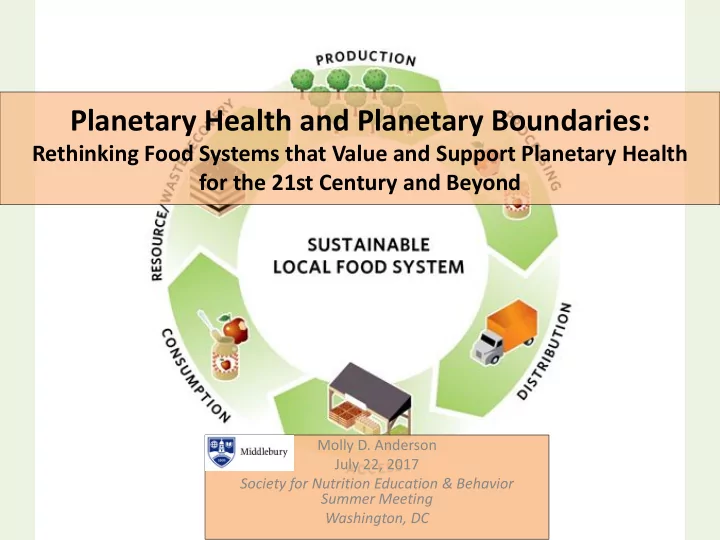
Planetary Health and Planetary Boundaries:
Rethinking Food Systems that Value and Support Planetary Health for the 21st Century and Beyond
Molly D. Anderson July 22, 2017 Society for Nutrition Education & Behavior Summer Meeting Washington, DC
SLIDE 2
Depicting food systems – for what purpose?
SLIDE 3
Depicting food systems – for what purpose?
SLIDE 4
Depicting food systems – for what purpose?
SLIDE 5 Purposes of systems analysis
- Better understand issues and problems stemming from the
interaction of system components and their key drivers
- Think logically and comprehensively about behavior over time of
those components; reason about the structure and function
- f the system
- Share this understanding with others
- Make predictions by modeling interactions
- Test assumptions and theories of change
- Help to figure out intervention points
- Develop visions of alternatives, and
imagine pathways to achieve them
SLIDE 6 Identifying leverage points
Source: Meadows, Donella H. 2008. Thinking in Systems. A
- Primer. White River Junction, VT: Chelsea Green Publishing.
SLIDE 7 State of Cultural Paradigms State of Ecosystem State of Human Health & Wellbeing
Identifying leverage points
State of Community
Social Effects Health Effects Environmental Effects Co-Effects
Source: Dyball, Robert & Barry
- Newell. 2015. Understanding
Human Ecology: A Systems Approach to Sustainability. Earthscan.
SLIDE 8 Prevalence of AMR bacteria in the environment Prevalence of AMR in humans
- Ex. 1: Using systems analysis – Antibiotics in livestock
Prevalence of diet-related disease Environmental impacts of industrialized agriculture
Industrialized agriculture is positive, necessary, “scientific”
Extent of STA use in livestock Political power of Big Ag/Big Food
Relationships of sub-therapeutic antibiotic use (STA), antimicrobial resistance (AMR) and cultural paradigms R R Cultural paradigm
SLIDE 9 Systems analysis in antibiotics example
- Better understand issues and problems stemming from the
interaction of system components and their key drivers
- Think logically and comprehensively about behavior over time
- f components in the system
- Share this understanding with others
- Make predictions by modeling interactions
- Test assumptions and theories of change
- Help to figure out intervention points
- Develop visions of alternatives, and
imagine pathways to achieve them
SLIDE 10
- Ex. 2: Using systems analysis - New England Food Vision
- Grow 50% of the food we consume in
New England by 2060
- Achieve the right to food for all
- Create racial equity and food justice
- Develop thriving communities
- Achieve sustainable fishing and farming
- Keep at least 70% forest cover
What this will take:
- Triple the amount of current farmland
(6 million acres) by returning to a similar landscape pattern as New England had in the mid-1900s
SLIDE 11
How can we reach the New England Food Vision?
Source: Christoph Hinske, Institute for Strategic Clarity
SLIDE 12
How can we reach the New England Food Vision?
SLIDE 13
How can we reach the New England Food Vision?
SLIDE 14 Systems analysis in the New England Food Vision
- Better understand issues and problems stemming from the
interaction of system components
- Think logically and comprehensively about behavior over time
- f components in the system
- Share this understanding with others
- Make predictions by modeling interactions
- Test assumptions and theories of change
- Help to figure out intervention points
- Develop visions of alternatives, and imagine pathways to
achieve them
SLIDE 15
How can we reach the New England Food Vision?