Nexus Fundamentals for Sales and Use Tax Compliance Understanding - - PowerPoint PPT Presentation

nexus fundamentals for sales and use tax compliance
SMART_READER_LITE
LIVE PREVIEW

Nexus Fundamentals for Sales and Use Tax Compliance Understanding - - PowerPoint PPT Presentation

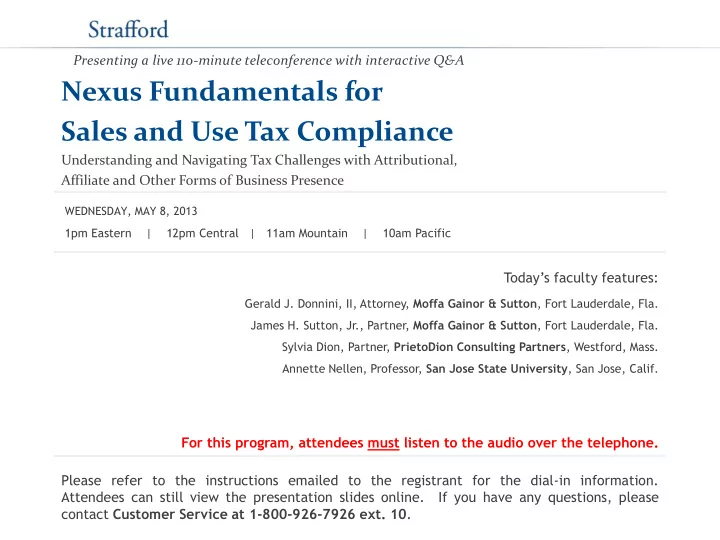
Presenting a live 110-minute teleconference with interactive Q&A Nexus Fundamentals for Sales and Use Tax Compliance Understanding and Navigating Tax Challenges with Attributional, Affiliate and Other Forms of Business Presence WEDNESDAY,


slide-1
SLIDE 1

Nexus Fundamentals for Sales and Use Tax Compliance

Understanding and Navigating Tax Challenges with Attributional, Affiliate and Other Forms of Business Presence Today‟s faculty features:

1pm Eastern | 12pm Central | 11am Mountain | 10am Pacific

Please refer to the instructions emailed to the registrant for the dial-in information. Attendees can still view the presentation slides online. If you have any questions, please contact Customer Service at 1-800-926-7926 ext. 10.

WEDNESDAY, MAY 8, 2013

Presenting a live 110-minute teleconference with interactive Q&A

Gerald J. Donnini, II, Attorney, Moffa Gainor & Sutton, Fort Lauderdale, Fla. James H. Sutton, Jr., Partner, Moffa Gainor & Sutton, Fort Lauderdale, Fla. Sylvia Dion, Partner, PrietoDion Consulting Partners, Westford, Mass. Annette Nellen, Professor, San Jose State University, San Jose, Calif.

For this program, attendees must listen to the audio over the telephone.

slide-2
SLIDE 2

Tips for Optimal Quality

Sound Quality Call in on the telephone by dialing 1-866-873-1442 and enter your PIN when prompted. If you have any difficulties during the call, press *0 for assistance. You may also send us a chat or e-mail sound@straffordpub.com immediately so we can address the problem. Viewing Quality To maximize your screen, press the F11 key on your keyboard. To exit full screen, press the F11 key again.

slide-3
SLIDE 3

Continuing Education Credits

Attendees must stay on the line throughout the program, including the Q & A session, in order to qualify for full continuing education credits. Strafford is required to monitor attendance. Record verification codes presented throughout the seminar. If you have not printed out the “Official Record of Attendance,” please print it now (see “Handouts” tab in “Conference Materials” box on left-hand side of your computer screen). To earn Continuing Education credits, you must write down the verification codes in the corresponding spaces found on the Official Record of Attendance form. Please refer to the instructions emailed to the registrant for additional

  • information. If you have any questions, please contact Customer Service

at 1-800-926-7926 ext. 10.

FOR LIVE EVENT ONLY

slide-4
SLIDE 4

Program Materials

If you have not printed the conference materials for this program, please complete the following steps:

  • Click on the + sign next to “Conference Materials” in the middle of the left-

hand column on your screen.

  • Click on the tab labeled “Handouts” that appears, and there you will see a

PDF of the slides and the Official Record of Attendance for today's program.

  • Double-click on the PDF and a separate page will open.
  • Print the slides by clicking on the printer icon.
slide-5
SLIDE 5

Nexus Fundamentals For Sales and Use Tax Compliance

Sylvia Dion, PrietoDion Consulting Partners sylviadion@verizon.net Annette Nellen, San Jose State University annette.nellen@sjsu.edu May 8, 2013 Gerald J. Donnini, II, Moffa Gainor & Sutton jerrydonnini@FloridaSalesTax.com James H. Sutton, Jr., , Moffa Gainor & Sutton JamesSutton@FloridaSalesTax.com

slide-6
SLIDE 6

Today’s Program

Legal Theories On Which Nexus Is Based [Annette Nellen] Common Nexus Issues And Mitigating Audit Risk [Annette Nellen and James Sutton] Current Developments [Sylvia Dion] Compliance Issues [Sylvia Dion] Current Legal Controversies [James Sutton and Gerald J. Donnini] Slide 8 – Slide 25 Slide 83 – Slide 96 Slide 26 – Slide 30 Slide 31 – Slide 70 Slide 71 – Slide 82

slide-7
SLIDE 7

Notice

ANY TAX ADVICE IN THIS COMMUNICATION IS NOT INTENDED OR WRITTEN BY THE SPEAKERS‟ FIRMS TO BE USED, AND CANNOT BE USED, BY A CLIENT OR ANY OTHER PERSON OR ENTITY FOR THE PURPOSE OF (i) AVOIDING PENALTIES THAT MAY BE IMPOSED ON ANY TAXPAYER OR (ii) PROMOTING, MARKETING OR RECOMMENDING TO ANOTHER PARTY ANY MATTERS ADDRESSED HEREIN.

You (and your employees, representatives, or agents) may disclose to any and all persons, without limitation, the tax treatment or tax structure, or both, of any transaction described in the associated materials we provide to you, including, but not limited to, any tax opinions, memoranda, or other tax analyses contained in those materials. The information contained herein is of a general nature and based on authorities that are subject to change. Applicability of the information to specific situations should be determined through consultation with your tax adviser.

slide-8
SLIDE 8

LEGAL THEORIES ON WHICH NEXUS IS BASED

Annette Nellen, San Jose State University

slide-9
SLIDE 9

Legal Theories

slide-10
SLIDE 10

10

“Nexus”

Sufficient nexus must exist for jurisdiction to impose tax

  • bligations.

Connection between vendor and state such that subjecting vendor to state's tax rules is neither unfair to vendor nor harmful to interstate commerce.

Fairness to vendor and no impediment to interstate commerce stem from U.S. Constitution—respectively, from Due Process Clause (14th Amendment) and Commerce Clause.

slide-11
SLIDE 11

11

Due Process Clause

"No State shall make or enforce any law which shall abridge the privileges or immunities of citizens of the United States; nor shall any State deprive any person of life, liberty, or property, without due process of law; nor deny to any person within its jurisdiction the equal protection of the laws." [14th Amendment, clause 1]

"[D]ue process requires some definite link, some minimum connection, between a state and the person, property or transaction it seeks to tax." Miller Brothers Co. v. Maryland, 347 U.S. 340, 345 (1954).

Unlike the Commerce Clause, the Due Process Clause does not give Congress any power to enact a law that would modify or violate the due process standard.

slide-12
SLIDE 12

12

Commerce Clause

"The Congress shall have power ... to regulate commerce with foreign nations, and among the several States, and with the Indian tribes." [Article I, Section 8, clause 3]

Courts often refer to the "dormant Commerce Clause" because Commerce Clause does not specifically limit state activities—it just grants power to Congress to regulate commerce. In applying the dormant Commerce Clause, courts consider the purpose served by the Commerce Clause and "whether action taken by state or local authorities unduly threatens the values the Commerce Clause was intended to serve." [Wardair Canada v. Florida Dept. of Revenue, 477 U.S. 1 (1986)]

slide-13
SLIDE 13

13

Quill, 504 US 298 (1992)

Fundamental differences between Due Process and Commerce Clauses

Due Process Commerce Clause Congress cannot change Congress controls ―Requires some definite link, some minimum connection, between a state and the person, property or transaction it seeks to tax‖ Involves ―fundamental fairness of governmental activity.‖ 4 factors of Complete Auto Transit,

  • Inc. v. Brady, 430 U.S. 274 (1977).

Bellas Hess, 386 U.S.753 (1967), ties to 1st factor - ―a vendor whose only contacts with the taxing State are by mail or common carrier lacks the ―substantial nexus‖ required by the Commerce Clause.‖ Limits ―state burdens on interstate commerce.‖ Purposeful availment is enough; physical presence not necessary Physical presence required

slide-14
SLIDE 14

14

Key Sales Tax Nexus Case: Quill

Must have physical presence in state to have substantial nexus.

No Due Process issue – Quill was clearly making a market in North Dakota via mail order catalogs.

If Congress wants different result – it can legislate one under its Commerce Clause power.

 ―No matter how we evaluate the burdens that use taxes impose

  • n interstate commerce, Congress remains free to disagree with
  • ur conclusions.‖
slide-15
SLIDE 15

15

Does Sales Tax Nexus Exist?

Approach for answering:

Get the facts

 Where are taxpayer‘s employees, agents, and physical property?

Any ―virtual‖ employees?

Any delivery trucks?

Any property owned by taxpayer leased to others?

 Examine:

Activities with related parties and entities.

Any sales reps (non-employees) – independent contractors, people earning any type of commission based on sales,

  • thers helping vendor in some way?

 Review state law

Use above to determine:

Physical presence nexus

Attributional nexus

slide-16
SLIDE 16

16

How Much Of Own Physical Presence Is Needed For Sales Tax Nexus?

A few diskettes?

 Not enough in Quill

Employee in state for a few days?

 Orvis v. Tax Appeals Tribunal of the State of New York and

Vermont Information Processing, Inc. v. Tax Appeals Tribunal, 654 N.E.2d 954 (N.Y. Ct. App. 1995), cert. denied, 516 U.S. 989 (1995)

 States not consistent

A different operation in the state?

 National Geographic Society v. Cal. Bd. of Equalization, 430 US

555 (1977)

Related entity in state?

slide-17
SLIDE 17

17

What About Attributional Nexus?

Attribution - Activities of others who have nexus in the state

 Independent contractors selling product

Scripto and Tyler Pipe

 Representative

State statute may use this term

Scholastic Books (cases in several states)

 Agent – someone acts on your behalf  Affiliate

Related entity, and common product or trademark or specified activity (check state law)

Operator of website with link (so-called ―Amazon‖ laws)

slide-18
SLIDE 18

18

Contractors Selling Product

Scripto, Inc. v. Carson, 362 US 207 (1960)

Georgia taxpayer

No property or operations in Florida, but …

10 commissioned salespeople (contractors) in Florida

Holding: continuous solicitation in Florida was sufficient to constitute ―substantial nexus‖ such that Scripto was obligated to collect Florida use tax on its sales in that state.

The court did not find the legal distinction between employee and independent contractor affected its conclusion. ―To permit such formal ‗contractual shifts‘ to make a constitutional difference would open the gates to a stampede of tax

  • avoidance. . . . The test is simply the nature and extent of the

activities of [Scripto] in Florida.‖

slide-19
SLIDE 19

19

What Do Contractors Do?

Tyler Pipe Industries Inc. v. Washington Department of Revenue, 483 U.S. 232 (1987)

―… the crucial factor governing nexus is whether the activities performed in this state on behalf of the taxpayer are significantly associated with the taxpayer‘s ability to establish and maintain a market in this state for the sales.‖

slide-20
SLIDE 20

20

Teachers As Reps Or Sales Helpers

Does Scholastic Books (in Missouri) have nexus in states where teachers hand out order forms, collect money and distribute books to students?

 YES - Scholastic Book Clubs, Inc. v. Farr, Comm’r of Revenue,

State of Tennessee, M2011-01443-COA-R3-CV (Ct App, 1/27/12)

 YES - Scholastic Book Clubs v. Commissioner, Docket CV 07

4013027S (CT Superior Ct, 2009), rev'd SC 18425 (CT Supreme Court, 2012)

 NO - Scholastic Book Clubs, Inc. v. State of Michigan, Dept. of

Treasury, 567 NW2d 692 (Mich Ct App 1997)

More – see Nellen, http://www.cpa2biz.com/Content/media/PRODUCER_CONTENT/Ne wsletters/Articles_2012/CorpTax/SalesTaxNexus.jsp

Why the inconsistency in rulings?

slide-21
SLIDE 21

21

Third-Party Repairs

Provision of in-state repair services by a third party?

 Multistate Tax Comm‘n (MTC) – yes, per MTC Bulletin 95-1 -

repair services not de minimis activities, but instead represent ―regular or systematic activities in furtherance of the seller‘s business, such as solicitation of sales or provision of services.‖

Addresses both sales/use tax and income tax nexus

Not followed in all states

 Look at facts, particularly nature of relationship between taxpayer

and third party, and nature of the work. And … answer can differ by state. Examples:

No nexus - Dell Catalog Sales v. Commissioner, 834 A2d 812 (Conn Sup. Ct. 2003)

Nexus - State of Louisiana and Secretary of Dept. of Revenue and Taxation v. Dell Int’l, Inc., et al, 922 So 2d 1257 (La Ct App 2006)

slide-22
SLIDE 22

Slide Intentionally Left Blank

slide-23
SLIDE 23

23

Agent – Related Entity

Related entities:

 Parent operates store in state and a connected entity is Internet

vendor with same name.

If separate entities and treat transactions same as third parties would (for example, Internet vendor pays bricks-mortar store to place coupons in its bags), then likely no nexus. (Barnesandnoblecom v. BOE, CGC-06-456465 (Ca Sup Ct SF, 2007) + New Mexico No. 11-10 (April 2011))

If act more like agent-principal and connection is related to sales, likely to find that in-state entity creates nexus for out-of- state Internet vendor (Borders Online, LLC v. BOE, 29 Cal Rptr 3d 176 (2005))

+ Check for affiliate nexus law in the state.

slide-24
SLIDE 24

24

Recent Affiliate/Nexus-Grabbing Laws

Two key versions

1.

Related entity and some commonality, such as product or trademark.

2.

Website link (or similar arrangement) and commissions to operator of the site for sales completed.

Website owner likely has no idea what was purchased.

Looks more like advertising, but paid based on amount of sale (usually).

Law may have a rebuttable presumption that vendor can overcome by showing website owner did not solicit sales. Examples:

CA Rev & Tax 6203(c) "Retailer engaged in business in this state"

http://www.leginfo.ca.gov/cgi- bin/displaycode?section=rtc&group=06001-07000&file=6201-6207

KS Sec. 18(h)(1) (revised April 2013) ―Retailer doing business in this state‖

http://www.cob.sjsu.edu/nellen_a/KS_Reg4-25- 13_SB83_affiliate_nexus.pdf

slide-25
SLIDE 25

25

Affiliate Nexus: Click-Through Type

States with some form of affiliate nexus (―Amazon/click-through‖ law): http://www.cob.sjsu.edu/nellen_a/affiliate_nexus.html

slide-26
SLIDE 26

COMMON NEXUS ISSUES AND MITIGATING AUDIT RISK

Annette Nellen, San Jose State University James Sutton, Moffa Gainor & Sutton

slide-27
SLIDE 27

27

Recent Comment From Lawmaker

―One of the most confusing issues a business ever faces with state tax issues is whether it has what is called ―nexus.‖ In tax jargon, that means sufficient connection to the state. If the business has nexus, it has to collect sales taxes on sales into the state right now – whether or not the Marketplace Fairness Act is passed.

This bill does nothing to solve the confusion on nexus. Even if it passes, businesses will still grapple with the issue of whether they have nexus or not in other states.‖

 Senator Max Baucus (D-MT), Chair Senate Finance Committee

(speaking about Marketplace Fairness bill – S. 743); 4/24/13

slide-28
SLIDE 28

28

Cautions On Affiliate Nexus

Multiple meanings of affiliate

If truly have an agent or rep in the state, new legislation not needed to find sales tax nexus

 Especially if in-state person tied to sales or maintaining a market

Laws vary from state to state:

 How to rebut any presumption  What type of affiliate action triggers nexus  Threshold level of sales from in-state affiliates

Watch for future state actions, court rulings and possible action by Congress

slide-29
SLIDE 29

29

Being Compliant

Know where property is located.

Know whereabouts and activities of employees, independent contractors and representatives.

Examine nature of transactions and relationships in the state.

Check on above every year (every quarter really).

Be sure company‘s tax department/adviser is consulted on key business decisions.

Keep up to date on law changes.

Start filing when nexus exists; consider stopping if nexus disappears.

slide-30
SLIDE 30

30

Problems Of Nexus Uncertainty

Seller believes it does NOT have nexus

 If wrong, owe tax, interest and penalty.

If never filed, no statute of limitations.

Seller thinks it might have nexus and collects

 May be incurring unnecessary compliance costs.  Customers may go elsewhere (if they don‘t know they owe use

tax).

Additional costs to companies:

 Determining where they may have sales tax nexus.  Dealing with differences among states.  Constant changes in state laws.

slide-31
SLIDE 31

CURRENT DEVELOPMENTS

Sylvia Dion, PrietoDion Consulting Partners

slide-32
SLIDE 32

Sales Tax Fundamentals: Recent Developments, Compliance Issues

Presented by: Sylvia F. Dion, MPA, CPA Founder & Managing Member PrietoDion Consulting Partners LLC May 8, 2013

1

slide-33
SLIDE 33

Presenting This Section Sylvia F. Dion, MPA, CPA

Founder and Managing Member PrietoDion Consulting Partners LLC

A Tax Firm Specializing in State & Local Tax and Employment Tax Consulting www.sylviadioncpa.com

Creator, Author, Publisher The State and Local Tax “Buzz”

A Professional Blog focused on SALT Issues and Developments www.thestateandlocaltaxbuzz.com

e-Commerce/Internet Tax Contributor

Sales Tax Support’s Sales Tax Issues, Insights and Ideas Blog http://www.salestaxsupport.com/blogs/sales-use-tax/

Published Author, Speaker

Articles published in Journal of Accountancy, Journal of State Taxation, Bloomberg BNA Multistate Tax Report and other journals

slide-34
SLIDE 34

Re Recent ent Developm elopments ents, , Compl plian iance ce Iss ssues s Outl tline ine

 State “Amazon Laws”

  • How they redefine physical presence nexus
  • How “Amazon” provisions vary
  • Why their impact extends beyond “internet only” sellers

 Federal Legislative Update - The Marketplace Fairness Act of 2013

  • What the MFA 2013 requires of states
  • Small seller exception, effective dates
  • Will it pass?
  • What companies can do to prepare

 Compliance Issues

  • Registration
  • Filing Frequency
  • Collection and Remittance
  • Sales Tax Exemptions

34

slide-35
SLIDE 35

Com

  • mmon

mon Sal ales es Ta Tax Myt yths hs An And Misperc sperceptions eptions

Misperception #1: There’s a federal internet law that prevents internet sales from being subject to sales tax. Fact: The Internet Tax Freedom Act (ITFA) of 1998 is not the reason sales tax isn’t collected

  • n many internet sales.

Misperception #2: Purchases made over the internet are tax-free. Fact: If an item is subject to tax in the customer’s state and the seller does not charge sales tax, the purchaser is still required to pay the tax in the form of the use tax unless they reside in one of the five states without a sales tax. Misperception #3: Internet retailers have been a special exemption from collecting sales tax. Fact: Retailers with no nexus to a state are not required to collect and are operating within the letter of the law.

35

slide-36
SLIDE 36

Sales les Ta Tax x An And Th The e U. S. Con

  • nsti

stitution tution

slide-37
SLIDE 37

“Quill” And Substantial Nexus

  • The U.S. Constitution prohibits states from unduly burdening interstate commerce
  • Two key clauses in the U.S. Constitution:
  • Due Process Clause (of the 14th Amendment) – prohibits a state from taxing

an out-of-state company unless there’s at least some connection between the

  • ut-of-state company and the taxing state.
  • Commerce Clause – requires the connection be more than trivial; it requires that

the out-of-state company have “substantial nexus” to the taxing state.

  • The Courts have had to interpret these clauses and define what is meant by

“substantial nexus”.

  • Substantial Nexus – Defined in the 1992 landmark Supreme Court of the United

States (SCOTUS) decision, Quill Corp. v. North Dakota, 504 U.S. 298 (1992)

37

slide-38
SLIDE 38

Slide Intentionally Left Blank

slide-39
SLIDE 39

“Quill” And Substantial Nexus

  • Two significant points the Supreme Court made in Quill:
  • When a company participates in interstate commerce within the borders of a

state, that company must have “substantial nexus” (achieved through physical presence – office, employees or property) to the state in order for the state to require collection of sales tax for purchases by in-state customers.

  • Congress has the power to change the law! Court said “Not only does

Congress have the power to change the law, they may be better equipped than the Courts to do so.” (paraphrased)

  • 20+ years later, the Quill decision still stands.
  • Several states have launched efforts to get around the physical presence

requirement of Quill by aggressively expanding what activities create a physical presence.

39

slide-40
SLIDE 40

State “Amazon Laws”

slide-41
SLIDE 41

The e Pr Prob

  • blem:

lem:

A Sig ignific ificant nt Per erce centa ntage ge Of Use e Tax Goes es Uncoll llected ected

  • Use tax is largely not reported and not collected.
  • National Conference of State Legislatures (NCSL) estimated that requiring collection
  • f sales tax on all on-line purchases would have generated approximately $24

billion in new annual revenue in 2012.

Top Five States In Revenue Loss

  • Est. 2012 Uncollected

Sales Tax (in Billions) California $4,159.70 Texas $1,777.10 New York $1,767.00 Florida $1,483.70 Illinois $1,058.80

41

slide-42
SLIDE 42

State “Amazon Laws”

  • States have reacted by enacting “Amazon” Laws (nicknamed after their largest

target and also because Amazon challenged the country’s first Amazon Law)

  • Some Amazon Laws focus on internet retailers who contract with in-state marketing

affiliates. Marketing affiliates are third-parties (individuals or businesses) that post Web-links (banners, widgets) on their Websites that refer customers to the on-line stores of internet retailers like Amazon and that are compensated (often via commission) for sales which originated from those Web-links.

42

slide-43
SLIDE 43

State “Amazon Laws” (Cont.)

  • States with a Web-linking Amazon provision take the position that in-state marketing

affiliates create a physical presence (that satisfies the Quill requirement) for the

  • ut-of-state (remote) retailers with whom they contract.
  • Engaging in-state marketing affiliates creates a nexus presumption.
  • Amazon Laws with a Web-linking provision are also referred to as “click-through”,

“web-linking” and “presumptive nexus” laws.

  • The presumption may be rebuttal or non-rebuttal (more in future slide)
  • Revenues generated from “clicks” on the Web-links of in-state affiliates which lead to

a remote seller’s website must often exceed a dollar threshold.

43

slide-44
SLIDE 44

State “Amazon Laws” (Cont.)

  • This revenue threshold is based on the total combined revenues which originated

from the Web-links of all of a remote retailer’s in-state marketing affiliates.

  • Following is an example of a “click-through” nexus provision:
  • “A presumption of nexus is created for a retailer that enters into an agreement

with one or more residents under which the resident, for a commission or other consideration refers potential customers, whether by a link on a website to the retailer, or otherwise, if the cumulative gross receipts from sales by the retailer to customers in the state who are referred to the retailer by all residents with this type of an agreement with the retailer is in excess of $10,000 during the preceding 12 months.”

44

slide-45
SLIDE 45

State “Amazon Laws” (Cont.)

  • The term “Affiliate” often causes confusion:
  • Amazon Laws are sometimes referred to as “Affiliate Tax” Laws because of the

marketing affiliate connection.

  • However, for federal and state corporate income tax purposes, the term “affiliate”

refers to entities that are related through common ownership.

  • Corporate affiliates are often members of the same federal consolidated group

and/or the state combined/unitary group.

  • Some states have “affiliate nexus” provisions – where nexus is created when a

related company, i.e., a corporate affiliate (not a marketing affiliate) operates in a state and the corporate affiliate’s in-state activities / presence creates nexus for the remote seller.

45

slide-46
SLIDE 46

State “Amazon Laws” (Cont.)

  • More on clarifying the term “affiliate”:
  • Some Amazon Laws contain BOTH a Web-linking provision and an affiliate

nexus provision (more on this in a future slide)

  • Marketing affiliates (third party websites that post Web-links) do not owe or

collect sales tax. The internet retailer that contracts with them collects the sales tax (in states that have a click-through nexus provision) and remits it to the taxing jurisdiction.

  • Marketing affiliates pay personal, corporate
  • r other business taxes on their net income

(which includes the commission or other revenue they earn for being marketing affiliates).

46

slide-47
SLIDE 47

State “Amazon Laws” (Cont.)

  • Another point to clarify: The phrase “Amazon Law” has come to mean any type of

state nexus expanding law intended to require remote retailers to collect tax on sales to in-state customers or increase the voluntary payment of use tax by in-state customers.

  • Click-through, web-linking nexus: Marketing affiliates create an in-state

physical presence for the remote retailer, a nexus presumption

  • Affiliate nexus: Related companies operating in the state create nexus for the

remote retailer

  • Notification and reporting: Remote retailers are not deemed to have nexus, but

the law imposes requirements on the remote retailer meant to encourage self- reporting of use tax by purchasers

47

slide-48
SLIDE 48

State “Amazon Laws” (Cont.)

  • Amazon Laws may include both a click-through and an affiliate (related party) nexus
  • provision. An example is California’s Amazon Law:
  • Click-through nexus applies if within the prior 12 months, a remote retailer’s total

sales of tangible personal property (TPP) to California consumers exceeded $1M and the retailer’s total cumulative sales of TPP to California customers which

  • riginated from Web-link referrals exceeded $10,000.
  • Nexus is attributed to a remote retailer who is a connected to an in-state corporation

(a commonly-controlled/California combined group member) if the related corporation performs services, e.g., design, manufacturing and fulfillment, in connection with the TPP sold by the remote retailer or whose California activities help the remote retailer establish or maintain a California market.

48

slide-49
SLIDE 49

State “Amazon Laws” (Cont.)

  • Some states are enacting legislation which completely eliminates a “click-through”

provision and focuses exclusively on affiliate (related party) nexus.

  • The focus in these states is on Amazon.com, which has been building distribution

centers in many states . (Note, Amazon’s distribution centers are owned by a separate Amazon entity – not by Amazon’s retail entities. Therefore, by enacting affiliate nexus provisions, these states are able to attribute nexus to Amazon’s retail entities.)

  • An example is Virginia’s affiliate nexus Amazon Law:

An out-of-state dealer (Virginia law refers to a retailer as a “dealer”) is presumed to be subject to Virginia’s sales and use tax collection requirement if a “commonly controlled person (i.e., a corporate affiliate) maintains a distribution center, warehouse, fulfillment center, office, or similar location within the Commonwealth that facilitates the delivery of tangible personal property sold by the dealer to its customers.” (VA S.B. 597, Signed into law, April 4,2012)

49

slide-50
SLIDE 50

State “Amazon Laws” (Cont.)

  • Some states have enacted Amazon Laws which focus on imposing a transaction

notice requirement on retailers that do not have nexus and are not required to be registered to collect sales tax.

  • The goal of notification laws is to increase self-reporting and payment of use tax by

in-state purchasers. (Some also argue that the goal is to force retailers to register to collect sales tax.)

  • Examples of states enacting a notification law include:
  • Oklahoma (enacted in 2010) and South Dakota (enacted in 2011)
  • Colorado - In 2010, Colorado enacted a Notification & Reporting law. In addition

to a purchaser notification requirement, the law also included a requirement to report purchases to Colorado and penalty provisions (for failing to notify and/or report).

50

slide-51
SLIDE 51

State “Amazon Laws” (Cont.)

  • And one state, Pennsylvania, decided it didn’t need to enact an Amazon Law

because the state’s existing law already incorporated “click-through” and “affiliate nexus” provisions.

  • On December 1, 2011, Pennsylvania DOR issued Sales and Use Tax Bulletin

2011-01, Remote Seller Nexus

  • Bulletin essentially reinforced the Pennsylvania DOR’s interpretation of the

existing law that activities such as engaging in-state marketing affiliates or storing inventory in a Pennsylvania warehouse, create a sales tax registration, collection and remittance requirement.

  • The remote seller registration and collection requirement is not based on new

enacting legislation. This is significant!

  • Original effective date was 2/1/12. Pennsylvania DOR extended effective date to

9/1/12 to give remote retailers more time to prepare.

51

slide-52
SLIDE 52

State “Amazon Laws”: Reb ebutt utting ing Th The e Nex exus us Pr Pres esumption umption

  • This nexus presumption may be rebuttable or non-rebuttable.
  • A rebuttable presumption provision generally requires remote seller to submitting

proof that in-state parties (e.g., marketing affiliates) did not actively solicit sales on the remote seller’s behalf.

  • Arkansas example: Nexus presumption may be rebutted by submitting proof that

the in-state parties with whom the seller has an agreement did not engage in any activity in Arkansas that was significantly associated with the seller’s ability to establish or maintain the seller’s market in Arkansas during the preceding 12

  • months. The seller may prove this by submitting written statements from all of the

Arkansas parties with whom the seller has an agreement that they did not engage in any solicitation in Arkansas on behalf of the seller during the preceding year.

  • In reality, difficult to rebut the nexus presumption.

52

slide-53
SLIDE 53

State “Amazon Laws” (Cont.)

The “state of the states”: States that have passed “Amazon” legislation, year enacted

  • Arkansas (2011)
  • California (originally enacted

2011, temp repeal, became eff. 9/15/12)

  • Colorado (2010 , Challenged)
  • Connecticut (2011)
  • Georgia (2012)
  • Illinois (2011, Challenged)
  • New York (2008 , Challenged)
  • North Carolina (2009)
  • Oklahoma (2010)
  • Pennsylvania (2011 – per bulletin,

not enacting legislation, eff. 9/1/12)

  • Rhode Island (2009)
  • South Carolina (2011)
  • South Dakota (2011)
  • Texas (2011)
  • Vermont (passed 2011, not effective

until 15 states pass similar legislation)

  • Virginia (2012)

53

slide-54
SLIDE 54

State “Amazon Laws”: Con

  • nstitutio

titutional nal Challen llenges ges

  • Are “Amazon Laws” constitutional?
  • States where “Amazon Laws” have been challenged:
  • New York: Amazon.com, LLC v. N.Y. State Dep’t of Taxation & Fin., 913

N.Y.S.2d 129, 139–41 (App. Div. 2010), aff’g as modified 877 N.Y.S.2d 842 (Sup.

  • Ct. 2009)
  • Colorado: Direct Marketing Association v. Huber,
  • No. 10-cv-01546-REB-CBS, 2012 WL 1079175

(D. Colo. 3/20/12). Doc 2012-6911 or 2012 STT 64-4

  • Illinois: Performance Marketing Association, Inc.
  • v. Hamer, Director, Illinois Department of Revenue
  • Despite their questionable constitutionality, potential for costly litigation, and the fact

that in some states they have not generated the sales tax revenues expected, states are not dissuaded from enacting them!!

54

slide-55
SLIDE 55

State “Amazon Laws”: Key Points

  • “Amazon” Law describes various types of nexus expanding laws:
  • Click-through, web-linking, presumptive nexus
  • Affiliate (related party) nexus
  • Notification and/or Reporting
  • Despite their constitutionality and the issues they raise, states will continue to

introduce/enact “Amazon” legislation.

  • Even without Amazon Laws, remote sellers may find they have nexus in many states

since nexus can be created by less than obvious activities, e.g., attendance at trade shows, hiring third party contractors to service product, using a third party fulfillment service such as Amazon’s FBA service, etc.

55

slide-56
SLIDE 56

State “Amazon Laws”: Key Points (Cont.)

  • The impact of Amazon Laws are not limited to “internet only” sellers.
  • Brick-and-mortars that sell over the internet and make sales to customers in states

with an Amazon Law should evaluate whether a state’s Amazon Law effects them. (Do they use marketing affiliates, are they part of a larger corporate group, etc.)

  • Equipment manufacturers that sell over the internet could also be subject to a

state’s Amazon Law in particular those with affiliate nexus provisions.

  • What can companies do?
  • Evaluate controlled group activities and the nexus profile of related companies as

many states are enacting affiliate (related party) Amazon provisions.

  • Stay informed of company activities (e.g., expansion in new states), often tax and

finance are not informed about a company’s activity that might trigger nexus.

56

slide-57
SLIDE 57

Fe Federa deral l Internet ternet Ta Tax x Le Legis isla lation tion

slide-58
SLIDE 58

Fed Feder eral l Inte terne rnet t Sa Sales es Tax x Leg egis islat lation ion

  • During the prior Congressional session (112th Congress) three Federal Internet

Tax proposals were introduced:

  • The Main Street Fairness Act, S. 1452/H.R. 2701 (July 2011)
  • The Marketplace Equity Act, H.R. 3179 (October 2011)
  • The Marketplace Fairness Act, S. 1832 (November 2011)
  • The Marketplace Equity Act and the Marketplace Fairness Act were both bi-

partisan efforts which moved through Congress.

  • Despite the momentum behind these proposals, all

3 proposals failed to pass by the end of the 112th Session.

  • Why? Fiscal Cliff Issues, Dysfunctional Congress
  • New legislation would need to be re-introduced!

58

slide-59
SLIDE 59

The he Marke rketpl tplac ace e Fa Fair irness ess Ac Act Of t Of 2013 13

  • On February 14, 2013 NEW Federal Internet Tax Legislation was introduced, The

Marketplace Fairness Act of 2013 (MFA 2013)

  • Two companion bills introduced simultaneously in the Senate and in the

House of Representatives (bi-cameral proposal)

  • Both bills read identically and are jointly referred to as the Marketplace

Fairness Act of 2013

  • The Senate version, S. 336, was introduced by Mike Enzi (R-WY), Lamar

Alexander (R-TN), Dick Durbin (D-IL) (the same three sponsors of the prior Marketplace Fairness Act) and 17 other Senators.

  • Several new co-sponsors added since the Feb 14th introduction
  • S. 336 is a bi-partisan effort.
  • Interesting note: Freshman Senator Heidi Heitkamp (D-ND), one of the

sponsors, was ND Commissioner of Revenue during Quill.

59

slide-60
SLIDE 60

Th The e Mar arket etplace place Fa Fairne rness ss Ac Act Of t Of 2013 13 (C (Con

  • nt.

t.)

  • The House version of the MFA 2013, H.R. 684, was introduced by Steve Womack (R-

AR), along with 36 co-sponsoring Representatives

  • Several new co-sponsors since the Feb. 14th introduction.
  • H.R. 684 is also a bi-partisan effort.
  • Included in the sponsoring group are Jackie Speier (D-CA) and John Conyers (D-

MI), key sponsors of two of the prior session’s federal internet tax proposals:

  • Rep Speier was a key sponsor of the Marketplace Equity Act (H.R. 3179, 112th

Congress). The other key sponsor of the MEA was Steve Womack.

  • Rep Conyers was the key sponsor of the House version of the Main Street

Fairness Act (H.R. 2701, 112th Congress)

60

slide-61
SLIDE 61

Th The e Mar arket etplace place Fa Fairne rness ss Ac Act Of t Of 2013 13 (C (Con

  • nt.

t.)

  • Like its predecessor, the MFA 2013 offers two ways states can obtain “collection

authority”:  States can qualify for collection authority by meeting the requirements to become Streamlined Sales Tax (SST) full-member states  Non-SST states can qualify for collection authority by fulfilling all the MFA of 2013’s alternative set of minimum simplification requirements

  • Some believe the MFA 2013 is an improvement over the prior MFA as it addresses

some of the concerns about the prior legislation.

  • Key difference between MFA 2013 and prior MFA: SST states must also comply with

the Act’s requirements.

61

slide-62
SLIDE 62

Th The e Mar arket etplace place Fa Fairne rness ss Ac Act Of t Of 2013 13 (C (Con

  • nt.

t.)

  • Like its predecessor, the MFA of 2013 gives those states that have been reluctant to

join the SST, an alternative method for obtaining collection authority.

  • Seen positively by some of the largest/most significant sales tax states, e.g.,

California, Texas, Florida, which have been reluctant to join the SST.

  • As of today, May 8, 2013, there are 22 full member states :

Arkansas, Georgia, Indiana, Iowa, Kansas, Kentucky, Michigan, Minnesota, Nebraska, Nevada, New Jersey, North Carolina, North Dakota, Oklahoma, Rhode Island, South Dakota, Vermont, Utah, Washington, West Virginia, Wisconsin and Wyoming

62

slide-63
SLIDE 63

Th The e Mar arket etplace place Fa Fairne rness ss Ac Act Of t Of 2013 13 (C (Con

  • nt.

t.)

  • Under the MFA of 2013 nexus would no longer be required!
  • States with collection authority will be able to require a remote seller to

collect their state’s sales tax even if the remote seller does not have nexus to their state.

  • Key point -> Under the MFA of 2013 there

will be more focus on whether a state has fulfilled the federal law’s requirements; less focus on a taxpayer’s nexus profile.

63

slide-64
SLIDE 64

Mark rketpla tplace ce Fair irnes ness s Ac Act Of 2013: 3: State te Requ quirem irements ents

  • Under the MFA 2013, all states (SST and non-SST) must meet the certain

minimum simplification and other requirements, such as:

  • Single state-level entity to administer all sales and use tax (“SUT”) laws
  • Single audit for all state and local taxing jurisdictions within the state
  • Single SUT return for use by remote sellers.
  • Uniform SUT base among the state and its local taxing jurisdictions
  • Collection at the applicable destination rate (the sum of the state rate and local

destination jurisdiction rate)

  • 90 days notice of a rate change and liability relief to remote sellers or CSPs

from liability for collecting sales & use taxes at the immediately preceding effective rate during the 90-day notice period if a state does not provide the required notice.

64

slide-65
SLIDE 65

Th The Ma Mark rketp etplace lace Fairnes irness Ac Act Of 2013: 3: State te Requ quirem irements ents

Simplification requirements (Cont.)

  • Provide certification procedures for Certified Service Providers (“CSPs”)
  • The software provided by CSPs must be capable of calculating and filing SUT

returns in every state qualified under the MFA of 2013.

  • Include liability relief provisions which provide the following;
  • Remote sellers are relieved from liability for incorrect collection, remittance or

non-collection of sales & use taxes if the liability is the result of an error or

  • mission made by the CSP or a result of incorrect information or software

provide by the state.

  • CSPs are relieved from liability for incorrect collection, remittance or non-

collection of sales & use tax if the liability is the result of misleading or inaccurate information provided by a remote seller or incorrect information or software provided by the state.

65

slide-66
SLIDE 66

Th The Ma Mark rketp etplace lace Fairnes irness Ac Act Of 2013: 3: Small ll Seller ller Exc xception tion

  • Under the MFA 2013, remote sellers with total annual U.S. remote gross

receipts of $1,000,000 or less are exempt from collecting sales tax in states in which they meet this threshold. Gross receipts are based on the preceding calendar year.

  • The MFA 2013 requires remote sellers to include the sales of

certain related businesses (based on attribution rules under IRC Sec. 267 or 707(b)(1)).

66

slide-67
SLIDE 67

Ma Mark rket etpla place ce Fa Fair irnes ness s Ac Act Of 2013: 3: Effective ective Dates es

  • Effective Dates:
  • For SST full-member states - no earlier than the first day of the calendar quarter

that is at least 90 days after the MFA of 2013 is enacted.

  • For non-SST member states - no earlier than the first day of the calendar quarter

that is at least 6 months after the State enacts legislation to implement the requirements. But will the MFA 2013 Pass?

67

slide-68
SLIDE 68

Th The Ma Mark rketp etplace lace Fairnes irness Ac Act Of 2013: 3: Recen cent t Develo velopm pments ents

  • On March 23rd, Marketplace Fairness language was added to Senate Fiscal 2014

Budget Bill (S. Con. Res. 8) in the form of an Amendment (S. Amdt. 578)

  • Marketplace Fairness Amendment approved by a significant majority (75 out of 99

Senators voted “yea”)

  • Does this mean the MFA 2013 was passed? NO, the 3/23/13 vote was non-binding

– Senators who voted to approve S. Amdt. 578, could vote against final legislation.

  • Vote was symbolic, an indication that the MFA 2013 could be enacted.

68

slide-69
SLIDE 69

Th The Ma Mark rketp etplace lace Fairnes irness Ac Act Of 2013: 3: Recen cent t Develo velopm pments ents (Con

  • nt.)

t.)

  • On April 16th, another Marketplace Fairness bill was introduced in the Senate – this

newest bill is S. 743, also referred to as the Marketplace Fairness Act of 2013.

  • S. 743 reads exactly the same as S. 336/H. 684.
  • Why? Another move by proponents to move the MFA 2013 along very quickly,

circumvent the normal committee procedure.

  • April 25th, a “cloture motion” vote occurred (meaning a vote to stop a filibuster and

move the proposal to a vote). Cloture motion vote – 63 yes, 30 no, 7 didn’t vote.

  • May 6th vote…… (will share the outcome now!)

69

slide-70
SLIDE 70

Th The e Ma Mark rketp etplace lace Fa Fairnes irness s Ac Act Of 20 2013: 3: Key y Poi

  • ints

nts

  • The MFA 2013 offers a “National Solution”, not an across the board national sales

tax.

  • Complying with the MFA 2013 is optional, not mandatory. A state may prefer to

enact their own law instead of complying with the federal law. Thus, Amazon laws will not cease to exist.

  • States must take action to obtain collection authority. States fulfill the simplification

and other requirements.

  • Nexus will no longer be required for a state to enforce its collection

requirement on a remote seller!!

  • Companies will need to continue to focus on their nexus profile, but will also need to

focus on what actions various states are taking to comply with the federal law if they sell to customers in those states.

  • Don’t be fooled by the “software will resolve all” claim.

70

slide-71
SLIDE 71

COMPLIANCE ISSUES

Sylvia Dion, PrietoDion Consulting Partners

slide-72
SLIDE 72

Sales les Ta Tax x Fu Fundam amentals: entals: Com

  • mpli

lianc ance e Issue ues

slide-73
SLIDE 73

Sales les Ta Tax x Fun undam amentals: entals: Com

  • mpli

lianc ance e Issue ues (Con

  • nt.)

t.)

  • You have nexus and are required to register, what now?

 Visit the State Tax Agency (e.g., Department of Revenue)

websites of those states in which you need to register – many

  • ffer a ―One-Stop‖ on-line registration process.

 Seek assistance if the registration process is confusing – many

taxpayers has ―opened a can of worms‖ because of the information they provided on a state registration form.

 State Tax Agency websites often have ―Starting a New Business‖

type guide. While these are a good starting point, be careful as the information in these guides is often very general and will not answer every single question you might have.

73

slide-74
SLIDE 74

Slide Intentionally Left Blank

slide-75
SLIDE 75

Sales les Ta Tax x Fu Fundam amentals: entals: Com

  • mpli

lianc ance e Issue ues (Con

  • nt.)

t.)

  • You have nexus and are required to register, what now?

 State Tax Agency (e.g., DOR) representatives can also help.

  • CAUTION: When calling the State Tax Agency, try to speak to

someone in the sales tax division / someone who is knowledgeable about sales tax – not just a general customer service taxpayer

  • representative. Ask for a specific cite, publication, ruling, etc. for

any important information they provide, as well as the name of the person spoken to.

  • General customer service tax representatives can and do give

incorrect information!!

 A good place to find a direct link to all the State Tax Agency Websites

is: http://www.thestateandlocaltaxbuzz.com/p/state-tax-department- links.html

 Have complex issues? Obtain the assistance of a CPA, tax attorney

  • r tax advisor that focuses on sales tax issues.

75

slide-76
SLIDE 76

Sales les Ta Tax x Fu Fundam amentals: entals: Com

  • mpli

lianc ance e Issue ues (Con

  • nt.)

t.)

  • Filing frequency – how often a taxpayer will be required to file sales

tax returns, remit sales tax collections.

  • Upon registering, will need to provide estimate of anticipated taxable

sales, sales tax to be collected – state will assign a filing frequency.

  • The state may adjust the filing frequency at a later date if

collections end up being higher than they were originated estimated to be.

  • Higher collections of sales tax = more frequent filings. For instance,

most retailers are always on a monthly filing frequency.

  • Most states required that the state return and payment be filed
  • electronically. (State websites have secure Webfile systems)

76

slide-77
SLIDE 77

Sales les Ta Tax x Fu Fundam amentals: entals: Com

  • mpli

lianc ance e Issue ues (Con

  • nt.)

t.)

  • Some states only impose a state level sales tax, only require a one

return to the state.

  • In other states, local jurisdictions impose a sales tax also – local

returns may be need to filed via paper return with an actual live check for payment.

  • Some states that impose both a state and local sales taxes require

reporting on one return on which local sales are broken out and reported on the ―line‖ or ―section‖ for the local jurisdiction.

  • If using ―home grown‖ / in-house system (not using an out-side

vendor‘s tax database), be aware of sales tax rate changes.

  • Even if sales tax was collected at an incorrect rate (because

unaware of a rate change), must still remit the tax based on the correct rate to the taxing authority.

77

slide-78
SLIDE 78

Sales les Ta Tax x Fu Fundam amentals: entals: Com

  • mpli

lianc ance e Issue ues (Con

  • nt.)

t.)

  • The Golden Rule of Sales Tax – ALL sales of Tangible Personal

Property (TPP) are taxable unless specifically exempted by statute or a valid exemption certificate is provided.

  • Taxable or Not Taxable - How do you know?
  • Taxability of products and services differs from state to state, e.g.,

food & clothing are not taxable in Pennsylvania, but are taxable in Virginia.

  • Food may be taxed at a different rate than clothing, an unprepared

bagel might not be subject to sales tax but a toasted bagel with cream cheese might be (even if purchased from same shop), etc.

  • What is and isn’t taxable is NOT uniform from state to state!!

78

slide-79
SLIDE 79

Sales les Ta Tax x Fun undam amentals: entals: Com

  • mpli

lianc ance e Issue ues (Con

  • nt.)

t.)

  • Sales Tax Exemptions – may be based on:
  • Statutory exemptions based on how the TPP will be used.
  • Sales for resale (purchase of component parts may fall into this

category)

  • Manufacturing exemption
  • R&D exemption
  • Agricultural exemption
  • Statutory exemption based on the status of the purchaser:
  • Non-profit organization
  • Government entity (e.g., municipality)
  • Exempt because the purchaser has asserted to state that the purchaser

will take on the responsibility of paying any taxed owned:

  • Direct Pay Permits
  • Accepting a valid exemption certificate in ―good faith‖ relieves seller from

liability for not collecting sales tax.

79

slide-80
SLIDE 80

Sales les Ta Tax x Fu Fundam amentals: entals: Com

  • mpli

lianc ance e Issue ues (Con

  • nt.)

t.)

  • Sales tax is a ―trustee tax‖ – is collected by the vendor (retailer,

seller) on behalf of the government to which it is due.

  • It is a crime to collect sales tax and not remit it!!!
  • Many businesses have been shut down and businesses owners

prosecuted for using sales tax collections to fund their operations.

  • With close to 10,000 state and local sales tax rates in the

country and a lack of uniformity on definitions and terminology, sales tax is complex!!!

  • Sales tax software can help with sales tax calculation, filing and

remittance, but it is not fool-proof and still requires a significant amount of the sales tax professional‘s time and effort!!

80

slide-81
SLIDE 81
  • I am happy to answer questions at the end of the webinar or afterwards.

(contact info on next page)

  • Want more information sales tax developments? Visit my blog, The State

and Local Tax “Buzz”, and SalesTaxSupport’s Sales-Use Tax Issues, Insights and Ideas blog (where I blog on Internet Tax developments): http://www.thestateandlocaltaxbuzz.com Internet Tax/E-Commerce blog section of SalesTaxSupport’s Sales-Use Tax Issues, Insights & Ideas blog: http://www.salestaxsupport.com/blogs/sales-use-tax/category/internet-tax- ecommerce/

Final Questions, Please: Interested In More Information?

slide-82
SLIDE 82

Contact me at: 978-846-1641 (direct) or at: sylviadion@verizon.net Or visit my company website at: www.sylviadioncpa.com Other contact info: Twitter @SylviaDionCPA LinkedIn: www.linkedin.com/in/sylviadioncpa

Have More Questions? Want More Information?

slide-83
SLIDE 83

CURRENT LEGAL CONTROVERSIES

James H. Sutton, Moffa, Gainor & Sutton, P.A. Gerald J. Donnini II, Moffa, Gainor & Sutton, P.A

slide-84
SLIDE 84

Current Legal Controversies

  • Complete Auto Transit v. Brady (1977)

― Announce Commerce Clause Standard ―

  • 1. Activity Must have SUBSTANTIAL NEXUS with Taxing State

  • 2. Must Be Fairly Apportioned

  • 3. Can Not Discriminate Against Interstate Commerce

  • 4. Must Be Fairly Related to the Service Provided by State
  • Was Nexus even at issue in Compete Auto

― “Appellant, in its complaint in Chancery Court, did not allege that its activity which Mississippi taxes does not have a sufficient nexus with the State.” Complete Auto, 430 U.S. at 277-78.

84

slide-85
SLIDE 85

Current Legal Controversies (Cont.)

  • Quill v. North Dakota (1992)

― Bifurcates "SUBSTANTIAL NEXUS" Prong of Complete Auto ―

  • 1. Commerce Clause Nexus

― Physical Presence ―

  • 2. Due Process Nexus

― Burger King / Asahi analysis ― Ie – purposeful availment

85

slide-86
SLIDE 86

Slide Intentionally Left Blank

slide-87
SLIDE 87

Current Legal Controversies (Cont.)

  • Recent Cases

― Overstock / Amazon v. New York State Dept of Tax & Finance ― Scholastic Book Cases ― Tennessee ― Connecticut ― Tennessee v. NV Sumatra Tobacco Trading (Really Due Process Case) ― Practical Tips

87

slide-88
SLIDE 88

Current Legal Controversies (Cont.)

  • Overstock / Amazon v. New York State Dept of Tax & Finance

― 2008 New York Modifies its definition of a vendor ― Statute creates presumption if seller/vendor pays a commission and the cumulative receipts exceeds $10,000 for a one year period ― Amazon Overstock challenge arguing unconstitutional ― Held Constitutional at Trial and Appellate Level

88

slide-89
SLIDE 89

Current Legal Controversies (Cont.)

Tax Law 1101 : “a person making sales of tangible personal property or services taxable under this article („seller‟) shall be presumed to be soliciting business through “a person making sales of tangible personal property or services taxable under this article („seller‟) shall be presumed to be soliciting business through an independent contractor or other representative if the seller enters into an agreement with a resident of this state under which the resident, for a commission or other consideration, directly or indirectly refers potential customers, whether by a link on an internet website or otherwise, to the seller, if the cumulative gross receipts from sales by the seller to customers in the state who are referred to the seller by all residents with this type of an agreement with the seller is in excess of ten thousand dollars during the preceding four quarterly periods”

89

slide-90
SLIDE 90

Current Legal Controversies (Cont.)

  • Commerce Clause – Must Have Physical Presence – Quill
  • 1. Substantial does not mean substantial rather it only has

to be “more than a „slightest presence.‟

  • 2. Website Owner satisfies the presence requirement
  • Analogized to Salesman
  • Websites are geared toward local audience
  • 3. “Plainly” & “Clearly” satisfies this test
  • Due Process – Purposeful Availment

― Same as Sending Catalogs in Quill ― How far can this go?

90

slide-91
SLIDE 91

Current Legal Controversies (Cont.)

  • Commerce Clause – Must Have Physical Presence – Quill
  • 1. Substantial does not mean substantial rather it only has

to be “more than a „slightest presence.‟

  • 2. Website Owner satisfies the presence requirement
  • Analogized to Salesman
  • Websites are geared toward local audience
  • 3. “Plainly” & “Clearly” satisfies this test
  • Due Process – Purposeful Availment

― Same as Sending Catalogs in Quill ― How far can this go?

91

slide-92
SLIDE 92

Current Legal Controversies (Cont.)

  • Scholastic Book Clubs, Inc. v. Tennessee & Connecticut(2012)
  • FACTS
  • Scholastic Book Clubs Inc – Missouri Corp
  • 2002-2008 about 8,000 Tennessee Schools Participated in the

Program resulting in sales of $34 million / 14,000 Teachers in Connecticut

  • No real or personal property or employees
  • Tennessee Argued – teachers who participated in the program

acted as agents by distributing catalogs to students

  • Scholastic said teachers really act as agents for the students to

secure books

92

slide-93
SLIDE 93

Current Legal Controversies (Cont.)

  • Scholastic Book Clubs, Inc. v. Tennessee (2012)
  • Did Scholastic have Nexus with Tenn?
  • Procedurally issue came down to whether the was

Commerce Clause Nexus

  • Quill – was there physical presence?
  • Appellate Court Agreed with Commissioner – Teachers are

Agents

  • Scholastic uses teachers and schools to facilitate sales

which is beyond mail order catalogs

  • Teachers distribute marketing information
  • That is “substantial nexus”

93

slide-94
SLIDE 94

Current Legal Controversies (Cont.)

  • Scholastic Book Clubs, Inc. v. Connecticut (2012)
  • Did Scholastic have Nexus with Connecticut ?
  • Are the teachers “representatives”
  • Turns to dictionary definition of “representative”
  • Concludes the teachers are reps because only means of selling books in

CT

  • Trial Court Concluded no Commerce Clause Nexus
  • Nature and Extent of the Activity not the title of the agency relationship
  • Scripto – independent contractors can create nexus
  • Bellas Hess – no sales reps and only connection was CC so no Nexus
  • Complete Auto – 4 part test
  • Quill – physical presence Test

94

slide-95
SLIDE 95

Current Legal Controversies (Cont.)

  • “On the basis of these principles, AT LEAST TWO JURISDICTIONS”

found nexus in similar cases

  • Cites Kansas and California Scholastic cases
  • Also cites Michigan and Arkansas with similar cases but found no Nexus
  • Both courts said no agency relationship because teachers did not

intend to bind book club

  • Distinguish because other courts relied on own agency law
  • Teachers here are similar to salesmen
  • US Supreme Court Denied cert to the Connecticut case on 10/9/12

95

slide-96
SLIDE 96

Current Legal Controversies (Cont.)

What the states are doing if companies do not comply:

  • Tax liens with aggressive bank freezes
  • Office/Director/Owner/Responsible Party Personal

Liability

  • Revocation of sales and use tax registration
  • Revocation of other business licenses
  • Criminal charges to really make it personal
  • Business owners who have never even had a parking

ticket being arrested for sales tax fraud

  • These are areas you REALLY need an expert handling.

96