Sales and Use Tax Key Fundamentals Mastering Tax Base, Compliance, - - PowerPoint PPT Presentation

sales and use tax key fundamentals
SMART_READER_LITE
LIVE PREVIEW

Sales and Use Tax Key Fundamentals Mastering Tax Base, Compliance, - - PowerPoint PPT Presentation

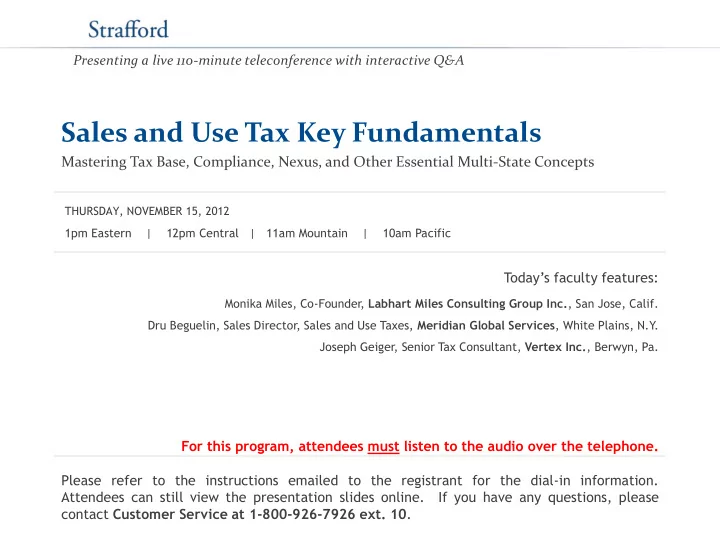
Presenting a live 110-minute teleconference with interactive Q&A Sales and Use Tax Key Fundamentals Mastering Tax Base, Compliance, Nexus, and Other Essential Multi-State Concepts THURSDAY, NOVEMBER 15, 2012 1pm Eastern | 12pm Central


slide-1
SLIDE 1

Sales and Use Tax Key Fundamentals

Mastering Tax Base, Compliance, Nexus, and Other Essential Multi-State Concepts

Today’s faculty features:

1pm Eastern | 12pm Central | 11am Mountain | 10am Pacific

Please refer to the instructions emailed to the registrant for the dial-in information. Attendees can still view the presentation slides online. If you have any questions, please contact Customer Service at 1-800-926-7926 ext. 10.

THURSDAY, NOVEMBER 15, 2012

Presenting a live 110-minute teleconference with interactive Q&A

Monika Miles, Co-Founder, Labhart Miles Consulting Group Inc., San Jose, Calif. Dru Beguelin, Sales Director, Sales and Use Taxes, Meridian Global Services, White Plains, N.Y . Joseph Geiger, Senior Tax Consultant, Vertex Inc., Berwyn, Pa.

For this program, attendees must listen to the audio over the telephone.

slide-2
SLIDE 2

Tips for Optimal Quality

Sound Quality Call in on the telephone by dialing 1-866-873-1442 and enter your PIN when prompted. If you have any difficulties during the call, press *0 for assistance. You may also send us a chat or e-mail sound@straffordpub.com immediately so we can address the problem. Viewing Quality To maximize your screen, press the F11 key on your keyboard. To exit full screen, press the F11 key again.

slide-3
SLIDE 3

Continuing Education Credits

Attendees must stay on the line throughout the program, including the Q & A session, in order to qualify for full continuing education credits. Strafford is required to monitor attendance. Please refer to the instructions emailed to the registrant for additional

  • information. If you have any questions, please contact Customer Service

at 1-800-926-7926 ext. 10.

FOR LIVE EVENT ONLY

slide-4
SLIDE 4

Program Materials

If you have not printed the conference materials for this program, please complete the following steps:

  • Click on the + sign next to “Conference Materials” in the middle of the left-

hand column on your screen.

  • Click on the tab labeled “Handouts” that appears, and there you will see a

PDF of the slides and the Official Record of Attendance for today's program.

  • Double-click on the PDF and a separate page will open.
  • Print the slides by clicking on the printer icon.
slide-5
SLIDE 5

Sales and Use Tax Key Fundamentals Seminar

Joseph Geiger, Vertex Inc. joseph.geiger@vertexinc.com

  • Nov. 15, 2012

Monika Miles, Labhart Miles Consulting Group monika@labhartmiles.com Dru Beguelin, Meridian Global Services dru.beguelin@meridianglobalservices.com

slide-6
SLIDE 6

Today’s Program

Sales Vs. Use Tax [Monika Miles] Sales And Use Tax Nexus [Monika Miles] Essential Compliance Concepts [Joseph Geiger] Revenue Agency Administration Of Sales Tax [Dru Beguelin] Role And Status Of SSTP [Dru Beguelin] Slide 8 – Slide 13 Slide 14 – Slide 33 Slide 34 – Slide 57 Slide 58 – Slide 66 Slide 67 – Slide 69

slide-7
SLIDE 7

Notice

ANY TAX ADVICE IN THIS COMMUNICATION IS NOT INTENDED OR WRITTEN BY THE SPEAKERS’ FIRMS TO BE USED, AND CANNOT BE USED, BY A CLIENT OR ANY OTHER PERSON OR ENTITY FOR THE PURPOSE OF (i) AVOIDING PENALTIES THAT MAY BE IMPOSED ON ANY TAXPAYER OR (ii) PROMOTING, MARKETING OR RECOMMENDING TO ANOTHER PARTY ANY MATTERS ADDRESSED HEREIN.

You (and your employees, representatives, or agents) may disclose to any and all persons, without limitation, the tax treatment or tax structure, or both, of any transaction described in the associated materials we provide to you, including, but not limited to, any tax opinions, memoranda, or other tax analyses contained in those materials. The information contained herein is of a general nature and based on authorities that are subject to change. Applicability of the information to specific situations should be determined through consultation with your tax adviser.

slide-8
SLIDE 8

SALES VS. USE TAX

Monika Miles, Labhart Miles Consulting

slide-9
SLIDE 9

Sales Tax 101

Sales tax is one of the most common taxes encountered every day by businesses and consumers alike.

9

slide-10
SLIDE 10

Sales Tax 101 (Cont.)

The concept of sales tax is prevalent in daily conversations because:

  • States need revenue.
  • Increasing numbers of online transactions
  • Smaller companies are able to expand their sales footprints quickly

because of increased technology.

10

slide-11
SLIDE 11

Some Terms And Definitions

  • Sales tax
  • Use tax
  • Nexus
  • Tangible personal property

11

slide-12
SLIDE 12

Sales Tax And Use Tax

  • Sales tax and complementary use tax are imposed by state and local

jurisdictions on retailers for the privilege of selling ―tangible personal property‖ in the jurisdictions.

  • 45 states and the District of Columba impose sales taxes.

12

slide-13
SLIDE 13

Sales Tax

  • The responsibility of sales tax collection is generally borne by the

seller, if the seller has the minimum connection necessary with the state to require the seller to collect and remit the tax. (Nexus)

  • If the seller does not have the minimum connection necessary to

collect, then the purchaser must self-remit the use tax.

13

slide-14
SLIDE 14

SALES AND USE TAX NEXUS

Monika Miles, Labhart Miles Consulting

slide-15
SLIDE 15

Nexus

  • ―The sufficient connection that an entity must have in order for a

state to impose a tax‖

  • Generally, physical contact between a taxpayer and state must
  • ccur.
  • Defined by U.S. constitutional principles and U.S. Supreme Court

cases

15

slide-16
SLIDE 16

Nexus Examples

  • An employee living or working in a state
  • An independent contractor working on behalf of the company in a

state

  • Soliciting sales in a state (i.e., regular travel to visit prospective

customers in a state)

  • Ownership of property in a state
  • Rental of property
  • Participating in trade shows

16

slide-17
SLIDE 17

Nexus: Why It’s Important

  • Sales tax is a gross tax. Net operating losses will not reduce a

sales/use tax liability.

  • Taxes based on capital stock may also apply.
  • An aggressive state may assert that tax is due when in fact nexus

has not been established.

17

slide-18
SLIDE 18

Tangible Personal Property

  • The term ―tangible personal property‖ (TPP) refers to property that

can be seen, weighed, measured, felt or touched, or perceived by the senses.

  • In general, unless otherwise exempt, sales of TPP are subject to

sales tax.

18

slide-19
SLIDE 19

History

  • Our current system stems from various state statutes and

regulations,

  • From the U.S. Congress, and
  • From U.S. Supreme Court decisions in multi-jurisdictional cases.

19

slide-20
SLIDE 20

U.S. Constitutional Basis For Sales Tax

  • Two constitutional provisions that are regularly discussed in state

tax cases are: – Due Process Clause – Commerce Clause

20

slide-21
SLIDE 21

Due Process Clause

  • No state shall ―deprive any person of life, liberty or property, without

due process of law.‖

  • Taxes = ―Property‖

21

slide-22
SLIDE 22

The Commerce Clause

  • Authorizes Congress to regulate commerce among the

states

  • Prohibits states from enacting laws that might unduly

burden or inhibit the free flow of trade among the states (dormant Commerce Clause)

22

slide-23
SLIDE 23

Summary

  • A state cannot impose a tax obligation on an out-of-state corporation

unless the Due Process Clause ―minimal connection‖ and the Commerce Clause ―substantial nexus requirements‖ are satisfied.

  • The landmark case in this regard is Quill Corp. v. North Dakota 504

U.S. 298 (1992).

23

slide-24
SLIDE 24

Quill: Facts

  • Mail order office supply retailer
  • Locations in California, Illinois and Georgia
  • No employees or other offices in North Dakota

24

slide-25
SLIDE 25

Quill (Cont.)

  • In Quill, the U.S. Supreme Court concluded that in addition to any

minimum connection with a state (Due Process Clause), a business must have substantial physical presence nexus (under the Commerce Clause) before the state could impose sales/use tax collection requirements.

25

slide-26
SLIDE 26

Catalog Sales

  • In Quill, the Supreme Court concluded that Congress was better

qualified to resolve the matter of state taxation of catalog sales.

  • Congress has taken no action!

26

slide-27
SLIDE 27

Catalog Vs. The Internet

VS.

27

slide-28
SLIDE 28

Sales Over The Internet

  • The Internet is, for sales tax purposes, in essence a virtual catalog.

If the seller has nexus in the state to which the order is to be shipped, the seller should collect and remit those taxes.

VS.

28

slide-29
SLIDE 29

The Growth Of Internet Sales

  • Non-existent when the high court decided Quill
  • No tax collection obligation on seller without a physical presence in

a state (like catalog sellers)

29

slide-30
SLIDE 30

Example

  • Susie, who resides in Texas, received a catalog from ShoesGalore

and has selected a pair to order.

  • She reviews the order form and notes in the fine print that

―customers in CA, FL, and IL must add sales tax.‖

  • Susie happily sends in her order form and feels like she has saved

the sales tax

30

slide-31
SLIDE 31

Why It’s Important

―Sales tax is a pass-through tax. The thing that concerns most companies is the burden and cost of collection and remittance of the taxes.”

31

slide-32
SLIDE 32

The “Amazon Dilemma”

  • Large vs. small companies
  • ―Tax loopholes‖
  • Compliance burden
  • Use tax

32

slide-33
SLIDE 33

Why It’s Important

  • Sellers of items via the Internet must collect and remit

applicable sales tax, if the seller has nexus in the state of the destination of the sale. If the seller does not have nexus, the seller is not yet required to collect and remit the tax.

33

slide-34
SLIDE 34

ESSENTIAL COMPLIANCE CONCEPTS

Joseph Geiger, Vertex Inc.

slide-35
SLIDE 35

35

Sales tax – General definition

  • Imposed on the sale of tangible personal property or services
  • Seller may pass tax on to the consumer; it must be separately

stated on the invoice.

  • Applies only to intrastate transactions
slide-36
SLIDE 36

36

Five states without a sales tax: ―NOMAD‖ states: New Hampshire Oregon Montana Alaska (although, local jurisdictions may impose a tax) Delaware

slide-37
SLIDE 37

37

Transaction tax

  • Imposed on the sale of tangible personal property or service
  • Purchaser is liable to the seller for tax due.
  • Must be separately stated on the invoice
slide-38
SLIDE 38

38

Privilege tax

  • Imposed on seller’s gross receipts for privilege of doing

business in state

  • Seller is liable for tax but can pass tax on to the purchaser.
  • Can be included in the sales price or separately stated on the

invoice

slide-39
SLIDE 39

39

Consumer levy – The ―true sales tax‖

  • Imposed on sales of tangible personal property and services
  • Imposed on the purchaser, but collected by the seller
  • Must be separately stated on the invoice
slide-40
SLIDE 40

40

Gross receipts tax

  • Imposed on the sale of tangible personal property and

services, but with fewer exemptions or exclusions to the taxable base

  • Hawaii — If the tax is passed on to the purchaser, then it

becomes part of the gross receipts, for tax calculation.

  • Must be separately stated on the invoice
slide-41
SLIDE 41

41

Use tax – General definition

  • Imposed on the storage, use or consumption of a taxable item
  • r service on which no sales tax has been paid
  • Complimentary to sales tax
  • Purchases made outside the taxing jurisdiction but used in the

taxing jurisdiction

slide-42
SLIDE 42

42

Types of use tax

  • Seller’s use — Tax collected by registered vendor on interstate

sales

  • Consumer’s use — Tax owed by the purchaser when the

vendor does not collect tax

slide-43
SLIDE 43

43

When you have determined nexus and reviewed situs rules in those states:

  • Determine your tax obligation for sales or use tax remittance

(seller’s use and consumer’s use)

  • Determine software requirements for correct tax type

calculation outcome

  • Jurisdiction data sent to automated tax system determines

situs.

slide-44
SLIDE 44
  • Not all states have absorption laws

1) A seller may not want to charge the buyer the tax. These are usually states in which the burden of the tax is intended to be imposed on the seller, not the buyer. 2) States often provide an exemption when separately charging sale tax would be really inconvenient (bars, food vendors at sporting events, vending machines, etc.) There may be a requirement that a sign be posted saying that the price includes the sales tax.

44

slide-45
SLIDE 45
  • Not all states have absorption laws (Cont.)

3) There are a few states that say that if the invoice says ―tax included,‖ that’s good enough. 4) Some states have no problem with the seller saying that it will refund the sales tax, even it has to charge the tax. 5) Many states allow the seller to say something like, ―The state makes us charge you tax, but we’ll give you a rebate

  • f 6%,‖ as long as the seller is not saying that it is

refunding the tax itself.

45

slide-46
SLIDE 46

46

The point at which tax is legally due

  • Origin
  • Destination
  • Administrative origin
slide-47
SLIDE 47

47

Goods shipped from one state and delivered across state lines to another state

  • Taxing situs is where the

goods are consumed.

slide-48
SLIDE 48

48

Ship-from and delivery locations are in the same state.

  • Taxing situs varies state by state.
slide-49
SLIDE 49

49

Origin States Modified Origin States

Arizona California Illinois Texas Missouri New Mexico Ohio Pennsylvania Tennessee Utah Virginia

Below is a listing of origin states. The taxing situs in these states is the seller’s location, when transactions are conducted within the

  • state. All other states are destination states.
slide-50
SLIDE 50

50

Once you have registered with a state:

  • Review whether the state is an origin or destination state (for

local tax application)

  • Review whether you have any physical presence in the state
  • Determine software requirements for correct situs

determination outcomes

slide-51
SLIDE 51

51

Transaction tax at the state and local levels can be imposed differently:

  • Local taxes are authorized by state statute.
  • Some items have reduced rates at the state level and are

exempt at the local level.

  • Home rule jurisdictions administer tax separately from states.
  • Some states have locals that override the other local rates.
slide-52
SLIDE 52
  • The amount on which the tax is imposed
  • Defined as the total amount of the sales price, without any

deduction for the cost of the goods sold, interest paid, other expenses or transportation

52

slide-53
SLIDE 53
  • Taxable and non-taxable components must be stated

separately, to preserve the non-taxable portion.

  • Tax base is adjusted for exemptions, exclusions or deductions.

53

slide-54
SLIDE 54
  • Coupons
  • Retailer
  • Manufacturer
  • Cash discounts
  • Excise taxes
  • Finance charges

54

slide-55
SLIDE 55
  • Installation charges
  • Installment sales
  • Returns
  • Repossessions

55

slide-56
SLIDE 56

56

Nexus Study Taxability Rules Tax Calculation

  • 1. Sales activities
  • 2. Physical

locations

  • 3. Business

changes

  • 1. Situs rules
  • 2. Tax base
  • 3. Jurisdiction
  • 4. Exemptions
  • 1. Jurisdiction data
  • 2. Tax rates
  • 3. Customer data
  • 4. Line item data

To minimize audit exposure and increase tax compliance

  • utcomes, review your nexus decisions and taxability rules, and

know what data must/can be sent to an automated tax compliance system.

slide-57
SLIDE 57

57

8

2 7

9

5 7

2

  • Nexus
  • Situs
  • Tax base
  • Exclusions and

exemptions

  • Administrative and

compliance issues

slide-58
SLIDE 58

REVENUE AGENCY ADMINISTRATION OF SALES TAX

Dru Beguelin, Meridian Global Services

slide-59
SLIDE 59

Administration Of Sales Tax

 Typical approaches to filing frequency  Typical approaches to e-filing  E-payment options available  Common exemptions and exemption certificates  Vendor compensation

59

slide-60
SLIDE 60

Filing Frequency

  • State and local jurisdictions
  • Determining monthly, quarterly, semi-annual or annual

returns

  • Each jurisdiction has its own guidelines.
  • Thresholds
  • Dollar amounts
  • Time period
  • Registrations
  • May determine frequency

60

slide-61
SLIDE 61

Filing Frequency (Cont.)

  • Pitfalls
  • Registrations
  • No-change jurisdictions
  • Processes
  • Remedies
  • Proactive
  • Persistent
  • The old fashioned way

61

slide-62
SLIDE 62

E-Filing

  • Streamlining the process
  • Saves time and money
  • Automated solutions
  • E-file capabilities
  • Manually
  • Jurisdictional Web sites
  • Third party
  • Peace of mind

62

slide-63
SLIDE 63

E-Payments

  • Streamlining the process
  • Saves time and money
  • Automated solutions
  • E-pay capabilities
  • Manually
  • Jurisdictional Web sites
  • Third party
  • Value-added resources

63

slide-64
SLIDE 64

– Exemptions Exemptions

  • Generally fall into three categories
  • Who is the purchaser?
  • What is being purchased?
  • How is it being used?
  • Documentation
  • Miscellaneous exemptions

64

slide-65
SLIDE 65

– Exemption Certificates

Exemption Certificates

  • Types of certificates
  • Unit
  • Blanket
  • Specific
  • Forms
  • Documentation

65

slide-66
SLIDE 66

Vendor Compensation

  • Many jurisdictions provide discounts.
  • Timely filer
  • Errors

66

slide-67
SLIDE 67

ROLE AND STATUS OF SSTP

Dru Beguelin, Meridian Global Services

slide-68
SLIDE 68

Streamlined Sales Tax Project

  • Role and status
  • Purpose
  • Administration
  • Simplification
  • Uniformity

68

slide-69
SLIDE 69

Streamlined Sales Tax Project (Cont.)

  • Streamlined Sales and Use Tax Agreement
  • 24 member states
  • Relevance
  • 12 years later
  • Benefits
  • Goals

69