Sales Tax Affiliate Nexus: Latest Developments Sales Tax Affiliate - - PowerPoint PPT Presentation

sales tax affiliate nexus latest developments sales tax
SMART_READER_LITE
LIVE PREVIEW

Sales Tax Affiliate Nexus: Latest Developments Sales Tax Affiliate - - PowerPoint PPT Presentation

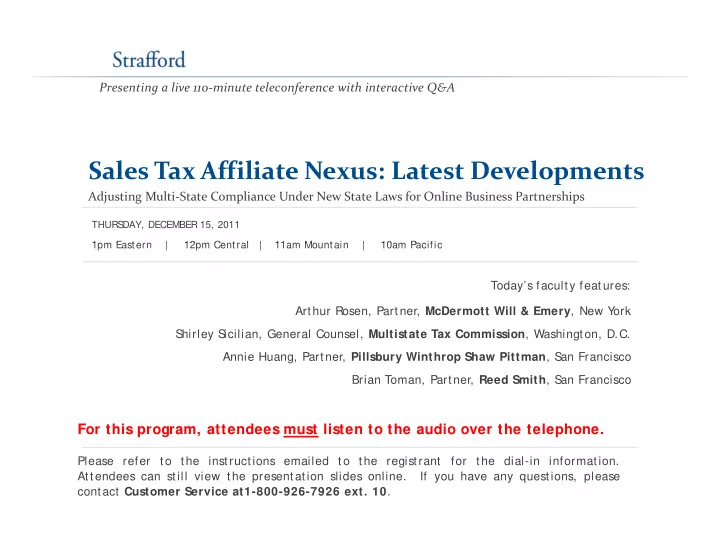
Presenting a live 110 minute teleconference with interactive Q&A Sales Tax Affiliate Nexus: Latest Developments Sales Tax Affiliate Nexus: Latest Developments Adjusting Multi State Compliance Under New State Laws for Online Business


slide-1
SLIDE 1

Presenting a live 110‐minute teleconference with interactive Q&A

Sales Tax Affiliate Nexus: Latest Developments Sales Tax Affiliate Nexus: Latest Developments

Adjusting Multi‐State Compliance Under New State Laws for Online Business Partnerships

1pm Eastern | 12pm Central | 11am Mountain | 10am Pacific THURS DAY, DECEMBER 15, 2011

Today’s faculty features:

1pm Eastern | 12pm Central | 11am Mountain | 10am Pacific

Arthur Rosen Partner McDermott Will & Emery New Y

  • rk

Arthur Rosen, Partner, McDermott Will & Emery, New Y

  • rk

S hirley S icilian, General Counsel, Multistate Tax Commission, Washington, D.C. Annie Huang, Partner, Pillsbury Winthrop Shaw Pittman, S an Francisco Brian Toman, Partner, Reed Smith, S an Francisco

For this program, attendees must listen to the audio over the telephone.

Brian Toman, Partner, Reed Smith, S an Francisco Please refer to the instructions emailed to the registrant for the dial-in information. Attendees can still view the presentation slides online. If you have any questions, please contact Customer Service at1-800-926-7926 ext. 10.

slide-2
SLIDE 2

Conference Materials

If you have not printed the conference materials for this program, please complete the following steps:

  • Click on the + sign next to “ Conference Materials” in the middle of the left-

hand column on your screen hand column on your screen.

  • Click on the tab labeled “ Handouts” that appears, and there you will see a

PDF of the slides for today's program.

  • Double click on the PDF and a separate page will open.

Double click on the PDF and a separate page will open.

  • Print the slides by clicking on the printer icon.
slide-3
SLIDE 3

Continuing Education Credits

FOR LIVE EVENT ONLY

Attendees must listen to the audio over the telephone. Attendees can still view the presentation slides online but there is no online audio for this program. Please refer to the instructions emailed to the registrant for additional

  • information. If you have any questions, please contact Customer Service

at 1-800-926-7926 ext. 10. at 1 800 926 7926 ext. 10.

slide-4
SLIDE 4

Tips for Optimal Quality

S d Q lit S

  • und Qualit y

For this program, you must listen via the telephone by dialing 1-866-873-1442 and entering your PIN when prompted. There will be no sound over the web connection. co ect o . If you dialed in and have any difficulties during the call, press *0 for assistance. Y

  • u may also send us a chat or e-mail sound@straffordpub.com immediately so

we can address the problem. Viewing Qualit y To maximize your screen, press the F11 key on your keyboard. To exit full screen, press the F11 key again press the F11 key again.

slide-5
SLIDE 5

S l T Affili t N L t t Sales Tax Affiliate Nexus: Latest Developments Seminar

  • Dec. 15, 2011

Annie Huang, Pillsbury Winthrop S haw Pittman annie.huang@pillsburylaw.com S hirley S icilian, Multistate Tax Commission ssicilian@mtc.gov Brian Toman, Reed S mith btoman@reedsmith.com Arthur Rosen, McDermott Will & Emery arosen@mwe.com

slide-6
SLIDE 6

Today’s Program

O i A d L t t S t t A ti S lid 7 S lid 20 Overview And Latest S tate Actions [S hirley S icilian and Annie Huang] S tate Attempts To Tax Remote Business: Background [A i H ] S lide 7 – S lide 20 S lide 21 – S lide 25 [Annie Huang] Legal Issues [Art hur Rosen and Brian Toman] S lide 26 – S lide 30 Political Implications [Art hur Rosen] S lide 31 – S lide 33 Federal S ales And Use Tax Legislation [Art hur Rosen and S hirley S icilian] S lide 34 – S lide 37 Practical Considerations [Brian Toman and Annie Huang] S lide 38 – S lide 39

slide-7
SLIDE 7

Shi l Si ili M l i T C i i

OVERVIEW AND LATEST STATE

Shirley Sicilian, Multistate Tax Commission Annie Huang, Pillsbury Winthrop Shaw Pittman

OVERVIEW AND LATEST STATE ACTIONS

slide-8
SLIDE 8

I d i Introduction

I Generally what states are attempting to do I. Generally what states are attempting to do A. General concept: Nexus based on agreements with “ affiliates” B. Pursuant to so-called “ click-through” nexus laws, state l gi l t h tt t d t t t i g j i di ti legislatures have attempted to exert taxing j urisdiction over certain out-of-state, Internet retailers based upon the retailer’s agreements with in-state residents to refer customers via a link to the retailer’s Web site to the retailer s Web site. C. This type of legislation typically provides that: (1) a remote seller has to register as a vendor and collect sales and use tax if the remote seller contracts with residents who link to the the remote seller contracts with residents who link to the remote seller’s Web page and are paid a commission; and (2) thereby generate over a threshold number of sales for the remote seller.

8

remote seller.

slide-9
SLIDE 9

Efforts To Address Quill And Role Of ‘Click Throu h’ Le islation And Role Of ‘Click‐Through’ Legislation

Working within Working to change Quill g Quill reality G id D fi PP reality

Congress:

Guidance: Define PP in Internet Age

Congress:

  • MS

F A (H.R. 2701 – S S T)

  • MEA (H.R. 3179)
  • MF

A (H.R. 1832) Courts:

PP Yes: Collect

  • Affiliate entity nexus
  • “ Click-through” nexus

Courts:

  • Oklahoma statute?
  • Colorado statute?

PP No: Notice/report

  • General statute: CO, OK,

S C S D VT

9

S C, S D, VT

  • Ad-hoc: e.g., NC
slide-10
SLIDE 10

‘Click‐Through’ Nexus Overview ‘Click‐Through’ Nexus Overview Click Through Nexus Overview Click Through Nexus Overview

Oregon CT CT NH NH VT Michigan Oregon Minnesota CT

Mass.

N.H.

Vt . New York Wisconsin Michigan Wyoming North Dakota S

  • uth Dakota

Idaho Montana Maine Washington MD CT CT Pennsylvania

  • W. VA

Michigan Nevada Utah Iowa Indiana Ohio Del.

N.J .

CT PA

  • W. Va.

Missouri Illinois Michigan Virginia Kentucky Wyoming Colorado S

  • uth Dakota

Nebraska Kansas California R.I. D C

MD

Legend

N l gi l ti d Miss. Alabama Missouri Miss. Alabama Georgia TN S . Carolina

  • N. Carolina

Kentucky Oklahoma Arizona New Mexico Arkansas D.C.

Nexus without statute Legislation under consideration

Nexus legislation passed

Legislation considered but not passed or passed then

Louisiana Florida Texas Hawaii Alaska

* V i l i ff if 15 h

10

vetoed Other (incl. notification requirement)

* Vermont is only in effect if 15 other states enac. ** California’ s legislation is delayed until 2012, subj ect to passage of federal legislation. *** S

  • uth Carolina has enacted a limited-notice requirement, and legislation is under

consideration.

slide-11
SLIDE 11

H S H D I How States Have Done It

I S tate statutes

State Effective Date Affiliate Threshold Statute

I. S tate statutes A. Enacted in NY , CA, IL, CT , AR,

Arkansas

  • Oct. 24, 2011

More than $10,000

  • Ark. Code Ann. § 26-

52-117 California

  • Jan. 1, 2013 if federal

legislation is enacted by July 31, 2012. More than $10,000 and more than $1,000,000 in annual in- state sales

  • Cal. Rev. & Tax. §

6203(c)

RI, NC and VT II. Two approaches: (1) rebuttable

y y ,

  • Sept. 15, 2012 if

federal legislation is not enacted. Connecticut July 1, 2011 More than $2,000

  • Conn. Gen. Stat. §

12-407(a)(12)(L)

( ) presumption; (2) irrebuttable presumption

12-407(a)(12)(L) Illinois July 1, 2011 More than $10,000 35 ILCS 105/2 and 110/2 New York June 1, 2008 More than $10,000 N.Y. Tax Law § 1101(b)(8)(vi)

presumption A. All have sales thresholds

North Carolina

  • Aug. 7, 2009

More than $10,000 N.C. Gen. Stat. § 105- 164.8 Rhode Island July 1, 2009 More than $5,000 R.I. Gen. Laws § 44- 18-15 Vermont When adopted in 15 More than $10,000

  • Vt. Stat. Ann. tit. 32,

11

  • ther states.

§ 9701(9)(I) (H.B.

436)

slide-12
SLIDE 12

S Cli k Th h N S State Click‐Through Nexus Statutes

I New Y

  • rk

I. New Y

  • rk

A. Presumed a “ vendor” if the seller: (1) enters into an agreement with a New Y

  • rk resident or residents for

consideration, (2) the New Y

  • rk resident or residents link

, ( ) to the remote retailer’s Web page, and (3) the cumulative gross receipts from sales through the links to customers in New Y

  • rk exceeds $10,000

B P ti b b tt d B. Presumption can be rebutted.

  • 1. E.g., if the seller includes in its agreements a provision

prohibiting associates from engaging in solicitation activities and each associate submits a signed activities, and each associate submits a signed certification stating the same. TS B-M-08(3)S (May 8, 2008)

12

slide-13
SLIDE 13

S Cli k h h S (C )

I Illinois

State Click‐Through Nexus Statutes (Cont.)

I. Illinois

  • A. Amends the definition of “ retailer maintaining a place of

business” to specify that a business becomes a ‘‘ retailer maintaining a place of business’’ in Illinois and is maintaining a place of business in Illinois, and is therefore required to collect tax, when it contracts with a person located in Illinois to pay a commission in return for the person’s direct or indirect referral of customers p through a Web site link.

  • B. Applies only when the retailer’s quarterly gross receipts

from click-through referral sales through persons in Illinois $ exceed $10,000 in each of the previous four quarters

  • C. No rebuttable presumption and no exception

13

slide-14
SLIDE 14

S Cli k h h S (C )

I Connecticut

State Click‐Through Nexus Statutes (Cont.)

I. Connecticut A. The definition of “ retailer” includes every person making sales of tangible personal property through an “ agreement with another person located in this state under which such person located in this state, for a commission or other consideration that is based upon the sale of tangible personal property or services by the retailer, directly or indirectly refers potential customers, whether by a link on an Internet web site or otherwise, to y the retailer.” B. No rebuttable presumption (final enacted legislation eliminated the presumption that was included in a prior

14

eliminated the presumption that was included in a prior version of the law)

slide-15
SLIDE 15

S Cli k h h S (C )

I. California (and “ the deal” )

State Click‐Through Nexus Statutes (Cont.)

A. Initial click-through legislation (AB X1 28) enacted on June 29, 2011. B. Recently enacted (signed S

  • ept. 23, 2011) AB 155 repeals AB X1 28 and

effectively “ delays” the implementation of click-through until S ept. 2012 2012. 1. Amends “ retailer engaged in business” a. $10,000 from commissioned referrals; $1 million in total annual in-state sales in state sales i. Up from $500,000 in AB X1 28 b. No presumption; exception for referrals that do not satisfy the requirements of the constitution q c. Also enacts affiliate nexus C. If federal legislation is enacted by July 31, 2012 (and California does not elect to implement that law on or before S

  • ept. 14, 2012), then click-

15

through is effective Jan. 1, 2013. D. If a federal bill is not enacted, then AB 155 is effective S

  • ept. 15, 2012.
slide-16
SLIDE 16

O h S S A d S G id

I. Other state statutes

Other State Statutes And State Guidance

A. Arkansas 1. $10,000 in-state sale requirement 2. Rebuttable presumption B. Rhode Island 1. $5,000 in-state sale requirement 2. Rebuttable presumption C. North Carolina 1. $10,000 in-state sale requirement 2. Rebuttable presumption D. Vermont 1. Enacted when similar legislation is adopted in 15 other states II. S tate guidance

16

A. Pennsylvania 1. “ Pa. S ales and Use Tax Bulletin,” 2011-01 (Dec. 1, 2011)

slide-17
SLIDE 17

E l Of R L i l i A

I Maryland (died April 2011 S B 824)

Examples Of Recent Legislative Attempts

I. Maryland (died April 2011 – S B 824) II. Massachusetts (in committee Nov. 2011 – HB 1731/ S B 1450) III. Hawaii (died May 2011 - HB 1183) IV. Louisiana (died June 2011 – HB 641) V. Michigan (introduced S

  • ept. 2011 - S

. 1452 and H.R. 2701)

17

slide-18
SLIDE 18

Variation: Reporting Approaches

I S ales and use tax information notice and reporting (and

g (Colorado And Oklahoma)

I. S ales and use tax information notice and reporting (and affiliate nexus) II. Colorado A. Must provide notice to customers that use tax not A. Must provide notice to customers that use tax not collected and may be due; $5 penalty per failure B. Must provide customers with annual statements of purchases; $10 penalty per failure C. Must provide the department with annual statements; $10 penalty per failure D. De minimis rule exempts retailers that made less than $100 000 i t t l l i C l d i th i $100,000 in total gross sales in Colorado in the prior calendar year and reasonably expect that total gross sales in Colorado in current calendar year less than $100,000 a Includes all sales of goods by all entities under

18

a. Includes all sales of goods by all entities under common control

slide-19
SLIDE 19

Variation: Reporting Approaches g (Colorado And Oklahoma), Cont.

I. Oklahoma A. S imilar to Colorado, but requires only the customer transactional notice B. De minimis rule exempts retailers that made less than $100,000 in total gross sales in Oklahoma in the prior year $100,000 in total gross sales in Oklahoma in the prior year and reasonably expect Oklahoma sales in the current year will be less than $100,000. C No penalt pro isions C. No penalty provisions

19

slide-20
SLIDE 20

D l Of MTC M d l S

I Colorado reporting statute

Development Of MTC Model Statutes

I. Colorado reporting statute A. Modeled after Colorado law B. Public hearing held; considering vote of the commission II. New Y

  • rk-style “ click-through” nexus statute

A C l t d l “ li k th h ” A. Completed sales vs. “ click-throughs”

  • 1. Protecting “ mere advertising”

B. What is the right threshold? $500,000/ $10,000? g $ , $ , C. S afe harbor?

20

slide-21
SLIDE 21

STATE ATTEMPTS TO TAX

Annie Huang, Pillsbury Winthrop Shaw Pittman

STATE ATTEMPTS TO TAX REMOTE BUSINESS: BACKGROUND

slide-22
SLIDE 22

History Of State Attempts To Tax

1942

Nelson v. Sears, Roebuck & Co. Nelson v. Montgomery Ward & Co. Northwestern States P l d C

1959

y Remote Businesses

1967 1980s

National Bellas Hess, Inc. v. Department

  • f Revenue of the State of Illinois

States break the law Portland Cement Company v. Minnesota

1959

Bloomingdale’s by Mail v. Dept. of Rev

1989 1992

Quill Corporation v. North Dakota

1992 L t 1990

Geoffrey v. SC

1993 1991

SFA Folio v. Bannon SFA Folio v. Tracy

1994 Late 1990s 2000 - Present

E-Commerce Streamlined Sales

Late 1990s 1999 - 2000 2000 - Present

Advisory Commission on Electronic Commerce

2004 1995

Current v. CA

2000 - Present

Tax and Related Federal Legislation

2004 2005 2007 2008 2009 2010

MTC Factor Nexus Proposal OH Commercial Activity Tax MBNA v. West Virginia Capital One v. MA DOR; CA & CT enact econ. nexus NY enacts “click-through” nexus Amazon v. NY

22

2010

slide-23
SLIDE 23

History Of State Attempts To Tax

I The physical presence requirement

y Remote Businesses (Cont.)

I. The physical presence requirement A. Quill Corp. v. Nort h Dakot a, 504 U.S . 298 (1992) B. S tare decisis: “ S t are decisis is usually the wise policy, because in t tt it i i t t th t th li bl l f most matters it is more important that the applicable rule of law be settled than that it be settled right ... But in cases involving the Federal Constitution, where correction through legislative action is practically impossible this Court has often legislative action is practically impossible, this Court has often

  • verruled its earlier decisions.” Burnet v. Coronado Oil & Gas

Co., 285 U.S . 393, 406- 407 (1932) (Brandeis, J., dissenting) 1 What does st are decisis mean for the current debate? 1. What does st are decisis mean for the current debate? a. Remember, Oklahoma declared that its statute did not violate Quill, because there is no “ undue burden” on

  • ut-of-state retailers

23

  • ut-of-state retailers.

2. What does st are decisis mean more generally?

slide-24
SLIDE 24

History Of State Attempts To Tax

I Attributional nexus

y Remote Businesses (Cont.)

I. Attributional nexus A. Nexus based on the activities of others B. Foundational cases: Tyler Pipe Indust ries v. Washingt on S t at e Dep’t . Rev., 483 U.S . 232 (1987); S cript o, Inc. v. Carson, 362 U.S . 207 (1960) C. Constitutional standard: Whether the activities performed C. Constitutional standard: Whether the activities performed by the in-state person on behalf of the out-of-state company are “ significantly associated with the taxpayer’s ability to establish and maintain a market in [the] state ability to establish and maintain a market in [the] state for the sales” D. General advertising does not create nexus. Miller Bros. C M l d 347 U S 340 (1954)

24

  • Co. v. Maryland, 347 U.S

. 340 (1954)

slide-25
SLIDE 25

History Of State Attempts To Tax

I Attributional nexus (Cont )

Remote Businesses (Cont.)

I. Attributional nexus (Cont .) A. Other noteworthy cases 1. Brick-and-mortar cases: Borders Online, LLC v. S t at e Bd. of Eq., 129 Cal. App. 4th 1179 (Cal. Ct. App. 2005), Barnesandnoble.com v. 129 Cal. App. 4th 1179 (Cal. Ct. App. 2005), Barnesandnoble.com v. S t at e Bd. of Eq., No. CGC-06-456465, (S

  • up. Ct., S

an Francisco Cnty., S

  • ept. 7, 2007), S

t . Tammany Parish Tax Collect or v. BarnesandNoble.com, Dkt. No. 05-5695 (E.D. La. 2007) a. E.g., S F A Folio, Bloomingdale’s By Mail – early 90s 2. S choolteacher cases: E.g., S cholast ic Book Clubs, Inc. v. Comm’ r of

  • Rev. S

ervices, No. CV 07 4013027 S (Conn. S

  • uper. Ct. Apr. 9, 2009)

(current appeal pending at CT S upreme Ct ) (current appeal pending at CT S upreme Ct .) a.

  • Cf. Click-through nexus statute.

3. Warranty repair services: E.g., Dell Market ing L.P . v. Tax’ n & Rev. Dep’t of New Mexico, 199 P .3d 863 (Ct. App. N.M. 2008)

25

p f , 99 6 (C pp )

slide-26
SLIDE 26

Arthur Rosen, McDermott Will & Emery

LEGAL ISSUES

Arthur Rosen, McDermott Will & Emery Brian Toman, Reed Smith

slide-27
SLIDE 27

Legal Issues And Arguments Associated

I. Background legal issues

g g With Click‐Through Nexus

A. Attributional nexus 1. The importance of market enhancement – “ significantly associated with the taxpayer’s ability to t bli h d i t i k t” establish and maintain a market” II. Constitutional concerns/ issues A. Ultimate issue is whether the arrangements satisfy Tyler Pipe III. S tates’ positions on “ click-through” A. The activities of the in-state affiliates satisfy the Tyler A. The activities of the in state affiliates satisfy the Tyler Pipe/ S cript o constitutional standards (or at least are presumed to), because the in-state affiliates establish and maintain a market for the remote sellers’ sales. B S k h i i h b d

27

B. S tates take the position these arrangements go beyond mere advertising.

slide-28
SLIDE 28

C R di Cli k Th h N

I. Case: The Direct Market ing Associat ion v. Huber, No. 10-cv-01546-REB-CBS

Cases Regarding Click‐Through Nexus

I. Case: The Direct Market ing Associat ion v. Huber, No. 10 cv 01546 REB CBS (D. Colo., Jan. 26, 2011) (order granting motion for preliminary inj unction) A. The U.S . District Court for the District of Colorado granted a motion for preliminary inj unction enj oining the Colorado Department of Revenue from enforcing its law from enforcing its law. II. Case: Amazon.com LLC v. Lay, 758 F . S

  • upp. 2d 1154 (W.D. Was. 2010)

A. Amazon filed a federal lawsuit alleging the North Carolina DOR’s attempts to obtain names, addresses and purchases of customers violated the First Amendment, Article I, §§ 4, 5 of the Washington S tate Constitution; and federal Video Privacy Protection Act, 18 US C § 2710. B. Declaratory j udgment sought 1 U S District Court stated “ [T]o the extent the [DOR] demands that 1. U.S . District Court stated, [T]o the extent the [DOR] demands that Amazon disclose its customers' names, addresses or any other personal information, it violates the First Amendment and the Video Privacy Protection Act, only as long as the DOR continues to have access to or possession of detailed purchase records obtained from

28

access to or possession of detailed purchase records obtained from Amazon ...”

slide-29
SLIDE 29

d l k h h ( )

III Case: Amazon com LLC v New Y

  • rk S

t at e Dep’t of Taxat ion and

Cases Regarding Click‐Through Nexus (Cont.)

III. Case: Amazon.com LLC v. New Y

  • rk S

t at e Dep t of Taxat ion and Finance, 877 NYS 2d 842 (N.Y . App. Div. 2010) A. The facial challenges to the constitutionality of the statute (Due Process Clause, Commerce Clause and equal protection) were rej ected rej ected. B. The as-applied challenges were remanded to the lower court for fact-finding with respect to whether the in-state residents referring customers to the Amazon Web site solicited sales for A i N Y k Amazon in New Y

  • rk.

1. Is the presumption reasonable? 2. Thoughts on the as-applied challenge IV. Case: Perf ormance Market ing Associat ion v. Hamer (filed in Cir. Ct.

  • f Cook County, Illinois, July 27, 2011)

A. The PMA has filed a suit in federal District Court challenging the

29

constitutionality of the Illinois click-through nexus law.

slide-30
SLIDE 30

Legal Issues And Arguments Associated

I. Difference between solicitation and advertising

Legal Issues And Arguments Associated With Click‐Through Nexus

I. Difference between solicitation and advertising II. Is method of compensation relevant? III Are “ click-through” nexus statutes necessary for a state to impose its III. Are click-through nexus statutes necessary for a state to impose its j urisdiction to tax? A. S ee recent Pa. S ales and Use Tax Bullet in, 2011-01 (Dec. 1, 2011) 1. Prospective enforcement?

30

p

slide-31
SLIDE 31

POLITICAL IMPLICATIONS

Arthur Rosen, McDermott Will & Emery

slide-32
SLIDE 32

P li i l I li i

I. Click-through nexus laws

Political Implications

I. Click through nexus laws A. Why states believe that it’s “ fair” B. What small businesses and large brick and mortar retailers say C. Who is really driving the effort? D Weighing the termination of in-state affiliate relationships vs taxation of D. Weighing the termination of in state affiliate relationships vs. taxation of remote sellers 1. What promotes business? 2. Job creation?

32

slide-33
SLIDE 33

P li i l I li i (C )

I. Contracting Around Quill and nexus

Political Implications (Cont.)

I. Contracting Around Quill and nexus A. Distribution center exemptions (and other nexus exemptions). 1. Private agreements (e.g., Tennessee) and legislative exemptions (e.g., S

  • uth Carolina)

a Are such incentives constitutional? Or fair? a. Are such incentives constitutional? Or fair? b. Can a state “ waive” its obligation to collect tax by contract? i. Tennessee At t orney General Opinion No. 11-55 (July 11, 2011) B Balancing economic development with j ust administration of the laws B. Balancing economic development with j ust administration of the laws 1. Use of related-party distributors. S ee Lyon Met al Product s, Inc. v. S t at e Bd. of Eq., 58 Cal. App. 4th 906 (Cal. Ct. App. 1997). 2. Amazon dispute in Texas

33

slide-34
SLIDE 34

Arthur Rosen, McDermott Will & Emery

FEDERAL SALES AND USE TAX

y Shirley Sicilian, Multistate Tax Commission

LEGISLATION

slide-35
SLIDE 35

F d l L i l i

I. Main Street Fairness Act (MSFA), H.R. 2701 A I t d d J l 29 2011

Federal Legislation

A. Introduced on July 29, 2011 B. Referred to the S ubcommittee on Courts, Commercial and Administrative Law on

  • Aug. 25, 2011

1. Independent from, but somewhat parallel with, S S T II M k t l E it A t (MEA) H R 3179 II. Marketplace Equity Act (MEA), H.R. 3179 A. Introduced on Oct. 13, 2011 B. Referred to the S ubcommittee on Courts, Commercial and Administrative Law on

  • Oct. 24, 2011

III M k l F i A (MFA) S B 1832 III. Marketplace Fairness Act (MFA), S.B. 1832 A. Introduced on Nov. 9, 2011 B. Hybrid of MS F A and MEA IV. Overstock.com bill A. Not yet introduced 1. MS F A +++++ V. ? (New draft legislation) A. Not yet introduced

35

1. S implified MEA

slide-36
SLIDE 36

F d l L i l i A C i Federal Legislation: A Comparison

Additional

MSFA MEA ?¹ MFA O t k

Additional Consideration:

 Do thresholds apply at

Streamlined Non- streamlined Sponsor Statewide Administration

 

Statewide Tax Base

   

MSFA MEA ?¹ Overstock

     

Conyers (MI) Womack (AR)

?

Enzi (WY) TBD

pp y individual seller level or platform level?

Statewide Tax Base

 

Local Rates:

  • Zip Code

 

  • Blended +

 

  • Software

                 

Vendor Discount

 

Threshold

500K

SST Governing Board

 

SST Simplification

 

20MM

TBD

   

1MM/0.1MM

1MM/0.1MM

(uniform definitions, forms and bundling rules)

 

Uniform Sourcing

 

No Liability if Rely on I f i F S

 

maybe

          

36

Information From State

 

Federal Court

  

¹ Based on recent draft legislation.

      

slide-37
SLIDE 37

F d l L i l i (C )

I Does the focus on “ click through” take away from any

Federal Legislation (Cont.)

I. Does the focus on click-through take away from any momentum that S TT or Main S treet Fairness may have? A. If states like New Y

  • rk can collect revenue on e-

commerce sales through other means, what is the incentive to j oin a compact that requires them to modify their laws? B. Importance of New Y

  • rk litigation and Illinois litigation

II The more bills the better? II. The more bills the better?

37

slide-38
SLIDE 38

Brian Toman, Reed Smith

PRACTICAL CONSIDERATIONS

Annie Huang, Pillsbury Winthrop Shaw Pittman

slide-39
SLIDE 39

P i l C id i

I Compliance

Practical Considerations

I. Compliance A. Recommendations for responding to state enactment of a “ click- through” nexus law (or a state’s stated position – e.g., Pennsylvania) Pennsylvania) II. Planning A. Review affiliate agreements; include in agreements a provision prohibiting associates from engaging in solicitation activities prohibiting associates from engaging in solicitation activities B. Changing the method of compensation C. S uspend affiliate relationship before in-state threshold is reached (rather than cancel program) D. Distribution and fulfillment activities E. Use of links to the remote seller

39