Water Energy Nexus Energy sector Water sector What is - - PowerPoint PPT Presentation

water energy nexus
SMART_READER_LITE
LIVE PREVIEW

Water Energy Nexus Energy sector Water sector What is - - PowerPoint PPT Presentation

6/23/2017 Content Water Energy Nexus Energy sector Water sector What is energy-water nexus? Milad Pooladsanj Why is nexus important? S upervisors: Amin Nobakhti Nexus in Iran Mahdi S harifzadeh Quantifying the


slide-1
SLIDE 1

6/23/2017 1

Water – Energy Nexus

Milad Pooladsanj S upervisors: Amin Nobakhti Mahdi S harifzadeh

Feb 2017

Milad Pooladsanj

2/ 33

 Energy sector  Water sector  What is energy-water nexus?  Why is nexus important?  Nexus in Iran  Quantifying the water-energy nexus  Challenges

Content

Milad Pooladsanj

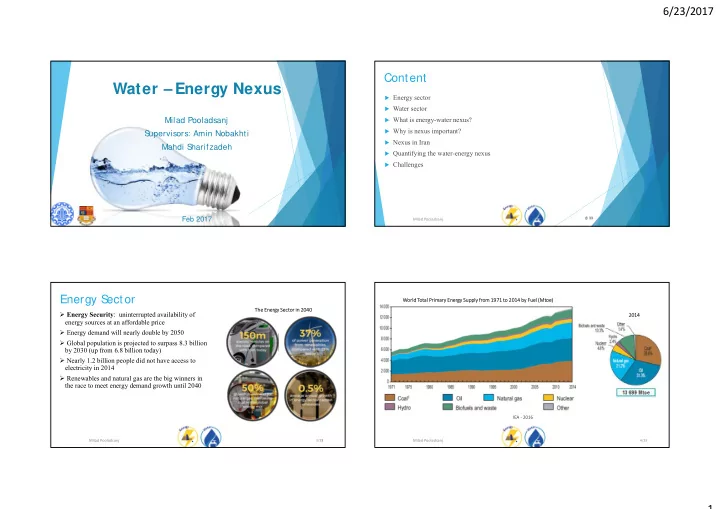
  • Energy Security: uninterrupted availability of

energy sources at an affordable price

  • Energy demand will nearly double by 2050
  • Global population is projected to surpass 8.3 billion

by 2030 (up from 6.8 billion today)

  • Nearly 1.2 billion people did not have access to

electricity in 2014

  • Renewables and natural gas are the big winners in

the race to meet energy demand growth until 2040

The Energy Sector in 2040

Energy S ector

3 3/33

Milad Pooladsanj

4/33

World Total Primary Energy Supply from 1971 to 2014 by Fuel (Mtoe)

IEA ‐ 2016

2014

slide-2
SLIDE 2

6/23/2017 2

Milad Pooladsanj

5/33

World Total Primary Energy Supply from 1971 to 2014 by Region (Mtoe) 2014

Milad Pooladsanj

6/33

Crude Oil Production from 1971 to 2014 by Region (Mt) 2015

  • Iran : 6th Country with 3.9% share of total

Milad Pooladsanj

7/33

Natural Gas Production from 1971 to 2014 by Region (bcm) 2015

  • Iran : 3rd Country with 5.1% share of total

Milad Pooladsanj

8/33

Coal Production from 1971 to 2014 by Region (Mt) 2015

slide-3
SLIDE 3

6/23/2017 3

Milad Pooladsanj

9/33

Nuclear Production from 1971 to 2014 by Region (TWh) 2015

Milad Pooladsanj

10/33

2015 Hydro Production from 1971 to 2014 by Region (TWh)

Milad Pooladsanj

11/33

2014 World Electricity Generation from 1971 to 2014 by Fuel (TWh)

  • Iran : 3rd Country with 5.8% share of electricity generation from oil
  • Iran : 4th Country with 3.9% share of electricity generation from natural gas

Milad Pooladsanj

12/33

2014 World Electricity Generation from 1971 to 2014 by Region (TWh)

slide-4
SLIDE 4

6/23/2017 4

Milad Pooladsanj

13/33

  • Critical for addressing climate change
  • Creating new economic opportunities
  • Providing energy access to billions of people without modern energy service

R enewables in Energy S ector

REN21 ‐ 2015

Milad Pooladsanj

14/33

REN21 ‐ 2015

Average annual growth in renewable energy capacity and biofuels production across the three end‐use sectors

Milad Pooladsanj

  • Water Security: The capacity of a population to safeguard sustainable access to adequate

quantities of and acceptable quality water

  • Water demand will nearly increase 50% by 2050
  • Climate change, population and water withdrawal intensify water stress

15/33

Water S ector

Total Water Resources Fresh Water Resources Human Freshwater Use

Milad Pooladsanj

16/33

Percent of population with access to improved water sources (%)

UN Water ‐ 2016

slide-5
SLIDE 5

6/23/2017 5

Milad Pooladsanj

17/33

Water Withdrawn Per Capita (m3/year)

FAO AQUASTAT‐ 2015

Milad Pooladsanj

18/33

Total renewable resources per capita (m3/inhab/yr)

UN Water ‐ 2016

Milad Pooladsanj

19/33

Proportion of renewable water resources withdrawn

FAO AQUASTAT‐ 2015

Milad Pooladsanj

20/33

Average Annual Precipitation in 2016 (mm/year)

FAO AQUASTAT‐ 2016

slide-6
SLIDE 6

6/23/2017 6

Milad Pooladsanj

What is Energy-Water Nexus?

  • Water and Energy: paramount

importance for human livelihood – closely intertwined → must be addressed together

  • we do not appreciate the coupled

correlation between them

  • Nucleus of this bond is the

reciprocal dependency of resources → how one resource’s demand can steer further demand

21/33

Milad Pooladsanj

22/33

Milad Pooladsanj

23/33

IEA ‐ 2012

Water use for electricity generation by cooling technology

Milad Pooladsanj

  • Water-related risks to energy security

 Shifts in water availability and quality → reduced reliability of supply

24/33

Why is Energy-Water Nexus Important?

 Increase in energy demand for water production, treatment and distribution

slide-7
SLIDE 7

6/23/2017 7

Milad Pooladsanj

25/33

  • Energy-related risks to water security

 Limited or unreliable access to affordable energy necessary to extract water  Allocation of water resources towards energy production → water security risks in other sectors  Risks of water contamination from energy- extraction processes

Amount of Energy Required to provide of water safe for human consumption

Milad Pooladsanj

Nexus In Iran

  • Renewable energy policies → 5000 MW

electricity production from wind/solar by 2020

  • Climate change policies → No relevant policy!

26/33

Milad Pooladsanj

27/33

Total Production of Renewables (Mtoe) CO2 Emissions from Fuel Combustion (Mt of CO2) TPES/population (toe per capita)

Milad Pooladsanj

28/33

Iran TPES from 1971 to 2013 by Fuel (Mtoe)

slide-8
SLIDE 8

6/23/2017 8

Milad Pooladsanj

29/33

Iran Electricity Generation from 1971 to 2013 by Fuel (TWh) 2013

Milad Pooladsanj

30/ 33

  • A nexus assessment methodology

Quantifying The Water-Energy Nexus

  • Providing insights on some of the response options

Qualitative analysis

  • Quantitative analysis → interlinkages matrix
  • Application of input/output tool
  • Comparison of interventions

Quantitative assessment

Milad Pooladsanj

31/ 33

Proposed Method

  • Multi-objective optimization: deterministic and stochastic

 Objective 1: Cost objective function

 Power generation cost  Water Generation cost

 Objective 2: Greenhouse Gas emission objective function

  • Climate change feedback: the proposed optimization problem is solved

using climate information in future

  • Comparison with IEA scenarios

Current policies scenario New policies scenario 450 policies scenario

Milad Pooladsanj

32/ 33

Challenges

  • Data collection across the interconnected systems of the nexus is

crucial

 information about different elements of the nexus separately  data on how the elements of the nexus relate to each other  Accuracy of the data released by different institutions

  • Complex optimization problem

 Non-linear: accurate but unsolvable!  Linear: accuracy problem

slide-9
SLIDE 9

6/23/2017 9

Milad Pooladsanj

33/ 33

Thanks for your attention