Ipso Facto Clauses: Not Always Unenforceable in Bankruptcy - - PowerPoint PPT Presentation

ipso facto clauses not always unenforceable in bankruptcy
SMART_READER_LITE
LIVE PREVIEW

Ipso Facto Clauses: Not Always Unenforceable in Bankruptcy - - PowerPoint PPT Presentation

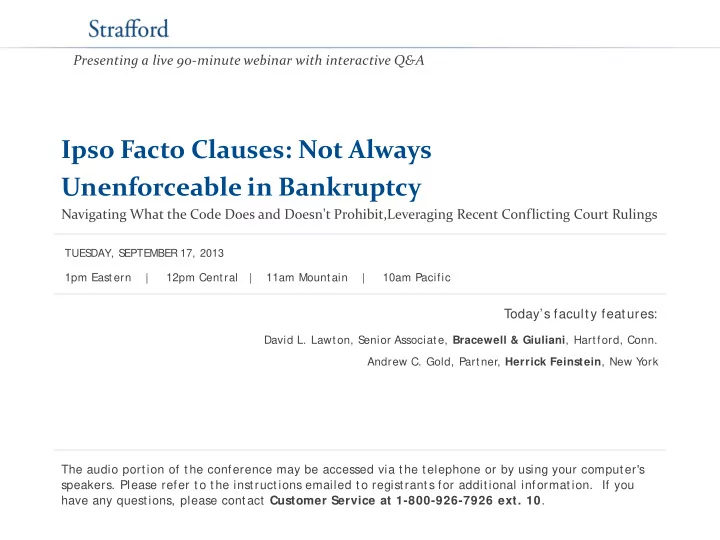
Presenting a live 90-minute webinar with interactive Q&A Ipso Facto Clauses: Not Always Unenforceable in Bankruptcy Navigating What the Code Does and Doesn't Prohibit,Leveraging Recent Conflicting Court Rulings TUES DAY, S EPTEMBER 17,


slide-1
SLIDE 1

Ipso Facto Clauses: Not Always Unenforceable in Bankruptcy

Navigating What the Code Does and Doesn't Prohibit,Leveraging Recent Conflicting Court Rulings

Today’s faculty features:

1pm East ern | 12pm Cent ral | 11am Mount ain | 10am Pacific

The audio portion of the conference may be accessed via the telephone or by using your computer's

  • speakers. Please refer to the instructions emailed to registrants for additional information. If you

have any questions, please contact Customer Service at 1-800-926-7926 ext. 10.

TUES DAY, S EPTEMBER 17, 2013

Presenting a live 90-minute webinar with interactive Q&A

David L. Lawt on, S enior Associat e, Bracewell & Giuliani, Hart ford, Conn. Andrew C. Gold, Part ner, Herrick Feinstein, New Y

  • rk
slide-2
SLIDE 2

Tips for Optimal Quality

S

  • und Qualit y

If you are listening via your computer speakers, please note that the quality of your sound will vary depending on the speed and quality of your internet connection. If the sound quality is not satisfactory and you are listening via your computer speakers, you may listen via the phone: dial 1-866-570-7602 and enter your PIN when prompted. Otherwise, please send us a chat or e-mail sound@ straffordpub.com immediately so we can address the problem. If you dialed in and have any difficulties during the call, press *0 for assistance. Viewing Qualit y To maximize your screen, press the F11 key on your keyboard. To exit full screen, press the F11 key again.

FOR LIVE EVENT ONLY

slide-3
SLIDE 3

Continuing Education Credits

For CLE purposes, please let us know how many people are listening at your location by completing each of the following steps:

  • In the chat box, type (1) your company name and (2) the number of

attendees at your location

  • Click the S

END button beside the box If you have purchased S trafford CLE processing services, you must confirm your participation by completing and submitting an Official Record of Attendance (CLE Form). Y

  • u may obtain your CLE form by going to the program page and selecting the

appropriate form in the PROGRAM MATERIALS box at the top right corner. If you'd like to purchase CLE credit processing, it is available for a fee. For additional information about CLE credit processing, go to our website or call us at 1-800-926-7926 ext. 35.

FOR LIVE EVENT ONLY

slide-4
SLIDE 4

Program Materials

If you have not printed the conference materials for this program, please complete the following steps:

  • Click on the ^ sign next to “ Conference Materials” in the middle of the left-

hand column on your screen.

  • Click on the tab labeled “ Handouts” that appears, and there you will see a

PDF of the slides for today's program.

  • Double click on the PDF and a separate page will open.
  • Print the slides by clicking on the printer icon.

FOR LIVE EVENT ONLY

slide-5
SLIDE 5

Ipso Facto Clauses: Not Always Unenforceable in Bankruptcy: Navigating What the Code Does and Doesn’t Prohibit, Leveraging Recent Conflicting Court Rulings

PART I IPSO FACTO CLAUSES IN BANKRUPTCY

David Lawton, Esq. Bracewell & Giuliani LLP

Financial Restructuring Group

September 2013

slide-6
SLIDE 6

What is an Ipso Facto Clause?

  • Ipso facto clauses provide that a contract will terminate upon the
  • ccurrence of an insolvency event, including a bankruptcy filing
  • An ipso facto clause may operate automatically or require notice
  • Ipso facto clauses are common provisions in many contracts, whether

enforceable or not

6

slide-7
SLIDE 7

Sample Ipso Facto Clause

  • This Agreement shall terminate, without notice, (i) upon the institution by or

against either party of insolvency, receivership or bankruptcy proceedings or any other proceedings for the settlement of either party's debts, (ii) upon either party making an assignment for the benefit of creditors, or (iii) upon either party's dissolution or ceasing to do business.

7

slide-8
SLIDE 8

Ipso Facto in the Bankruptcy Context

  • Effects of Filing Bankruptcy:
  • Automatic stay (§ 362)
  • Use, sale or lease of property (§ 363)
  • Executory Contracts and Unexpired Leases (§ 365)
  • Trustee/debtor has option to assume, reject or assign
  • Rejection: requires court approval
  • Assumption/assignment:
  • debtor must satisfy certain prerequisites to protect the counterparty

(including curing any defaults other than bankruptcy filing and providing adequate assurance of ongoing payment);

  • claims under assumed contract have administrative priority.

8

slide-9
SLIDE 9

What is an Executory Contract?

  • § 365 right to assume/reject a contract applies only to “executory contracts” and

“unexpired leases”

  • Executory Contract:
  • A contract that requires further performance from each party at the petition

date

  • “A contract under which the obligation of both the bankrupt and the other

party to the contract are so far unperformed that the failure of either to complete performance would constitute a material breach excusing the performance of the other.” - Prof. Countryman

  • Executory contracts: service contracts, supply contracts, bank revolver,

forwards, swaps, hedges, etc.

  • “Non-executory” contracts: Most loans, bond indentures, most sales or other

transactions where performance or payment is complete and/or finite

9

slide-10
SLIDE 10

Ipso Facto Clauses in Executory Contracts are Generally Unenforceable in Bankruptcy

  • Section 365(e)(1) of the Bankruptcy Code provides that, unless certain

exceptions apply, ipso facto clauses in executory contracts are not enforceable.

  • (1) Notwithstanding a provision in an executory contract or unexpired lease, or in

applicable law, an executory contract or unexpired lease of the debtor may not be terminated or modified, and any right or obligation under such contract or lease may not be terminated or modified, at any time after the commencement

  • f the case solely because of a provision in such contract or lease that is

conditioned on:

  • (A) the insolvency or financial condition of the debtor at any time before the

closing of the case;

  • (B) the commencement of a case under this title; or
  • (C) the appointment of or taking possession by a trustee in a case under this

title or a custodian before such commencement.

10

slide-11
SLIDE 11

Reasons for Unenforceability

  • What if such ipso facto clauses were enforceable?
  • The debtor’s ability to assume or reject executory contracts would be
  • meaningless. It would be difficult, if not impossible, for most debtors-in-

possession to operate and to restructure.

  • A debtor typically has ongoing contractual relationships with other parties

(vendors, suppliers, lenders, employees, etc.) and depends on those relationships to conduct its business. Section 365 protects a debtor’s ability to restructure without the severe interruption that would occur if the debtor’s counterparties were able to terminate their contractual arrangements.

  • Nonetheless, the debtor does not always have the option to assume or reject

executory contracts. Certain classes of executory contracts require special treatment to avoid injustice or systemic risk.

11

slide-12
SLIDE 12

Safe Harbor Provisions §365(e) Exceptions

  • § 365(e)(2) provides for the enforcement of ipso facto clauses in certain

executory contracts:

  • Certain Personal Services Contracts – §365(e)(2)(A) provides that ipso facto

clauses are enforceable if applicable law excuses a party from accepting performance from, or rendering performance to, the trustee or to an assignee

  • f such contract or lease unless the party agrees otherwise. The most

common type of contract falling into this exception is a contract for unique personal services by a person with “special knowledge, judgment, taste, skill

  • r ability” (e.g., a music recording contract).
  • Contracts to Extend Credit/Issue Securities - §365(e)(2)(B) provides that ipso

facto clauses are enforceable in “contract[s] to make a loan, or extend other debt financing or financial accommodations, to or for the benefit of the debtor,

  • r to issue a security of the debtor.” This exception generally only applies to

contracts to extend financing or issue securities and not, for example, to supply contracts that incidentally provide for extension of credit because parties are permitted to pay over time.

12

slide-13
SLIDE 13

Safe Harbor Provisions (Continued) § 556 – Forwards & Commodity Contracts

  • Forward Contracts - §556 of the Bankruptcy Code preserves the right to liquidate,

terminate or accelerate a forward contract. Require satisfaction of two preconditions:

  • (1) Contract must fit within the Code's definition of "commodity contract,"

"forward contract," "securities contract," "swap agreement," "repurchase agreement," or "master netting agreement."

  • (2) Party must be a "commodity broker," "forward contract merchant,"

"swap participant," "financial participant," "repo participant" or "master netting agreement participant."

  • Careful attention required to defined terms in the Bankruptcy Code.
  • Section 556 does not create termination rights; it merely preserves such rights to

the extent they exist under a qualifying forward/commodities contract.

13

slide-14
SLIDE 14

Safe Harbor Provisions (Continued) § 556 – Forwards & Commodity Contracts

  • All amounts to be liquidated must be “qualifying transactions”
  • The right to terminate under a qualifying forward contract or commodity

contract must be exercised promptly. A party can lose its right to liquidate by waiting until the market moves in its favor. (In re Lehman Bros. Holds. Inc. (Metavante ruling))

  • § 556 only permits the counterparty to terminate, liquidate or accelerate. To the

extent there are ancillary obligations in the contract, they are not enforceable post-petition.

  • In re Lehman Bros. Holds. Inc., 452 B.R. 31 (Bankr. S.D.N.Y. 2011).
  • In re Calpine Corp., 2009 WL 1578282 (Bankr. S.D.N.Y. May 7, 2009).

14

slide-15
SLIDE 15

Special Treatment of Other Executory Contracts & Unexpired Leases

  • The Bankruptcy Code provides for special treatment for certain types of

executory contracts and unexpired leases that affect a debtor’s ability to assume, reject or assign such contracts under § 365, including:

  • Purchase or sale of securities (§ 744)
  • Leases of property to a municipality (§ 929)
  • Certain transportation leases:
  • Aircraft equipment and vessels (§ 1110)
  • Railroad rolling stock (§ 1168)
  • Collective Bargaining Agreements (§ 1113)
  • Retiree Benefits (§ 1114)

15

slide-16
SLIDE 16

16

slide-17
SLIDE 17

David Lawton

Bracewell & Giuliani LLP 225 Asylum Street, Suite 2600 Hartford, CT 06103 Office: (860) 256-8544 Mobile: (860) 502-5187 David.Lawton@bgllp.com

17

slide-18
SLIDE 18

18

IPSO F

ACTO CLAUSES: NOT ALW AYS

UNENFORCEABLE IN BANKRUPTCY: NAVIGATING WHAT THE CODE DOES AND DOESN’T PROHIBIT, LEVERAGING RECENT CONFLICTING COURT RULINGS

PART II CASE LAW REVIEW

Presented by: Andrew C. Gold

slide-19
SLIDE 19

19

CASES INVALIDATING IPSO FACTO PROVISIONS

  • General Motors Acceptance Corp. v. Rose (In re Rose), 21 B.R. 272 (Bankr. D.N.J.

1982)

  • Riggs National Bank v. Perry, 792 F.2d 982 (4th Cir. 1984)
  • In re W.R. Grace & Co., 475 B.R. 34 (D. Del. 2012)
slide-20
SLIDE 20

20

CASES UPHOLDING IPSO FACTO PROVISIONS

  • In re 20 Bayard Views, LLC, Case No. 09-50723 (Bankr. E.D.N.Y. Aug. 11, 2010)

(Stong, J.) (unpublished oral decision)

  • In re Saint Vincent’s Catholic Medical Centers of New York, 440 B.R. 587 (Bankr.

S.D.N.Y. 2010)

  • In re AMR Corp., 485 B.R. 279 (Bankr. S.D.N.Y. 2013)
  • In re General Growth Properties, Inc., 451 B.R. 323 (Bankr. S.D.N.Y. 2011)
slide-21
SLIDE 21

21

W.R. Grace (District of Delaware)

  • Bank lenders held unsecured claims against debtor. Under debtor’s chapter 11

plan, bank lenders received 100% of $500 mm principal amount of debt, plus 6.09% interest

  • Interest rate was greater than contract non-default rate, but less than default

rate

  • Among other things, bank lenders argued that they were impaired under the

plan unless default rate interest was paid based on provision in credit agreement which provided that bankruptcy filing was event of default

slide-22
SLIDE 22

22

W.R. Grace (District of Delaware)

  • “Prior to the adoption of the Bankruptcy Code in 1978, such ipso facto clauses

were commonly enforced. Now, however, it is well-established that ipso facto clauses are unenforceable as a matter of law under the bankruptcy code.”

  • “[T]he Court agrees with the general trend of the federal courts that the

prohibition against ipso facto clauses is not limited to actions based upon §§ 541(c) and 365(e).”

  • Court specifically distinguished facts of W.R. Grace from GGP case: unsecured

creditor vs. secured creditor; solvency undetermined vs. “exceedingly solvent”; ipso facto clause required notice vs. automatic trigger; lack of equitable considerations that were considered in GGP

slide-23
SLIDE 23

23

General Growth Properties (Bankruptcy S.D.N.Y.)

  • Secured creditor and GGP each owned 50% interest in joint venture, which
  • wned number of malls
  • GGP pledged membership interest to secured creditor to secure note evidencing

$254 mm loan; note included ipso facto provision triggering default interest upon filing of a GGP bankruptcy

  • GGP was not otherwise in default pre-petition
  • GGP filed plan that proposed to cure and reinstate secured creditor by paying

creditor principal amount of loan plus contract interest at non-default rate; creditor thus deemed unimpaired and not entitled to vote on plan

  • Secured creditor objected to plan on basis that it was impaired because it was

entitled to default interest triggered solely by the bankruptcy filing

slide-24
SLIDE 24

24

General Growth Properties (Bankruptcy S.D.N.Y.)

  • Bankruptcy court (Judge Gropper) agreed with secured creditor and awarded it

default interest on basis that:

  • Oversecured creditor was entitled to default interest under section 506(b)

because of presumption of contract rate subject to equitable considerations

  • Second Circuit principle enunciated in Ruskin v. Griffiths that secured creditor

entitled to default interest by solvent debtor, where there is return to equity (in battle between secured creditor and equity, secured creditor should win)

  • Default interest was consistent with section 1123(d), because determination
  • f amount necessary to cure defaults is in accordance with underlying

documents and applicable nonbankruptcy law

  • Default interest clause was enforceable contract provision--no basis to

invalidate under section 365 b/c the note was not an executory contract or unexpired lease

slide-25
SLIDE 25

25

PRINCIPLES OF STATUTORY CONSTRUCTION

  • Plain language of statute should be enforced on its terms
  • Must presume Congress is knowledgeable about the law it is amending
  • Where an exception to a rule is intended, Congress does not “hide elephants in

mouseholes”

slide-26
SLIDE 26

26

PRACTICAL APPLICATION

  • As case law illustrates, bankruptcy default provisions are still in play in certain

jurisdictions

  • For lenders: draft bankruptcy default provisions that automatically trigger default

interest upon bankruptcy filing, without need for any action or discretion to enforce default interest rate

  • For borrowers: require default interest based on filing of bankruptcy to be

triggered by lender’s election or other action

slide-27
SLIDE 27

27

CONCLUSIONS

  • GGP, 20 Bayard, AMR cases appear to be better reasoned and adhere to

statutory rules of construction

  • Lenders should take advantage of current trend
  • Even if ipso facto provision allowing default interest is enforceable, lender still

may not be awarded default interest: have to be an oversecured creditor in a solvent debtor case where the creditor has not engaged in misconduct, the award

  • f default interest will not effect unsecured creditor distributions, and does not

impede the debtor’s ability to obtain a fresh start

slide-28
SLIDE 28

28

Andrew C. Gold Herrick, Feinstein LLP 2 Park Avenue New York, NY 10016 212-592-1400 agold@herrick.com THANK YOU