SURVIVE and THRIVE #EveryNewborn #EveryChildAlive #EveryNewborn - - PowerPoint PPT Presentation

survive and thrive
SMART_READER_LITE
LIVE PREVIEW

SURVIVE and THRIVE #EveryNewborn #EveryChildAlive #EveryNewborn - - PowerPoint PPT Presentation

SURVIVE and THRIVE #EveryNewborn #EveryChildAlive #EveryNewborn #EveryChildAlive SURVIVE and THRIVE: Transforming care for every small and sick newborn #EveryNewborn #EveryChildAlive WHY THIS REPORT? Urgency: a decade to meet SDG


slide-1
SLIDE 1

#EveryChildAlive #EveryNewborn

#EveryNewborn #EveryChildAlive
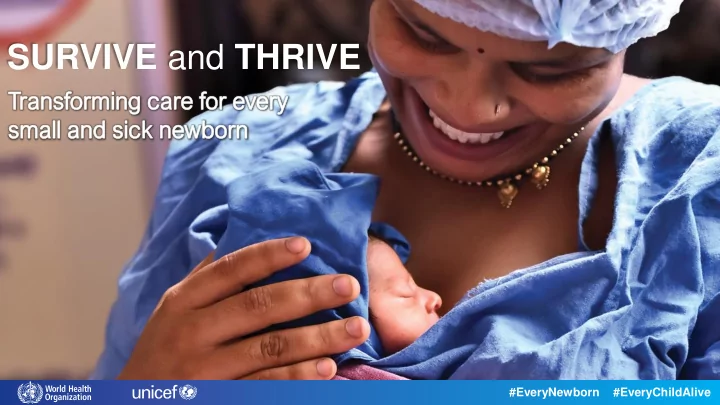
SURVIVE and THRIVE

slide-2
SLIDE 2

#EveryNewborn #EveryChildAlive SURVIVE and THRIVE: Transforming care for every small and sick newborn

Access report at bit.ly/care4everynewborn

2

WHY THIS REPORT?

  • Urgency: a decade to meet SDG targets, and those for every

newborn to survive, and thrive are off track, maybe more so after COVID-19 pandemic. Some countries may not meet SDG3.2 target until a century too late

  • UHC: Small & sick newborns are our most vulnerable citizens and

their care is a key part of UHC. Every country can do more

  • Opportunity: 94 authors from every continent (except Antarctica!)

have been involved, showing wide commitment to this issue. Chapter 1: Now is the time to transform care for newborns Chapter 2: What the numbers say Chapter 3: Deliver the care they are entitled to Chapter 4: Ensure they thrive Chapter 5: Use data for action Chapter 6: Immediate action is needed

NOW!

slide-3
SLIDE 3

#EveryNewborn #EveryChildAlive SURVIVE and THRIVE: Transforming care for every small and sick newborn

3

slide-4
SLIDE 4
  • Dr. Ornella Lincetto
  • Introduction to the webinar series and the speakers – Dr.

Ornella Lincetto, World Health Organization

  • Key findings of ‘Ensure they thrive’, Chapter 4 of the Survive

and Thrive report - Dr. Janna Patterson, Senior Vice President, Global Child Health and Life Support at the American Academy of Pediatrics

  • Empowering and engaging parents in caring for their sick

newborn: example of a neonatal unit in New Delhi– Prof. Arti Maria, Head of Department of Neonatology at Dr. RML hospital in New Delhi

  • COVID-19 impact on early childhood development and ways

to support nurturing care during the outbreak– Dr. Ornella Lincetto, World Health Organization

  • Questions and answers
  • Closing and next webinar

AGENDA – Session 1

Facilitator: Dr. Ornella Lincetto, Senior Medical Officer, WHO

  • Prof. Arti Maria
  • Dr. Janna Patterson
slide-5
SLIDE 5

#EveryNewborn #EveryChildAlive SURVIVE and THRIVE: Transforming care for every small and sick newborn

5

CHAPTER 4 Ensure they thrive

slide-6
SLIDE 6

CHAPTER 4. Ensure they thrive

#EveryNewborn #EveryChildAlive SURVIVE and THRIVE: Transforming care for every small and sick newborn

6

KEY MESSAGES

  • 1. Every newborn and young child’s ability to thrive is the direct result
  • f nurturing care and positive interaction with their environment.
  • 2. All newborns, especially those who have had major complications

at birth and during the neonatal period, require regular follow-up and nurturing care to optimize development.

  • 3. Investments in early childhood development benefit individuals,

communities and countries.

slide-7
SLIDE 7

#EveryNewborn #EveryChildAlive SURVIVE and THRIVE: Transforming care for every small and sick newborn

7

KEY MESSAGES

  • 1. THRIVE:

Newborns require nurturing care and positive interaction with their environment.

slide-8
SLIDE 8

CHAPTER 4. Ensure they thrive

#EveryNewborn #EveryChildAlive SURVIVE and THRIVE: Transforming care for every small and sick newborn

8

What does it mean to thrive?

  • An individual who thrives is able to develop his or her

full potential, from conception through early childhood

  • Developmental potential is holistic and includes cognition,

social and emotional interactions, linguistic and motor skills.

  • The first 1000 days (from conception to 24 months) is critical in the context of

preterm birth & neonatal illness.

  • Thriving is the process of maturing through interactions between the child and the

environment.

slide-9
SLIDE 9

CHAPTER 4. Ensure they thrive

#EveryNewborn #EveryChildAlive SURVIVE and THRIVE: Transforming care for every small and sick newborn

9

Why is early childhood so significant?

  • Once-in-a-lifetime opportunity to develop the brain, a period

that is foundational to later health, functioning and well-being

  • The infant’s brain depends on nurturing care for healthy

development

  • Lack of nurturing care may lead to lowered cognitive,

language, executive functioning, psychosocial outcomes

  • Protective factors (e.g. early stimulation and responsive care,

good nutrition and protection) can offset some risk factors

  • Investments in care not only benefit individuals,

but also communities and countries

slide-10
SLIDE 10

CHAPTER 4. Ensure they thrive

#EveryNewborn #EveryChildAlive SURVIVE and THRIVE: Transforming care for every small and sick newborn

10

Importance of integrating developmentally supportive care for small and sick newborns

  • Programmes are needed to deliver packages of

interventions that provide nurturing care to promote developmental potential of the infant and young child in the first 1000 days

  • Newborns at greatest risk of suffering from developmental

delays, physical disabilities, & poor neurodevelopmental functioning:

  • Small for gestational age
  • Premature or low birthweight
  • Afflicted with neonatal infections, intrapartum-related

complications, neonatal jaundice

slide-11
SLIDE 11

#EveryNewborn #EveryChildAlive SURVIVE and THRIVE: Transforming care for every small and sick newborn

11

KEY MESSAGES

  • 2. OPTIMIZE

DEVELOPMENT:

All newborns, especially those who are small and sick, need regular follow-up & nurturing care to survive and thrive.

slide-12
SLIDE 12

CHAPTER 4. Ensure they thrive

#EveryNewborn #EveryChildAlive SURVIVE and THRIVE: Transforming care for every small and sick newborn

Adapted from: Altimier L, Phillips R. Newborn & Infant NsgRev 2016; 16:230.

12

Effective interventions to promote development

slide-13
SLIDE 13

CHAPTER 4. Ensure they thrive

#EveryNewborn #EveryChildAlive SURVIVE and THRIVE: Transforming care for every small and sick newborn

13

How health care professionals can support development

Providers should:

  • Recognize and be responsive to behavioural cues of nonverbal infants
  • Structure environment and incorporate individualized care provided by parents
  • Educate and empower parents to be effectively engaged in care-giving in hospital and at home

Recommended caregiving behavior:

slide-14
SLIDE 14

CHAPTER 4. Ensure they thrive

#EveryNewborn #EveryChildAlive SURVIVE and THRIVE: Transforming care for every small and sick newborn

14

Effective interventions to promote development

Parent & Family Engagement

  • Contributes to newborn care during hospitalization
  • Feed with mother’s own or donated breastmilk
  • Practice good hygiene for self & baby
  • Recognize & respond to baby’s cues

about hunger & discomfort

  • Ensure baby is fed, warm, clean, sleeping well, comforted
  • Provide appropriate sensory stimulation,

especially touch and vocalization

  • Fosters greater emotional connection with newborn

and improve parenting abilities

slide-15
SLIDE 15

CHAPTER 4. Ensure they thrive

#EveryNewborn #EveryChildAlive SURVIVE and THRIVE: Transforming care for every small and sick newborn

15

Kangaroo mother care: 20 years on

Setting: Colombia

Study 1 (1993-1996)

  • Randomized controlled trials
  • f newborns weighing <1000 g at birth
  • Documented Kangaroo Mother Care (KMC)

benefits on survival, neurodevelopment, breastfeeding, quality of mother–infant bonding Follow-up Study (2012-2014), n=264

  • KMC had significant, long-lasting social & behavioural protective effects,

magnified by longer duration of skin-to-skin contact and participation of fathers

Source: Charpak N et al. Pediatrics 2017; 139(1):pii:e20162063.

slide-16
SLIDE 16

CHAPTER 4. Ensure they thrive

#EveryNewborn #EveryChildAlive SURVIVE and THRIVE: Transforming care for every small and sick newborn

16

A Parent’s Story A Mexican mother fights for her twins and goes on to support

  • ther parents internationally

“It was 36 hours after birth until I could see my children again. I told the staff to please take a picture for me. That is how I met my twins… There was a lack of follow-up care… a lack of emotional support when my kids were young.”

Pictured: Ilein with son Alonso and daughter Camila

– Ilein Bolaños Gonzalez, founder of Con Amor Vencerás

slide-17
SLIDE 17

#EveryNewborn #EveryChildAlive SURVIVE and THRIVE: Transforming care for every small and sick newborn

17

KEY MESSAGES

  • 3. INVEST:

Investments in early childhood development benefit individuals, communities and countries.

slide-18
SLIDE 18

CHAPTER 4. Ensure they thrive

#EveryNewborn #EveryChildAlive SURVIVE and THRIVE: Transforming care for every small and sick newborn

18

Discharge and beyond: empowering parents and caregivers

  • Parents and caregivers frequently report feeling

less than fully confident about caring for newborns after discharge

  • Support caregiving at home and improve home

environment, parental mental health & confidence with:

  • Robust discharge plan sensitive to parents’ needs
  • Discharge education accommodating parental schedules

& preferred learning styles

  • Individualized education programmes
  • Parent support forums
slide-19
SLIDE 19

CHAPTER 4. Ensure they thrive

#EveryNewborn #EveryChildAlive SURVIVE and THRIVE: Transforming care for every small and sick newborn

19

At-home interventions

  • Ensure baby is fed, warm, clean,

sleeping well, and comforted

  • Provide early stimulation,

shown to have short-term benefits to cognitive, motor, social-emotional development for LBW infants in LMICs

  • Encourage infant and young child to:
  • Explore the environment using sight, touch, sound and smell
  • Manipulate objects
  • Interact socially with caregivers

Sources: Engle PL et al. Lancet. 2011;378(9799):1339–53. Aboud FE, Yousafzai AK. Reproductive, Maternal, Newborn, and Child Health. 2016:241.

slide-20
SLIDE 20

CHAPTER 4. Ensure they thrive

#EveryNewborn #EveryChildAlive SURVIVE and THRIVE: Transforming care for every small and sick newborn

20

At-home interventions

  • Deliver sensitive and responsive caregiving/feeding
  • Benefits child development and academic outcomes,

decreases hospitalizations

  • Demonstrated results
  • Reduces parental stress levels,

supports more positive maternal behaviour, improves maternal–infant interactions

  • LMICs: consistent benefits for disadvantaged children,

particularly those at risk of malnutrition

Sources: Eshel N et al. Bull World Health Organ. 2006;84(12):991–8. Brett Jet al. BMJ Open. 2011;1(1):e000023. Charpak N et al. Pediatrics. 2017;139(1): pii: e20162063. Aboud FE, Yousafzai AK. Annu Rev Psychol. 2015;66(1):433–57. Britto PR et al. Lancet. 2017;389(10064):91–102.

slide-21
SLIDE 21

CHAPTER 4. Ensure they thrive

#EveryNewborn #EveryChildAlive SURVIVE and THRIVE: Transforming care for every small and sick newborn

21

Screening and Monitoring

  • Newborn screening programmes hold promise for

prevention and access to needed early interventions

  • Screening and monitoring for early childhood

development is important across developmental stages, even into school age in some cases

  • Assessment approaches are increasingly available for individual children, to

evaluate programs and to monitor populations

  • Connecting early identification of delays or disability to quality early intervention

programmes will be important to assure the healthiest possible child and family

  • utcomes
slide-22
SLIDE 22

CHAPTER 4. Ensure they thrive

#EveryNewborn #EveryChildAlive SURVIVE and THRIVE: Transforming care for every small and sick newborn

22

Screening for Parental Distress

  • Screening is important to identify parents at risk and

emotional distress experiences in NICU

  • Stress and distress are amplified in humanitarian crises
  • Staff should be trained to screen for parental distress
  • Families should be linked to resources for appropriate care and support
slide-23
SLIDE 23

CHAPTER 4. Ensure they thrive

#EveryNewborn #EveryChildAlive SURVIVE and THRIVE: Transforming care for every small and sick newborn

23

Global guidelines for community practitioners

  • WHO and UNICEF global care guidelines
  • Other guidelines on nurturing care for small & sick newborns: forthcoming
slide-24
SLIDE 24

CHAPTER 4. Ensure they thrive

#EveryNewborn #EveryChildAlive SURVIVE and THRIVE: Transforming care for every small and sick newborn

24

Conclusion

  • Programmes are needed to integrate early childhood development

with interventions in the first 1000 days

  • Support the newborn and family through early detection of disability
  • r developmental delay and routine follow-up
  • Prioritize developmentally supportive care to improve outcomes for

newborns: foster a family-centred, nurturing, supportive sensory environment With the right care, small and sick newborns can survive and thrive.

slide-25
SLIDE 25

#EveryNewborn #EveryChildAlive SURVIVE and THRIVE: Transforming care for every small and sick newborn

Access report at: bit.ly/care4everynewborn

25

Join the Small and Sick Newborn Care Community of Practice You can register at https://ibpnetwork.org/topics/14356 and click on “request invitation"

SSNC CoP is hosted by WHO ibp network

slide-26
SLIDE 26

CHAPTER 4. Ensure they thrive

#EveryNewborn #EveryChildAlive SURVIVE and THRIVE: Transforming care for every small and sick newborn

26

COVID-19 pandemic Effect on Early Childhood Development

  • Economic and structural impacts:
  • Rises in poverty and food insecurity, loss of caregivers, and reduced access

and use of health care

  • Social and psychological impacts:
  • Stress and depression experienced by caregivers, undermining their ability to

provide consistent nurturing care

  • Impact is on entire life course of the child, but also future generations

Stenz, L., Schechter, D.S., Serpa, S.R., and Paoloni-Giacobino, A. Intergenerational transmission of DNA methylation signatures associated with early life

  • stress. Current genomics. 2018; 19: 665–675

Effects of the Global COVID-19 Pandemic on Early Childhood Development: Short- and Long-Term Risks and Mitigating Program and Policy Actions.https://www.jpeds.com/article/S0022-3476(20)30606-5/fulltext

slide-27
SLIDE 27

CHAPTER 4. Ensure they thrive

#EveryNewborn #EveryChildAlive SURVIVE and THRIVE: Transforming care for every small and sick newborn

27

Ways to Support Nurturing Care during COVID-19:Responsive Care Giving, Health and Nutrition

  • Promote family-centered care during delivery,

hospitalization and after-home care.

  • Provide pregnant women/new mothers counselling
  • n health/breastfeeding/care during COVID-19
  • Use health and nutrition platforms to deliver

messages on coping, parenting and early stimulation

  • Promote family handwashing and hygiene
  • Emergency food delivery, including micronutrient and

ready-to-use therapeutic food supplements for pregnant women and young children

slide-28
SLIDE 28

CHAPTER 4. Ensure they thrive

#EveryNewborn #EveryChildAlive SURVIVE and THRIVE: Transforming care for every small and sick newborn

28

Ways to Support Nurturing Care, Security and Safety during COVID-19 pandemic

  • Ensure ECD is prioritized within the COVID-19

response to protect this generation of young children

  • Reach parents with income and mental health

support, encouragement and practical ideas

  • Targeted childcare and psychosocial support

for essential workers on the frontline of the crisis

  • Support parents to take care of their own

physical and mental well-being so they can better provide nurturing care for their children

  • Set up support services for women and

children experiencing domestic violence and abuse

slide-29
SLIDE 29

Resources on healthy parenting and mental health in the COVID-19 context

  • https://www.who.int/news-room/campaigns/connecting-

the-world-to-combat- coronavirus/healthyathome/healthyathome---healthy- parenting

  • https://www.who.int/news-room/campaigns/connecting-

the-world-to-combat- coronavirus/healthyathome/healthyathome---mental- health

  • EHS guidance: https://www.who.int/publications-

detail/10665-332240

  • https://www.unicef.org/parenting/coronavirus-covid-19-

guide-parents

slide-30
SLIDE 30

#EveryChildAlive #EveryNewborn #EveryNewborn #EveryChildAlive

Transforming care for every small and sick newborn

slide-31
SLIDE 31

CHAPTER 4. Ensure they thrive

#EveryNewborn #EveryChildAlive SURVIVE and THRIVE: Transforming care for every small and sick newborn

31

Acknowledgments

Authors for Chapter 4 Pia Britto, Nathalie Charpack, Bernadette Daelmans, Arti Maria, Janna Patterson, Susan Niermeyer Managing Editors for the Report Lily Kak, Joy Lawn, Ornella Lincetto, Gina Murphy, Judith Robb-McCord, Nabila Zaka PowerPoint slides and graphics Stefanie Kong, Kayley LeFaiver Overall >94 authors and experts from all over the world have input and all are appreciated!

slide-32
SLIDE 32

#EveryNewborn #EveryChildAlive SURVIVE and THRIVE: Transforming care for every small and sick newborn

Access report at: bit.ly/care4everynewborn

32

  • Check out the webinar series: bit.ly/NewbornSeries
  • Register for the next webinar on 1st July: ‘Use data for

action’: 8 am GMT session: bit.ly/01JulyS1 11 am GMT session: bit.ly/01JulyS2

  • Join the conversation: #EveryNewborn, #EveryChildAlive

Join the Community of Practice for the care of the small and sick newborn: Register at https://ibpnetwork.org/topics/14356 Online kick-off event 24 June 2 pm GMT