SURVIVE and THRIVE #EveryNewborn #EveryChildAlive #EveryNewborn - - PowerPoint PPT Presentation

survive and thrive
SMART_READER_LITE
LIVE PREVIEW

SURVIVE and THRIVE #EveryNewborn #EveryChildAlive #EveryNewborn - - PowerPoint PPT Presentation

SURVIVE and THRIVE #EveryNewborn #EveryChildAlive #EveryNewborn #EveryChildAlive CHAPTER 6 Immediate action is needed 2 SURVIVE and THRIVE: Transforming care for every small and sick newborn #EveryNewborn #EveryChildAlive CHAPTER 6.


slide-1
SLIDE 1

#EveryChildAlive #EveryNewborn

#EveryNewborn #EveryChildAlive
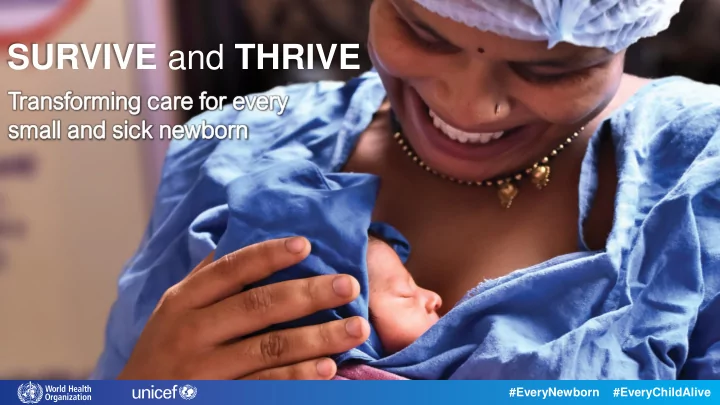
SURVIVE and THRIVE

slide-2
SLIDE 2

#EveryNewborn #EveryChildAlive SURVIVE and THRIVE: Transforming care for every small and sick newborn

2

CHAPTER 6 Immediate action is needed

slide-3
SLIDE 3

CHAPTER 6. Immediate action is needed

#EveryNewborn #EveryChildAlive SURVIVE and THRIVE: Transforming care for every small and sick newborn

3

KEY MESSAGES

  • 1. Expanding coverage of key interventions before, during, and after

pregnancy could save the lives of nearly 2.9 million women, newborns and stillbirths by 2030 in 81 priority countries.

  • 2. 1.7 million newborn lives could be saved each year by investing in quality

newborn care; almost half of this impact (747,400 newborn lives saved per year) would result from providing special and intensive hospital care for small and sick newborns.

  • 3. Reaching the targets of the SDGs and the Every Newborn Action Plan to

end preventable newborn mortality by 2030 requires transforming care for small and sick newborns through health system investments, stakeholder collaboration and engagement, implementation, information and innovation.

slide-4
SLIDE 4

#EveryNewborn #EveryChildAlive SURVIVE and THRIVE: Transforming care for every small and sick newborn

4

KEY MESSAGES

  • 1. LIVES SAVED:

Expanding coverage of key interventions before, during, and after pregnancy could save millions of women, newborns and stillbirths.

slide-5
SLIDE 5

CHAPTER 6. Immediate action is needed

#EveryNewborn #EveryChildAlive SURVIVE and THRIVE: Transforming care for every small and sick newborn

5

Lives Saved Analysis

  • The Lives Saved Tool is a mathematical modeling tool which allows

users to estimate the impact of coverage of key interventions on mortality in low- and middle-income countries.

  • Widely used by UN agencies, government, implementing partners

and academics for health planning and advocacy;

  • More details on the methods and data available at www.livessavedtool.org
  • Chapter 6 presents results from an updated lives saved analysis

based on information published in The Lancet Every Newborn series in 2014.

  • A costing analysis is also presented.
slide-6
SLIDE 6

CHAPTER 6. Immediate action is needed

#EveryNewborn #EveryChildAlive SURVIVE and THRIVE: Transforming care for every small and sick newborn

6

Analysis Summary

  • 81 Countdown to 2030 countries
  • Countdown to 2030 priority countries account for 95% of maternal deaths,

90% of deaths among children <5 years of age

  • Scenarios:
  • Baseline
  • Reaching ENAP targets for 2020 and 2025 (KMC, resuscitation, and antibiotics)
  • Closing the quality gap for facility births without comprehensive care
  • Closing the quality gap for facility births WITH comprehensive care
  • Universal coverage (95%) by 2025
  • Start: 2016 | End: 2030
  • Modeling to estimate cause-specific mortality decline and intervention attribution
slide-7
SLIDE 7

CHAPTER 6. Immediate action is needed

#EveryNewborn #EveryChildAlive SURVIVE and THRIVE: Transforming care for every small and sick newborn

7

Lives-saved analysis

(of which 747 400 are small and sick newborns)

Saving the lives of 2.9 million women, stillbirths and newborns by 2030 in 81 priority countries is achievable if coverage of key interventions is expanded before, during, and after pregnancy.

slide-8
SLIDE 8

CHAPTER 6. Immediate action is needed

#EveryNewborn #EveryChildAlive SURVIVE and THRIVE: Transforming care for every small and sick newborn

Estimated effect of scaling-up interventions on maternal and neonatal deaths and stillbirths by 2030, from a 2016 baseline

8

1.7 million newborn lives could be saved each year by investing in quality newborn care 747,400 newborn lives saved directly from special and intensive hospital care for small and sick newborns.

slide-9
SLIDE 9

#EveryNewborn #EveryChildAlive SURVIVE and THRIVE: Transforming care for every small and sick newborn

9

KEY MESSAGES

  • 2. QUALITY CARE:

1.7 million newborn lives could be saved each year by investing in quality newborn care.

slide-10
SLIDE 10

CHAPTER 6. Immediate action is needed

#EveryNewborn #EveryChildAlive SURVIVE and THRIVE: Transforming care for every small and sick newborn

10

Closing the “quality of care gap” with special and intensive newborn care

  • 28% of newborn deaths (n=667,200) could be averted in 2025 by addressing

the quality gap in special and intensive newborn care

  • Expanded case management of prematurity would account for ½ of impact
slide-11
SLIDE 11

CHAPTER 6. Immediate action is needed

#EveryNewborn #EveryChildAlive SURVIVE and THRIVE: Transforming care for every small and sick newborn

11

Estimated effect of interventions on intrapartum-related neonatal deaths

* ITN – insecticide-treated bed nets. ** IRS – indoor residual spraying.

# IPTp – Intermittent preventative treatment of malaria during pregnancy.

  • PPROM – preterm premature rupture of membranes

Highest impact interventions on intrapartum related deaths:

  • Appropriate labour

and delivery management (64%)

  • Neonatal

resuscitation (19%)

Averted intrapartum-related neonatal deaths

slide-12
SLIDE 12

CHAPTER 6. Immediate action is needed

#EveryNewborn #EveryChildAlive SURVIVE and THRIVE: Transforming care for every small and sick newborn

12

Estimated effect of interventions on infection-related neonatal deaths

* ITN – insecticide-treated bed nets. ** IRS – indoor residual spraying.

# IPTp – Intermittent preventative treatment of malaria during pregnancy.
  • PPROM – preterm premature rupture of membranes

Highest impact interventions on infection-related deaths:

  • Clean postnatal care

practices (48%)

  • Clean birth practices

(18%)

Averted infection-related neonatal deaths (sepsis, pneumonia)

slide-13
SLIDE 13

CHAPTER 6. Immediate action is needed

#EveryNewborn #EveryChildAlive SURVIVE and THRIVE: Transforming care for every small and sick newborn

13

Estimated effect of interventions on preterm-related neonatal deaths

Highest impact interventions on preterm-related deaths:

  • Intensive care

and KMC (75%)

Averted preterm-related neonatal deaths (direct complications)

slide-14
SLIDE 14

CHAPTER 6. Immediate action is needed

#EveryNewborn #EveryChildAlive SURVIVE and THRIVE: Transforming care for every small and sick newborn

14

Impact on major causes of neonatal mortality

  • Full scale-up of all interventions could

result in

  • 86% fewer deaths due to prematurity
  • 76% fewer deaths due to intrapartum-

related complications

  • 74% fewer neonatal deaths related to

serious infections (eg. sepsis and pneumonia)

slide-15
SLIDE 15

CHAPTER 6. Immediate action is needed

#EveryNewborn #EveryChildAlive SURVIVE and THRIVE: Transforming care for every small and sick newborn

15

Cost of inpatient care for small and sick newborns

  • US$ 959.3 million to scale-up inpatient care of small and sick newborns by 2025
  • US$ 0.20 per capita
  • US$ 1700 per newborn death averted

*Total package includes preconception nutrition care, antenatal care, care during labour and childbirth, immediate neonatal care, care of the healthy neonate and care of the small and sick neonate. Table adapted from: Bhutta et al. 2014. Can available interventions end preventable deaths in mothers, newborn babies, and stillbirths, and at what cost?

slide-16
SLIDE 16

#EveryNewborn #EveryChildAlive SURVIVE and THRIVE: Transforming care for every small and sick newborn

16

KEY MESSAGES

  • 3. PATH TO 2030:

Ending preventable newborn mortality by 2030 requires transforming care for small and sick newborns.

slide-17
SLIDE 17

CHAPTER 6. Immediate action is needed

#EveryNewborn #EveryChildAlive SURVIVE and THRIVE: Transforming care for every small and sick newborn

17

The path to 2030

Requires: 1. Targeted advocacy and policy efforts 2. A focus on equitable, high-quality and affordable services 3. A family-centred approach 4. Health systems that ensure full access to high-quality essential and special newborn care 5. Health systems to scale-up their special and intensive newborn care services 6. Accurate, reliable data

slide-18
SLIDE 18

CHAPTER 6. Immediate action is needed

#EveryNewborn #EveryChildAlive SURVIVE and THRIVE: Transforming care for every small and sick newborn

18

Every Newborn Action Plan: strategic objectives

  • 1. Strengthen and invest in care around the time
  • f birth and care for small and sick newborns
  • 2. Improve the quality of maternal and newborn care
  • 3. Reach every woman and newborn to reduce

inequities

  • 4. Harness the power of parents, families

and communities

  • 5. Count and track every small and sick newborn
slide-19
SLIDE 19

CHAPTER 6. Immediate action is needed

#EveryNewborn #EveryChildAlive SURVIVE and THRIVE: Transforming care for every small and sick newborn

19

Strategic Objective 1: Strengthen and invest in care around the time of birth and care for small and sick newborns

Invest

  • Develop/expand national ENAP strategies/action plans to include inpatient newborn care and allocate

adequate financial resources

  • Design and invest in facility networks for inpatient newborn care
  • Assess available maternal and newborn care services for populations in humanitarian settings

Implement

  • Ensure international newborn care standards and guidelines are adapted and available in facilities
  • Provide and monitor inpatient care for appropriate thermal management; infection prevention protocols and

practices; availability of antibiotics and dosage instructions; optimal newborn nutrition support; safe delivery of

  • xygen & phototherapy

Inform

  • Improve data collection efforts to increase understanding of where, when and why newborns are dying – and

how this connects to care delays

  • Establish or refine HMIS to track and influence human resource decisions

Innovate

  • Identify and procure diagnostics/equipment that are affordable, safe, effective and appropriate for use in low-

resource settings

  • Test innovative parent/community/health-care provider partnership models to expand access to and use of

facility-based services and post-discharge follow-up care

slide-20
SLIDE 20

CHAPTER 6. Immediate action is needed

#EveryNewborn #EveryChildAlive SURVIVE and THRIVE: Transforming care for every small and sick newborn

20

Strategic Objective 2: Improve the quality of maternal and newborn care

Invest

  • Ensure each level of care has the necessary staff, equipment, commodities, supplies and diagnostics to deliver

quality care; that the clinical space facilitates full participation of parents/family members to care for newborn

  • Establish/update evidence-based laws, policies and regulations around the newborn continuum of care to

ensure non-discriminatory access to high-quality care for all newborns in need Implement

  • Deploy quality-improvement approaches that advance provider skills and competencies, promote parent

engagement and minimize harm to the newborn

  • Encourage a facility ethos and environment that supports dignified and pain-free death for newborns who are

too fragile to survive; compassionate bereavement care for parents and clinical staff Inform

  • Establish/strengthen MPDSR systems and protocols including notification of neonatal deaths w/in 24 hours
  • Develop, refine, validate indicators to reflect accurately the content and quality of care
  • Track longer-term outcomes for newborns w/ disabilities to better assess impact of inpatient care and services

for early childhood development Innovate

  • Establish innovative approaches to motivate clinical staff and identify ways to evaluate the experience of care

and prevent distress and burn-out

  • Design, test and scale-up new and innovative service-delivery approaches and cost-effective health-care

technologies, including those specifically designed for low-resource settings

slide-21
SLIDE 21

CHAPTER 6. Immediate action is needed

#EveryNewborn #EveryChildAlive SURVIVE and THRIVE: Transforming care for every small and sick newborn

21

Strategic Objective 3: Reach every woman and newborn to reduce inequities

Invest

  • Develop and enact country policies on UHC, including financial protection mechanisms that guarantee

access to a comprehensive package of interventions for small and sick newborns

  • Design and implement a comprehensive plan for development of the health workforce

Implement

  • Eliminate social and financial barriers that limit access to care, including for female newborns who are

especially vulnerable in some populations

  • Ensure health-care services in humanitarian settings can adequately respond to projected needs,

strengthen referral process from camps/informal settlements to static hospital facilities. Inform

  • Investigate the sociodemographic characteristics of newborns who are dying, establish national targets to

reduce identified equity gaps

  • Use national/subnational data to design context-specific action plans for communities and the health

system, which promote equitable access to inpatient and post-discharge follow-up care Innovate

  • Support implementation research to understand which programmatic interventions work, and why, and to

refine services including post-discharge home visits by community health workers and women’s groups

  • Design new finance schemes to protect families from catastrophic out-of-pocket expenses and to ensure

equitable access to services for poor and marginalized families

slide-22
SLIDE 22

CHAPTER 6. Immediate action is needed

#EveryNewborn #EveryChildAlive SURVIVE and THRIVE: Transforming care for every small and sick newborn

22

Strategic Objective 4: Harness the power of parents, families & communities

Invest

  • Establish policies, laws and regulations that support the newborn and are designed to promote partnerships

and coalitions among parents, families and the health-care system

  • Engage private sector to support multimedia communication campaigns to change social norms, promote zero

tolerance for preventable newborn mortality, and advocate for optimal care-seeking behaviours Implement

  • Promote family-centered care principles in the care of small and sick newborns
  • Design/implement campaigns to raise awareness about the care needs of small and sick newborns and the

best ways to support affected families

  • Connect community health workers with local organizations to broaden community outreach and identify

newborns who may need long-term or developmentally supportive care Inform

  • Engage affected parents and families to monitor inpatient newborn care services, as well as long-term

developmental care for those with more specific needs.

  • Develop, validate, contextualize tools that measure types of support that parents, families, and newborns

receive

  • Educate/engage men to understand the needs, risks and danger signs of pregnancy, childbirth, postnatal

period Innovate

  • Consider and test telemedicine and digital tools to support parents in the care of their newborns
  • Involve patient/parent representatives in the design of new products, programmes and research proposals
slide-23
SLIDE 23

CHAPTER 6. Immediate action is needed

#EveryNewborn #EveryChildAlive SURVIVE and THRIVE: Transforming care for every small and sick newborn

23

Strategic Objective 5: Count and track every small and sick newborn

Invest

  • Identify, refine, develop tools to assess service readiness and health outcomes of inpatient newborn care,

as well as to evaluate referral processes and pathways and to shape resource priorities

  • Support long-term investment in functional and routine systems that can be integrated with the national

HMIS. Implement

  • Design and use standardized neonatal inpatient records linked to perinatal datasets.
  • Support the use of validated indicators in national HMIS.

Inform

  • Count every newborn in all settings, including humanitarian settings, using birth (and death) registration
  • Track NMR by gender and by birth weight groups in order to identify and respond to mortality patterns or

trends Innovate

  • Use multi-domain tools to monitor at-risk newborns for complications
  • Establish indicators to evaluate the effectiveness of follow-up care for ongoing nutritional and developmental

health needs

  • Establish metrics to track early childhood development interventions and to guide care delivery, supporting

those at highest risk of development delays or disabilities

slide-24
SLIDE 24

CHAPTER 6. Immediate action is needed

#EveryNewborn #EveryChildAlive SURVIVE and THRIVE: Transforming care for every small and sick newborn

24

Research priorities to guide change

  • High-quality, context-specific research is needed
  • Shared learning within and across countries
  • The Description, Discovery, Development and Delivery

framework highlights examples of key research priorities, and can be used to inform the design and delivery of care

  • Where feasible, mothers, other parents and community representatives

should be included in research design and monitoring processes

slide-25
SLIDE 25

CHAPTER 6. Immediate action is needed

#EveryNewborn #EveryChildAlive SURVIVE and THRIVE: Transforming care for every small and sick newborn

25

Everyone has a role to play to ensure a thriving next generation.