Compliance Fundamentals Mastering Tax Base, Nexus, Sourcing and - - PowerPoint PPT Presentation

compliance fundamentals
SMART_READER_LITE
LIVE PREVIEW

Compliance Fundamentals Mastering Tax Base, Nexus, Sourcing and - - PowerPoint PPT Presentation

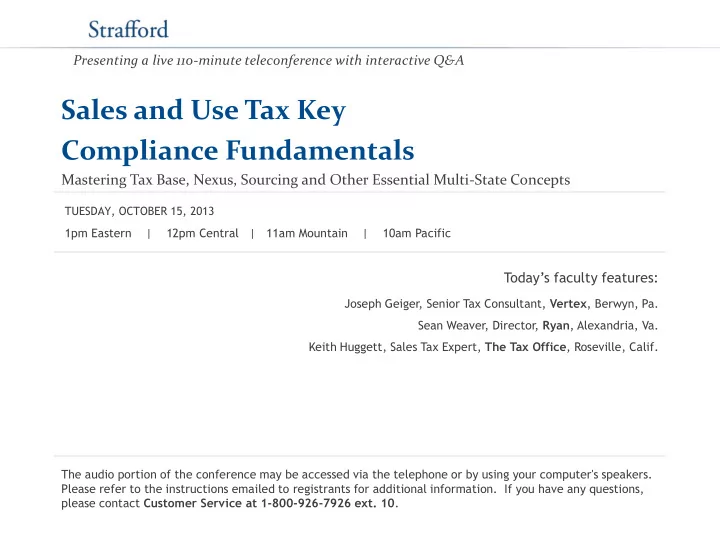
Presenting a live 110-minute teleconference with interactive Q&A Sales and Use Tax Key Compliance Fundamentals Mastering Tax Base, Nexus, Sourcing and Other Essential Multi-State Concepts TUESDAY, OCTOBER 15, 2013 1pm Eastern | 12pm


slide-1
SLIDE 1

Sales and Use Tax Key Compliance Fundamentals

Mastering Tax Base, Nexus, Sourcing and Other Essential Multi-State Concepts

Today’s faculty features:

1pm Eastern | 12pm Central | 11am Mountain | 10am Pacific The audio portion of the conference may be accessed via the telephone or by using your computer's speakers. Please refer to the instructions emailed to registrants for additional information. If you have any questions, please contact Customer Service at 1-800-926-7926 ext. 10. TUESDAY, OCTOBER 15, 2013

Presenting a live 110-minute teleconference with interactive Q&A

Joseph Geiger, Senior Tax Consultant, Vertex, Berwyn, Pa. Sean Weaver, Director, Ryan, Alexandria, Va. Keith Huggett, Sales Tax Expert, The Tax Office, Roseville, Calif.

slide-2
SLIDE 2

Sound Quality If you are listening via your computer speakers, please note that the quality

  • f your sound will vary depending on the speed and quality of your internet

connection. If the sound quality is not satisfactory, you may listen via the phone: dial 1-866-873-1442 and enter your PIN when prompted. Otherwise, please send us a chat or e-mail sound@straffordpub.com immediately so we can address the problem. If you dialed in and have any difficulties during the call, press *0 for assistance. Viewing Quality To maximize your screen, press the F11 key on your keyboard. To exit full screen, press the F11 key again.

FOR LIVE EVENT ONLY

slide-3
SLIDE 3

Attendees must listen throughout the program, including the Q & A session, in

  • rder to qualify for full continuing education credits. Strafford is required to

monitor attendance. Record verification codes presented throughout the seminar. If you have not printed out the “Official Record of Attendance,” please print it now (see “Handouts” tab in “Conference Materials” box on left-hand side of your computer screen). To earn Continuing Education credits, you must write down the verification codes in the corresponding spaces found on the Official Record of Attendance form. Please refer to the instructions emailed to the registrant for additional

  • information. If you have any questions, please contact Customer Service

at 1-800-926-7926 ext. 10.

FOR LIVE EVENT ONLY

slide-4
SLIDE 4

If you have not printed the conference materials for this program, please complete the following steps:

  • Click on the ^ symbol next to “Conference Materials” in the middle of the left-

hand column on your screen.

  • Click on the tab labeled “Handouts” that appears, and there you will see a

PDF of the slides and the Official Record of Attendance for today's program.

  • Double-click on the PDF and a separate page will open.
  • Print the slides by clicking on the printer icon.

FOR LIVE EVENT ONLY

slide-5
SLIDE 5

Sales and Use Tax Key Compliance Fundamentals

Keith Huggett, The Tax Office khuggett@plan4tax.com

  • Oct. 15, 2013

Joseph Geiger, Vertex joseph.geiger@vertexinc.com Sean Weaver, Ryan sean.weaver@ryan.com

slide-6
SLIDE 6

Today’s Program

Essential Concepts of Sales Tax and Revenue Agency Administration [Keith Huggett] Sales Tax Nexus and Sourcing of Transactions [Joseph Geiger] Sales Tax Exemptions and Exemption Certificates [Sean Weaver] Slide 8 – Slide 44 Slide 45 – Slide 82 Slide 83 – Slide 93

slide-7
SLIDE 7

Notice

ANY TAX ADVICE IN THIS COMMUNICATION IS NOT INTENDED OR WRITTEN BY THE SPEAKERS’ FIRMS TO BE USED, AND CANNOT BE USED, BY A CLIENT OR ANY OTHER PERSON OR ENTITY FOR THE PURPOSE OF (i) AVOIDING PENALTIES THAT MAY BE IMPOSED ON ANY TAXPAYER OR (ii) PROMOTING, MARKETING OR RECOMMENDING TO ANOTHER PARTY ANY MATTERS ADDRESSED HEREIN.

You (and your employees, representatives, or agents) may disclose to any and all persons, without limitation, the tax treatment or tax structure, or both, of any transaction described in the associated materials we provide to you, including, but not limited to, any tax opinions, memoranda, or other tax analyses contained in those materials. The information contained herein is of a general nature and based on authorities that are subject to change. Applicability of the information to specific situations should be determined through consultation with your tax adviser.

slide-8
SLIDE 8

ESSENTIAL CONCEPTS OF SALES TAX

Keith Huggett, The Tax Office

slide-9
SLIDE 9

www.plan4tax.com

Essential Concepts of Sales Tax

9

slide-10
SLIDE 10

www.plan4tax.com

Sales Tax vs. Use Tax

10

slide-11
SLIDE 11

www.plan4tax.com

Definitions

  • Sales Tax: Tax imposed on the retail sale of

personal property in this state

  • Use Tax: Tax imposed on the consumption or

use of property in this state, not otherwise subject to sales tax

11

slide-12
SLIDE 12

www.plan4tax.com

Types of Taxes

  • Seller Privilege
  • Imposed on the seller’s

gross receipts for the “privilege” of doing business in the state.

  • Seller is liable for the tax

but can pass it on to the purchaser.

  • Can be included in the price
  • r separately stated on the

invoice.

12

slide-13
SLIDE 13

www.plan4tax.com

Types of Tax Part 2

  • Transaction Tax
  • Imposed on the sale of

tangible personal property or service.

  • Purchaser is liable to

the seller for the taxes due.

  • Must be separately

stated on the invoice.

13

slide-14
SLIDE 14

www.plan4tax.com

Tax Types Part 3

  • Consumer Levy
  • What we consider to be

“sales tax”

  • Imposed on the sales of

tangible personal property and services.

  • Imposed on the purchaser

but collected by the seller.

  • Must be separately stated
  • n the invoice.

14

slide-15
SLIDE 15

www.plan4tax.com

Last One….

  • Gross Receipts Tax
  • Imposed on the tangible

personal property and services but with fewer exemptions or exclusions to the taxable base

  • Must be separately stated on

the invoice

  • Hawaii has special

considerations: if the tax is passed on to the purchaser it becomes part of the gross receipts for tax calculations

15

slide-16
SLIDE 16

www.plan4tax.com

Vendor Responses to Sales Tax

  • Not all states have absorption laws

1) A seller may not want to charge the buyer the tax. These are usually states in which the burden of the tax is intended to be imposed on the seller, not the buyer. 2) States often provide an exemption when separately charging sale tax would be really inconvenient (bars, food vendors at sporting events, vending machines, etc.) There may be a requirement that a sign be posted saying that the price includes the sales tax.

16

slide-17
SLIDE 17

www.plan4tax.com

Vendor Responses cont.

3) There are a few states that say that if the invoice says “tax included,” that’s good enough. 4) Some states have no problem with the seller saying that it will refund the sales tax, even it has to charge the tax. 5) Many states allow the seller to say something like, “The state makes us charge you tax, but we’ll give you a rebate of 6%,” as long as the seller is not saying that it is refunding the tax itself.

17

slide-18
SLIDE 18

www.plan4tax.com

Streamlined Sales & Use Tax Agreement

  • The SSUTA focuses on improving sales and use tax systems for

all sellers and for all types of commerce through all of the following:

  • State level administration of sales and use tax collections.
  • Uniformity in the state and local tax bases.
  • Uniformity of major tax base definitions.
  • Central, electronic registration system for all member states.
  • Simplification of state and local tax rates.
  • Uniform sourcing rules for all taxable transactions.
  • Simplified administration of exemptions.
  • Simplified tax returns & simplification of tax remittances.
  • Protection of consumer privacy.

18

slide-19
SLIDE 19

www.plan4tax.com

SSUTA Q&A

  • How does SSUTA simplify sales tax administration?
  • Through tax law simplification, efficient administrative

procedures & emerging technologies.

  • How do uniform definitions reduce business

administrative expenses?

  • The Agreement defines sixty-nine different administrative

terms and products and services that states either tax or

  • exempt. A business making sales into a Streamlined state only

needs to know whether the product or service they sell is taxable or exempt.

19

slide-20
SLIDE 20

www.plan4tax.com

Revenue Agency Administration

  • f Sales Tax

20

slide-21
SLIDE 21

www.plan4tax.com

Filing Frequency

  • State and local jurisdictions
  • Determining monthly, quarterly, semi-annual or annual

returns

  • Each jurisdiction has its own guidelines.
  • Thresholds
  • Dollar amounts
  • Time period
  • Registrations
  • May determine frequency

21

slide-22
SLIDE 22

www.plan4tax.com

Filing Frequency cont.

  • Pitfalls
  • Registrations
  • No-change jurisdictions
  • Processes
  • Remedies
  • Proactive
  • Persistent
  • The old fashioned way

22

slide-23
SLIDE 23

www.plan4tax.com

E-Filing

  • Streamlining the process
  • Saves time and money
  • Automated solutions
  • E-file capabilities
  • Manually
  • Jurisdictional Web sites
  • Third party
  • Peace of mind

23

slide-24
SLIDE 24

www.plan4tax.com

E-Payments

  • Streamlining the process
  • Saves time and money
  • Automated solutions
  • E-pay capabilities
  • Manually
  • Jurisdictional Web sites
  • Third party
  • Value-added resources

24

slide-25
SLIDE 25

www.plan4tax.com

State of the State

  • Audit Program
  • State audits nearly 1% of permit holders
  • Program identidied $497.7 million in deficiencies
  • Taxpayers received $131.5 million in refunds
  • Top Areas of Taxpayer Noncompliance
  • Use tax on out-of-state purchases ($122M)
  • Unsupported sales for resale ($76M)
  • Additional sales based on markup of costs

25

slide-26
SLIDE 26

www.plan4tax.com

What Can States Do?

  • Increase audit activity;
  • Increase tax collection efforts;
  • Expand nexus statutes;
  • Increase tax rates;
  • Expand taxable base and eliminate

exemptions;

  • Expand EDI filing requirements

26

slide-27
SLIDE 27

www.plan4tax.com

In California...

  • State, county, and local rate

currently 7.50%

  • 28 County Additional District Taxes;
  • ~116 Additional City Taxes;
  • Effective October 1, 2013
  • City of San Fernando Tax increase

from 9.0% to 9.5%

  • Highest rates - La Mirada, Pico

Rivera, Southgate at 10%

Raising Tax Rates Since January 1, 2009

27

slide-28
SLIDE 28

www.plan4tax.com

FTB Use Tax Remittances

AGI Use Tax Participation

  • Avg. Use Tax Reported

$0 to 30K 0.15% $76 $30k to $60K 0.34% $70 $60K to$100K 0.66% $81 > $100K 1.12% $311 Total , All AGI 0.42% $170

Participation and Average Use Tax Payments by AGI Class in 2009

28

slide-29
SLIDE 29

www.plan4tax.com

Enforcing Use Tax Remittance

Qualified Purchaser Program

  • Business with more than $100,000 gross sales

must register and file use tax returns.

  • Targets purchases subject to use tax from out-
  • f-state sellers.
  • Could eventually be used to administer tax on

professional services.

29

slide-30
SLIDE 30

www.plan4tax.com

Qualified Purchaser Program cont.

  • Issues at Inception
  • 200,000 estimated registrants at inception;
  • Actually registered 500,000 - should have

been 800,000

  • Over 250,000 registered file $0 returned.

30

slide-31
SLIDE 31

www.plan4tax.com

Qualified Purchaser Program cont.

  • Changes to Program Since Inception:
  • Discontinued "automatic" registration;
  • Allows close out if revenue drops below

$100,000 for 2 years, not automatic.

  • Automatically deregisters taxpayers who file

$0 returns for 3 years.

31

slide-32
SLIDE 32

www.plan4tax.com

"SCOP"ing Out New Revenue

  • Statewide Compliance and

Outreach Program (SCOP)

  • Seven teams located

throughout the state will conduct door-to-door vists to all non-residential retail businesses based on zip code.

  • Offshoot of Business license

Inspection Program (BLIP).

  • During 2010/11,

approximately 91,000 businesses were visited.

32

slide-33
SLIDE 33

www.plan4tax.com

SCOP Purpose...

  • To educate business owners regarding their

sales and use tax reporting responsibilities;

  • Make sure businesses have the required state

tax and fee permits;

  • Provide a field presence for the Board of

Equalization;

  • Address the tax gap.

33

slide-34
SLIDE 34

www.plan4tax.com

SCOP Staff Procedures

  • Review returns for reporting

differences;

  • Discuss with taxpayer,

provide evidence to provide support for reported amounts;

  • Provide opportunity to file

amended returns;

  • Issue Filed Billing Order;
  • Refer to Audit Department.

34

slide-35
SLIDE 35

www.plan4tax.com

SCOP Issues…

  • Criminals impersonating taxpayers;
  • Compliance department performing audits;
  • Audit selection based on SCOP results.

35

slide-36
SLIDE 36

www.plan4tax.com

Auditor’s Surfing the Web

  • Internet Outreach Program
  • - Contacting Internet Retailers by Email
  • 3 or more sales per year = RETAILER

36

slide-37
SLIDE 37

www.plan4tax.com

Other Revenue Generating Programs

  • Mining data from DMV, FAA,

Coast Guard, customs and FTB returns to verify use tax payment

  • n purchases of vehicles, vessels,

aircraft, or imports;

  • Increase top delinquent list to

500;

  • Increases in penalties
  • - 40% penalty on unreported tax

collected form customers after January 1, 2006

37

slide-38
SLIDE 38

www.plan4tax.com

Audits & Representation

  • Audit Trends
  • - Greater use of sampling
  • - SCOP
  • - Data Mining
  • - Increased penalty use
  • - More aggressive penalty use
  • Overall goal – ZERO No-change Audits

38

slide-39
SLIDE 39

www.plan4tax.com

Taxpayer Remedies

  • Appeals
  • Settlement
  • Installment Agreements

Payment Plans

  • Offers In Compromise

39

slide-40
SLIDE 40

www.plan4tax.com

The Role of the Consultant

  • Buffer between auditor and company
  • Relief to understaffed tax department
  • Review audit working papers prior to finalizing audit
  • Perform reverse audit to identify credits, exemptions,

refunds not currently utilized

  • Determine/support nexus positions and taxability of

transactions

  • Represent companies before state tax jurisdictions
  • Bring cash back to the company’s bottom line

40

slide-41
SLIDE 41

www.plan4tax.com

Audits & Representation – The Other Side

  • No surprises
  • Perform pre-audit
  • Reconcile total and taxable sales to books
  • Reconcile sales and use tax payable accounts
  • Test claimed exempt sales
  • Verify payments of use tax on consumables and fixed assets
  • Out of the ordinary transactions
  • Appeals
  • Auditors are first level. Companies often must appeal to get

the “right” answer.

41

slide-42
SLIDE 42

www.plan4tax.com

Reverse Audits

  • Seek to protect company’s interest in tax
  • Can be performed in conjunction with sales

tax audit

  • Auditors look for underpayments, not
  • verpayments
  • Deficiency interest higher than credit interest
  • Refunds can either be obtained from state or

from vendors. Rules vary by state.

42

slide-43
SLIDE 43

www.plan4tax.com

Managing Exposure through VDA’s

  • Voluntary Disclosure
  • Negotiates settlement anonymously and agrees to file returns

prospectively

  • Areas of negotiation:
  • Look back
  • Method of reporting
  • Penalties & interest
  • Once, entered, time is of the essence
  • Other considerations: Income, Franchise, Capital

Stock, Taxes, etc…

43

slide-44
SLIDE 44

Slide Intentionally Left Blank

slide-45
SLIDE 45

SALES TAX NEXUS AND SOURCING OF TRANSACTIONS

Joseph Geiger, Vertex

slide-46
SLIDE 46

Objectives

  • Discuss the basics of sales and use tax including

tax types, alternative vendor responses to sales taxes, Streamlined Sales Tax Project, revenue agency administration, nexus, sourcing of transactions, exemptions and exemption certificate management.

46

slide-47
SLIDE 47

Presenter

  • Joseph F. Geiger, Jr., Esq., CPA,

MST, MSA

  • Senior Tax Consultant, Vertex
  • Over 25 years in accounting, audit and

tax

  • Public accounting and industry

experience

  • Represented audit clients at local, state

and federal levels, including U.S. Tax Court

47

slide-48
SLIDE 48

Agenda

48

Topic Time

Nexus Defined 5 minutes Types of Nexus 5 minutes Supreme Court Cases 5 minutes Amazon Case History 5 minutes Sourcing of Transactions 5 minutes

slide-49
SLIDE 49

Definition

Nexus

slide-50
SLIDE 50

Nexus Definition

  • “A level of connection between a taxing

jurisdiction and an entity. Required before a taxing jurisdiction can impose its taxes on a business.”

  • Defined by U.S. constitutional principles and

U.S. Supreme Court cases

50

slide-51
SLIDE 51

Constitutional Principles

  • Due Process Clause (14th Amendment)
  • No state shall “deprive any person of life, liberty
  • r property, without due process of law.”
  • Commerce Clause (10th Amendment)
  • Authorizes Congress to regulate commerce among

the states; prohibits states from enacting laws that might unduly burden or inhibit the free flow

  • f trade among the states.

51

slide-52
SLIDE 52

Types of Nexus

  • Types of Nexus
  • Physical Presence
  • De Minimis Activities
  • Agency (Representational) Nexus
  • Affiliate Nexus
  • Click-Thru (Economic Presence) Nexus

52

slide-53
SLIDE 53

Activities That Could Create Nexus

  • Activities that could create nexus include:
  • Retail location
  • Sales representative making calls in state
  • Interstate delivery in seller’s own vehicle
  • Office or warehouse in state

53

slide-54
SLIDE 54

Activities That Could Create Nexus

  • Activities that could create nexus include:
  • Tangible personal property in state
  • Training classes held in state
  • Tangible personal property leased or rented to

someone located in the state

  • Repair or maintenance by seller or service

provider of tangible personal property in state

54

slide-55
SLIDE 55

Agency (Representational) Nexus

  • The operation of independent contractors to

solicit sales within a state has been held to create sufficient nexus to require the collection of use

  • tax. The status of an independent contractor who

transmits orders to the manufacturer or wholesaler can be changed to that of a retailer who accepts and fills orders for goods purchased by the retailer from the manufacturer or

  • wholesaler. Such a change in status would free

the manufacturer or wholesaler from the use tax duties but would impose on such a retailer the responsibility to collect and remit sales tax.

55

slide-56
SLIDE 56

Affiliate Nexus

  • The existence of common ownership

between a company that has a physical presence in a state and a related entity that has no physical presence (e.g., an out-of-state mail order affiliate) in the state but makes substantial sales into the state is usually sufficient to create nexus for the out-of-state affiliate in most states.

56

slide-57
SLIDE 57

Click-Thru Nexus

  • Click-through nexus is imposed by some states. A retailer

is presumed to be soliciting or transacting business by an independent contractor, agent, or other representative if the retailer enters into an agreement with a state resident who, pursuant to the agreement and for a commission or

  • ther consideration, directly or indirectly refers potential

customers, whether by link on an internet website or

  • therwise, to the retailer.
  • The presumption is applied by some states only if the

cumulative gross receipts from sales by the retailer to the state’s residents who are referred to the retailer by this type of agreement with the retailer is in excess of a specified dollar amount on a quarterly or annual basis.

57

slide-58
SLIDE 58

Scripto Case

  • In Scripto v. Carson, 362 U.S. 207 (1960), the Supreme

Court held that the presence of brokers, wholesalers, or jobbers who regularly solicit sales on a commission basis for an out-of-state corporation constitutes a sufficient nexus to require the corporation to collect and remit use

  • taxes. In this case, Scripto, Inc. operated an advertising

specialty division in Atlanta, Georgia. The division, trading under the name of Adgif Company, sold mechanical writing instruments that were adapted for advertising purposes by imprinting advertising messages on the

  • instruments. Adgif did not own, lease, or maintain any
  • ffice, distributing house, warehouse or other place of

business in the state of Florida. Nor did it have any regular employee or agent there or maintain any bank account or stock of merchandise in Florida.

58

slide-59
SLIDE 59

National Bella Hess Case

  • In National Bellas Hess, Inc. v. Department of Revenue of

the State of Illinois, 386 U.S. 753 (1967), the Supreme Court upheld the distinction between mail order sellers with retail outlets, solicitors, or property within a state and those who do no more than communicate with customers in the state by mail or common carrier as part

  • f a general interstate business. Illinois sought to enforce

its requirement that National Bellas Hess register as a collector of sales and use tax in Illinois based on its statutory definition of a retailer as any firm “engaged in soliciting orders within this State from users by means of catalogues or other advertising, whether such orders are received or accepted within or without this State.”

59

slide-60
SLIDE 60

Slide Intentionally Left Blank

slide-61
SLIDE 61

Quill Case

  • In Quill Corp. v. North Dakota, 504 U.S. 298 (1992), the U.S.

Supreme Court first made a distinction between the Due Process Clause minimum connection requirement and the Commerce Clause substantial nexus requirement, holding that the Commerce Clause, but not the Due Process Clause, barred North Dakota from requiring an out-of-state mail-order company to collect use tax on goods sold to North Dakota customers because the company had no outlets, sales representatives, or significant property in the state. In so ruling, the Court reaffirmed the portion of National Bellas Hess that established under the Commerce Clause a "bright line" rule that permits a state to compel out-of-state mail-order vendors with a physical presence in the state to collect its use taxes, but not those vendors who do no more than communicate with customers in the state by mail or common carrier as part of a general interstate business.

61

slide-62
SLIDE 62

Amazon Case

  • In April 2008, Governor Paterson signed into New

York Tax Law a provision that creates a presumption of nexus based on Web site linking

  • arrangements. Under the new statute, an out-of-

state vendor is presumed to have nexus in New York if the vendor:

  • Enters into agreements with a resident for website

referrals or links;

  • Pays commissions or fees for such referrals; and
  • The total gross receipts from sales made as a result
  • f all such arrangements is at least $10,000 during

the preceding four quarterly periods.

62

slide-63
SLIDE 63

Amazon Case (continued)

  • The new provision thus requires collection
  • f New York taxes from New Yorkers by
  • ut-of-state sellers that contractually agree

to pay commissions to New York residents for referring potential customers to them, provided that more than $10,000 was generated from such New York referrals during the preceding four quarterly periods.

63

slide-64
SLIDE 64

Amazon Case (continued)

  • On April 25, 2008, Amazon.com LLC and Amazon Services, LLC

(collectively, Amazon) filed suit in New York State court, seeking to declare the new statute unconstitutional. Some basic facts are:

  • Amazon is a Washington-based company that sells merchandise

exclusively online

  • It had no physical presence in New York, no affiliated retail stores in

New York and no other contacts with New York, other than Web site linking arrangements

  • At the heart of this dispute was Amazon's Associates Program, which

allows participants (Associates) to maintain links to Amazon.com on their own Web sites and compensates them by paying a percentage

  • f the proceeds of the sale
  • If Amazon accepts the prospective Associate's applications, the parties

enter into an Operating Agreement, which makes clear that the relationship of the parties is that of independent contractors. Through the program, Amazon authorizes Associates to place different types of links from their Web sites to its own.

64

slide-65
SLIDE 65

Amazon Case (continued)

  • Appellate Division of the Supreme Court of New

York, First Department, No. 07823, November 4, 2010

  • Reinstated complaints filed by Amazon.com and

Overstock.com

  • Found that the statute is constitutional on its face

in relation to the Commerce Clause and Due Process Clause, and does not violate the Equal Protection Clause on its face or as applied

  • Remanded to the lower court to determine whether

the two companies met the threshold requirements

65

slide-66
SLIDE 66

Amazon Case (continued)

  • In March 2013, the New York Supreme Court

held that it was acceptable for the state to make a law that required online retailers to collect tax based purely because a New York based company received a commission for the in-state company’s web site forcing a potential customer to the out-of-state online retailer’s website.

66

slide-67
SLIDE 67

Amazon Case (continued)

  • In August 2013, Overstock.com and

Amazon.com Inc. petitioned the U.S. Supreme Court to overturn a demand that it collect sales tax on its goods sold in New York

  • State. The online retailers are asking the court

to consider the constitutionality of states collecting taxes from companies that do not have such physical operations as warehouses in those states.

67

slide-68
SLIDE 68

Marketplace Fairness Act of 2013

  • S.B. 743 was passed by U.S Senate on May 6, 2013.
  • Would allow states to require out-of-state businesses

to collect sales tax. If this bill becomes law, states would gain authority to make remote businesses collect sales tax, some within 180 days of the bill’s passage.

  • States that are members of the Streamlined Sales

and Use Tax Agreement (SST) would automatically be granted this authority. States that are not SST members would be required to implement simplification requirements.

  • The bill provides an exception for businesses with

annual remote sales of $1 million or less.

68

slide-69
SLIDE 69

Where Does Your Company Have Nexus?

  • Do you know where your company is

conducting activities?

  • Do you know what types of relationships your

company has entered into?

  • Do you know all the ways your company

makes sales?

69

slide-70
SLIDE 70

Nexus - Some Things to Keep in Mind

  • When you review your nexus affiliation

consider the following:

  • Watch out for business changes that might create nexus
  • Launching internet services
  • Contracting with independent sales reps
  • Look for de minimis rules for protected activities and keep

to the restrictions

  • Trade shows
  • Visits by employees

70

slide-71
SLIDE 71

Slide Intentionally Left Blank

slide-72
SLIDE 72

Situs Explained

Sourcing of Transactions

slide-73
SLIDE 73

Situs Definition

  • In law, the situs (Latin for position or site) of

property is where the property is treated as being located for legal purposes.

  • It is the point at which sales or use tax is

legally due.

73

slide-74
SLIDE 74

Destination-based vs. Origin-based

  • The term “sales tax sourcing” is used to describe

which tax rates are applied to a given purchase, and to which jurisdictions the tax money collected is

  • wed. In most cases, this doesn’t affect brick-and-

mortar stores, where the customer comes into the store to purchase the product. In this case, the sales tax is based on the rate where the store is located.

  • Sales tax sourcing becomes much more important for

retailers who ship products to other locations, such as online retailers and those who sell products by

  • catalog. When you ship a product to another address,

the knowledge of your tax rules becomes very important in both the sales tax calculation and when completing your tax returns.

74

slide-75
SLIDE 75

Destination-based vs. Origin-based

  • Most states use destination-based sales tax,

which defines the source of the transaction to be the destination at which the product will eventually be used, or the address to which the product is shipped. This is a more common practice, but one that is also harder to manage. In this case, retailers who ship product to an address within their state must collect sales tax at the rate of the address to which the product is being shipped.

75

slide-76
SLIDE 76

Destination-based vs. Origin-based

  • Only a few states have laws that are origin-

based, where products that are shipped to the customer are taxed based on the location

  • f the business itself.

76

slide-77
SLIDE 77

Situs on Interstate Transactions

  • Goods shipped from one state and delivered

across state lines to another state

  • Taxing situs is where the goods are consumed

77

slide-78
SLIDE 78

Situs – Intrastate Transaction

78

  • Ship from and delivery location are in the

same state

  • Taxing situs varies state by state
slide-79
SLIDE 79

Situs Rules

  • Below is a listing of origin states. The taxing

situs in these states is the seller’s location when transactions are conducted within

  • state. All other states are destination states.

79

Origin States Modified Origin States

Arizona California Illinois Texas Missouri Ohio Pennsylvania Tennessee Virginia

slide-80
SLIDE 80

Situs – Some Things to Keep in Mind

  • Once you have registered with a state:
  • Review whether or not the state is an origin or

destination state (for local tax application)

  • Review whether or not you have any physical

presence in the state

  • When you have determined nexus, and

reviewed situs rules in those states:

  • Determine your tax obligation for sales or use tax

remittance (seller’s use and consumer’s use)

80

slide-81
SLIDE 81

Contact Information

  • Joseph F. Geiger, Jr., Esq., CPA, MST, MSA
  • Vertex Consulting
  • Telephone: 484-595-6353
  • Email: joseph.geiger@vertexinc.com

81

slide-82
SLIDE 82

Slide Intentionally Left Blank

slide-83
SLIDE 83

SALES TAX EXEMPTIONS AND EXEMPTION CERTIFICATES

Sean Weaver, Ryan

slide-84
SLIDE 84

www.ryan.com

Sales and Use Tax Exemptions

slide-85
SLIDE 85

Sales and Use Tax: Nationwide Review

Sean M. Weaver, Director

slide-86
SLIDE 86

Manufacturing

Available to taxpayers who manufacture, fabricate or process tangible personal property “Physical or chemical change” Creative Applications Texas, California, Florida

86

slide-87
SLIDE 87

Research & Development

Exempts sales tax purchases of qualified machinery and equipment used primarily for research and development Percentage of use – 51% or 100% Creative Applications

87

slide-88
SLIDE 88

Purchase for Resale

Tangible Personal Property purchased for resale is exempt from sales tax Reseller collects sales tax from purchaser Creative Applications Contracts

88

slide-89
SLIDE 89

Exempt Entities

United States Government, State Governments, Semipublic Institutions, Not-for-Profit Corporations Government Contracts Real Estate Improvements Creative Applications

89

slide-90
SLIDE 90

Sales Tax Credits & Incentives

State Governments Offer Sales Tax Credits & Incentives New Jobs, Capital Investment, Term Data Centers & Manufacturing Creative Applications

90

slide-91
SLIDE 91

Quality Assurance

Equipment Used for Quality Assurance or Control Texas, Illinois, etc. Creative Applications

91

slide-92
SLIDE 92

Pollution Control

Equipment Used for Pollution Control Texas, California, Illinois, etc. Creative Applications

92

slide-93
SLIDE 93

Ryan’s Award-Winning Tax Services

Largest Indirect Tax Practice in the United States

  • f America

Fortune 500 Clients Local, State, Federal and International Tax Services

93