Compliance TODAY October 2013 A PUBLICATION OF THE HEALTH CARE - - PDF document

compliance
SMART_READER_LITE
LIVE PREVIEW

Compliance TODAY October 2013 A PUBLICATION OF THE HEALTH CARE - - PDF document

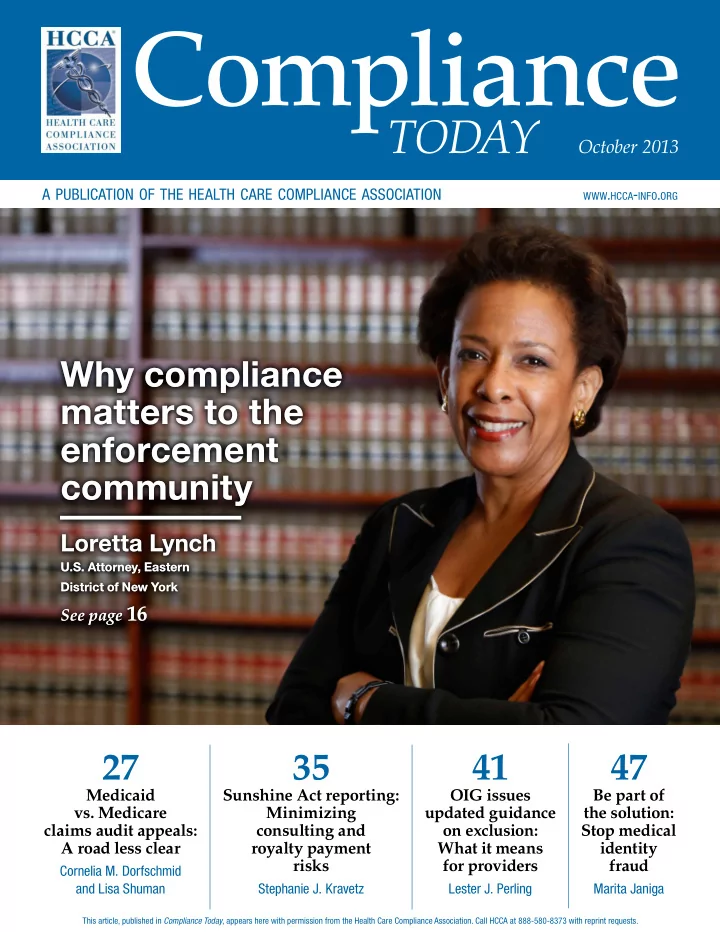
Compliance TODAY October 2013 A PUBLICATION OF THE HEALTH CARE COMPLIANCE ASSOCIATION WWW . HCCA - INFO . ORG Why compliance Why compliance matters to the matters to the enforcement enforcement community community Loretta Lynch Loretta


slide-1
SLIDE 1

27

Medicaid

  • vs. Medicare

claims audit appeals: A road less clear

Cornelia M. Dorfschmid and Lisa Shuman

41

OIG issues updated guidance

  • n exclusion:

What it means for providers

Lester J. Perling

35

Sunshine Act reporting: Minimizing consulting and royalty payment risks

Stephanie J. Kravetz

47

Be part of the solution: Stop medical identity fraud

Marita Janiga

A PUBLICATION OF THE HEALTH CARE COMPLIANCE ASSOCIATION

WWW.HCCA-INFO.ORG

Compliance

TODAY

October 2013

Why compliance matters to the enforcement community

Loretta Lynch

U.S. Attorney, Eastern District of New York

See page 16

Why compliance matters to the enforcement community

Loretta Lynch

U.S. Attorney, Eastern District of New York

See page 16

This article, published in Compliance Today, appears here with permission from the Health Care Compliance Association. Call HCCA at 888-580-8373 with reprint requests.
slide-2
SLIDE 2 58 www.hcca-info.org 888-580-8373 Compliance Today October 2013

I

n November 2012, the Centers for Medicare & Medicaid Services (CMS) issued a long- awaited fjnal rule, which clarifjed statutory requirements that physicians must follow to certify patients as eligible for the Medicare home health benefjt.1 In the newly promul- gated rule, physicians are required to complete face-to-face encounters with each home health patient at regular intervals and assess the patient’s eligibility under Medicare’s complex medical necessity guidelines.2 The face-to-face encounter rule and the procedures home health agencies (HHA) must develop to comply with the rule are fraught with compliance and reim- bursement implications for the home health

  • industry. Although challenging, compliance

with this rule has become even more important as the Offjce of the Inspector General (OIG) recently announced its intent to focus its review efforts on face-to-face encounters by HHAs.3 As noted in the OIG’s Work Plan for 2013, which summarizes the OIG’s activi- ties for the upcoming fjscal year, the OIG intends to analyze the extent to which HHAs are complying with the face-to-face encounter requirements. In light of the government’s ongoing focus on fraud and abuse activities in the healthcare industry, as well as the OIG’s intent to focus specifjcally

  • n HHAs in this upcoming year, it is

vital that HHAs are knowledgeable about the requirements of face-to-face encounters and develop compliance measures to respond effectively to those requirements.

fundamental requirements

The fjrst step to complying with the face-to-face encounter rule is to fully understand its technical require- ments.4 To certify a patient as eligible for home health services, physicians are required to certify that: · home health services are (or were) needed because the patient is (or was) confjned to the home;

by Kristen P. McDonald, Esq., Lindsey Lonergan, Esq., and Krunal Shah

Face-to-face requirements: What pitfalls lie ahead for home health agencies?

» The long-awaited rule on home health face-to-face encounters has been published. » OIG recently indicated its intent to focus on the home health industry. » Home health agencies can learn from the pitfalls other providers have experienced with the face-to-face requirements. » Thorough documentation is required to ensure compliance with both the technical and medical necessity elements of the face-to-face encounter. » Compliance programs, including training, should be updated to refmect the face-to-face requirements.

McDonald Lonergan Shah

Kristen P. McDonald (kmcdonald@jonesday.com) is a Partner and Lindsey Lonergan (llonergan@jonesday.com) is an Associate in the Health Care and Life Sciences group at Jones Day in Atlanta. Krunal Shah was a 2013 Summer Associate in the Atlanta Jones Day offjce.

slide-3
SLIDE 3 888-580-8373 www.hcca-info.org 59 Compliance Today October 2013

· the patient needs (or needed) skilled ser- vices on an intermittent basis; · a plan of care has been established and is periodically reviewed by a physician, and · the services are (or were) furnished while the patient is (or was) under the care of a physician. Furthermore, as of January 1, 2011, Medicare requires that a certifying physician document that the physician, or an allowed non-physician practitioner (NPP), had a face- to-face encounter with the individual seeking home health services.5 Allowable non-phy- sician practitioners include a certifjed nurse-midwife, a physician assistant,

  • r a nurse practitio-

ner or clinical nurse specialist working in collaboration with the physician. Once this encounter occurs, the certifying physi- cian must personally compose a narra- tive describing the patient’s clinical condition as observed during the face-to-face encounter and documenting how the patient’s clinical condition supports the patient’s home- bound status and need for skilled services. The narrative must be signed by the certifying physician, and the certifjcation must include both the date when the physician or NPP saw the patient and the date when the physician signed his/her narrative.6

Potential pitfalls of the face-to-face encounter

Although the face-to-face encounter require- ment is new to the home health industry, the face-to-face requirement is not new to

  • ther segments of the healthcare indus-
  • try. Indeed, hospice providers have been

required to complete face-to-face encounters to recertify patients for hospice services since January 1, 2011.7 Similar to the face-to-face requirements now imposed on HHAs, CMS requires that hospices meet specifjc require- ments when conducting and documenting face-to-face encounters. The Medicare Benefjt Policy Manual requires that a hospice physi- cian or hospice nurse practitioner must have a face-to-face encounter with the benefjciary within 30 days of the individual’s third benefjt period, and up to 30 days prior to every subse- quent benefjt period. The physician or nurse practitioner is required to document the specifjc clinical fjndings found in that encounter, and attest that these fjndings support a life expec- tancy of six months

  • r less.8

Because hospice providers have been reviewed for compli- ance with face-to-face requirements since the fjnal rule specifjc to hospice agencies was fjnalized in November 2010, HHAs may learn valuable lessons from some of the pitfalls that hospices have experienced with face-to-face

  • documentation. Most notably, hospice provid-

ers have experienced an uptick in Medicare contractor audits and resulting claims denials,

  • ften based on technical fmaws in the face-

to-face documentation. In many instances, hospice claims have been denied because of a lack of signature by the certifying physician and/or the lack of a date on the certifjcation. In other instances, hospice claims have been denied because the narrative is not deemed

Most notably, hospice providers have experienced an uptick in Medicare contractor audits and resulting claims denials,

  • ften based on technical

fmaws in the face-to-face documentation.
slide-4
SLIDE 4 60 www.hcca-info.org 888-580-8373 Compliance Today October 2013

suffjcient to justify the patient as appropriate for hospice. The increasing amount of audits and result- ing claim denials not only negatively affect hospices’ reimbursement fmow, but also place an increasing burden on hospices to analyze the cost/benefjt ratio associated with appeal- ing such denials. Complicating the hospice’s evaluation of whether to appeal is the realiza- tion that the administrative appeal process by which providers appeal claim denials is incred- ibly backlogged, so much so that it may take months if not a year or more to appeal denied

  • claims. During this time, interest continues to

accrue on the amount sought to be recouped by a Medicare contractor.

strategies to reduce the risk of such pitfalls

In light of what hospices have experienced with claims denials based on perceived fmaws in the face-to-face encounter documentation, HHAs can implement a number of strate- gies to reduce the risk of being subject to denials related to face-to-face requirements. For example, to reduce the risk of claim denials resulting from technical documen- tation errors, it is important for HHAs to thoroughly analyze what Medicare specifj- cally requires for face-to-face encounters and the corresponding documentation of such

  • encounters. This, in turn, will enable HHAs

to prospectively evaluate their face-to-face encounter forms to ensure that all appropri- ate data fjelds and required language are contained in the forms. That way, when the face-to-face encounter forms are completed, there will be a clear roadmap as to exactly what information should be included on the form. Furthermore, by ensuring that the forms have all required fjelds and lan- guage, the HHA will be immediately able to determine whether the grounds for any denial, particularly if technical, are based

  • n Medicare requirements or possibly an

inaccurate interpretation of those require- ments by the Medicare contractor. Additionally, it is important for HHAs to ensure that all staff fully understand the specifjcs of the face-to-face requirement. To accomplish this, HHAs are urged to update their regular compliance training to specifj- cally address the face-to-face requirement, including documentation of the face-to-face

  • encounter. As part of this compliance train-

ing, it may be wise to incorporate any claim denials based on face-to-face requirements into real-time training, so that any fmaws in the face-to-face procedures and documentation are corrected immediately to avoid similar errors in the future. It may also be wise for HHAs to provide specifjc training on the face-to-face requirement and associated documentation to those individuals responsible for appealing claim denials, so that those individuals can easily understand the grounds for denial and evaluate the risks and benefjts of appealing a particular claim.

medical necessity

In addition to ensuring that HHAs and their staff fully understand the requirements of the face-to-face encounter and correspond- ing documentation, it is also imperative that HHAs also fully understand the medi- cal necessity implications of the face-to-face encounter form. Under the hospice require- ments, with regard to medical necessity, Medicare requires that the narrative statement prepared by the certifying physician be based upon the clinical condition of the patient at the time of the encounter.9 If the certifying physi- cian concludes that the patient continues to be eligible for hospice services, the narrative statement must describe, in particular, the clini- cal conditions of the patient which support the physician’s medical determination. Similarly for HHAs, if the certifying physician con- cludes that the benefjciary is eligible for home

slide-5
SLIDE 5 888-580-8373 www.hcca-info.org 61 Compliance Today October 2013

health services, the narrative statement must describe, in particular, the clinical conditions which support that the patient is homebound and requires skilled services.10 Although the physician must personally prepare the narratives, HHAs can assist the physician in this process in several ways. For example, the HHAs can ensure that the phy- sician has all of the medical records for that patient immediately available to him/her, along with the clinical documentation from the face-to-face encounter. By doing so, the HHA can ensure that the physician has all clinical information available from which to make an accurate assessment of the patient’s eligibility for home health services. HHAs also can provide training to their certifying physi- cians on the requirements of the face-to-face rule, including the defjnition of “homebound” and “need for skilled services,” so that that the physicians fully understand the clinical condi- tions for which benefjciaries may be eligible for home health services.

takeaway points

Although the new face-to-face encounter rule has compliance and reimbursement implica- tions for HHAs, the strategies described above can help ensure that the complex requirements do not negatively impact the HHAs’ overall compliance with Medicare regulations or their reimbursement fmow. Knowing the face-to-face encounter rule and its nuances, as well as devel-

  • ping strategies to respond to its requirements,

are important for all HHAs, especially now that the OIG has expressed its intention to review HHAs over the next year.

1. Medicare Program; Home Health Prospective Payment System Rate Update for Calendar Year 2013, Hospice Quality Reporting Requirements, and Survey and Enforcement Requirements for Home Health Agencies, 77 Fed. Reg. 67068 (November 8, 2012) (to be codifjed at 42 CFR pt. 424) 2.
  • Id. at 67106
3. U.S. Dept. of Health and Human Services, Offjce of Inspector General, Work Plan Fiscal Year 2013, 11-12. Available at http:/ /1.usa.gov/1aADq9p 4. 42 C.F.R. § 424.22(a). 5. 42 C.F.R. § 424.22(a)(v). 6. 42 C.F.R. § 424.22(a)(v)(D).
  • 7. 42 C.F.R. § 418.22(a)(4).
8. Centers for Medicare & Medicaid Services: Medicare Benefjt Policy Manual, Pub. No. 100-02, ch. 9 § 20.1 (Rev. 144, April 06, 2011). Available at http:/ /go.cms.gov/15PGYCV 9. Id. 10. 42 C.F.R. § 424.22(a)(v)(D).

Don’t forget to earn Ceus for this issue

Complete the Compliance Today CEU quiz for the articles below from this issue: · schooled in fraud: Compliance lessons from the “Lying Dutchman” by Scott Killingsworth (page 63) · rehab risks in a raC world by Nancy J. Beckley (page 71) · the hiPaa fjnal rule: transforming the business associates’ landscape by Dan Ross (page 75) to complete a quiz: Visit www.hcca-info.org/quiz, log in with your username and password, select a quiz, and answer the questions. The online quiz is self-scoring and you will see your results immediately. You may also email, fax, or mail the completed quiz. emaiL: ccb @ compliancecertifjcation.org fax: 952-988-0146 maiL: Compliance Certifjcation Board 6500 Barrie Road, Suite 250 Minneapolis, MN 55435 United States to receive one (1) Ceu for successfully completing the quiz: You must answer at least three questions correctly. Only the fjrst attempt at each quiz will be accepted. Each quiz is valid for 12 months, beginning on the fjrst day of the month

  • f issue. Quizzes received after the expiration date

indicated on the quiz will not be accepted. Questions: Call CCB at 888-580-8373.