
SLIDE 1
Slide 1 / 83
This material is made freely available at www.njctl.org and is intended for the non-commercial use of students and teachers. These materials may not be used for any commercial purpose without the written permission of the owners. NJCTL maintains its website for the convenience of teachers who wish to make their work available to other teachers, participate in a virtual professional learning community, and/or provide access to course materials to parents, students and others.
Click to go to website: www.njctl.org New Jersey Center for Teaching and Learning Progressive Science Initiative
Slide 2 / 83
www.njctl.org
Unit 3: Presentation E Redox Reactions
AP Chemistry Slide 3 / 83 REDOX Reactions
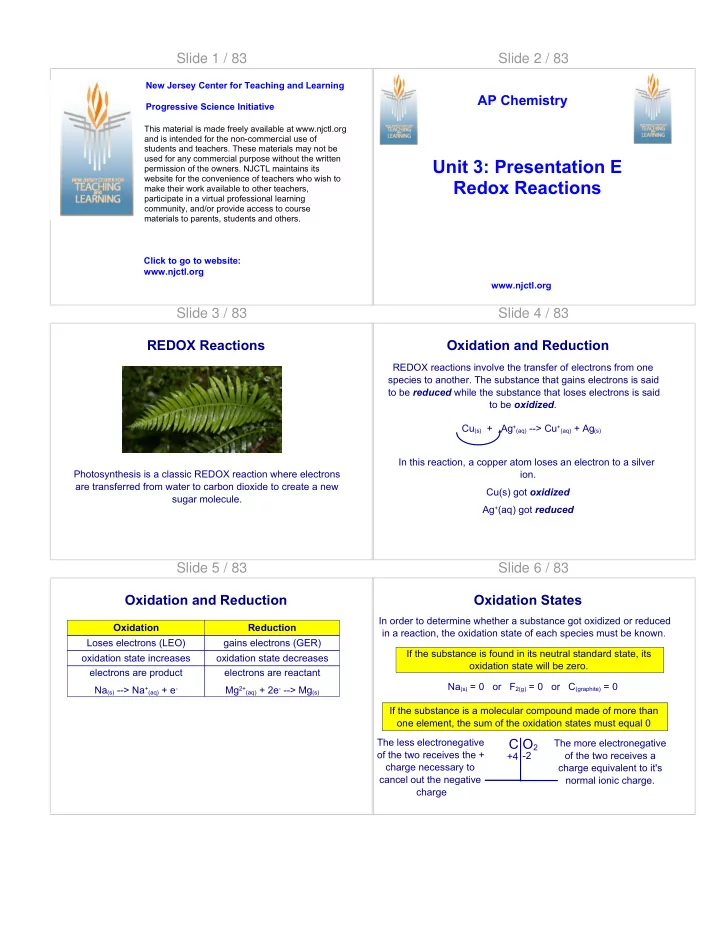
Photosynthesis is a classic REDOX reaction where electrons are transferred from water to carbon dioxide to create a new sugar molecule.
Slide 4 / 83 Oxidation and Reduction
REDOX reactions involve the transfer of electrons from one species to another. The substance that gains electrons is said to be reduced while the substance that loses electrons is said to be oxidized. Cu(s) + Ag+(aq) --> Cu+(aq) + Ag(s) In this reaction, a copper atom loses an electron to a silver ion. Cu(s) got oxidized Ag+(aq) got reduced
Slide 5 / 83 Oxidation and Reduction
Oxidation Reduction Loses electrons (LEO) gains electrons (GER)
- xidation state increases
- xidation state decreases
electrons are product Na(s) --> Na+(aq) + e- electrons are reactant Mg2+(aq) + 2e- --> Mg(s)
Slide 6 / 83 Oxidation States
In order to determine whether a substance got oxidized or reduced in a reaction, the oxidation state of each species must be known. If the substance is found in its neutral standard state, its
- xidation state will be zero.
Na(s) = 0 or F2(g) = 0 or C(graphite) = 0 If the substance is a molecular compound made of more than
- ne element, the sum of the oxidation states must equal 0
C O2
The more electronegative
- f the two receives a
charge equivalent to it's normal ionic charge.
- 2
The less electronegative
- f the two receives the +