
Slide 1 / 121
This material is made freely available at www.njctl.org and is intended for the non-commercial use of students and teachers. These materials may not be used for any commercial purpose without the written permission of the owners. NJCTL maintains its website for the convenience of teachers who wish to make their work available to other teachers, participate in a virtual professional learning community, and/or provide access to course materials to parents, students and others.
Click to go to website: www.njctl.org New Jersey Center for Teaching and Learning Progressive Science Initiative
Slide 2 / 121
www.njctl.org
The Atom
AP Chemistry Slide 3 / 121 Deducing the structure of the atom took a lot of brainpower. . .
and even more funky hair styles
Slide 4 / 121 Birth of Atomic Theory
A number of key discoveries led to the current understanding that the atom is the basic building block of matter.
- 1. Law of Definite Composition
- 2. Law of Multiple Proportions
Slide 5 / 121
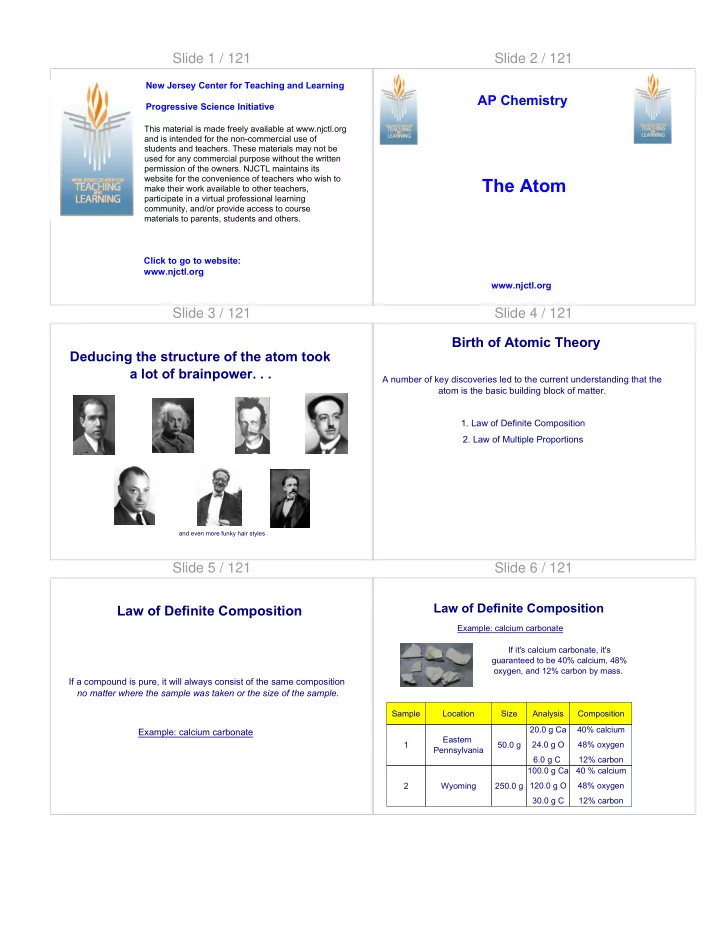
If a compound is pure, it will always consist of the same composition no matter where the sample was taken or the size of the sample.
Law of Definite Composition
Example: calcium carbonate
Slide 6 / 121
Sample Location Size Analysis Composition 1 Eastern Pennsylvania 50.0 g 20.0 g Ca 24.0 g O 6.0 g C 40% calcium 48% oxygen 12% carbon 2 Wyoming 250.0 g 100.0 g Ca 120.0 g O 30.0 g C 40 % calcium 48% oxygen 12% carbon Example: calcium carbonate If it's calcium carbonate, it's guaranteed to be 40% calcium, 48%
- xygen, and 12% carbon by mass.