New Jersey Center for Teaching and Learning AP Chemistry - - PDF document

new jersey center for teaching and learning ap chemistry
SMART_READER_LITE
LIVE PREVIEW

New Jersey Center for Teaching and Learning AP Chemistry - - PDF document

Slide 1 / 83 Slide 2 / 83 New Jersey Center for Teaching and Learning AP Chemistry Progressive Science Initiative This material is made freely available at www.njctl.org and is intended for the non-commercial use of students and teachers.


slide-1
SLIDE 1

Slide 1 / 83

This material is made freely available at www.njctl.org and is intended for the non-commercial use of students and teachers. These materials may not be used for any commercial purpose without the written permission of the owners. NJCTL maintains its website for the convenience of teachers who wish to make their work available to other teachers, participate in a virtual professional learning community, and/or provide access to course materials to parents, students and others.

Click to go to website: www.njctl.org New Jersey Center for Teaching and Learning Progressive Science Initiative

Slide 2 / 83

www.njctl.org

Unit 3: Presentation E Redox Reactions

AP Chemistry Slide 3 / 83 REDOX Reactions

Photosynthesis is a classic REDOX reaction where electrons are transferred from water to carbon dioxide to create a new sugar molecule.

Slide 4 / 83 Oxidation and Reduction

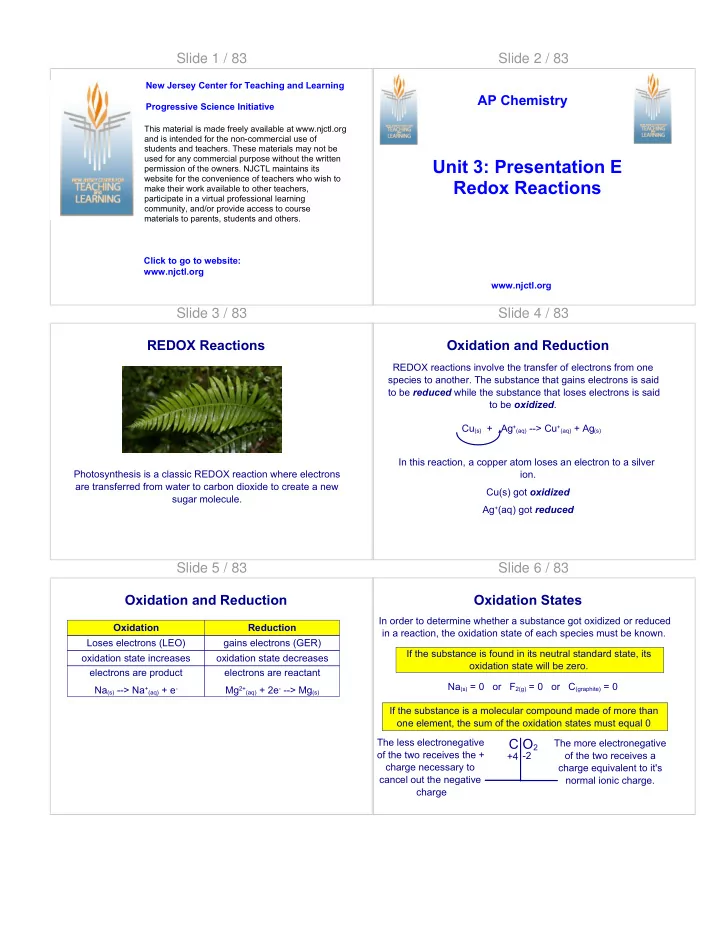
REDOX reactions involve the transfer of electrons from one species to another. The substance that gains electrons is said to be reduced while the substance that loses electrons is said to be oxidized. Cu(s) + Ag+(aq) --> Cu+(aq) + Ag(s) In this reaction, a copper atom loses an electron to a silver ion. Cu(s) got oxidized Ag+(aq) got reduced

Slide 5 / 83 Oxidation and Reduction

Oxidation Reduction Loses electrons (LEO) gains electrons (GER)

  • xidation state increases
  • xidation state decreases

electrons are product Na(s) --> Na+(aq) + e- electrons are reactant Mg2+(aq) + 2e- --> Mg(s)

Slide 6 / 83 Oxidation States

In order to determine whether a substance got oxidized or reduced in a reaction, the oxidation state of each species must be known. If the substance is found in its neutral standard state, its

  • xidation state will be zero.

Na(s) = 0 or F2(g) = 0 or C(graphite) = 0 If the substance is a molecular compound made of more than

  • ne element, the sum of the oxidation states must equal 0

C O2

The more electronegative

  • f the two receives a

charge equivalent to it's normal ionic charge.

  • 2

The less electronegative

  • f the two receives the +

charge necessary to cancel out the negative charge +4

slide-2
SLIDE 2

Slide 7 / 83 Oxidation States

For ionic species, the sum of the oxidation states must equal the charge on the ion.

S O32-

+4 -2 For ionic compounds, first separate the compound into its ions, then determine charge on each element.

Mg Cr2O7

+2 -2

Cr2 O7

+ 6 -2

Slide 8 / 83 Oxidation States

Peroxides and hydrides In a peroxide (H2O2 or Na2O2) O carries an oxidation state of -1. In a hydride (NaH or CaH2), H carries an oxidation state of -1.

Slide 9 / 83

1

Oxidation/Reduction reactions study the transfer of ________ between atoms and molecules.

A protons B neutrons C H+ ions D

OH- ions

E

electrons

Slide 10 / 83

2

Which of the substances found in the reaction below would contain an element with an

  • xidation number = 0?

10Au(s) + 36H+(aq) + 6NO3-(aq) --> 3N2(g) + 18H2O(l) + 10Au3+(aq)

A Au B HNO3 C Au and N2 D

Au and H2O

E

N2 and Au3+

Slide 11 / 83

3

In the substance glucose (C6H12O6), the sum total of the oxidation states must equal _____.

A 0 B +1 C

The sum total of the number of valence electrons present in each element

D

+3

E

24

Slide 12 / 83

4

In the compound IBr, which element would be the most electronegative and what would it's oxidation state be?

I Br

A I, -1 B Br, -1 C I, 0 D

Br, 0

E

Br, +1

slide-3
SLIDE 3

Slide 13 / 83

5

The oxalate ion, C2O42-, is one of the common components of kidney stones! Which is the more electronegative atom in the ion and what is it's

  • xidation state?

A C, +4 B C, -2 C C, -4 D

O, -2

E

O, -4

Slide 14 / 83

6

The polyatomic ion cyanide (CN-) is toxic and used in the mining of gold in America's desert southwest. Which of the following could be a correct set of

  • xidation states for C and N in the ion?

A C = +4, N = -3 B C = +4, N = 0 C C = +2, N = -3 D

C = 0, N = +1

E

C = -3, N = +4

Slide 15 / 83

7

What is the oxidation state of O in the compound N2O (laughing gas) and what would be the total negative charge from all the oxygens?

N N O

A -2, -2 B -1, 0 C -2, 0 D

  • 2, -4

E

  • 2, -4

Slide 16 / 83

8

What would be the oxidation state of the fluorine atom in the compound OF2 and what would be the total negative charge from the Flourines?

A -1, -1 B 0, -1 C -1, -2 D

  • 1, -3

E

  • 1, 0

Slide 17 / 83 Slide 18 / 83

10

What is the oxidation number of each oxygen atom in the compound MnO 2 ?

A

  • 2

B

  • 1

C D

+1

E

+2

slide-4
SLIDE 4

Slide 19 / 83

11 What is the oxidation state of S in the S2O32- ion?

The S2O32- ion can do great harm to metals like iron.

A -2 B +2

C -1 D +4 E 0

Slide 20 / 83

12 What is the oxidation state of each atom in

CaC2O4?

A Ca = 0, C = +2, O = -2 B Ca = +2, C = +2, O = -2 C Ca = +4, C = +4, O =-2 D

Ca = +2, C = +3, O = -2

E

Ca = +2, C = +4, O = -2

Slide 21 / 83

13 In 2004, Coca cola had to recall their Dasani brand

water because of the presence of the bromate ion in the drinking water. What would be the oxidation state of all atoms in CuBrO3?

A Cu = +2, Br = -1, O = -2 B Cu = +1, Br = +3, O = -2 C Cu = +2, Br = +4, O = -2 D

Cu = +1, Br = +5, O =-2

E

Cu = 0, Br = +6, O =-2

Slide 22 / 83

14 Chloroform, CHCl3, has wide uses. It is used as an

anesthetic, a refrigerant, and in the making of teflon. What is the oxidation state of carbon in chloroform?

A -2 B -1 C D

+2

E -3

Slide 23 / 83

15 In which of the following compounds would oxygen

have an oxidation state of -1?

A Li2O2 B Mg(OH)2 C CH3OH D O2 E Li2O

Slide 24 / 83 REDOX Reactions

To determine which substances got oxidized or reduced, look at the change in the substances oxidation state. H+(aq) + I O3-(aq) + F-(g) --> I2(s) + F2(aq) + H2 O(l) +1 +5 -2

  • 1

+1 -2 IO3-(aq) got reduced = +5 --> 0 F2(g) got oxidized = 0 --> -1

slide-5
SLIDE 5

Slide 25 / 83

16 Which of the following represents a reduction?

A An elements charge going from -3 --> -2 B An elements charge going from -2 -->-3 C An elements charge going from 0 --> +2 D An elements charge going from +1 --> +3 E None of these

Slide 26 / 83

17 Which of the following represents an oxidation?

A Al3+(aq) --> Al(s) B F2(g) --> 2F-(aq) C Mn7+ --> Mn2+ D

Fe2+(aq) --> Fe3+(aq)

E

O-(aq) --> O2-(aq)

Slide 27 / 83

18 In which of the following equations does O get

  • xidized?

A 2H2O2 -- 2H2O + O2 B 2H2O --> 2H2 + O2 C CH4 + 2O2 --> CO2 + 2H2O D 3Fe + 3O2 --> 2Fe2O3 E A and B

Slide 28 / 83

19 Which of the following is NOT an oxidation/reduction

reaction?

A Ca + 2H+ --> Ca2+ + H2 B H2 + Cl2 -->2HCl C 4Al + 3O2 --> 2Al2O3 D

CaO + CO2 --> CaCO3

E

Mg3N2 --> 3Mg + N2

Slide 29 / 83

20 Which of the following would be TRUE regarding the

reaction that occurs below.

Cr2O72-(aq) + 14H+(aq) + 6Fe2+(aq) --> 2Cr3+(aq) + 7H2O(l) + 6Fe3+(aq) A Cr2O72- gets oxidized to Cr3+ B Fe2+ gets reduced to Fe3+ C H+ gets reduced to H2O D

Cr2O72- gets oxidized to H2O

E

Fe2+ gets oxidized to Fe3+

Slide 30 / 83 Oxidizing and Reducing Agents

Any substance that gets oxidized is called a reducing agent or reducer becomes the electrons lost will be gained by another species. Any substance that gets reduced is called an oxidizing agent

  • r oxidizer becomes the electrons gained will be lost by

another species. Remember: Reducing Agents are Oxidized Oxidation Agents are Reduced.

slide-6
SLIDE 6

Slide 31 / 83 Oxidizing and Reducing Agents

Good reducing agent must lose electrons easily. Neutral metals

  • r substances with low ionization energies fit the bill.

For example: Na, I-, Fe2+ Good oxidizing agents must gain electrons easily. Neutral or positive non-metals or highly positive metals fit the bill here. For example: MnO4-, CrO42-, F2, O2, HNO3

Slide 32 / 83

21 Identify the oxidizing agent in the following

reaction. Al(s) + 6HCl(aq) --> AlCl3(aq) + H2(g)

A Al B AlCl3 C HCl D H2

Slide 33 / 83

22 Which substance is oxidized in the following

reaction? (First, assign oxidation numbers.) Cu + S ➝ CuS

A Cu B S C

Cu and S

D CuS E This is not a redox reaction.

Slide 34 / 83

23 Which substance is the reducing agent below?

Cu + S ➝ CuS

A Cu B S C

Cu and S

D CuS E This is not a redox reaction.

Slide 35 / 83

24 Which substance is oxidized in the following

reaction? (First, assign oxidation numbers.) Ca + Fe3+ ➝ Ca2+ + Fe

A Ca B Fe3+ C

Ca2+

D Fe E This is not a redox reaction.

Slide 36 / 83

25 Which substance is the reducing agent?

3 K + Al(NO3)3 ➝ Al + 3 KNO3

A K B Al(NO3)3 C

KNO3

D This is not a redox reaction.

slide-7
SLIDE 7

Slide 37 / 83

26 Which of the following would make the best

  • xidizing agent?

A H2O B IO3- C IO2- D I2 E I-

Slide 38 / 83

27 Which of the following would make the best reducing agent? A F2(g) B Cl2(g) C K(s) D Al(s) E C(s)

Slide 39 / 83

28 Good oxidizing agents will have low ionization energies. Yes No

Slide 40 / 83

29 Which of the following would make the best

  • xidizing agent?

A HNO B HNO2 C HNO3 D Na E H2O

Slide 41 / 83

30 Which of the following would make the best reducing agent? A F- B Cl- C Br- D I- E O2-

Slide 42 / 83 Balancing REDOX Reactions

In a redox reaction, both the atoms AND electrons must be balanced. Example: Cu2+(aq) + Ag(s) --> Cu(s) + Ag+(aq) Gained 2 e- Lost 1 e- Even though there is one of each atom on each side, the equation is not balanced because the number of electrons lost does not equal the number gained. This can be changed by reacting more Ag atoms so more electrons are lost. Balanced: Cu2+(aq) + 2Ag(s) --> Cu(s) + 2Ag+(aq) Gained 2 e- Lost 2 e-

slide-8
SLIDE 8

Slide 43 / 83 Balancing REDOX Reactions

Example: Balance the following: Al(s) + Fe2+(aq) --> Al3+(aq) + Fe(s) 2Al(s) + 3Fe2+(aq) --> 2 Al

3+(aq) + 3Fe(s)

Lost 6e- Gain 6e-

move for answer Slide 44 / 83

31 What is the correct set of coefficients when the

reaction below is balanced? Cu+(aq) + Mg(s) --> Cu(s) + Mg2+(aq)

A 1,2,1,2 B 1,1,1,1 C 2,1,2,1 D

2,2,1,1

E

1,1,2,2

Slide 45 / 83 Balancing REDOX Reactions

REDOX reactions occur in solutions just like most of the reactions we do in Chemistry. REDOX reactions are different because the medium in which the reaction occurs affects the results of the reactions. Since REDOX reactions depend on the movement of electrons, certain chemical species - like rogue H + ions (aka protons) - can have an impact on how the reaction occurs. Therefore, when balancing a REDOX reaction it is important to note if there is an excess or deficit of H + ions. In other words, is the solution in which the reaction is occurring Acidic (excess of H +) or Basic (deficit

  • f H+). Acidic and Basic solutions have slightly different rules for

balancing in each scenario.

Slide 46 / 83

Guidelines for Balancing REDOX Reactions

  • 1. Determine Oxidation states of all elements
  • 2. Determine which element was oxidized, which was reduced
  • 3. Write half reactions for the element that was oxidized and the element

that was reduced

  • 4. Using coefficients, balance the elements (all non-hydrogen or non-
  • xygen elements) that are being oxidized/reduced in each half reaction
  • 5. Balance remaining oxygen atoms in water molecules in each

half reaction

  • 6. Balance the remaining hydrogen atoms with H+ ions in each half reaction
  • 7. Balance charge with electrons (e-) in each half reaction
  • 8. Multiple coefficients in each half reaction by a number to make sure

electrons are balanced

  • 9. Recombine the two half reactions by adding them together. Cancel out

any redundant chemical species - electrons should always cancel out

Slide 47 / 83

MnO4-(aq) + Fe2+(aq) --> Fe3+(aq) + MnO2(s)

MnO4- O:-2 Mn + (4*-2)=-1 Therefore: Mn: +7 Fe: +2 MnO2 O:-2 Mn + (2*-2)=0 Therefore: Mn:+4 Fe: +3 Step 1) Determine Oxidation states of all elements

Acidic REDOX Reactions Example Slide 48 / 83

MnO4-(aq) + Fe2+(aq) --> Fe3+(aq) + MnO2(s) MnO4- O:-2 Mn + (4*-2)=-1 Therefore: Mn: +7 Fe: +2 MnO2 O:-2 Mn + (2*-2)=0 Therefore: Mn:+4 Fe: +3 Step 2) Determine which element got oxidized and which element got reduced Because Mn went from an oxidation state of +7 to +4, it must have been reduced. Because Fe went from an oxidation state of +2 to +3, it must have been oxidized. (It is able to accept more oxygen now since it is more positive) Question: Mn is the oxidizing agent and Fe is the reducing agent.

Acidic REDOX Reactions Example

Which agent is the oxidizing agent?

slide-9
SLIDE 9

Slide 49 / 83

MnO4-(aq) + Fe2+(aq) --> Fe3+(aq) + MnO2(s) Step 3) Write half reactions for the element that was oxidized and the element that was reduced MnO4-(aq) --> MnO2(s) Fe2+(aq) --> Fe3+(aq) Reduction half reaction Oxidation half reaction

Note: A half reaction is literally just one half of a reaction. It is useful sometimes in REDOX reactions to look at the reduction half and the oxidation half separately, and to write a half reaction just look at the change in the species reducing (reduction half reaction) and the change in the species oxidizing (oxidation half reaction). REMEMBER: Since a half reaction is only PART of a chemical reaction it may include invalid chemical species (like lone electons, cations, or anions). When you

  • riginally write half reactions they may not be balanced. THAT IS OKAY!

Acidic REDOX Reactions Example Slide 50 / 83

Step 4) Using coefficients, balance the elements that are being

  • xidized/reduced in each half reaction

MnO4-(aq) --> MnO2(s) Fe2+(aq) --> Fe3+(aq) Reduction half reaction Oxidation half reaction Mn is already balanced! Fe is already balanced!

Acidic REDOX Reactions Example Slide 51 / 83

Step 5) Balance the remaining Oxygen atoms with water molecules in each half reaction MnO4-(aq) --> MnO2(s) + 2H2O(l) Fe2+(aq) --> Fe3+(aq)

2 excess Oxygen atoms are balanced with 2 more water molecules No Oxygen needs balancing!

Reduction half reaction Oxidation half reaction

Acidic REDOX Reactions Example Slide 52 / 83

Step 6) Balance the remaining Hydrogen atoms with H+ ions in each half reaction

MnO4-(aq) + 4H+(aq) --> MnO2(s) + 2H2O(l) Fe2+(aq) --> Fe3+(aq) 4 excess Hydrogen atoms are balanced with 4 more H+ ions No Hydrogen needs balancing

Reduction half reaction Oxidation half reaction

Acidic REDOX Reactions Example Slide 53 / 83

Step 7) Balance the charge with electrons in each half reaction MnO4-(aq) + 4H+(aq) --> MnO2(s) + 2H2O(l) Fe2+(aq) --> Fe3+(aq)

Charges: MnO4-:-1*1 =-1 H+: +1*4 =+4 Total +4 + -1 =+3 Charges: MnO2-: 0 H+: 0 Total 0 Charges: Fe2+:+2*1=+2 Total +2 Charges: Fe3+: +3*1=+3 Total +3

MnO4-(aq) + 4H+(aq) + 3e- --> MnO2(s) + 2H2O(l) The charges can be balanced by adding 3e- to the reactants side of this half reaction The charges can be balanced by adding 1e- to the products side of this half reaction

Fe2+(aq) --> Fe3+(aq) + e- Reduction half reaction Oxidation half reaction

Acidic REDOX Reactions Example Slide 54 / 83

Step 8) Multiply coefficients in each half reaction to make sure electrons are balanced

MnO4-(aq) + 4H+(aq) + 3e- --> MnO2(s) + 2H2O(l)

Fe2+(aq) --> Fe3+(aq) + e-

Multiply the oxidation half reaction by 3 in order to balance

  • ut the 3 electrons in the

reduction half reaction

3Fe2+(aq) --> 3Fe3+(aq) + 3e- Reduction half reaction Oxidation half reaction

Acidic REDOX Reactions Example

slide-10
SLIDE 10

Slide 55 / 83

Step 9) Recombine the two half reactions by adding them together. Cancel out any redundant chemical species

Reduction half reaction + Oxidation half reaction

MnO4-(aq) + 4H+(aq) + 3e- --> MnO2(s) + 2H2O(l)

3Fe2+(aq) --> 3Fe3+(aq) + 3e-

MnO4-(aq) + 4H+(aq) + 3e- + 3Fe2+(aq)--> MnO2(s) + 2H2O(l) + 3Fe3+(aq) + 3e- MnO4-(aq) + 4H+(aq) + 3Fe2+(aq)--> MnO2(s) + 2H2O(l) + 3Fe3+(aq)

Acidic REDOX Reactions Example Slide 56 / 83 Balancing REDOX Reactions in Acid Solutions

MnO4-(aq) + Fe2+(aq) --> MnO2(s) + Fe3+(aq)

Check that all atoms and charges are balanced

4H+(aq) + MnO4-(aq) + 3Fe2+(aq) --> MnO2(s) + 3Fe3+(aq) + 2H2O(l) Reactants Products Fe atoms = 3 Fe atoms = 3 Mn atoms = 1 Mn atoms = 1 O atoms = 4 O atoms = 4 H atoms = 4 H atoms = 4 Total charge = 9+ Total charge = 9+

Slide 57 / 83

NO3-(aq) + I2(s) --> IO3-(aq) + NO2(g)

Determine Oxidation states of all elements

NO3-(aq) + I2(s) --> IO3-(aq) + NO2(g) 5, -2 0 5,-2 4,-2

Determine which element was oxidized, which was reduced

Reduced: NO3-(N went from +5 -->+4) Gained 1 e- Oxidized: I2 (I went from 0 -->+5) Lost 5 e - move for answer move for answer

Balancing REDOX Reactions in Acid Solutions Slide 58 / 83

Using coefficients, balance the elements that are being oxidized/ reduced

NO3-(aq) + I2(s) --> IO3-(aq) + NO2(g) NO3-(aq) + I2(s) --> 2IO3-(aq) + NO2(g)

Multiply coefficients by a number to make sure electrons are balanced

10NO3-(aq) + I2(s) --> 2IO3-(aq) + 10NO2(g) Gain 10 e- Lose 10 e-

move for answer

move for answer

Balancing REDOX Reactions in Acid Solutions Slide 59 / 83

Balance remaining oxygen atoms with water molecules

NO3-(aq) + I2(s) --> IO3-(aq) + NO2(g) 10NO3-(aq) + I2(s) --> 2IO3-(aq) + 10NO2(g) + 4H2O(l)

Balance remaining H atoms with H+ ions

8H+(aq) + 10NO3-(aq) + I2(s) --> 2IO3-(aq) + 10NO2(g) + 4H2O(l)

move for answer

move for answer

Balancing REDOX Reactions in Acid Solutions Slide 60 / 83

NO3-(aq) + I2(s) --> IO3-(aq) + NO2(g) Reactants Products N atoms = 10 N atoms = 10 I atoms = 2 I atoms = 2 O atoms = 30 O atoms = 30 H atoms = 8 H atoms = 8 Total charge = 2- Total charge = 2-

Check that all atoms and charges are balanced

8H+(aq) + 10NO3-(aq) + I2(s) --> 2IO3-(aq) + 10NO2(g) + 4H2O(l)

Move for answer Balancing REDOX Reactions in Acid Solutions

slide-11
SLIDE 11

Slide 61 / 83

32 What is the proper coefficient in front of CO2 after the equation below is balanced in an acidic medium?

H+(aq) + MnO4− (aq) + C2O42− (aq) ➝ Mn2+ (aq) + CO2 (aq) + H2O(l)

A 1 B 2 C 4 D 6 E 10

Slide 62 / 83

33 What is the coefficient of the bromide ion after the following REDOX reaction is balanced? A 1 B 2 C 4 D 5 E 6

N2H4(l) + BrO3-(aq) --> N2(g) + Br-(aq) + H2O(l)

Slide 63 / 83

34 For the reaction represented below, how many electrons will be transferred when the equation is properly balanced? Cu + NO3- --> NO2 + Cu2+

A 2 B 4 C 5 D 6 E 8

Slide 64 / 83 Guidelines for Balancing Basic REDOX Reactions

To balance REDOX reactions that occur under basic conditions, follow the same steps for acidic conditions with one key difference. Recall, in an acidic solution there are excess H+ ions, which is why it is okay to leave H+ in the final reaction ex: MnO4-(aq) + 4H+(aq) + 3Fe2+(aq)--> MnO2(s) + 2H2O(l) + 3Fe3+(aq) However, in a basic solution there are no excess H+ ions, so we must eliminate the H+ ions. We do that by adding something that exists in excess in a basic solution - OH- ions. Balancing Basic REDOX Reactions BONUS STEP:

  • 10. Add OH- ions to both sides of your reaction to cancel out H+

ions and convert them to water. *Remember, cancel out any redundant chemical species you create in doing this!

Slide 65 / 83 Basic REDOX Reactions Example

Step 10) Add OH- ions to both sides of your reaction to cancel out excess H+ ions and convert them to water. *Remember, cancel out any redundant chemical species you create in doing this! MnO4-(aq) + 4H+(aq) + 3Fe2+(aq)--> MnO2(s) + 2H2O(l) + 3Fe3+(aq) 4 OH- ions are needed on each side to cancel out the H+ ions

MnO4-(aq) + 4H+(aq) + 3Fe2+(aq) + 4OH-(aq)--> MnO2(s) + 2H2O(l) + 3Fe3+(aq)+ 4OH-(aq)

OH- ions combine with H+ ions to form water

MnO4-(aq) + 3Fe2+(aq) + 4H2O(l)--> MnO2(s) + 2H2O(l) + 3Fe3+(aq)+ 4OH-(aq)

Cancle out the redundant species MnO4-(aq) + 3Fe2+(aq) + 4H2O(l)--> MnO2(s) + 2H2O(l) + 3Fe3+(aq)+ 4OH-(aq) MnO4-(aq) + 3Fe2+(aq) + 2H2O(l)--> MnO2(s) + 3Fe3+(aq)+ 4OH-(aq) Final Answer!

Slide 66 / 83

Zn + NO3- --> Zn2+ + NH4+ Follow procedure for balancing in acidic solution 10H+ + 4Zn + NO3- --> 4Zn2+ + NH4+ + 3H2O After adding H+ ions, add equivalent number of OH- to each side 10 OH- + 10H+ + 4Zn + NO3- --> 4Zn2+ + NH4+ + 3H2O + 10 OH-

Balancing REDOX Reactions in Basic Solutions

slide-12
SLIDE 12

Slide 67 / 83

Zn + NO3- --> Zn2+ + NH4+ The H+ and OH- will react to make water, cancel out water from each side if necessary 10 H2O + 4Zn + NO3- --> 4Zn2+ + NH4+ + 3H2O + 10 OH- 7H2O + 4Zn + NO3- --> 4Zn2+ + NH4+ + 10 OH- so after canceling 3 H2O from each side

Balancing Redox Reactions in Basic Solutions Slide 68 / 83

Zn + NO3- --> Zn2+ + NH4+ Check atoms and charges 7H2O + 4Zn + NO3- --> 4Zn2+ + NH4+ + 10 OH- Reactants Products Zn atoms = 4 Zn atoms = 4 N atoms = 1 N atoms = 1 O atoms = 10 O atoms = 10 H atoms = 14 H atoms = 14 Total charge = -1 Total charge = -1

Balancing Redox Reactions in Basic Solutions

move for answer Slide 69 / 83

Follow procedure for balancing in acidic solution PbO2(s) + Cl-(aq) --> ClO-(aq) + Pb(OH)3-(aq) 2H2O(l) + PbO2(s) + Cl-(aq) --> ClO-(aq) + Pb(OH)3- + H+(aq) After adding H+ ions, add equivalent number of OH- to each side

OH-(aq) + 2H2O(l) + PbO2(s) + Cl-(aq) --> ClO-(aq) + Pb(OH)3- + H+(aq) + OH-(aq)

move for answer move for answer Balancing Redox Reactions in Basic Solutions Slide 70 / 83

The H+ and OH- will react to make water, cancel out water from each side if necessary

OH-(aq) + 2H2O(l) + PbO2(s) + Cl-(aq) --> ClO-(aq) + Pb(OH)3- + H2O(l)

And after crossing out 1 H2O molecule from each side

OH-(aq) + H2O(l) + PbO2(s) + Cl-(aq) --> ClO-(aq) + Pb(OH)3-

PbO2(s) + Cl-(aq) --> ClO-(aq) + Pb(OH)3-(aq)

move for answer Balancing Redox Reactions in Basic Solutions Slide 71 / 83

Check atoms and charges

OH-(aq) + H2O(l) + PbO2(s) + Cl-(aq) --> ClO-(aq) + Pb(OH)3- (aq)

PbO2(s) + Cl-(aq) --> ClO-(aq) + Pb(OH)3-(aq) Reactants Products Pb atoms = 1 Pb atoms = 1 Cl atoms = 1 Cl atoms = 1 H atoms = 3 H atoms = 3 O atoms = 4 O atoms = 4

move for answer

Balancing Redox Reactions in Basic Solutions

Slide 72 / 83

35 When the following reaction is balanced in basic

solution, what is the proper coefficient in front of the hydroxide ion and which side of the reaction is it on? MnO4-(aq) + IO3-(aq) --> MnO2(s) + IO4-(aq)

A 3, product side B 2, product side C 2, reactant side D

3, reactant side

E

1 reactant side

slide-13
SLIDE 13

Slide 73 / 83

36 When the equation below is balanced in basic

solution, what are the proper coefficients for the hydroxide and bromide ions respectively? Br2(l) + OH-(aq) --> Br-(aq) + BrO3-(aq) + H2O(l)

A 6OH- and 5Br- B 3OH- and 2Br- C 6OH- and 4Br- D

2OH- and 2Br-

E

5OH- and 3Br-

Slide 74 / 83

37 What is the coefficient of the hydroxide ion after the following REDOX reaction has been balanced? A 2 B 4 C 6 D 8 E 10

Cl2(g) + Cr(OH)3(s) + OH-(aq) --> Cl-(aq) + CrO42-(aq) + H2O(l)

Slide 75 / 83

Application

The breathalyzer test is a REDOX reaction that uses a color change to see how much alcohol (C2H5OH) is present in a driver's breath. Cr2O72-(aq) + C2H5OH(aq) --> CH3COOH(aq) + Cr3+(aq)

  • range

colorless colorless blue/green The officer can then see how much alcohol is present by looking for a color change from orange to blue/green. Now, let's balance it in acid solution!

2Cr2O72-(aq) + 3C2H5OH(aq) + 16H+(aq) --> 3CH3COOH(aq) + 4Cr3+(aq) + 11H

2O(l)

move for answer

Slide 76 / 83 REDOX Stoichiometry

Titrations can be utilized in REDOX reactions to determine the concentration of an analyte. By oxidizing or reducing an analyte with a standardized reductant

  • r oxidant titrant, the amount of analyte can be determined.

standardized titrant unknown analyte

Slide 77 / 83 REDOX Stoichiometry

The end point of a titration is often accompanied by a color change as a substance is either formed or created. It is then important to know some colors for some important oxidants and reductants. MnO4-(aq) = purple CrO42-(aq) = yellow Cr2O72-(aq) = orange

Slide 78 / 83 REDOX Stoichiometry

Transition metal ions also form complex ions that have particular colors. Fe3+(aq) = yellow/brown Co2+(aq) = pink Cu2+(aq) = blue Cr3+(aq) = green

slide-14
SLIDE 14

Slide 79 / 83 REDOX Stoichiometry

Let's examine a titration of potassium permanganate with iron(II) nitrate in acidic medium

8H+(aq) + MnO4-(aq) + 5Fe2+(aq) --> Fe3+(aq) + Mn2+(aq) + 4H2O(l)

As the permanganate disappears, so does the purple color and as the Fe3+ is made, the yellow/brown color appears. When the purple is gone, the permanganate has all reacted.

Excess MnO4-(aq) Excess Fe3+(aq)

Slide 80 / 83

38 How many mL of 2M HCl would need to be added to 10 mL of 0.34 M solution of potassium permanganate in order for all of the permanganate to be titrated by the reaction below?

8H+(aq) + MnO4-(aq) + 5Fe2+(aq) --> Fe3+(aq) + Mn2+(aq) + 4H2O(l)

Slide 81 / 83

39 How many mL of 0.44 M iron(II) nitrate would be needed to titrate a 340 gram sample of potassium permanganate by the reaction below?

8H+(aq) + MnO4-(aq) + 5Fe2+(aq) --> Fe3+(aq) + Mn2+(aq) + 4H2O(l)

Slide 82 / 83

40 What would be the expected color change in the analyte given the following titration? A red to orange B purple to clear C yellow to green D orange to clear E the color will remain the same

CrO42-(aq) + I-(aq) --> I2(s) + Cr3+(aq)

analyte titrant

Slide 83 / 83