Nature as an owner: the next step in environmental protection? - - PowerPoint PPT Presentation
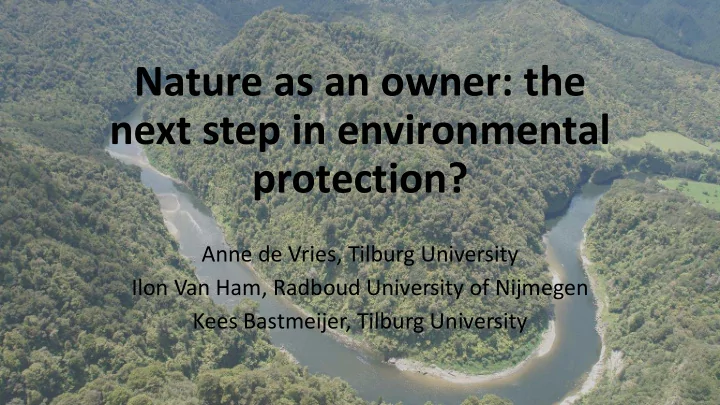
Nature as an owner: the next step in environmental protection? Anne de Vries, Tilburg University Ilon Van Ham, Radboud University of Nijmegen Kees Bastmeijer, Tilburg University Western (liberal) view on nature T he earth and all that is
Western (liberal) view on nature
“The earth and all that is therein is given to men for the support and comfort of their being” (John Locke, 1690)
Nature protection through property rights?
- De Vries-Stotijn, Van Ham, Bastmeijer,
Protection through property From private to river-held rights, Water International 2019(44), P. 736-751
- The Netherlands: Natuurmonumenten
- Society with over 719.000 members
- Owning 101,066 hectares (363 areas)
- New Zealand: Queens Elisabeth II Trust
- Network of private owned properties
- More than 182.000 ha (4503 covenants)
- Semi-public supervision by trust
- Independent from states
- Long term protection
possible
- Increasing popularity
- Additional to public
environmental law
- Limits public expenses
- Voluntary
- Monitoring and supervision
- Lack of specialized knowledge
- Less suitable for areas owned by
many different owners
- Legal limitations (e.g. no main
positive duties via Dutch easement; res nullius)
- States become lazy?
Whanganui River: A legal person owning the river
Te Awa Tupua Act 2017
- S 12: “Te Awa Tupua is “an indivisible and living whole,
comprising the Whanganui River from the mountains to the sea, incorporating all its physical and metaphysical elements.”
- S 14: “Te Awa Tupua is a legal person and has all the
rights, powers, duties, and liabilities of a legal person.”
- The river acts and speaks through a representative body,
Te Pou Tupua (S 19(d))
Effects
- Transfer of crown-owned parts to
Te Awa Tupua (S. 40-41)
- Cannot be allianated (S. 43)
- River liable as owner (S. 56 &
Schedule 5)
- Tax (S. 25)
Limitations
- The Act does not limit existing
private property rights or public use (S. 16 &46)
- Private owned parts can be
transferred and vested in Te Awa Tupua only with full consent of the private owner (S. 48-49)
- Water cannot be owned
Better alternative to no
- wnership
- Strong signal, nature gets
“own” voice
- Shift in thinking about human-
nature relationship
- Legal standing
- Independent from the whims
- f politics
- River-owned parts cannot be
allianated
- Still human-made, can be
taken away again
- Private ownership is
unaffected
- Water cannot be owned
- Practical?
- Equally expensive for states
The future
- Better alternative to no ownership
- Legal personality for animals?