SLIDE 1 1
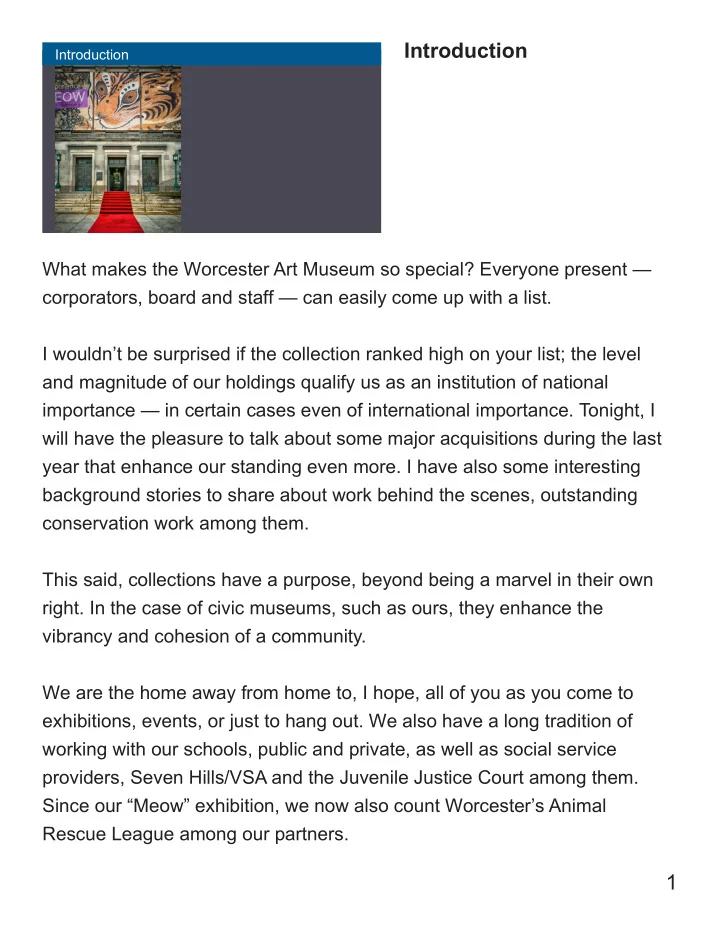
What makes the Worcester Art Museum so special? Everyone present — corporators, board and staff — can easily come up with a list. I wouldn’t be surprised if the collection ranked high on your list; the level and magnitude of our holdings qualify us as an institution of national importance — in certain cases even of international importance. Tonight, I will have the pleasure to talk about some major acquisitions during the last year that enhance our standing even more. I have also some interesting background stories to share about work behind the scenes, outstanding conservation work among them. This said, collections have a purpose, beyond being a marvel in their own
- right. In the case of civic museums, such as ours, they enhance the
vibrancy and cohesion of a community. We are the home away from home to, I hope, all of you as you come to exhibitions, events, or just to hang out. We also have a long tradition of working with our schools, public and private, as well as social service providers, Seven Hills/VSA and the Juvenile Justice Court among them. Since our “Meow” exhibition, we now also count Worcester’s Animal Rescue League among our partners.
Introduction
Introduction
SLIDE 2 2
But this is not where ambitions end. Some of you may still remember the Corporator meeting four years ago, when our 2020 vision was presented and endorsed. This statement is in your package — study it well! It is the framework for measuring this museum’s — YOUR museum’s —
- success. WAM’s vision builds on Worcester’s renaissance, as our city
evolves from a stand-alone hub into an important actor of the Greater Boston-Area. What about leveraging our collections and programs to increase the local "cool" factor? When students enroll into our 13 colleges and universities, Worcester must be an additional asset. What about partnering with our neighbors (WPI among them) to enhance our neighborhood and thereby enhance Worcester’s attraction, not just for its citizens but also those who live in the nearby? Don’t forget: there are several million potential visitors within a half hour car ride! But first things first. I would like to start my report on the past year by highlighting some of the events that fueled the substantial growth in
- attendance. We basically doubled the number of visitors to the Museum
within four years, to nearly 124,000 in fjscal year 2016.
Introduction
Introduction
SLIDE 3 3
There are many “events of the year” that take place at the Worcester Art Museum. In certain cases, these are “events of a lifetime,” such as weddings organized in our Renaissance Court or, for the first time this year, the swearing in of judges. Building on this, I am proud to announce that the Worcester Art Museum is becoming a site for naturalization ceremonies, and the fjrst event will take place a month from now. There are also many personal experiences that we become aware of when visitors share them with us. For those whom we welcomed for the very fjrst time, it may have been an outing with friends, the “wow” effect of a particular artwork, or the mastering of a new technique in the studio art program. In terms of impact, it is fair to say that the Meow exhibition allowed us to break quite some visitation records. Combined with the presentation of our Last Judgment tapestry, our team — supported by The Coby Foundation and Worcester’s own Rand-Whitney Container — was able to create the perfect museum experience. Thanks to the ongoing generosity of The Kirby Foundation, we were able to offer another Free August, attracting this time no less than 23,000 guests. Those of you who dropped by that month could see with your own eyes that our facilities can actually support that kind of
- ambition. Our 2020 goal of 200,000 visitors would only require a monthly
average between 16,000 and 17,000. Let’s do it!
Events of the Year
Events of the Year
SLIDE 4 4
When the Higgins Armory Museum Collection came to us, overnight we became the steward for the second most important collection of arms and armor in the Western hemisphere (second only to the Metropolitan Museum of Art in New York City). Worcester Art Museum became a much more family-focused organization, and you will see further progress in the years to come. Such a sudden change via art acquisition is, however, rare. Normally, collections evolve over time, and it is our responsibility that we aim consistently high and remain consistent with our role as a regional powerhouse. Two acquisitions highlight this year’s achievements. Philippe-Jacques Van Brée’s outstanding depiction of a studio with female students from 1816 was one of the stars of the last international art fair in Maastricht in the
- Netherlands. We know of three major museums that tried to acquire the
- painting. Our Director of Curatorial Affairs, Jon Seydl, supported by a board
member, Rachel Kaminsky, led the race! Jon spotted this gem, worked with the gallery, Rachel, and me over just one day to secure the purchase of this delightful work, beating all the other contenders out of the field. This painting will be one of the highlights of our upcoming Flora in Winter event. The other work is a painting we bought in New York. It is by a distinguished artist from the first half of the 20th century, Otto Dix, and comes with an equally distinguished provenance. It also provoked quite some soul
Enhancing the Collection
Enhancing the Collection
SLIDE 5
5
searching when we discussed the purchase. One member of the collections committee said something that will always stay with me: Worcester is among the top ten destinations for refugees of war, many of them from areas where museums don’t exist — a work like this they can totally relate to, as pregnancy is part of the human experience. Did you ever wonder why this subject is so rarely to be seen in museums? The texts next to Otto Dix’s work in the gallery will give you part of the answer.
Enhancing the Collection
Enhancing the Collection
SLIDE 6 6 Enhancing the Collection
I would also like to thank all those who continued to give high level art to the Museum. Last year alone we received 40 works, most of them on paper, which will become part of future exhibitions, or for the “inside take,” make an appointment with our department of Prints Drawings and Photographs — a stunning collection in its own right that constitutes more than 60% of
From all these gifts, Cornelis van Haarlem’s large format depiction of Paris and Oenone is highlighted here. No more a household name today, Cornelis was a prominent representative of the early Dutch Golden Age, catering to the refined tastes of Europe s high aristocracy and ultra-wealthy
- merchants. We already own two small formats by this artist, but this work is
a true visual anchor when you enter the last of our Renaissance galleries. The theme, a couple of lovers, is also a highly welcome addition to WAM’s growing collection of mythological scenes, underscoring the pagan and life- embracing aspect of our European heritage. When you look for that work in
- ur galleries, don’t forget to pay a visit to Venus Disarming Cupid, which is
attributed to Paulo Veronese and was donated only some years ago by the same collector, Hester Diamond. It is passionate art lovers like her and all of the others who have enhanced our collections this past fiscal year and the years before, that deserve our gratitude. Let us thank our generous donors with rousing applause!
Enhancing the Collection
SLIDE 7 7 Caring for the Collection
I want to give you a little “insider” knowledge about how we care for our
- collections. Did you know that museums not only add to collections but
also let works go? De-accessioning, the museum term, is rather time
- consuming. It consists of identifying material in the collection that has either
been included erroneously, no longer meets quality standards, or exists in too many versions. After careful consideration by experts from in and
- utside the organization, the collections committee presents a list to the full
board for vote. Works in question are either given to other organizations or sold at auction. The money earned always goes back into the acquisition
- fund. In the past Fiscal Year, we de-accessioned 862 works, that have now
found good homes elsewhere. As a consequence, we will soon be able to relinquish our off-site storage and will reduce our operating costs. My report about collection care would be incomplete if I didn’t mention
- conservation. This last year was outstanding for Rita Albertson and her
- team. On the left you can see a detail of our superb Renoir, which is a
reinterpretation of Delacroix’ masterwork at the Louvre Museum in Paris;
- n the right the Last Judgment tapestry, one of our claims to fame as a
collection.
Caring for the Collection
SLIDE 8 8
Let us start with the Renoir. Some time ago, we were approached by the Tate in London and the Minneapolis Museum of Art about a loan for their exhibition about the impact of Delacroix on later generations. Renoir’s version of Delacroix’s masterwork was considered of central importance for the argument. This was the incentive for our conservation lab to look a bit closer at the work. The varnish had yellowed over many years, and although I always was very fond of that painting by Renoir but had no inkling
- f the beauty that unfolded after treatment. Just in terms of brushwork and
color, our recent conservation efforts have yielded magnifjcent results. We now see the magic of white Mediterranean light, the incredibly fresh colors, and the brushwork that makes Renoir so special (although there are many art historians who love to hate his work). See for yourself in our Jeppson IdeaLab, where you also learn about details of the treatment. Our Renoir, which I consider to be a masterpiece in its own right, will soon reclaim its rightful place of choice in our 19th-century gallery of European painting.
Caring for the Collection
Caring for the Collection
SLIDE 9 9
Now to the Last Judgment tapestry, which over 50 years of display in the Renaissance Court had collected more than its fair share of grime. Additionally, colors of more recent repairs had faded considerably, and in some areas the stability of the fabric needed to be reinforced. As you may recall, we received a generous grant from two Belgian organizations — the King Baudoin Foundation and the René and Karin Jonckeheere Fund — to finance conservation. This connection is very much due to one of
- ur friends in Antwerp, Thomas Leyson, to whom I send my heartfelt
- thanks. Our chief conservator accompanied our treasure to a specialized
laboratory outside Brussels. After successful treatment, the tapestry was first put on view in an exhibition organized by the Royal Museums in the Belgian capital, and five months later was displayed in its regained splendor at WAM. Unfortunately, tapestries cannot be shown for as long as paintings — originally, they were taken out only for very special
- ccasions — think coronations, high profile visits, religious holidays etc.
When will you see it again? We promise it will be soon, this time in combination with other art works — think Arms and Armor or Renaissance Paintings.
Caring for the Collection
Caring for the Collection
SLIDE 10 10
Collecting art and caring for it is only part of what art museums do. We facilitate the experience of art and, thereby, enhance the civic life of our
- region. We provide value by connecting, supporting, and partnering.
“The Museum was amazingly impressive,” writes a visitor from MetroWest. “A marvelous cross-cultural journey ... You seem to have successfully found the perfect balance between ... scholarship and the ability to relate that in a friendly, lighthearted way to visitors of all ages and educational levels ... I still can’t stop mentally reviewing all of the wonderful and engaging things I saw (last week) ... a real highlight of my summer! I keep online-researching art I saw there because I want to learn more about it. Your exhibitions are truly stimulating!” This is one of many comments we received over the past year. We invite our visitors to give us feedback, positive and negative, so that we know where we are on the right track and where we need to improve.
Connecting, Supporting and Partnering
Connecting, Supporting and Partnering
SLIDE 11 11
Connecting, Supporting and Partnering
Connecting, Supporting and Partnering
Besides connecting individual visitors with art, we leverage our collections to support the mission of organizations in the community. Did you know that the Worcester Art Museum started as early as in 1919 to work with the public school system? We were one of the first museums in the country to connect children with the magic of art and the empowerment of artistic
- expression. We continue to do that and to also expand our collaboration
with institutions of higher education — Worcester has 13 colleges and serves more than 35,000 students. One of our proudest initiatives in the last year was the Cyanotypes exhibition, put together with a professor and students of Clark University. The students received first hand curatorial experience, and the university got mentions in the national press, as well as the prospect of further grant money for such collaborative projects. We also expanded our collaboration with the Worcester Youth Center, which provides “a place where young people can build lasting positive change in their lives,” and who had their first art exhibition at WAM. We work with such diverse groups as UMass Medical School Family Medicine residents, garden clubs, associations of senior and residents of assisted living homes, boys and girl scouts, as well as homeschoolers. We are currently reaching close to 20,000 visitors annually via these collaborations, and further growth is planned.
SLIDE 12
12
But art is really just the starting place for connection: our art is and should be a vehicle for our becoming a civic center. The Renaissance Court is now a polling station — more than 500 citizens from our precinct cast their votes this past November in the national elections. In my introductory remarks, I already mentioned the swearing in ceremony for federal judges in Central Massachusetts and our fjrst naturalization ceremony on January 11th. What can be more moving than to become a citizen of this country, surrounded by 5000 years of human creativity? We will do everything we can so that these 48 new citizens will consider the Museum as their new home away from home.
Connecting, Supporting and Partnering
Connecting, Supporting and Partnering
SLIDE 13 13
The renaissance of Worcester is based on a vibrant and expanding Greater Boston Area. Our city has transformed itself from a stand-alone industrial hub to a service, education, and research-driven player. The reach of the Museum is expanding beyond Worcester County. We now serve Norfolk and Middlesex counties, and reach Southern New Hampshire as well as Northern Connecticut. Within half an hour’s drive are more than two million inhabitants! Total visitation numbers have grown continuously; we have more than doubled our visitation since 2011. In the last fiscal year we welcomed more than 120,000 visitors. The Worcester-Boston corridor has been an important contributor. From FY15 to FY16 we saw a 50% increase in the number of non-member visitors from Greater Boston, the majority coming from Middlesex County. Much more growth is possible. That growth will support our ambition to reach 200,000 visitors by 2020. We also made quite some headway in terms of diversifying and growing
- ur corporation geographically. In this hall, we now gather a much higher
percentage of representatives from our neighboring counties, in addition to looking towards Boston. We also connect with the school systems east
- f us, and we partner with chambers of commerce and not for profits
wherever possible. There is definite opportunity, when our offerings are at equidistance and of equal attraction. Think about the intimacy of the experience of high level art, the availability of parking, the absence of traffjc jams, etc.
Becoming a Regional Magnet
Becoming a Regional Magnet
SLIDE 14 14 Access!
Access, however, plays an important role, too. This starts with the physical access — our access bridge towards the Salisbury Street entrance embodies our commitment. As you may remember, this entrance was closed for many years, and was one of the first things we addressed in
- 2012. The bridge opened in November of last year, with the presence of
State Senators Harriette Chandler and Michael Moore, Worcester Mayor Joe Petty and City Manager Ed Augustus, and Anita Walker of the Massachusetts Cultural Council. Access is also predicated on money. Although in our current operational model we depend on entrance fees, we do our very best to open the Museum for free: think of our Free August, which allowed us to grow visitation almost ten fold, from 2,400 visitors in 2011 to 23,000 this summer! Think free first Saturday mornings of each month, when our family audience visitation peaks. Moving forward, we will continue to need help to keep this up.
Access!
SLIDE 15 15
n n n n n n n n n n n n n n n n n n w w w w w w w w w w w w Ó ^ w w w w w Ó ^ w Ó ^ Ó ^ Ó ^ Ó ^
! ! ! ! ! ! ! ! ! ! ! ! ! ! ! i i i i i i i i i i i i i i i
WPI Gateway Park Worcester Polytechnic Institute (WPI) Campus Institute Park Salisbury Park Elm Park Elm Park SALISBURY ST GROVE ST PARK AVE T S T T O C S E R P T S T N E C S E R C 9 2 E T A T S R E T N I B E E C H M O N T S T N O R T H S T LANCASTER ST WEST ST D E A N S T D R U R Y L N M E T C A L F S T OTSEGO RD INSTITUTE RD LEE ST VALLEY HILL DR SAGAMORE RD BOYNTON ST WHITMAN RD W A C H U S E T T S T P I N E T R E E D R GERMAIN ST DOVER ST HAVILAND ST S U N V A L L E Y D R HIGHLAND ST G O L D S B E R R Y S T WESTLAND ST RUSSELL ST FOREST ST MILTON ST EINHORN RD H A C K F E L D R D REGENT ST H A R V A R D S T PRATT ST M O N T V A L E R D RUTLAND TER FARNUM ST M O N A D N O C K R D L I N C O L N S T ACADEMY ST ERNEST S. JOHNSON UP W A S H B U R N W A Y FARADAY ST MILITARY RD MAIN ST BURGESS RD B A N C R O F T T O W E R R D EDGEWORTH ST ELBRIDGE ST H U M B O L D T A V E SCHUSSLER RD T R O W B R I D G E R D HOMER ST B U T T E R N U T H I L L D R WACONAH RD GARDEN ST HALL ST ALGONQUIN RD CARBON ST POWERS CT OLD LINCOLN ST MASSACHUSETTS AVE BROOKFIELD ST FRUIT ST B E L M O N T S T G O U L D I N G S T T S N E D I R B T U C K E R M A N S T H O W E S T UNNAMED RD B Y R O N S T SEVER ST HOWATSON WAY S I G O U R N E Y S T MAJOR TAYLOR BLVD VALLEY HILL LN M O U N T H O P E T E R FENIMORE RD BERKSHIRE ST SHEFFIELD RD MORAN CT R E D D I N G C T PINE TREE LN LANCASTER TER MILTON PL R U S S E L L S T T S M U N R A F MONADNOCK RD WEST ST MASSACHUSETTS AVE
±
500 1,000 250 Feet
Size: 11x17
Salisbury Cultural District
1 in = 500 ft
Rural Cemetery Massachusetts Avenue Local Historic District Montvale Local Historic District WORCESTER HOLDEN AUBURN MILLBURY SHREWSBURY B O Y L S T O N LEICESTER GRAFTON
§ ¨
I-190
§ ¨
I-290 Produced by: smithm Date: 5/13/2015 Path: Z:\eoed\Zoning Map\Zoning Certification\Map_Cultural District_2014-04-15_MS_edits_5-11-2015_w-Overlays.mxd 2.5 5 1.25 Miles
Locus Map Legend Cultural District Boundary Adaptive Re-Use of Buildings Cultural / Civic Institution House of Worship Selected Housing Massachusetts Avenue Local Historic District Montvale Local Historic District Parks WPI Main Campus
Ó ^
Creative Economic Businesses
! i
Parking
n w
Restaurants WRTA Bus Stops Founding Stakeholders
" ¸
American Antiquarian Society
"
Worcester Center for Crafts
" º
Worcester Historical Museum
" »
Worcester Art Museum
"
Worcester Polytechnic Institute
"
Worcester State University
"
" ¿
Friends of Institute Park Bancroft Tower (National Historic Register)
What if?
When we talk about reaching visitors from the broader region — and beyond — we must also think about our built environment. Visitors who drive for half an hour or longer need parking, they also need a welcoming beginning to their visit. To that effect, we founded the Salisbury Cultural District a year
- ago. It is located on the Northern end of Main Street, comprises WPI, the
American Antiquarian Society, the Historical Museum, Tuckerman Hall, Trinity Church, Veterans Inc., and many more business and organizations. It is by working together that we will accomplish big things, such as landscaping, parking, and upgrading of streetscape. In addition, we will be doing our part for the urban renaissance of our city. Southern Main Street — thanks to successful efforts of our city administration, Hanover Theatre and many more — is taking off now. Although urban decay has hit our part of Worcester much less hard, a successful holistic approach on Main North will do wonders, not only for us but also for the capacity of Worcester to ultimately regenerate the entirety of Main Street. The development of the Voke Lofts, the Old Courthouse, and
- ther once empty buildings is just the beginning.
What if?
SLIDE 16 16
What if?
What if?
When we talk about the Worcester Art Museum as the living room of Worcester and a magnet for the entire region, we must also think about our
- facility. Our collection has grown — think of the 2000 pieces of Arms and
Armor — but the building also shows its age after decades of deferred
- maintenance. Did it ever strike you that the locations for our shop and café
could be better? What about the coat check for groups, the state of our rest rooms? Have your friends ever complained about difficult navigation, the absence of sufficiently big spaces for functions, such as big weddings? The list goes on and on. Now is the moment to do something about it, without breaking the bank.
SLIDE 17
17
What if?
What if?
We contracted wHY, the same architecture firm that designed and built the aforementioned access bridge, to conceive of a master plan for WAM. The Principle, Kulapat Yantrasast, and his team, are among the rising stars in the world of architecture. As far as I know, there is no major competition in and outside the US where wHY isn’t on the list of invited competitors. The track record is impressive and comprises the Metropolitan and the Harvard Art Museums, as well as the Chicago Art Institute, besides colleges — Pomona in California — parks, and residences. While our plan is still a work in progress, I would like to share with you some images, under the auspices of the magical two words: what if. You are seeing the current state of our Lancaster facade on the left and a rendering of how that side could be transformed into a truly welcoming main entrance, centralizing visitor amenities while also addressing our issues of visitor flow. There is a lot of behind-the-scenes that we need to address at the same time: art storage and transportation, offices, climate control — you name the issues, we have got them.
SLIDE 18
18 What if?
What if?
Kulapat Yantrasast calls his team’s proposed interventions “acupuncture.” Like the insertion of needles sets off a broader healing process for us humans, relatively modest interventions in the body of the building will have a gigantic and positive impact on the institutional capacity to serve.
SLIDE 19 19
What if?
What if?
Admittedly, the entrance lobby, as rendered here, looks quite ambitious. Yet, it is only an addition of about 6,000-square feet — 6,000 square feet that will allow us to grow our permanent gallery space by about 30% and the temporary exhibition space by 10%, while we transform our entire campus into a lively addition to the experience of Worcester. Stay tuned. We will inform you as plans develop. We are currently talking with all of
- ur neighbors, the city, as well as our friends from the Worcester Colleges,
about cost sharing synergies, leveraging what we have for a shared future.
SLIDE 20 20
Solid Financial ¡Growth
$1,786,996 ¡ 24% $1,466,646 ¡ 20% $4,093,866 ¡ 56% 2011 Earned ¡Revenue Raised ¡Revenue Endowed ¡Revenue $1,896,292 ¡ 21% $2,945,658 ¡ 33% $4,175,517 ¡ 46% 2016 Earned ¡Revenue Raised ¡Revenue Endowed ¡Revenue
Financial Growth Since 2011
Before talking about expansion, we need to work on our finances. Jim Collins, our treasurer, talked about challenges and solutions. Let me expand on the latter: WAM’s financial evolution in the past five years is something to be very proud of. As the comparison between 2011 and 2016 shows, our annual operating budget has grown from $8.7M to $10.8M, which corresponds to a whopping increase of 24%. This increase translates into institutional vibrancy. All the accomplishments I have been reporting
- n so far would not have been possible without the appropriate resources.
The more resources we have, the better we can contribute to the renaissance of our city and to the cultural life of our region! Rarely does a single income stream suffice to allow an institution the realization of its full potential. Normally, it is the combination of earned, raised, and endowment-generated revenues that plug the need. The Higgins is a case in point. While able to earn revenue, it struggled because there was no sufficient endowment and limited capacity to raise money. As we all know, the Higgins Armory closed and transformed the Worcester Art Museum, which made it a “win-win” equation for both institutions.
Financial Growth Since 2011
SLIDE 21 21
As opposed to most regional cultural institutions, the Worcester Art Museum is fortunate to have an endowment of consequence. That endowment takes care of basic needs and also assures — via permanently restricted funds — that we can continue to build our collection. This said, our recent financial growth is mostly based on raised income, which has grown during the past five years from roughly $1.4M to $4M. As the pie charts show, the contribution to our annual operating budget has grown from 20% to 33%. This is truly an accomplishment. Our earned revenue has also grown, from $1.8M to $1.9M, but that is modest in comparison. What defines raised revenue? Grant money is a big contributor; we have been increasingly successful with our applications to local, regional, and national foundations. But others have also contributed significantly to our financial increase. Within the last five years, board giving has tripled. We have many representatives of our local foundations, as well as our board in the room, and I would like to express my heartfelt thanks for this growing investment in the cultural vibrancy of our community.
Solid Financial ¡Growth
$1,786,996 ¡ 24% $1,466,646 ¡ 20% $4,093,866 ¡ 56% 2011 Earned ¡Revenue Raised ¡Revenue Endowed ¡Revenue $1,896,292 ¡ 21% $2,945,658 ¡ 33% $4,175,517 ¡ 46% 2016 Earned ¡Revenue Raised ¡Revenue Endowed ¡Revenue
Financial Growth Since 2011
Financial Growth Since 2011
SLIDE 22 22
We have also seen signifjcant growth in corporator support. This is my
- pportunity to thank all of YOU in this room. Those who went from one
level of giving to the next, thank you, those who have helped to attract new members to our Salisbury society, thank you, those who helped grow
- ur business partners, thank you. Not everybody can give on the same
magnitude — but every gift to this institution counts and is an investment in the cultural vibrancy of Worcester and the region. We are as good and impactful as you want us to be.
Solid Financial ¡Growth
$1,786,996 ¡ 24% $1,466,646 ¡ 20% $4,093,866 ¡ 56% 2011 Earned ¡Revenue Raised ¡Revenue Endowed ¡Revenue $1,896,292 ¡ 21% $2,945,658 ¡ 33% $4,175,517 ¡ 46% 2016 Earned ¡Revenue Raised ¡Revenue Endowed ¡Revenue
Financial Growth Since 2011
Financial Growth Since 2011
SLIDE 23 23
Successfully Diversifying our Income Streams
2,000,000 ¡ 4,000,000 ¡ 6,000,000 ¡ 8,000,000 ¡ 10,000,000 ¡ 12,000,000 ¡ 2011 2012 2013 2014 2015 2016 2017 2018 2019 2020 Earned ¡Revenue Raised ¡Revenue Endowed ¡Revenue
Financial Forecast
Financial Forecast
As much as the accomplishments of the past are reason to celebrate, we must plan for the future. As we build momentum, it is important to decrease the percentage of our endowment draw. Our Long Range Plan requests that WAM’s draw decreases to 5.5% by 2020 and, shortly thereafter, to 4.5%. This is doable, but means that raised and earned revenue need to grow further. I’ve already covered raised revenue; let me now focus on the earned portion, which is more complicated. One measure for museums like ours looks at things like the café and studio art programs: do they break even? The volume of our café has grown tremendously and our shop is thriving. Most museums don’t consider these revenue streams as consequential, but guests appreciate the opportunity to eat, and to take home a memento of their museum experience.
SLIDE 24 24
Successfully Diversifying our Income Streams
2,000,000 ¡ 4,000,000 ¡ 6,000,000 ¡ 8,000,000 ¡ 10,000,000 ¡ 12,000,000 ¡ 2011 2012 2013 2014 2015 2016 2017 2018 2019 2020 Earned ¡Revenue Raised ¡Revenue Endowed ¡Revenue
Financial Forecast
Financial Forecast
The bigger numbers are traditionally provided via revenue at the gate, basic membership and facility rentals. We are working on boosting those income sources at a higher rate. A year from now, I will hope to talk about successes in these quarters and plans for further growth. How can you as corporators help? Encourage your friends to become members, and encourage your friends and businesses to rent our spaces for receptions. But make no mistake; as much as our focus will be on earned income in the years to come, the biggest contribution to the vibrancy of your Museum will come from philanthropic giving. So please help us to attract new Salisbury members, new business partners, corporate giving, etc.
SLIDE 25 25
Jim Welu
People
People
Since stepping down as director, Jim Welu has continued to be a stellar ambassador for the Museum, behind the scenes and on center stage. Would you believe that it is already five years ago that he passed the baton to me? Besides building on his legacy, we also made quite some progress in honoring his amazing contributions to this institution over the 25 years of his tenure as director. You may remember that in my last report, I talked about an endowment campaign in his honor. I now have the pleasure to tell you that we are on the homestretch of that campaign, with the goal of finishing it no later than next spring. Then, our Director of Curatorial Affairs will also proudly sign as the James A. Welu Curator of European Art at the Worcester Art Museum, in the same way that I am signing as the C. Jean and Myles McDonough Director of this wonderful institution. I would like to thank all those who generously have contributed to make this happen. We will soon have reasons to celebrate Jim at WAM.
SLIDE 26 26
There are many people that I could include in my ending remarks. Our annual report, which is available for viewing on-line, will have to take care
- f that. Let me simply thank our outgoing president, Joe Bafaro Jr, for his
incredible services to this institution. It has been such a pleasure to work with you and the Board, Joe. We will miss you on the executive committee, your wisdom in so many complex situations will resonate as we will ask
- urselves, “What would Joe do?” I know that you will be staying engaged
— we made plans. Let me also welcome our new president, Lisa Kirby Gibbs, who — like all
- f you — cares so much for this institution, sees all the potential that we
have, and will unlock it with the staff, us, and all of you, our corporators. We are living in exciting times of mastering challenges, of growth, of fun realizing this wonderful institution’s potential further. We can all say that we were there, ready to do our share to make this a transformative couple of years! Please join us for the reception in the Renaissance Court in the Museum to continue this celebration. Thank you.
Yes, We Can!
Lisa Kirby Gibbs Joe Bafaro
Yes, we can!