Mole Mapping: Managing High Risk Patients through Imaging 1 - - PDF document

mole mapping managing high risk patients through imaging
SMART_READER_LITE
LIVE PREVIEW

Mole Mapping: Managing High Risk Patients through Imaging 1 - - PDF document

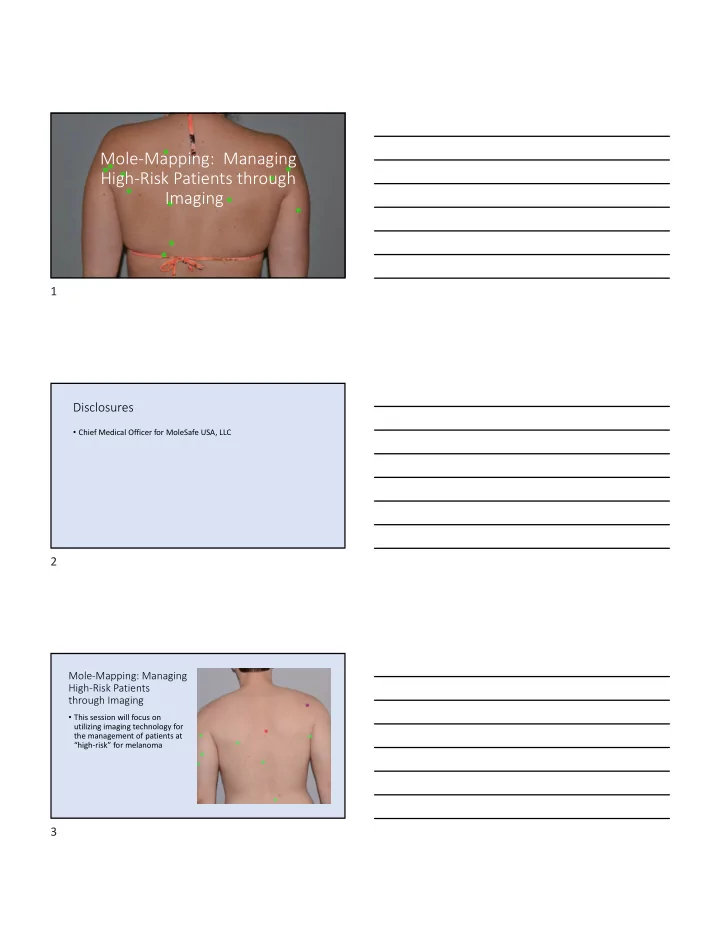
Mole Mapping: Managing High Risk Patients through Imaging 1 Disclosures Chief Medical Officer for MoleSafe USA, LLC 2 Mole Mapping: Managing High Risk Patients through Imaging This session will focus on utilizing imaging


slide-1
SLIDE 1

Mole‐Mapping: Managing High‐Risk Patients through Imaging

Disclosures

  • Chief Medical Officer for MoleSafe USA, LLC

Mole‐Mapping: Managing High‐Risk Patients through Imaging

  • This session will focus on

utilizing imaging technology for the management of patients at “high‐risk” for melanoma

1 2 3

slide-2
SLIDE 2

ABCD’s of Melanoma

A – Asymmetry B – Border Irregularity C – Color Variegation D – Diameter great than 6 mm

And E

E – Evolving

‐ Size ‐ Shape ‐ Symptoms ‐ Surface Bleeding ‐ Shades of Color

Abbasi,N.R.et al. Early Diagnosis of Cutaneous Melanoma.Revisiting The ABCD Criteria .JAMA. 2004;292:2771‐2776

Defining a “High‐Risk” Patient

  • North America Definition
  • Personal History of Melanoma
  • Family History of Melanoma
  • Dysplastic Nevi
  • Many Nevi
  • Fair skin, inability to tan

Watts CG, Dieng M, Morton RL, et al. Clinical practice guidelines for identification, screening and follow‐up of individuals at high risk of primary cutaneous melanoma: a systematic review. British Journal of Dermatology. 2015: 33‐47

4 5 6

slide-3
SLIDE 3

Melanoma Statistics

  • Increase in incidents rates
  • It is estimated that the number of new melanoma cases diagnosed in 2019

will increase 7.7%

  • Most new melanomas are de novo
  • How can we spot them?

American Cancer Society – Cancer Facts & Figures 2019 A meta‐analysis of nevus‐associated melanoma: Prevalence and practical implications Pampena, Riccardo et al. Journal of the American Academy of Dermatology, Volume 77, Issue 5, 938 ‐ 945.e4

A recent study published in the JAAD shows that there is general agreement among Pigmented Lesion Experts recommending Total Body Photography and Dermoscopic Imaging for “high‐risk” patients.

Recommendation #1: Total body photography is recommended for patients with familial atypical multiple mole melanoma syndrome (FAMMM Syndrome, aka dysplastic nevus syndrome) Strongly Agree: 91% Agree: 0% Neither Agree nor Disagree: 9% Disagree: 0% Strongly Disagree: 0% Recommendation #1: Serial digital dermoscopic imaging is recommended for montioring "ugly duckling" nevi with equivocal dermoscopic features Strongly Agree: 55% Agree: 27% Neither Agree nor Disagree: 0% Disagree: 0% Strongly Disagree: 18% Recommendation #2: Total body photography is recommended in adults with > than 50 nevi that have one or more

  • f the following: (1) a personal history of

multiple cutaneous melanomas; (2) a personal history of an amelanotic melanoma; multiple pink nevi, multiple clinically atypical nevi, and/or; (3) a genetic syndrome that predisposes to the development of cutaneous melanoma. Strongly Agree: 64% Agree: 36% Neither Agree no Disagree: 0% Disagree: 0% Strongly Disagree: 0% Recommendation #2: Serial digital dermoscopic imaging is recommended in patiets with a large or growing lentigo‐ like lesion that lack diagnostic dermoscopic features with a plan to re‐ evaluate at a three to six‐month interval Strongly Agree: 27% Agree: 55% Neither Agree no Disagree: 18% Disagree: 9% Strongly Disagree: 0% Total Body Photography Serial Digital Dermoscopic Imaging

Waldman RA, Grant‐Kels JM, Curiel CN, Curtis J, Rodriguez SG, Hu S, Kerr P, Marghoob A, Markowitz O, Pellacani G, Rabinovitz H, Rao B, Scope A, Stein JA, Swetter SM, Consensus Recommendations for the Use of Non‐Invasive Melanoma Detection Techniques Based on Results of an International DELPHI Process, Journal of the American Academy of Dermatology (2019), doi: https://doi.org/10.1016/j.jaad.2019.09.046.

7 8 9
slide-4
SLIDE 4

A recent study published in the JAAD shows that there is general agreement among Pigmented Lesion Experts recommending Total Body Photography and Dermoscopic Imaging for “high‐risk” patients.

Waldman RA, Grant‐Kels JM, Curiel CN, Curtis J, Rodriguez SG, Hu S, Kerr P, Marghoob A, Markowitz O, Pellacani G, Rabinovitz H, Rao B, Scope A, Stein JA, Swetter SM, Consensus Recommendations for the Use of Non‐Invasive Melanoma Detection Techniques Based on Results of an International DELPHI Process, Journal of the American Academy of Dermatology (2019), doi: https://doi.org/10.1016/j.jaad.2019.09.046.

What is Mole‐ Mapping?

  • Combining multiple imaging techniques and

clinical follow‐up

  • Total Body Photography
  • Clinical Imaging
  • Dermoscopic Imaging

1 + 1 = 3

Total Body Photography (TBP) 10 11 12

slide-5
SLIDE 5

TBP – Photographic Medical Record

Creating a benchmark, similar to an EKG or x‐ray

Incidence of New and Changed Nevi and Melanomas Detected Using Baseline Images and Dermoscopy in Patients at High Risk for Melanoma

Jeremy P. Banky, MBBS; John W. Kelly, MDBS; Arch Dermatol. 2005;141:998-1006.

  • The use of baseline photography and dermoscopy was associated

with low biopsy rates and early detection of melanomas. Only 3 nevi were biopsied for every melanoma.

  • This compares to benign‐malignant ratios of 12:1 for dermatologists

and 30:1 for general physicians.

TBP – Identifying New Lesions 13 14 15

slide-6
SLIDE 6

TBP – Identifying Changing Lesions Underlying Rationale of using TBP

‐ Stable lesions are biologically indolent (senescent) ‐ New/Changing lesions are biologically relevant & may represent:

‐ Melanoma ‐ Melanoma Precursor

Courtesy of Dr. Marghoob & Dr. Rabinovitz

< 1‐3% new or changed lesions will be melanoma (clinical)

Study Year # pts. # lesions Nevi/ patient # changed # melanoma %MM/ changed Schiffner 2003 145 272 1.9 95 0.0 Bauer 2005 196 2015 10.3 128 2 1.6 Robinson 2004 100 3482 34.8 193 4 2.1 Banky 2005 309 573 18 3.1 Kittler 2000 202 1862 9.2 75 8 10.7 Menzies 2001 245 318 1.3 61 7 11.5 Hasenssle 2004 212 2939 13.9 112 15 13.4 Altamura 2008 1859 2602 1.4 487 81 16.6

Courtesy of Dr. Marghoob & Dr. Rabinovitz

TS1

16 17 18

slide-7
SLIDE 7

Slide 18 TS1

Taylor Sheridan, 10/11/2019

slide-8
SLIDE 8

Patients who benefit from Total Body Photography

  • Personal/Family History of melanoma
  • Atypical/Dysplastic Nevi Syndrome
  • Multiple Nevi of different size, shape, and color
  • Patient’s with high anxiety of developing melanoma

Clinical/Dermoscopic Imaging

How good are skin cancer specialists at diagnosing melanoma based on visual examination alone?

  • Sensitivity = 70%
  • Specificity = 75%
  • NNT (benign: malignant ratio) = 12-15
  • Bafounta. Arch Dermatol 2001;137:1343
  • Marks. JAAD;1997;36:599
  • Hansen. JAAD 2009;61:599
  • Vestergaard. BJD 2008;159:669

Carli , BJD;2004;150:687

Courtesy of Dr. Marghoob & Dr. Rabinovitz

19 20 21

slide-9
SLIDE 9

Diagnostic accuracy of melanoma may be improved with dermoscopy Pehamberger et al. 1993: diagnostic accuracy of 46‐54% (clinical) increasing to 62‐91% (dermoscopy)

How good are skin cancer specialists at diagnosing melanoma with aid of dermoscopy?

  • Sensitivity = 90%
  • Specificity = 86%
  • NNT (benign:malignant ratio) = 4-7
  • Vestergaard. BJD 2008;159:669

Bafounta, Arch Dermatol 2001;137:1343

  • Hansen. JAAD 2009;61:599

Carli , BJD;2004;150:687

Courtesy of Dr. Marghoob & Dr. Rabinovitz

Spectrum of Melanocytic Lesions

Nevi Malignant Melanoma

22 23 24

slide-10
SLIDE 10

Clinical Exam

There are only a few clinical features which separate melanoma from nevi.

Nevi Malignant Melanoma

Lesions in the overlapping area often require a biopsy for diagnosis. Clinically Uncertain Lesions

Dermoscopic Exam

With dermoscopy there are dermoscopic features that correlate to benign or malignant patterns, thereby improving accuracy over clinical visual inspection

Nevi Malignant Melanoma Benign Patterns Malignant Patterns Intrinsic Limitation of Dermoscopy: Uncertain Patterns

Sometimes a dermatoscope isn’t enough

  • Powerful tool to aid the diagnosis of early

melanomas

  • High‐risk patients need more than a “point in

time” evaluation

25 26 27

slide-11
SLIDE 11

Sometimes a dermatoscope isn’t enough

  • How can you spot change

without reference images?

Short Term Surveillance

Image a suspicious melanocytic lesion that does not satisfy the classic dermoscopic criteria for the diagnosis of melanoma. The lesion is then re‐imaged at 3 month intervals. If a change is noted, the lesion is biopsied. It is believed that if a lesion is malignant, there will be a change within this time period without a significant risk to the patient.

The Value of Serial Digital Dermoscopic Imaging (SDDI) 28 29 30

slide-12
SLIDE 12

Why use Mole Mapping?

  • For Providers
  • Increased Sensitivity & Specificity
  • Reduced Benign‐to‐Malignant Ratio
  • Time Restrictions
  • For Patients
  • Earlier Diagnosis
  • No more “is that all?”
  • Reduce Patient Anxiety

How to incorporate Mole Mapping into your Practice

There are many options:

  • 1. The use of Electronic Medical Records
  • 2. Outsourcing to imaging clinics

Thank You!

31 32 33