MOL2NET, 2018 , 4, doi:10.3390/mol2net-03-xxxx 2 processes (Smith - - PDF document

mol2net 2018 4 doi 10 3390 mol2net 03 xxxx 2 processes
SMART_READER_LITE
LIVE PREVIEW

MOL2NET, 2018 , 4, doi:10.3390/mol2net-03-xxxx 2 processes (Smith - - PDF document

MOL2NET, 2018 , 4, doi:10.3390/mol2net-03-xxxx 1 MOL2NET, International Conference Series on Multidisciplinary Sciences MDPI http://sciforum.net/conference/mol2net-03 Phytochemical Profiling and Antioxidant Activity of Aqueous Extract of Aegle


slide-1
SLIDE 1

MOL2NET, 2018, 4, doi:10.3390/mol2net-03-xxxx 1

MDPI

MOL2NET, International Conference Series on Multidisciplinary Sciences http://sciforum.net/conference/mol2net-03

Phytochemical Profiling and Antioxidant Activity of Aqueous Extract of Aegle marmelos Fruit Shell

Ankita Chaubey (ankitachaubey007@gmail.com), Ashok Kumar Dubey (adubey.nsit@gmail.com)

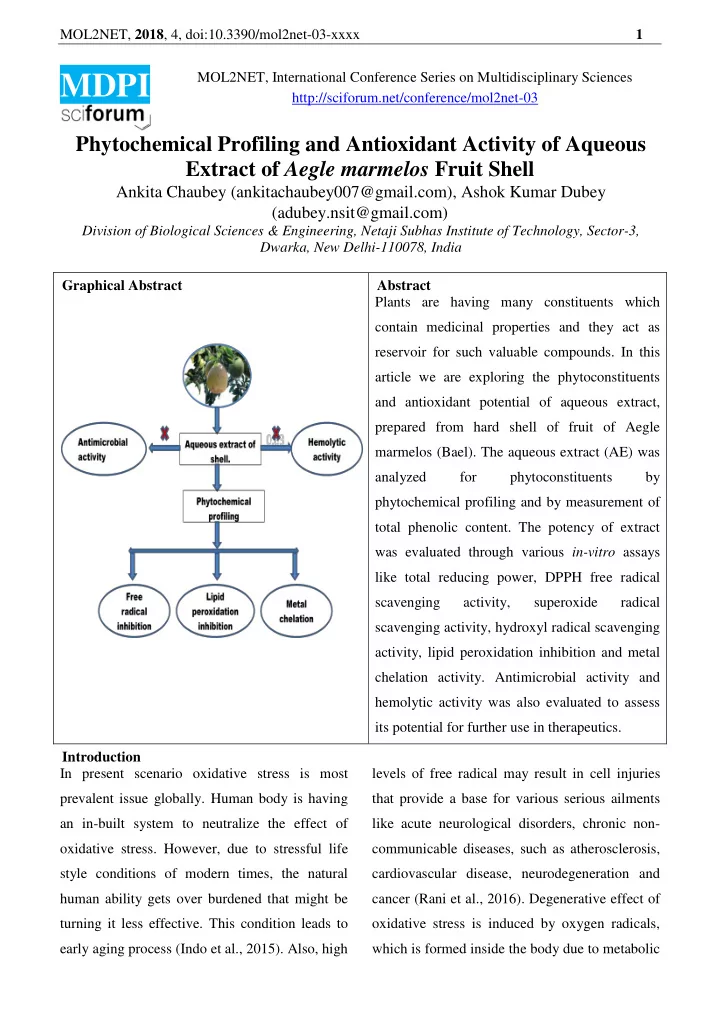
Division of Biological Sciences & Engineering, Netaji Subhas Institute of Technology, Sector-3, Dwarka, New Delhi-110078, India Graphical Abstract Abstract Plants are having many constituents which contain medicinal properties and they act as reservoir for such valuable compounds. In this article we are exploring the phytoconstituents and antioxidant potential of aqueous extract, prepared from hard shell of fruit of Aegle marmelos (Bael). The aqueous extract (AE) was analyzed for phytoconstituents by phytochemical profiling and by measurement of total phenolic content. The potency of extract was evaluated through various in-vitro assays like total reducing power, DPPH free radical scavenging activity, superoxide radical scavenging activity, hydroxyl radical scavenging activity, lipid peroxidation inhibition and metal chelation activity. Antimicrobial activity and hemolytic activity was also evaluated to assess its potential for further use in therapeutics. Introduction In present scenario oxidative stress is most prevalent issue globally. Human body is having an in-built system to neutralize the effect of

  • xidative stress. However, due to stressful life

style conditions of modern times, the natural human ability gets over burdened that might be turning it less effective. This condition leads to early aging process (Indo et al., 2015). Also, high levels of free radical may result in cell injuries that provide a base for various serious ailments like acute neurological disorders, chronic non- communicable diseases, such as atherosclerosis, cardiovascular disease, neurodegeneration and cancer (Rani et al., 2016). Degenerative effect of

  • xidative stress is induced by oxygen radicals,

which is formed inside the body due to metabolic

slide-2
SLIDE 2

MOL2NET, 2018, 4, doi:10.3390/mol2net-03-xxxx 2 processes (Smith et al., 1996). Plants are being exploited from ancient times against various metabolic disorders as well as infectious diseases and are focused for the formulation of medicines.

  • A. marmelos (Bael) has been taken for the study

as many studies have reported lots of potential therapeutic applications of various parts of this

  • plant. It has been used in traditional systems of

medicine to cure constipation, diarrhoea, dysentery, peptic ulcer and respiratory infections. Several studies on different parts of this plant showed that the plant is having antidiarrhoeal (Shobha et al., 2001), antidiabetic (Veerappan et al., 2005), anti-inflammatory, antipyretic, analgesic (Lotufu et al., 2005), anticancer (Jagetia et al., 2005), radioprotective (Rana et al., 1997) and antimicrobial activities (Rani et al., 2004). All part of this plant has investigated except the hard shell of fruit which is supposed to be a waste product. So here we are investigating the hard shell of fruit to evaluate its potency as an antioxidant. Antioxidants scavenges the free radicals by various methods like reacting with free radical, metal chelation

  • etc. thus terminating the oxidation process

(Sanchez, 2002) (Dhalwal, et al., 2008) . So the extract, prepared from hard shell of A. marmelos was evaluated for all these activities. Materials and Methods The fruits of A. marmelos were collected from NSIT campus, New Delhi. The shell part was separated from fruit pulp and cleaned. Outer hard shell was dried, crushed and finely grinded and then aqueous extract was prepared by using hot percolation method via soxhlet apparatus. Then aqueous extract was concentrated by rotary evaporator and then dried in vacuum oven. Phytochemical profiling was done using various biochemical assays (Ahuja et al., 2011; Rao et al. 2011; Savithramma et al., 2011). Total phenolic content and total flavonoid content was evaluated using gallic acid and quercetin as standard parameter respectively (Meda et al, 2005). To assess the free radical scavenging activity of aqueous extract, DPPH radical scavenging assay (Wang et al., 2011), hydroxyl radical scavenging assay (Halliwell et al., 1987) and superoxide radical scavenging assay (Nishikimi et al., 1972) were performed. Lipid peroxidation inhibition (Sudha et al., 2016) and metal chelation activity (Singh et al., 2004) of aqueous extract were evaluated along with total reducing power (Mathew et al, 2006) to measure the antioxidant potential of extract. Antimicrobial activity of this extract was evaluated against some bacterial and fungal strains. The extract was also evaluated for hemolytic activity (Beutin et., al., 1996) to ensure its toxicity. Results and Discussion Aqueous extract has shown positive results different classes of compounds, for example, Glycosides, Sterols, Terpenoids, Phenolic compounds, Saponins and amino acids. It has shown good amount of phenolic content equivalent to gallic acid. It has shown potential free radical scavenging activity in DPPH, Superoxide and hydroxyl radical scavenging

  • assays. The extract was showing significant

activity in metal chelation and lipid peroxidation inhibition too. It has shown no antimicrobial activity against any strain that was tested. No toxicity was observed in hemolytic assays.

slide-3
SLIDE 3

MOL2NET, 2018, 4, doi:10.3390/mol2net-03-xxxx 3 Conclusions From the observations of given work it can be inferred that aqueous extract of fruit shell of A. marmelos is a good antioxidant. It had shown prominent metal chelation activity and did not exhibit any hemolytic activity, which may be useful in exploring its therapeutic applications further. References

  • 1. Indo, H. P.; Yen, H-C.; Nakanishi, I.;

Matsumoto, K-I.; Tamura, M.; Nagano, Y.; Matsui, H.; Gusev, O.; Cornette, R.; Okuda, T.; Minamiyama, Y.; Ichikawa, H.; Suenaga, S.; Oki, M.; Sato, T.; Ozawa, T.; Clair, D. K. St.; Majima, H. J. A mitochondrial superoxide theory for

  • xidative stress diseases and aging. J

Clin Biochem Nutr. 2015, 56(1), 1-7

  • 2. Rani, V.; Deep, G.; Singh, R.K.; Palle,

K.; Yadav, U.C. Oxidative stress and metabolic disorders: Pathogenesis and therapeutic strategies. Life Sci. 2016, 148, 183-93

  • 3. Smith, M.A; Perry, G.; Sayre, L.M.;

Anderson, V.E.; Beal, M.F.; Kowall, N. Oxidative damage in Alzheimers. Nature. 1996, 382, 120–121

  • 4. Shobha, F.G.; Thomas, M. Antidiarrhoeal

activity of four medicinal plants in castor

  • il

induced diarrhoea. J.

  • Ethnopharmacol. 2001, 76, 73-76.
  • 5. Veerappan,

A.; Shigeru, M.; Renganathan, D. Studies on the anti- inflammatory, antipyretic and analgesic properties of the leaves of Aegle marmelos Corr. J. Ethonopharmacol. 2005, 96, 159.

  • 6. Lotufu, L.V.; Khan, M.T.; Ather, A.;

Wilke, D.V.; Simenez, P.C.; Pessoa, C.; de Moraes, M.E.; De Moraes, M.O. Studies of the anticancer potential of plants used in Bangladeshi folk medicine.

  • J. Ethonopharmacol. 2005, 99, 21.
  • 7. Jagetia, G.C.; Venkatesh, P.; Baliga, M.S.

Aegle marmelos (L) Correa inhibits the proliferation

  • f

transplanted Ehrlich ascites carcinoma in mice. Biol. Pharm.

  • Bull. 2005, 28, 58.
  • 8. Rana, B.K.; Jain, A.K. Evaluation of anti-

fungalactivity of essential oil isolated from leaves of the A. marmelos. J.

  • Ethnopharmacol. 1997, 57, 29.
  • 9. Rani, P.; Khullar, N. Antimicrobial

evaluation of some medicinal plants for their anti-enteric potential against multi- drug resistant Salmonella typhi.

  • Phytother. Res. 2004, 18, 670-673.
  • 10. Sanchez, C.M. Methods used to evaluate

the free radical scavenging activity in foods and biological system. J Food Sci Tech Int. 2002; 8, 121–137

  • 11. Dhalwal, K.; Shinde, V.M.; Namdeo,

A.G.; Mahadik, K. R. Antioxidant Profile and HPTLC-Densitometric Analysis of Umbelliferone and Psoralen in Aegle

  • marmelos. Pharm. Biol. 2008, 46, (4),

266–272

  • 12. Ahuja, J. Suresh, J.; Deep, A; Madhuri;

Pratyusha; Ravi. Phytochemical Screening of Aerial Part of Artemisia parviflora Roxb: A Medicinal Plant. Der Pharmacia Lettre. 2011, 3(6),116-124

slide-4
SLIDE 4

MOL2NET, 2018, 4, doi:10.3390/mol2net-03-xxxx 4

  • 13. Rao,

M.L.; Savithramma, N. Phytochemical Studies of Svensonia hyderpbadensis (walp) Mold: A Rare Medicinal Plant. Der Pharmacia Lettre. 2011, 3(4), 51-55

  • 14. Savithramma, N.; Rao, M.L.; Suhrulatha,
  • D. Screening of Medicinal Plants for

Secondary Metabolites. Middle-East J.

  • Sci. 2011, 8(3), 579-584,
  • 15. Meda, A.; Lamien, C.E.; Romito, M.;

Millogo, J.; Nacoulma, O.G. Determination of the total phenolic, flavonoid and proline contents in Burkina Fasan honey, as well as their radical scavenging activity. Food Chem. 2005, 91, 571–577

  • 16. Wang, S.; Meckling, K.A.; Marcone,

M.F.; Kakuda, Y.; Tsao, R. Can phytochemical antioxidant rich foods act as anti-cancer agents? Food Res Intern. 2011, 46, 2545–2554.

  • 17. Halliwell,

B.; Gutteridge, J.M.C.; Aruoma, O. I. The deoxyribose method: a simple ‘‘test tube’’ assay for determination of rate constants for reactions of hydroxyl radicals. Anal.

  • Biochem. 1987, 165, 215–219.
  • 18. Nishikimi, M.; Rao, N.A.; Yagi, K.. The
  • ccurrence of superoxide anion in the

reaction

  • f

reduced phenazine methosulphate and molecular oxygen.

  • Biochem. Biophys. Res. Commun. 1972,

46, 849–864.

  • 19. Govindan Sudha, G.; Janardhanan, A.;

Moorthy, A.; Chinnasamy, M; Gunasekaran, S.; Thimmaraju, A; Gopalan, J. Comparative Study on the Antioxidant Activity of Methanolic and Aqueous Extracts from the Fruiting Bodies of an Edible Mushroom Pleurotus

  • djamor. Food Sci. Biotechnol. 2016,

25(2), 371-377

  • 20. Singh, N.; Rajini P.S. Free radical

scavenging activity of an aqueous extract

  • f potato peel. Food Chem. 2004, 85,

611–616

  • 21. Mathew, S.; Abraham, T.E. In vitro

antioxidant activity and scavenging effects of Cinnamomum verum leaf extract assayed by different

  • methodologies. Food Chem Toxicol.

2006, 44, 198–206

  • 22. Beutin, L.; Zimmermann, S.; Gleier, K.

Rapid detection and isolation of shiga- like toxin (verocytotoxin)- producing Escherichia coli by direct testin g of individual enterohemolytic colonies from washed sheep blood agar plates in VTEC-RPLA assay. J. Clin. Microbiol., 1996; 34(11), 2812-2814.