
MOL2NET, 2018, 4, doi:10.3390/mol2net-04-xxxx 1
MDPI
MOL2NET, International Conference Series on Multidisciplinary Sciences http://sciforum.net/conference/mol2net-04
Ecotoxicological assessment of pharmaceuticals using computational toxicology approaches: QSTR and interspecies QTTR modeling
- K. Khan (kabirkhan78621@gmail.com)a , S. Kar (supratik.kar@icnanotox.org)b , H.Sanderson
(hasa@envs.au.dk)c , K.Roy (kunalroy_in@yahoo.com)a * and J. Leszczynski (jerzy@icnanotox.org)b
aDrug Theoretics and Cheminformatics Laboratory, Department of Pharmaceutical Technology,
Jadavpur University, Kolkata 700032, India *Corresponding author: K Roy, Phone: +91 98315 94140; Fax: +91-33-2837-1078; URL: http://sites.google.com/site/kunalroyindia/
bInterdisciplinary Center for Nanotoxicity, Department of Chemistry, Physics and Atmospheric
Sciences, Jackson State University, Jackson, MS-39217, USA
cNational Environmental Research Institute, Department of Policy Analysis, Aarhus University,
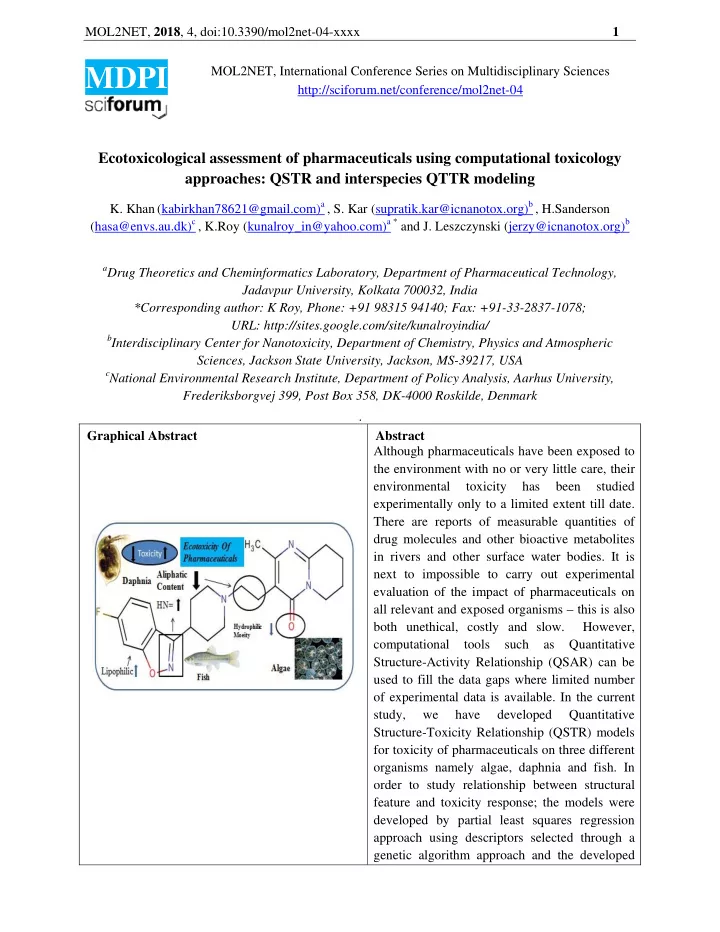
Frederiksborgvej 399, Post Box 358, DK-4000 Roskilde, Denmark . Graphical Abstract Abstract Although pharmaceuticals have been exposed to the environment with no or very little care, their environmental toxicity has been studied experimentally only to a limited extent till date. There are reports of measurable quantities of drug molecules and other bioactive metabolites in rivers and other surface water bodies. It is next to impossible to carry out experimental evaluation of the impact of pharmaceuticals on all relevant and exposed organisms – this is also both unethical, costly and slow. However, computational tools such as Quantitative Structure-Activity Relationship (QSAR) can be used to fill the data gaps where limited number
- f experimental data is available. In the current
study, we have developed Quantitative Structure-Toxicity Relationship (QSTR) models for toxicity of pharmaceuticals on three different
- rganisms namely algae, daphnia and fish. In
- rder to study relationship between structural
feature and toxicity response; the models were developed by partial least squares regression approach using descriptors selected through a genetic algorithm approach and the developed