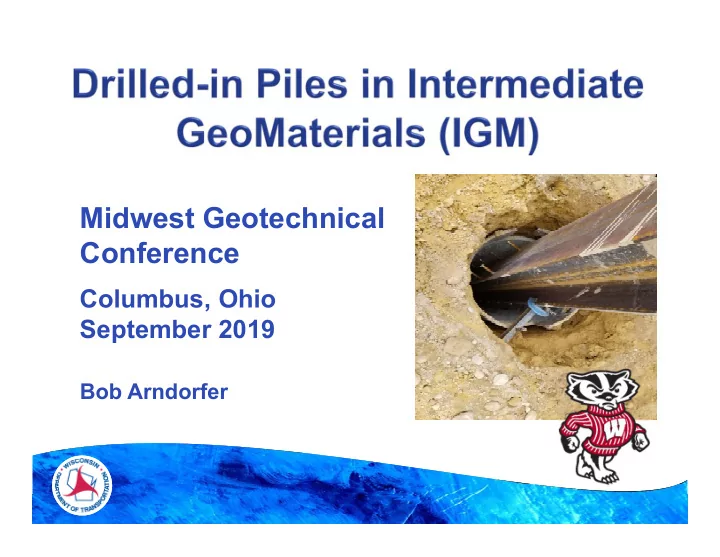
Midwest Geotechnical Conference Columbus, Ohio September 2019 Bob - - PowerPoint PPT Presentation

midwest geotechnical conference
SMART_READER_LITE
LIVE PREVIEW

Midwest Geotechnical Conference Columbus, Ohio September 2019 Bob - - PowerPoint PPT Presentation

Midwest Geotechnical Conference Columbus, Ohio September 2019 Bob Arndorfer AASHTO Definitions: Cohesive IGMs - Exhibit Unconfined Compression Strengths Between 10-100 ksf Cohesionless IGMs - Exhibit Blow Counts (N) Greater Than 50


slide-1
SLIDE 1

Midwest Geotechnical Conference

Columbus, Ohio September 2019

Bob Arndorfer

slide-2
SLIDE 2
  • AASHTO Definitions:
  • Cohesive IGMs - Exhibit Unconfined

Compression Strengths Between 10-100 ksf

  • Cohesionless IGMs - Exhibit Blow Counts (N)

Greater Than 50 Blows/Foot Using Standard Penetration Test

2

slide-3
SLIDE 3
  • Hole is Drilled (Pre-bored) Into the IGM Material

and Bottom is Cleaned

  • H-Pile Is Placed Into Hole – No Driving (Seated)
  • Hole Is Backfilled With Concrete
  • Pile Extends Up Into Abutment
  • Is the Resulting Deep Foundation Member a

Shaft or a Pile?

3

slide-4
SLIDE 4
  • WisDOT Experience with IGM Varies
  • Codes Provide Limited Guidance on Design

Methodology/Pile Capacity in IGM Materials

  • Project Used Load Test to Verify Design

Assumptions For Drilled-in Piles

  • Lead to a Methodology Used to Design Drilled-

in Piles in IGM Material

  • Help Eliminate Some Common Pile Installation

Issues In These Situations

  • Goal – Save Money

4

slide-5
SLIDE 5
  • WisDOT Often Designs MSE Walls Around

Abutments

  • Reduce Bridge Span Lengths
  • Support Abutments on Piles Through MSE Backfill
  • Install Piles Prior to Wall Construction
  • IGM Materials Make Pile Length Estimates Difficult
  • Difficult Driving Often Leads to Pile Alignment Issues
  • What About Installing Pre-bored/Backfilled Piles

Into the Very Dense IGM?

5

slide-6
SLIDE 6
  • Alternative Foundations?
  • Why Not Use Spread Footings?
  • Why Not Use Drilled Shafts?
  • Will Address Those Later
  • Proper Design Methodology – Shaft or Pile?
  • What Corresponding Resistance Factor?
  • Cost Effective to Conduct a Pile Load Program?

6

slide-7
SLIDE 7

7

slide-8
SLIDE 8
  • Site Has High-strength Till Soils
  • Consultant-Designed Project
  • Multi-Year Construction
  • Project Had Enough Lead Time to

Accommodate Load Test Program

  • Was an Adjacent, On-going Project We Could

Add Load Test Program to

  • Results From Load Test Incorporated Into

Project Plans (Pre-Letting)

8

slide-9
SLIDE 9

9

slide-10
SLIDE 10

10

Chippewa River

slide-11
SLIDE 11

11

Chippewa River

slide-12
SLIDE 12

12

Chippewa River

slide-13
SLIDE 13
  • Driven H-Piles Using Modified Gates:
  • Resistance Factor of 0.50
  • Driven H-Piles Using Pile Driving Analyzer:
  • Resistance Factor of 0.65
  • Drilled Shafts:
  • Resistance Factor 0.35-0.5 (No Load Test)
  • Bored H-Piles With Static Load Test:
  • Resistance Factor of 0.8 (Load Test)
  • Resistance Factor of 0.8 (Shaft Spacing)

13

slide-14
SLIDE 14
  • Sometimes Piles Run Very Long (Increased Cost

and Times), or Very Short (Creating a Lateral Resistance Concern)

  • Difficult to Achieve Necessary Alignment Above

Driven Elevation – Often Not Aware of This Until After Hammer Leads are Removed

  • Adjacent Bridge Experienced Both of These

Issues

14

slide-15
SLIDE 15
  • Larger Diameter/Conflicts With MSE Wall
  • Requires Slightly Longer Bridge
  • Lower Resistance Factor (No Load Test),

Resulting in Deeper Shafts

  • Secant Walls Also Considered – High Cost

15

slide-16
SLIDE 16
  • Multi-span Bridges: WisDOT Typically Does Not

Use Spread Footings on MSE Walls

  • Would Require Expensive Full-retaining

Abutments and Wings Instead of MSE Wall

  • Early Cost Estimate Indicated Pre-bored Piles

w/Load Test May Be Most Cost Effective Alternative

  • Decision: Conduct Load Test of Pre-bored

Hybrid Piles to Confirm Design/Costs

16

slide-17
SLIDE 17
  • Assume Similar Nominal Load to Driven Piles
  • Same Number of Support Members
  • Same Spacing of Members
  • Use to Estimate Shaft Depths Using Static Analysis
  • Check To Ensure No Settlement Issues
  • Use HP 14x74 Piles
  • 30” Pre-bored Holes (Contractor Used 34”)
  • Pre-bore to 20’ Below MSE Wall Pad
  • Include Side Friction and End Bearing

17

slide-18
SLIDE 18
  • Resistance Factors of 0.8 (Load Test) and 0.8

(Shaft Spacing)

  • Only Tested Axial
  • Added to Existing Adjacent-Project Contract
  • Jim Long Designed and Conducted Load Test
  • Standard Test – 1 Test Pile and 4 Reaction Piles
  • Load Frame Designed by Contractor
  • Davisson Failure Criteria Used – Pile or Shaft?
  • $100k Cost

18

slide-19
SLIDE 19

19

Chippewa River Top of Shaft Bottom

  • f Shaft

Settlement?

slide-20
SLIDE 20

20

slide-21
SLIDE 21

21

slide-22
SLIDE 22

22

slide-23
SLIDE 23

23

slide-24
SLIDE 24

24

slide-25
SLIDE 25

25

slide-26
SLIDE 26

26

slide-27
SLIDE 27

27

slide-28
SLIDE 28

28

Design Load = 500 Kips

slide-29
SLIDE 29
  • Follow AASHTO For Shaft Design in IGM
  • Nominal Shaft Capacity of 500 Kips
  • Resistance Factors
  • 0.8 For Using Load Test
  • 0.8 For Shaft Spacing
  • Total Applied = 0.65 (End Bearing and Side Friction)
  • Equates to Factored Load of 325 Kips
  • Conservatively Used Design Shaft Depth From

Load Test (Based on Pile Criteria)

29

slide-30
SLIDE 30
  • Same Shaft Depths as Load Test
  • Use 14x73 H-Piles With 4” Shear Studs
  • 34” Diameter Pre-bored Holes
  • Require Full-depth Casing
  • Spacing of Piles – 5.5 and 6.0 Feet
  • Place Piles in Hole – Firmly Seat (Do Not Drive)
  • Socket-in Piles With Concrete – Full Depth
  • Piles Extend to Abutment
  • No Ground Disturbance Within 10’ for 24 Hours

30

slide-31
SLIDE 31

31

slide-32
SLIDE 32

32

slide-33
SLIDE 33

33

slide-34
SLIDE 34

34

slide-35
SLIDE 35

35

slide-36
SLIDE 36

36

slide-37
SLIDE 37

37

slide-38
SLIDE 38
  • Pile Installation Went Well
  • Dry Holes, Cased All the Way Down
  • Good Contractor Production
  • Able to Keep Alignment
  • No Subsurface Pre-boring Surprises
  • No Other Issues Noted
  • Project Still Being Constructed, But Abutments

and Walls Have Been Completed

38

slide-39
SLIDE 39
  • Based on Comparison to Static Pile Estimates

For Driven Piles and Actual Bid Costs of Pre- bored Piles

  • Load Test Costs Removed ($100k)
  • Bridge B-13-831 Savings: $200k
  • Bridge B-13-832 Savings: $130k
  • Possible Total Savings: ≈ $200-330k

39

slide-40
SLIDE 40

B-13-0831 $208,664.40

slide-41
SLIDE 41

B-13-0832 $129,336.40

slide-42
SLIDE 42
  • Will Consider This Deep Foundation Type on

Future Projects With Similar Subsurface Conditions and Designs

  • During Design – Will Estimate Costs to Ensure

This Option is the Most Economical Foundation

  • Hope This May Generate Creation of More

Design Guidance

42

slide-43
SLIDE 43

43