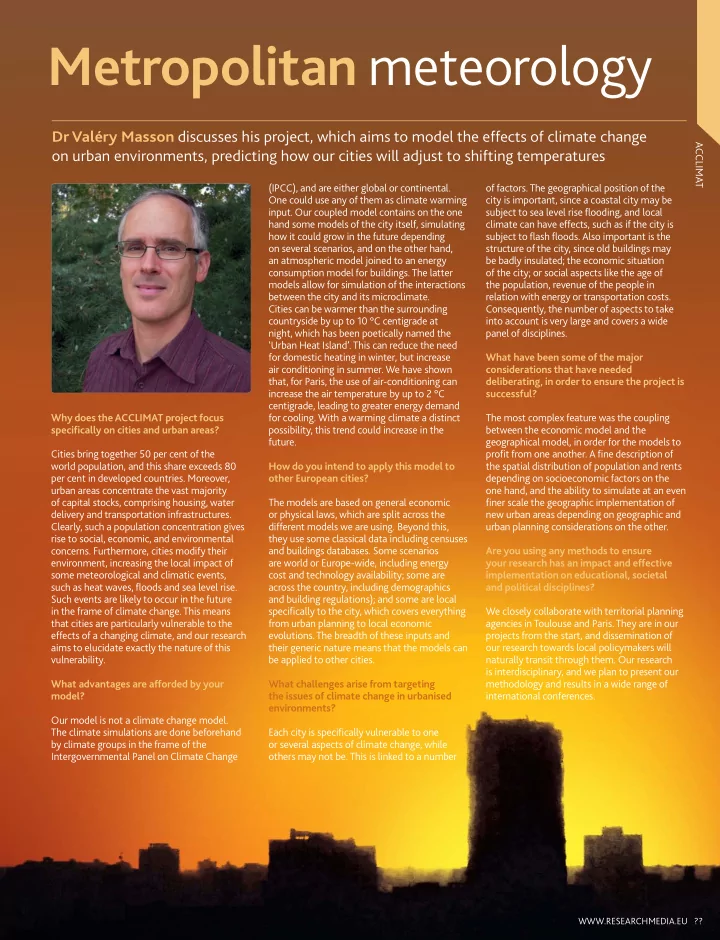

Dr Valéry Masson discusses his project, which aims to model the effects of climate change
- n urban environments, predicting how our cities will adjust to shifting temperatures
Why does the ACCLIMAT project focus specifi cally on cities and urban areas? Cities bring together 50 per cent of the world population, and this share exceeds 80 per cent in developed countries. Moreover, urban areas concentrate the vast majority
- f capital stocks, comprising housing, water
delivery and transportation infrastructures. Clearly, such a population concentration gives rise to social, economic, and environmental
- concerns. Furthermore, cities modify their
environment, increasing the local impact of some meteorological and climatic events, such as heat waves, fl
- ods and sea level rise.
Such events are likely to occur in the future in the frame of climate change. This means that cities are particularly vulnerable to the effects of a changing climate, and our research aims to elucidate exactly the nature of this vulnerability. What advantages are afforded by your model? Our model is not a climate change model. The climate simulations are done beforehand by climate groups in the frame of the Intergovernmental Panel on Climate Change (IPCC), and are either global or continental. One could use any of them as climate warming
- input. Our coupled model contains on the one
hand some models of the city itself, simulating how it could grow in the future depending
- n several scenarios, and on the other hand,
an atmospheric model joined to an energy consumption model for buildings. The latter models allow for simulation of the interactions between the city and its microclimate. Cities can be warmer than the surrounding countryside by up to 10 °C centigrade at night, which has been poetically named the ‘Urban Heat Island’. This can reduce the need for domestic heating in winter, but increase air conditioning in summer. We have shown that, for Paris, the use of air-conditioning can increase the air temperature by up to 2 °C centigrade, leading to greater energy demand for cooling. With a warming climate a distinct possibility, this trend could increase in the future. How do you intend to apply this model to
- ther European cities?
The models are based on general economic
- r physical laws, which are split across the
different models we are using. Beyond this, they use some classical data including censuses and buildings databases. Some scenarios are world or Europe-wide, including energy cost and technology availability; some are across the country, including demographics and building regulations); and some are local specifi cally to the city, which covers everything from urban planning to local economic
- evolutions. The breadth of these inputs and
their generic nature means that the models can be applied to other cities. What challenges arise from targeting the issues of climate change in urbanised environments? Each city is specifi cally vulnerable to one
- r several aspects of climate change, while
- thers may not be. This is linked to a number
- f factors. The geographical position of the
city is important, since a coastal city may be subject to sea level rise fl
- oding, and local
climate can have effects, such as if the city is subject to fl ash fl
- ods. Also important is the
structure of the city, since old buildings may be badly insulated; the economic situation
- f the city; or social aspects like the age of
the population, revenue of the people in relation with energy or transportation costs. Consequently, the number of aspects to take into account is very large and covers a wide panel of disciplines. What have been some of the major considerations that have needed deliberating, in order to ensure the project is successful? The most complex feature was the coupling between the economic model and the geographical model, in order for the models to profi t from one another. A fi ne description of the spatial distribution of population and rents depending on socioeconomic factors on the
- ne hand, and the ability to simulate at an even
fi ner scale the geographic implementation of new urban areas depending on geographic and urban planning considerations on the other. Are you using any methods to ensure your research has an impact and effective implementation on educational, societal and political disciplines? We closely collaborate with territorial planning agencies in Toulouse and Paris. They are in our projects from the start, and dissemination of
- ur research towards local policymakers will
naturally transit through them. Our research is interdisciplinary, and we plan to present our methodology and results in a wide range of international conferences.
Metropolitan meteorology
WWW.RESEARCHMEDIA.EU ??
ACCLIMAT