HIGH RESOLUTION MEASUREMENT FOR FRACTURE BEHAVIOR OBSARVATION OF - - PDF document

high resolution measurement for fracture behavior
SMART_READER_LITE
LIVE PREVIEW

HIGH RESOLUTION MEASUREMENT FOR FRACTURE BEHAVIOR OBSARVATION OF - - PDF document

18 TH INTERNATIONAL CONFERENCE ON COMPOSITE MATERIALS HIGH RESOLUTION MEASUREMENT FOR FRACTURE BEHAVIOR OBSARVATION OF CFRP H. Kusano 1 * , T. Mizuno 2 , A. Yamada 3 , Y. Aoki 4 , Y. Hirano 4 1 Collaboration Promotion Department, Analytical &


slide-1
SLIDE 1

18TH INTERNATIONAL CONFERENCE ON COMPOSITE MATERIALS

  • 1. Introduction

The objective of this study is the high temporally resolution measurement for the tensile fracture behavior of CFRP. The advantages of CFRP are lighter, higher specific stiffness and strength than the metals. The use

  • f CFRP is expanding into not only the

aerospace, the rapid transit railway, automotives industry but also the industries on sports, leisure and so on. There are some proposed theories to find out the tensile fracture of CFRP by numerical simulation. However, the tensile fracture mechanism of unidirectional CFRP had not been experimentally made clear because the fracture speed of unidirectional CFRP is quite

  • high. To observe the fracture of unidirectional

CFRP in detail, we should use high-speed imaging more than 100,000fps recording speed.

  • 2. Specimens and Experimental methods

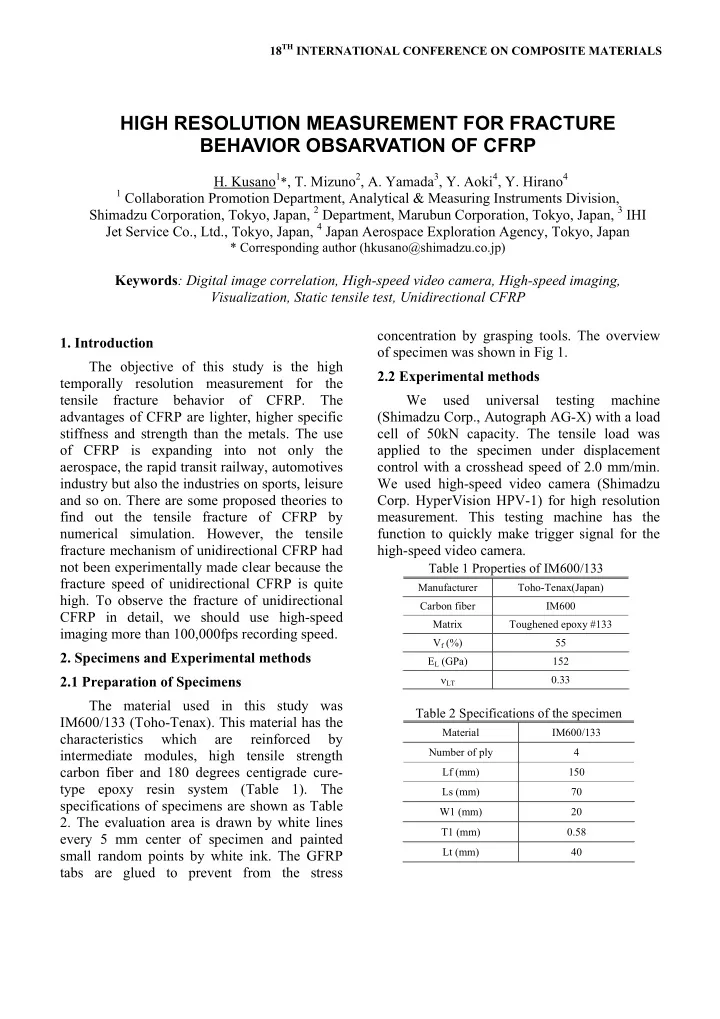
2.1 Preparation of Specimens The material used in this study was IM600/133 (Toho-Tenax). This material has the characteristics which are reinforced by intermediate modules, high tensile strength carbon fiber and 180 degrees centigrade cure- type epoxy resin system (Table 1). The specifications of specimens are shown as Table

  • 2. The evaluation area is drawn by white lines

every 5 mm center of specimen and painted small random points by white ink. The GFRP tabs are glued to prevent from the stress concentration by grasping tools. The overview

  • f specimen was shown in Fig 1.

2.2 Experimental methods We used universal testing machine (Shimadzu Corp., Autograph AG-X) with a load cell of 50kN capacity. The tensile load was applied to the specimen under displacement control with a crosshead speed of 2.0 mm/min. We used high-speed video camera (Shimadzu

  • Corp. HyperVision HPV-1) for high resolution
  • measurement. This testing machine has the

function to quickly make trigger signal for the high-speed video camera.

Table 1 Properties of IM600/133

Manufacturer Toho-Tenax(Japan) Carbon fiber IM600 Matrix Toughened epoxy #133 Vf (%) 55 EL (GPa) 152 nLT 0.33

Table 2 Specifications of the specimen

Material IM600/133 Number of ply 4 Lf (mm) 150 Ls (mm) 70 W1 (mm) 20 T1 (mm) 0.58 Lt (mm) 40

HIGH RESOLUTION MEASUREMENT FOR FRACTURE BEHAVIOR OBSARVATION OF CFRP

  • H. Kusano1*, T. Mizuno2, A. Yamada3, Y. Aoki4, Y. Hirano4

1 Collaboration Promotion Department, Analytical & Measuring Instruments Division,

Shimadzu Corporation, Tokyo, Japan, 2 Department, Marubun Corporation, Tokyo, Japan, 3 IHI Jet Service Co., Ltd., Tokyo, Japan, 4 Japan Aerospace Exploration Agency, Tokyo, Japan

* Corresponding author (hkusano@shimadzu.co.jp)

Keywords: Digital image correlation, High-speed video camera, High-speed imaging, Visualization, Static tensile test, Unidirectional CFRP

slide-2
SLIDE 2

Fig.1 Overview of specimen

2.3 Image analysis methods We used digital image correlation (DIC) method about the image gotten by high speed video camera. We selected larger inspection area and the appropriate overlap quantity at image analysis of DIC. We set an inspection area in 64 pixels square and overlap quantity in 50% on the image.

  • 3. Results

3.1 Static tensile test The result of one of the specimens is shown as Fig.3. The maximum load was 32.8kN, and the rupture strength was 2860MPa at this specimen.

Fig.2 Experimental system in this study Fig.3 Load-crosshead position curve

3.2 High-speed imaging Destructive behaviors of this specimen were recorded by high-speed video cameras at

  • nce. The images provided at 250,000fps by

high-speed video camera were shown as Fig.4. This specimen was broken by a minute crack (Fig.4-A). The crack grew while cutting fiber (Fig.4-B). After a few micro seconds, Splitting was observed in the specimen surface (Fig.4-C). The secondary crack occurred in the specimen upper side (Fig.4-E). The new crack grew in the specimen underside as the upper side crack grew (Fig.4-E, F, and G). Underside crack was made by secondary crack. The specimen was stretched by the test load. The specimen was stored up a test load until destroyed. When the crack grew, the specimen shrunk rapidly to the

  • riginal length. The compression strength was

added to the broken specimen. This strength exceeded the rupture strength of compression at this material.

Lf Ls Lt W1 Fiber direction

slide-3
SLIDE 3

3 HIGH RESOLUTION MEASUREMENT FOR FRACTURE BEHAVIOR OBSARVATION OF CFRP

Fig.4 High-speed images of static tensile fracture provided at 250,000fps

3.3 Digital image correlation This image was analyzed by Digital image correlation (DIC; LaVision GmbH, Strain Master). We got 100 images per 5 kN load on static tensile test at 250,000fps. Fig.5 was shown DIC result of the images with same load. These results were shown that strain was changing very small at about 300msec

  • n same load. The looseness of the strain with

the same load was up to 135 me, and minimum to -123me. Table 3 was shown strain analyzed by DIC. And Fig.6 was shown stress – strain curve form DIC in this test. The red line was indicated general stress – strain curve for IM600 from JAXA- ACDB. The test result was well accorded with JAXA-ACDB. Fig.7 was shown as DIC result on static tensile test before fracture. There was high strain area on the center of the specimen.

Fig.5 Variations of strains at 300 msec on each load Table 3 Surface strain form DIC Looseness of strain [me] Load [kN] Strain [me] Maximum Minimum 104

  • 110

5 2160 135

  • 123

10 5070 48

  • 74

15 8480 66

  • 98

20 10910 62

  • 85

25 14200 69

  • 80

Strain [me] Strain [me] Strain [me] Strain [me] Strain [me] Strain [me] Time [msec] Time [msec] Time [msec] Time [msec] Time [msec] Time [msec] (1) 0kN (2) 5kN (3) 10kN (4) 15kN (5) 20kN (6) 25kN Strain [me] Strain [me] Strain [me] Strain [me] Strain [me] Strain [me] Time [msec] Time [msec] Time [msec] Time [msec] Time [msec] Time [msec] (1) 0kN (2) 5kN (3) 10kN (4) 15kN (5) 20kN (6) 25kN

A: 0msec B: 4msec C: 8msec D: 12msec E: 20msec F: 28msec G: 40msec G: 60msec Crack initiation Crack growth and splitting 2nd crack Compression crack

slide-4
SLIDE 4

2500 5000 7500 10000 12500 15000 0.5 1 1.5 2 2.5 Stress [MPa] Strain [me]

Fig.6 Stress – Strain curve from DIC result Fig.7 DIC result on static tensile test before fracture

Fig.4 analyzed by DIC was shown as Fig.8. The crack tip maximized strain on t he early stages of the strain. There is an area with high strain around the crack tip. On crack growing, strain was gone down (24 – 32 ms). Compression strain was calculated in the specimen underside (36 – 44 ms). It was shown there was dynamic compression behavior in static tensile test.

Fig.8 DIC result at fracture process

  • 4. Conclusions

· We could get the high speed image for static tensile fracture. We could

  • bserve

the fracture process

  • n

unidirectional CFRP with high speed video camera. · In to Digital Image Correlation, we could quantify the high speed image. Maximum tensile strain was 29,000me from DIC result. Maximum compression strain was -31900 me.

slide-5
SLIDE 5

5 HIGH RESOLUTION MEASUREMENT FOR FRACTURE BEHAVIOR OBSARVATION OF CFRP

These values were too big, we couldn’t measure with the strain gauge. And the strain changing on fracture process was very faster than sampling rate of the systems, we couldn't measure strain on fracture behavior in very short time with any general strain instrument

  • systems. We took fracture images of

unidirectional CFRP with high speed

  • camera. We succeeded in the creating

the images of the very quick change of the fracture in using DIC. · DIC can measure the strain distribution

  • f not only the points but also the

surface.