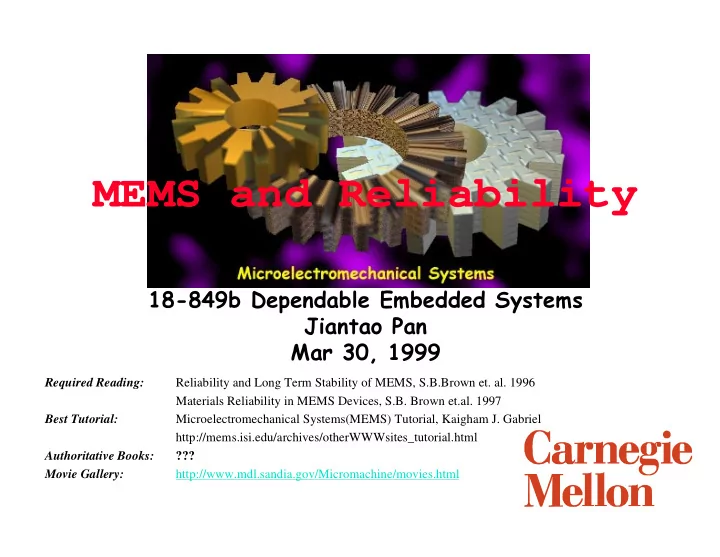
MEMS and Reliability - - PowerPoint PPT Presentation

mems and reliability
SMART_READER_LITE
LIVE PREVIEW

MEMS and Reliability - - PowerPoint PPT Presentation

MEMS and Reliability Reliability and Long Term Stability of MEMS,


slide-1
SLIDE 1
  • Required Reading:

Reliability and Long Term Stability of MEMS, S.B.Brown et. al. 1996 Materials Reliability in MEMS Devices, S.B. Brown et.al. 1997 Best Tutorial: Microelectromechanical Systems(MEMS) Tutorial, Kaigham J. Gabriel http://mems.isi.edu/archives/otherWWWsites_tutorial.html Authoritative Books: ??? Movie Gallery: http://www.mdl.sandia.gov/Micromachine/movies.html

MEMS and Reliability

slide-2
SLIDE 2

2

You Are Here

slide-3
SLIDE 3

3

Introduction

◆ What is MEMS(MicroElectroMechanical Systems)

  • Microelectromechanical systems (MEMS):

– are integrated micro devices or systems – combine electrical and mechanical components – are fabricated using integrated circuit (IC) compatible batch-processing techniques – range in size from micrometers to millimeters. – can sense, control, and actuate on the micro scale – can function individually or in arrays to generate effects on the macro scale.

  • Revolutionizing “traditional” mechanical and materials

engineering into “high-tech”.

  • The next logical step in the silicon revolution.
  • $10 Billion market today, $34 Billion market in 2002
  • Fascinating, amazing, …

◆ DARPA MEMS program Goal:

  • co-located perception, processing and control
slide-4
SLIDE 4

4

Applications:Size DOES Matter

◆ Optical switching:

  • Integrated Optics, Micro-optics

◆ Embedded sensors & actuators

  • Inertial: accelerometers that deploy car airbags
  • Pressure

◆ Biomedical devices

  • Non-invasive biomedical sensors

◆ Microfluidics

  • Inkjet-printer cartridges
  • Miniature analytical instruments
  • Chip-based DNA processing & sequencing
  • Propellant and combustion control
  • Chemical factories on chip

◆ Mass data storage

  • Terabytes per square centimeter

◆ Low-power, high-resolution small displays ◆ Microinstruments & Micromachines

  • Micropumps

◆ Microrobots

slide-5
SLIDE 5

5

MEMS Fabrication

◆ “System on a chip”: a miniature embedded system itself

  • Including computing, sensing and actuating parts
  • Similar to IC manufacturing process
  • Usually fabricated completely assembled -- no piece parts

◆ Characteristics of Fabrication

  • Miniaturization
  • Multiplicity
  • Microelectronics

◆ Fabrication methods and materials

  • Bulk micromachining
  • Wafer-to-wafer bonding
  • High-aspect ratio micromachining
  • Surface micromachining
slide-6
SLIDE 6

6

Fabrication Procedures

◆ Significant distinctions between MEMS and ICs are noted in bold italics.

Source: Electronics Technology Office, DARPA

slide-7
SLIDE 7

7

Typical Size

◆ Spider mite raids

microlock

  • This is not
  • Godzilla. This is a

spider mite (a miniscule, white fleck to the human eye) hanging out

  • n a microlock
  • mechanism. Note

the scale key in the lower right corner.

◆ “The technologies and applications of three-dimensional devices with sizes in

the micrometer ranges.”

slide-8
SLIDE 8

8

Reliability of MEMS

◆ More than just Electro+Mechanical failures

  • Mechanical reliability
  • Electrical reliability
  • Material reliability
  • Interactions of mechanical and electrical part

◆ Macro failure modes not applicable ◆ Unique failure modes at microscopic level

  • Static overload
  • Delamination
  • Creep
  • Environmental attack
  • Fatigue
slide-9
SLIDE 9

9

◆ Capillary forces

  • Liquid-air interface induced in etching
  • Stiction happens even without liquid; aggravated by moisture

◆ Operational Methods

  • Drive signals not comply to mechanical model

– e.g. MEMS actuators driven by model based drive signals have 5 orders of magnitude longer life than square wave signals in experiment.

  • Noise in drive signals

◆ Mechanical Instabilities

  • Gear position, spring shape, alignment, etc
  • Buckling

◆ Electrical Instabilities

  • Linear clamping caused by static electricity

Root Causes

slide-10
SLIDE 10

10

Techniques for Higher Reliability

◆ Chemical surface treatments

  • Super-critical drying method
  • Hydrophobic coating

◆ Model-based operational methods

  • Optimized electrical drive signals
  • Minimized constraint forces

◆ Clever design modifications

  • Improved thickness, stiffness, endurance, shape, etc
slide-11
SLIDE 11

11

Conclusions

◆ Revolutionary, fast growing new technology ◆ Still in its infancy

  • Like IC technology 30 years ago

◆ Reliability: How MEMS fail is not well understood

  • Study shows material strength is NOT a key factor

– failures induced by deficiencies in material/mechanical properties not majority, such as fracture strength or fatigue-related fracture

  • Failures causes typically related to contacting or rubbing surfaces:

Stiction and friction-related wear

  • Unique failure modes at microscopic level

– Static overload, Delamination, Creep, Environmental attack, Fatigue

  • Reliability can be enhanced by optimized designs and better

techniques

slide-12
SLIDE 12

12

Future Direction

Trends in electromechanical integration Log-log plot of number of transistors merged with number of mechanical components for existing and future MEMS devices and systems.

slide-13
SLIDE 13

13

On the Reading Papers

◆ Reliability and Long-Term Stability of MEMS

  • High-level generalization of MEMS failure modes
  • Different failure modes in microscope v.s. macroscope

◆ Materials Reliability in MEMS Devices

  • An accelerated testing technique on stress/fatigue testing
  • Found fatigue life of poly is a function of stress
  • Previous work found crack growth dependent on moisture