Tronics RF-MEMS Switch: Status & Benefits for Active Antennas - - PowerPoint PPT Presentation

tronics rf mems switch status amp benefits for active
SMART_READER_LITE
LIVE PREVIEW

Tronics RF-MEMS Switch: Status & Benefits for Active Antennas - - PowerPoint PPT Presentation

Tronics RF-MEMS Switch: Status & Benefits for Active Antennas MUCH MORE THAN A MEMS FOUNDRY 1 Content Company overview Introduction to RF MEMS switches Tronics RF MEMS switch RF MEMS switches for Active


slide-1
SLIDE 1

1

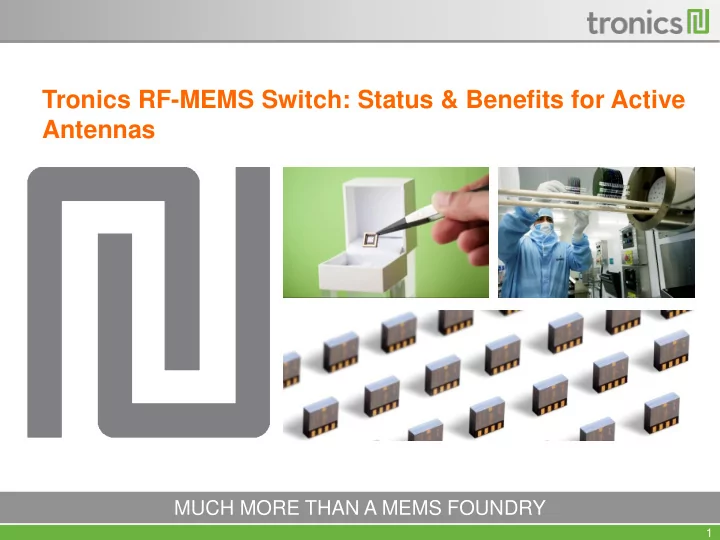
Tronics RF-MEMS Switch: Status & Benefits for Active Antennas

MUCH MORE THAN A MEMS FOUNDRY

slide-2
SLIDE 2

2

Content

  • Company overview
  • Introduction to RF MEMS switches
  • Tronics’ RF MEMS switch
  • RF MEMS switches for Active Electronically Steerable Antennas
  • Conclusions
slide-3
SLIDE 3

3

Who is Tronics ?

Tronics designs, manufactures and sells custom or standard MEMS products for high growth markets

Life sciences Consumer Industrial Aerospace & Security

Transducers and Proteomic MicroArrays Combo sensors

Activity monitoring, remote control

Sensors and actuators

Seismic oil exploitation

High performance gyro and accelero

Navigation & stabilization Diagnostic & therapeutics

slide-4
SLIDE 4

4 Listed on Alternext Paris since February 2015

Key facts & figures

92 employees including 55 engineers and scientists Leading customer references 2015 revenue: $12.5 M 15 years of R&D 25 active patent families

2 direct production sites, plus distributors in

Japan, China, Israel and Turkey

> 1,500,000 high performance devices produced

Tronics (Dallas) Tronics (Grenoble)

slide-5
SLIDE 5

5

Advanced MEMS product developments

Innovative Devices Transducers RF Circuits Print Heads µmechanic Optics Inertial Devices Microfluidics Gratings Silicon Lenses Mirrors Optical Filters Gyros Accelerometers Geophones Arming Devices Assays DNA Chips Diagnostic Chips Micro-pumps Innovative Devices Transducers RF Circuits Print Heads µmechanic Optics Inertial Devices Microfluidics Gratings Silicon Lenses Mirrors Optical Filters Gyros Accelerometers Geophones Arming Devices Assays DNA Chips Diagnostic Chips Micro-pumps

slide-6
SLIDE 6

6

Introduction to RF MEMS switches I

1990s: First publications (Hughes Research Lab, Rockwell Science, TI) 2001: more than 30 companies working on RF MEMS switches (including Motorola, AnalogDevices, Samsung, ST-microelectronics, Thales) and various research labs worldwide Excellent RF performance, but major reliability issues hindered industrialization 2003: First products announced (Magfusion, Terravicta, Radant) but no success A lot of companies stopped their activities Since 2013: Several new products that seem to be successful (WiSpry, Cavendish Kinetics, Analog Devices) Rockwell Radant AD

slide-7
SLIDE 7

7

Introduction to RF MEMS switches II

  • MEMS = Micro devices, having movable parts, fabricated with processes

similar to IC fabrication

  • RF MEMS = MEMS devices capable of reconfiguring the RF characteristics of

a device.

  • RF MEMS switches can be stand alone devices (e.g. SPST, SPDT or xPyT)
  • r be used in RF Circuits (phase shifters, filters, ..)
  • Typical configuration:

from K. Van Caekenberge “RF MEMS on the Radar”, IEEE microwave magazine October 2009

slide-8
SLIDE 8

8

The Concept of TRONICS RF MEMS switch

 Developed in partnership with AIRBUS

Switch concept: Airbus Fabrication technology, WLP& TSV: Tronics

+

  • Capacitive, series switch
  • Normally open
  • Electrostatic actuation
slide-9
SLIDE 9

9

General features of TRONICS RF MEMS switch

 Design adaptable from 2 GHz to 70 GHz  Wide band response  High power handling  Low actuation voltage <24V  Low power consumption  Small and low weight  Hermetic Wafer Level Package  SMD compatible => Easy integration and reduced of footprint on board  ITAR-free solution

SPDT SP4T

slide-10
SLIDE 10

10

Example of SPDT switch configuration & integration

Example: SPDT Assembly examples wire bonding SMD mounting

slide-11
SLIDE 11

11

Example of typical performance SPDT 12 – 18GHz

Parameter SPDT Frequency range (GHz) 12-18 Actuation voltage (V) <24 Switching speed (µs) <50 Insertion loss (dB) 1 Isolation (dB) >35 Matching (dB)

  • 15
  • Max. input power (dBm)

(hot switching) >40 Matching Isolation

slide-12
SLIDE 12

12

Preliminary Reliability Results

 First reliability tests passed without degradation

  • f S-parameters, actuation voltage, and switching time:

 Switching cycles > 60mio  Thermal cycling: 3 consecutive temperature cycles according to JEDEC J-STD-020 rev. C with 260° C peak temperature  Exposure to humidity: 1 h pressure cooker test  Mechanical shock: 5 consecutive shocks in all 6 axis 1500g for 0.5ms (MIL-STD-883J)  Power handling (hot) > 10W (unpackaged switch):

 Full qualification in 2016

slide-13
SLIDE 13

13

Benefits of RF MEMS switches in AESA

  • Low losses
  • High power handling
  • Low power consumption
  • Integrability into RF circuits (phase

shifters, filters

Radarsatellite TerraSAR-X E-Scan antenna in Eurofighter nose

  • J. Maciel et al , MEMS Electronically steerable antennas for fire control

radars, IEEE radar conference 2007

slide-14
SLIDE 14

14

RF MEMS in T/R module

Tunable filter or Switchable filter bank Matching network Polarization switch Phase shifter

slide-15
SLIDE 15

15

RF circuits for AESA using RF MEMS switches (examples)

  • Phase shifter*
  • T-line matching network
  • Switched filter bank **

* Schoenlinner, B. et al. “ The low complexity RF MEMS switch at EADS: an overview “. International Journal of Microwave and Wireless Technologies, 2011. ** Reines et al. “A Low loss RF MEMS Ku-Band Integrated Switched Filter Bank“, IEEE Microwave and Wireless Components Letters, Vol. 15, No. 2,February 2005, pp. 74-76.

  • Tunable filter*
slide-16
SLIDE 16

16

Required switch performance

Switch for Filter bank Polarization switch Status Tronics RF MEMS Frequency (GHz) 5-18 5-18

Switch configuration >SP4T SPDT, SP4T

Insertion loss (dB) <0.3 <0.3

Isolation (dB) >30 >20

Max input power (W) 1 >10 (peak) >2.5 (mean)

Switching mode cold

Switching speed (µs) 50

Switching cycles > 8x10⁷

Source: Private communications R. Rieger, Airbus Defence & Space

slide-17
SLIDE 17

17

Conclusion

 The combination of Tronics’ MEMS know how with the switch concept of Airbus allows the fabrication of RF switches

  • Wide band response
  • High power handling
  • Easy integration and reduced footprint due to Wafer level package
  • Ultra-low power consumption
  • Small and low weight

 First demonstrators show very good RF performance and reliability  Active electronically steerable antennas are an interesting application for RF MEMS  Tronics’ goal is to set up an open technology platform for microwave and millimeterwave switches and circuits

slide-18
SLIDE 18

18

Thank you ! beatrice.wenk@tronicsgroup.com