Curves and Surfaces CMSC 635 January 15, 2013 - - PDF document

curves and surfaces
SMART_READER_LITE
LIVE PREVIEW

Curves and Surfaces CMSC 635 January 15, 2013 - - PDF document

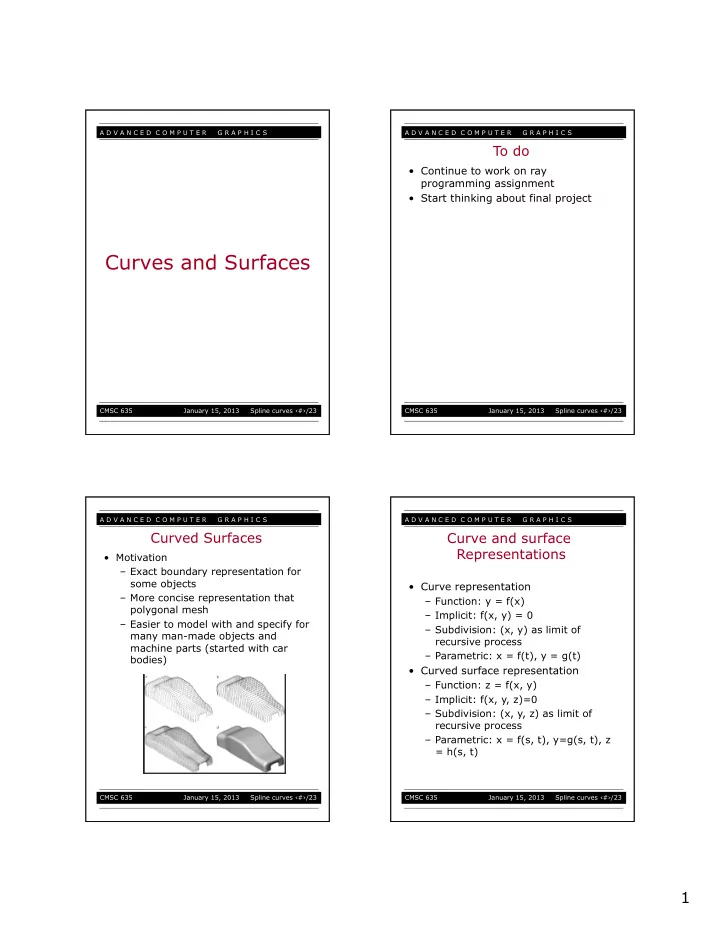
A D V A N C E D C O M P U T E R G R A P H I C S A D V A N C E D C O M P U T E R G R A P H I C S To do Continue to work on ray programming assignment Start thinking about final project Curves and Surfaces CMSC 635


slide-1
SLIDE 1

1

A D V A N C E D C O M P U T E R G R A P H I C S CMSC 635 January 15, 2013 Spline curves ‹#›/23

Curves and Surfaces

A D V A N C E D C O M P U T E R G R A P H I C S CMSC 635 January 15, 2013 Spline curves ‹#›/23

To do

  • Continue to work on ray

programming assignment

  • Start thinking about final project

A D V A N C E D C O M P U T E R G R A P H I C S CMSC 635 January 15, 2013 Spline curves ‹#›/23

Curved Surfaces

  • Motivation

– Exact boundary representation for some objects – More concise representation that polygonal mesh – Easier to model with and specify for many man-made objects and machine parts (started with car bodies)

A D V A N C E D C O M P U T E R G R A P H I C S CMSC 635 January 15, 2013 Spline curves ‹#›/23

Curve and surface Representations

  • Curve representation

– Function: y = f(x) – Implicit: f(x, y) = 0 – Subdivision: (x, y) as limit of recursive process – Parametric: x = f(t), y = g(t)

  • Curved surface representation

– Function: z = f(x, y) – Implicit: f(x, y, z)=0 – Subdivision: (x, y, z) as limit of recursive process – Parametric: x = f(s, t), y=g(s, t), z = h(s, t)

slide-2
SLIDE 2

2

A D V A N C E D C O M P U T E R G R A P H I C S CMSC 635 January 15, 2013 Spline curves ‹#›/23

Parametric Surfaces

  • Boundary defined by parametic

function – x = f(u, v) – y = f(u, v) – Z = f(u, v)

  • Example (sphere):

– X = sin (θ) cos (φ) – Y = sin (θ) sin (φ) – Z = cos(θ)

A D V A N C E D C O M P U T E R G R A P H I C S CMSC 635 January 15, 2013 Spline curves ‹#›/23

Parametric Representation

  • One function vs. many (defined

piecewise)

  • Continuity
  • A parametric polynomial curve of
  • rder n:
  • Advantages of polynomial curves

– Easy to compute – Infinitely differentiable everywhere

A D V A N C E D C O M P U T E R G R A P H I C S CMSC 635 January 15, 2013 Spline curves ‹#›/23

Spline Constructions

  • Cubic spline is the most common

form

  • Common constructions

– Bezier: 4 control points – B-splines: approximating C2, local control – Hermite: 2 points, 2 normals – Natural splines: interpolating, C2, no local control – Catmull-Rom: interpolating, C1, local control

A D V A N C E D C O M P U T E R G R A P H I C S CMSC 635 January 15, 2013 Spline curves ‹#›/23

Bezier Curve

  • Motivation: Draw a smooth intuitive

curve (or surface) given a few key user-specified control points

  • Properties:

– Interpolates is tangent to end points – Curve within convex hull of control polygon

Smooth Bezier curve (drawn automatically)

Control point

slide-3
SLIDE 3

3

A D V A N C E D C O M P U T E R G R A P H I C S CMSC 635 January 15, 2013 Spline curves ‹#›/23

Linear Bezier Curve

  • Just a simple linear combination or

interpolation (easy to code up, very numerically stable) P0 P1 F(0) F(u) F(1) Linear (Degree 1, Order 2) F(0) = P0, F(1) = P1 F(u) = ? P0 P1 1-u u F(u) = (1-u) P0 + u P1

A D V A N C E D C O M P U T E R G R A P H I C S CMSC 635 January 15, 2013 Spline curves ‹#›/23

deCastljau: Quadratic Bezier Curve

P0 P1 P2 Quadratic Degree 2, Order 3 F(0) = P0, F(1) = P2 F(u) = ? F(u) = (1-u)2 P0 + 2u(1-u) P1 + u2 P2 P0 P1 P2 1-u 1-u u u 1-u u

A D V A N C E D C O M P U T E R G R A P H I C S CMSC 635 January 15, 2013 Spline curves ‹#›/23

Geometric Interpretation: Quadratic

u u u 1-u 1-u

A D V A N C E D C O M P U T E R G R A P H I C S CMSC 635 January 15, 2013 Spline curves ‹#›/23

Geometric Interpolation: Cubic

u u u u u u

slide-4
SLIDE 4

4

A D V A N C E D C O M P U T E R G R A P H I C S CMSC 635 January 15, 2013 Spline curves ‹#›/23

Summary: deCasteljau Algorithm

  • A recursive implementation of curves

at different orders

Linear Degree 1, Order 2 F(0) = P0, F(1) = P1

P0 P1 P0 P1 1-u u

F(u) = (1-u) P0 + u P1

P0 P1 P2

Quadratic Degree 2, Order 3 F(0) = P0, F(1) = P2

P0 P1 P2

F(u) = (1-u)2 P0 + 2u(1-u) P1 + u2 P2 1-u 1-u u u 1-u u A D V A N C E D C O M P U T E R G R A P H I C S CMSC 635 January 15, 2013 Spline curves ‹#›/23

Summary: deCasteljau Algorithm

  • A recursive implementation of curves

at different orders

  • Further consideration: polar

coordinates P0 P1 P2 P3

Cubic Degree 3, Order 4 F(0) = P0, F(1) = P3

P0 P1 P2 P3

1-u 1-u 1-u u u u u u u 1-u 1-u F(u) = (1-u)3 P0 +3u(1-u)2 P1 +3u2(1-u) P2 + u3 P3 1-u A D V A N C E D C O M P U T E R G R A P H I C S CMSC 635 January 15, 2013 Spline curves ‹#›/23

Bezier: disadvantages

  • Single piece, no local control (move

a control point, whole curve changes)

  • Complex shapes: can be very high

degree, difficult to deal with

  • In practice: combine many Bezier

curve segments – But only position continuous at the joint points since Bezier curves interpolate end-points (which match at segment boundaries) – Unpleasant derivative (slope) discontinuities at end-points

A D V A N C E D C O M P U T E R G R A P H I C S CMSC 635 January 15, 2013 Spline curves ‹#›/23

Piecewise polynomial curves

  • Ideas:

– Use different polynomial functions for different parts of the curve

  • Advantage:

– Flexibility – Local control

  • Issue

– Smoothness at joints (G: geometry continuity: C: derivative continuity)

slide-5
SLIDE 5

5

A D V A N C E D C O M P U T E R G R A P H I C S CMSC 635 January 15, 2013 Spline curves ‹#›/23

Continuity

  • Continuity Ck indicates adjacent

curves have the same kth derivative at their joints

  • C0 continuity: Adjacent curves share

– Same endpoints: Qi(1) = Qi+1(0)

  • C-1: discontinuous curves

A D V A N C E D C O M P U T E R G R A P H I C S CMSC 635 January 15, 2013 Spline curves ‹#›/23

Continuity

  • C1 continuity: Adjacent curves share

– Same endpoints: Qi(1) = Qi+1(0) and – Same derivative:Qi’(1) = Qi+1’(0)

  • C2 continuity:

– Must have C1 continuity, and – Same second derivatives: Qi ’’(1) = Qi+1 ’’(0)

  • Most engineering applications (e.g.,

those in car and airplane industry) require at least C1 continuity

A D V A N C E D C O M P U T E R G R A P H I C S CMSC 635 January 15, 2013 Spline curves ‹#›/23

Splines

  • More useful form of representation compared to the

Bezier curve

  • How they work: Parametric curves governed by

control points

  • Mathematically: Several representations to choose
  • from. More complicated than vertex lists. See chapter

22 of the book for more information. Simple parametric representation:

  • Advantage: Smooth with just a few control point
  • Disadvantage: Can be hard to control
  • Uses:

– representation of smooth shapes. Either as

  • utlines in 2D or with Patches or Subdivision

Surfaces in 3D – animation Paths – approximation of truncated Gaussian Filters

A D V A N C E D C O M P U T E R G R A P H I C S CMSC 635 January 15, 2013 Spline curves ‹#›/23

A Simple Animation Example

  • Problem: create a car

animation that is driving up along the y-axis with velocity [0, 3], and arrive at the point (0, 4) at time t=0. Animate its motion as it turns and slows down so that at time t=1, it is at position (2, 5) with velocity [2, 0].

  • Solution

– First step: generate a mathematical description. – Second step: choose the curve representation

  • Hermite curve: r(t)=GMT(t)
  • Exercise: Bezier curve representation?
slide-6
SLIDE 6

6

A D V A N C E D C O M P U T E R G R A P H I C S CMSC 635 January 15, 2013 Spline curves ‹#›/23

Catmull Rom Spline

  • Can be used to solve the following

problem.

  • Solution:

– Math representation – Curve construction

  • Catmull Rom spline to construct the

vectors from the two or three neighbors take home exercise: read chap 22 in the book and construct the curve and the B-spline using the Chen code.

A D V A N C E D C O M P U T E R G R A P H I C S CMSC 635 January 15, 2013 Spline curves ‹#›/23

Subdivision curves

  • A simple idea

– Using the midpoint of the edge from one point to the next, replace that point with a new one to create a new polygon to construct a new curve. – problem with this?

  • Further readings:

– Laplacian interpolation and smoothing (Gabriel Taubin @ Brown) – Joe Warren@ Rice (on mesh)

A D V A N C E D C O M P U T E R G R A P H I C S CMSC 635 January 15, 2013 Spline curves ‹#›/23

Surfaces

  • Curves -> Surfaces
  • Bezier patch:

– 16 points – Check out the Chen code for surface construction