MDTAs I895 Bridge Project Smart Work Zone Implementation N Boston - - PowerPoint PPT Presentation

mdta s i895 bridge project
SMART_READER_LITE
LIVE PREVIEW

MDTAs I895 Bridge Project Smart Work Zone Implementation N Boston - - PowerPoint PPT Presentation

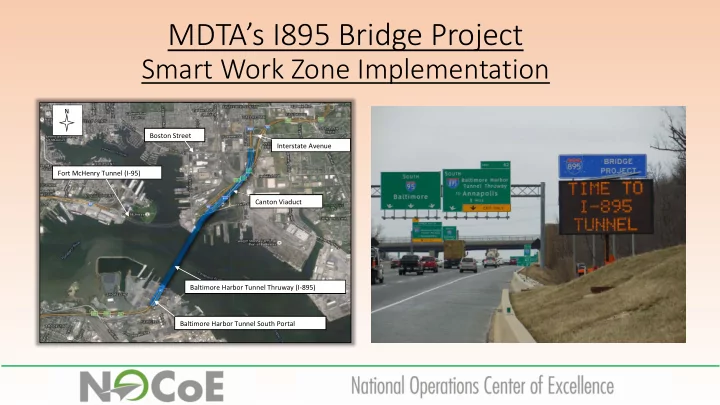
MDTAs I895 Bridge Project Smart Work Zone Implementation N Boston Street Interstate Avenue Fort McHenry Tunnel (I-95) Canton Viaduct Baltimore Harbor Tunnel Thruway (I-895) Baltimore Harbor Tunnel South Portal SWZ Smart Work Zone


slide-1
SLIDE 1

MDTA’s I895 Bridge Project

Smart Work Zone Implementation

Interstate Avenue Baltimore Harbor Tunnel South Portal

N

Baltimore Harbor Tunnel Thruway (I-895) Fort McHenry Tunnel (I-95) Boston Street Canton Viaduct
slide-2
SLIDE 2

SWZ – Smart Work Zone

  • Agencies can use a variety of ITS applications to enhance work zone mobility and safety.
  • Real-time traveler information systems provide drivers with real-time travel conditions prior to and within a work

zone, and may also provide information on alternative routes in the corridor. The goal is to divert drivers away from the work zone when congestion exists.

  • Queue warning systems quickly detect the presence of congestion at the work zone and warn approaching

motorists that traffic is slowed or stopped ahead.

  • Dynamic lane merge systems encourage motorists to merge at specific points as they approach a lane closure,

depending on current operating conditions.

  • Incident management systems enable agencies, contractors, and responders to detect incidents in the work zone

faster, allowing quicker response and clearance.

  • Variable speed limit systems harmonize speeds before and within the work zone, calming traffic flow and warning
  • f slowed or stopped traffic ahead.
  • Automated enforcement systems detect and capture images of speeding vehicles for enforcement purposes.
  • Entering/exiting vehicle notification warns drivers of slow-moving construction vehicles that may be entering the

travel lane. It can also warn travelers that a work vehicle is exiting the travel lane and not to follow it into the work space.

  • Performance measurement systems monitor and archive data on traffic conditions to support real-time traveler

information dissemination, modify operations, and facilitate evaluation.

slide-3
SLIDE 3

SWZ – Common Applications

Queue Warnings Variable Speed Limits Zipper (Late) Merge Truck Entry Systems Applications

slide-4
SLIDE 4

SWZ WZ – Queu eue W e Warni ning ng System ems

Typical Equipment: 1 PCMS w/Doppler + 4 Sensors 1 Optional Added PCMS (1 mi before Taper)

Typical Benefits:

Reduce Chance of Rear End Crashes by 18-45%

slide-5
SLIDE 5

SWZ WZ – Queu eue W e Warni ning ng System ems

Source: ARTBA Work Zone Safety Consortium (Sept 2015)

slide-6
SLIDE 6

I-895 B Bridge ge Project– SWZ Ov Z Overview

I-895 P Projec ect Ar Area ea

Project Limits:

  • 1,000 FT South of Tunnel (MM 8.80) to Interstate

Ave / Boston St (MM 11.65)

  • Project will extend about 3 miles (bridge ~ ¾ mile

long)

Interstate Avenue Baltimore Harbor Tunnel South Portal

N

Baltimore Harbor Tunnel Thruway (I-895) Fort McHenry Tunnel (I-95) Boston Street Canton Viaduct

Scope of Work

  • Replacement of Canton Viaduct
  • Complete replacement of the 60 year-old, Canton

Viaduct and Holabird Ave. Ramp Bridges

  • Rehabilitation to the BHT
  • Tunnel deck
  • Portal approaches and retaining walls
  • Interior tiles
  • Fire main and standpipe
  • Rehabilitation of tunnel approach roadway and

retaining walls

slide-7
SLIDE 7

I-89 895 5 – SWZ Ov Z Overview

Schedule:

Advertisement: Summer 2017 NTP: April 2018 Main Bridge Construction: November 2018 Reduced Lanes only after I-95 Improvements complete After Thanksgiving Construction Complete: Summer 2021

Impacts & Other Project Scheduling

  • 3 major harbor crossings
  • I-95 (Major North/South Route)
  • I-895 (Parallels I-95, Thruway)
  • I-695 (Baltimore Beltway)
  • All harbor crossings are tolled facilities operated by

MDTA

slide-8
SLIDE 8

I-89 895 5 – SWZ Ov Z Overview

  • I-95
  • I-895 diversion route with excess capacity
  • FT-3003 / I-95 from Moravia Road to the Fort McHenry Tunnel

─ Capacity Improvements

  • I-695
  • I-895 diversion route with excess capacity
  • KB-3003 / Maintenance and Repairs of Curtis Creek Drawbridges

─ Reduced capacity on I-695; Completed before Canton Viaduct Stage 2

  • I-895
  • HT-2658 / I-895 Over Patapsco River Flats Superstructure Replacement

─ Reduced capacity on I-895; Already Encourages diversion from I-895

slide-9
SLIDE 9

I-89 895 5 – SWZ Ov Z Overview

  • Stage 1
  • Two lanes each direction
  • Sub-stages 1A, 1A-1,1B and 1C
  • Stage 2
  • One lane each direction (southbound bridge)
  • Closure of Holabird Avenue Ramp
  • Sub-stages 2A,2B and 2C
  • Stage 3
  • One lane each direction (northbound bridge)
  • Sub-stages 3A, 3B-1,3B-2 and 3C
  • Stage 4
  • Two lanes each direction

Maintenance of Traffic -

  • Short Term Roadway Closures

(Nights & Weekends)

  • Long Term Roadway Closures

(24/7)

  • Two-way Traffic Operations in

each bore maintained for majority of Stages

slide-10
SLIDE 10

I-89 895 5 – SWZ Ov Z Overview

I-895 Traffic Management System

GENERAL SYSTEM SPECIFICATION:

  • The project utilizes Portable Traffic Sensors (PTS) and Portable Variable Message

Sign(PVMS).

  • PTSs and PVMSs used are self contained trailer mounted portable units.
  • All PVMSs AND PTSs are proposed to use solar power.
  • All PVMSs AND PTSs are proposed to communicate using cellular or wireless internet

communications.

  • All PVMSs incorporate a branding sign for the project as shown in the plans and

specifications.

  • The contractor was required to install the above devices for construction stages 2, 3 AND

4, including all associated sub-stages, OR as needed by engineer.

slide-11
SLIDE 11

I-89 895 5 – SWZ Ov Z Overview

  • Regional Deployment of Devices

10 Portable Traffic Sensors I-895

  • Contractor Installed/Maintained

Operational for Stages 2,3 and 4

  • Real-Time Congestion Warning
slide-12
SLIDE 12

I-89 895 5 – SWZ Ov Z Overview

  • Regional Deployment of Devices

13 Portable Variable Message Signs I-895 − I-95 I-695 − I-97 MD 295 − MD 2 US 40 − Moravia Road

slide-13
SLIDE 13

I-89 895 5 – SWZ Ov Z Overview

  • Regional Deployment of Devices

13 Portable Variable Message Signs I-895 − I-95 I-695 − I-97 MD 295 − MD 2 US 40 − Moravia Road

slide-14
SLIDE 14

I-89 895 5 – SWZ Ov Z Overview

Sys ystem M m Map

slide-15
SLIDE 15

I-89 895 5 – SWZ Ov Z Overview

  • Remote Data Collection and Automated

Data Processing

Speed Thresholds Volumes Lane Occupancy

  • Web-based System Management
  • User Notifications

Email or Text

  • MDTA System Override

Avoid Conflicting Messages

slide-16
SLIDE 16

I-89 895 5 – SWZ Ov Z Overview

  • Penalties for Non-Operational

System

$2,500 per day first 10 days $5,000 per day every day after 10

  • Project “Branding”
  • Contract Unit Cost
  • $690,000 Lump Sum
slide-17
SLIDE 17

I-895 – SWZ Overview

slide-18
SLIDE 18

I-89 895 5 – Hybrid R Routes

3rd Party TT Data

(From PCMS to Sensor)

Portable Sensors

(From Closest PCMS to Tunnel)

Combined 3rd Party & Portable Sensor Route Results in Cost-Effective Best Travel Time Data

slide-19
SLIDE 19

I-89 895 5 – Real eal Time S e Sens ensor S Spee peeds ds

slide-20
SLIDE 20

I-89 895 5 – Message H Histor

  • ry &

& TT Da Data

Alt Rte Suggested TT > 3X Free Flow

slide-21
SLIDE 21

I-89 895 5 – Auto tomate ted A Alerts to to T TMC MC

Alt Rte Suggested TT > 3X Free Flow

slide-22
SLIDE 22

SWZ WZ – Heat Map R Reports

slide-23
SLIDE 23

SWZ WZ – Heat Map R Reports

See All Message Sign Change History Hover Over Any Sensor Speed to See Details

slide-24
SLIDE 24