Algorithmic Questions in Higher-Order Fourier Analysis Madhur - - PowerPoint PPT Presentation

algorithmic questions in higher order fourier analysis
SMART_READER_LITE
LIVE PREVIEW

Algorithmic Questions in Higher-Order Fourier Analysis Madhur - - PowerPoint PPT Presentation

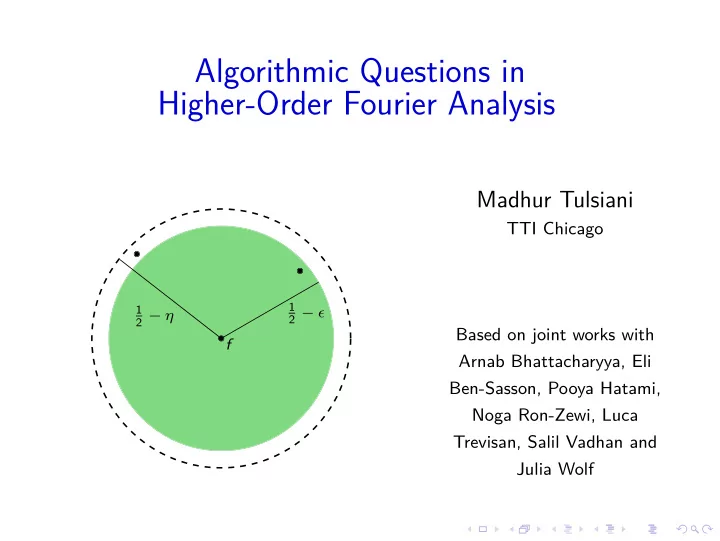
Algorithmic Questions in Higher-Order Fourier Analysis Madhur Tulsiani TTI Chicago 1 1 2 2 Based on joint works with f Arnab Bhattacharyya, Eli Ben-Sasson, Pooya Hatami, Noga Ron-Zewi, Luca Trevisan, Salil Vadhan and Julia


slide-1
SLIDE 1

Algorithmic Questions in Higher-Order Fourier Analysis

f

1 2 − ǫ 1 2 − η
Madhur Tulsiani

TTI Chicago Based on joint works with Arnab Bhattacharyya, Eli Ben-Sasson, Pooya Hatami, Noga Ron-Zewi, Luca Trevisan, Salil Vadhan and Julia Wolf

slide-2
SLIDE 2

Decomposition Theorems

slide-3
SLIDE 3

Decomposition Theorems

Object of study Family of algorithms or functions

slide-4
SLIDE 4

Decomposition Theorems

Object of study Family of algorithms or functions

=

Structured

+

No apparent structure (Pseudorandom)

slide-5
SLIDE 5

Decomposition Theorems

Object of study Family of algorithms or functions

=

Structured

+

No apparent structure (Pseudorandom)

  • Decompose an object in to structured and pseudorandom parts.
slide-6
SLIDE 6

Decomposition Theorems

Object of study Family of algorithms or functions

=

Structured

+

No apparent structure (Pseudorandom)

  • Decompose an object in to structured and pseudorandom parts.
  • Can often ignore the pseudorandom part for many applications.

Structured part easier to study.

slide-7
SLIDE 7

Fourier analysis

  • Space of functions g : Fn

2 → R.

slide-8
SLIDE 8

Fourier analysis

  • Space of functions g : Fn

2 → R.

  • Functions

χα(x) = (−1)α·x = (−1)

  • j αjxj

form an orthonormal basis under the inner product f , g = Ex [f (x)g(x)].

slide-9
SLIDE 9

Fourier analysis

  • Space of functions g : Fn

2 → R.

  • Functions

χα(x) = (−1)α·x = (−1)

  • j αjxj

form an orthonormal basis under the inner product f , g = Ex [f (x)g(x)].

  • Any function g can be written as

g =

  • α∈Fn

2

ˆ g(α)χα .

slide-10
SLIDE 10

Fourier analysis

  • Space of functions g : Fn

2 → R.

  • Functions

χα(x) = (−1)α·x = (−1)

  • j αjxj

form an orthonormal basis under the inner product f , g = Ex [f (x)g(x)].

  • Any function g can be written as

g =

  • α∈Fn

2

ˆ g(α)χα .

  • [Parseval]: g2 = g, g = Ex
  • (g(x))2

=

α (ˆ

g(α))2.

slide-11
SLIDE 11

A basic decomposition in Fourier analysis

g : Fn

2 → [−1, 1]

slide-12
SLIDE 12

A basic decomposition in Fourier analysis

g : Fn

2 → [−1, 1]

χα(x) = (−1)α·x = (−1)

  • i αjxj

α ∈ Fn

2

g =

  • S
  • g(α)χα
slide-13
SLIDE 13

A basic decomposition in Fourier analysis

g : Fn

2 → [−1, 1]

χα(x) = (−1)α·x = (−1)

  • i αjxj

α ∈ Fn

2

g =

  • S
  • g(α)χα =
  • |

g(α)|>ǫ

  • g(α)χα +
  • |

g(α)|≤ǫ

  • g(α)χα =

k

  • i=1

ciχαi + f

slide-14
SLIDE 14

A basic decomposition in Fourier analysis

g : Fn

2 → [−1, 1]

χα(x) = (−1)α·x = (−1)

  • i αjxj

α ∈ Fn

2

g =

  • S
  • g(α)χα =
  • |

g(α)|>ǫ

  • g(α)χα +
  • |

g(α)|≤ǫ

  • g(α)χα =

k

  • i=1

ciχαi + f

  • k ≤ 1/ǫ2.

simple structure

slide-15
SLIDE 15

A basic decomposition in Fourier analysis

g : Fn

2 → [−1, 1]

χα(x) = (−1)α·x = (−1)

  • i αjxj

α ∈ Fn

2

g =

  • S
  • g(α)χα =
  • |

g(α)|>ǫ

  • g(α)χα +
  • |

g(α)|≤ǫ

  • g(α)χα =

k

  • i=1

ciχαi + f

  • k ≤ 1/ǫ2.

simple structure

  • f has small correlation with linear functions.

pseudorandom ∀α, |f , χα| = |Ex [f (x)χα(x)]| ≤ ǫ

slide-16
SLIDE 16

Getting high: Quadratic Fourier Analysis

[Gowers 98, Green 07]

  • “Fourier pseudorandomness” often insufficient for many applications

(e.g. counting 4-term APs in a set).

slide-17
SLIDE 17

Getting high: Quadratic Fourier Analysis

[Gowers 98, Green 07]

  • “Fourier pseudorandomness” often insufficient for many applications

(e.g. counting 4-term APs in a set).

  • [Gowers 98]: Defined uniformity norms (Gowers norms). “Right”

notion of pseudorandomness for many applications. f 4

U2 = Ex,y,z [f (x) · f (x + y) · f (x + z) · f (x + y + z)] .

Think f = indicator of a set. f U2 counts 2-dimensional "boxes" in set.

slide-18
SLIDE 18

Getting high: Quadratic Fourier Analysis

[Gowers 98, Green 07]

  • “Fourier pseudorandomness” often insufficient for many applications

(e.g. counting 4-term APs in a set).

  • [Gowers 98]: Defined uniformity norms (Gowers norms). “Right”

notion of pseudorandomness for many applications. f 4

U2 = Ex,y,z [f (x) · f (x + y) · f (x + z) · f (x + y + z)] .

Think f = indicator of a set. f U2 counts 2-dimensional "boxes" in set.

  • Can define higher norms similarly

f 8

U3 = Ex,y,z,w

  • f(x) f(x+y) f(x+z) f(x+y+z)

f(x+w) f(x+y+w) f(x+z+w) f(x+y+z+w)

slide-19
SLIDE 19

Norms, Shnorms... so what?

  • f U2 measures correlation with Fourier characters (linear phase

functions).

  • max

α

  • ˆ

f (α)

  • 4

≤ f 4

U2 ≤

  • max

α

  • ˆ

f (α)

  • 2
slide-20
SLIDE 20

Norms, Shnorms... so what?

  • f U2 measures correlation with Fourier characters (linear phase

functions).

  • max

α

  • ˆ

f (α)

  • 4

≤ f 4

U2 ≤

  • max

α

  • ˆ

f (α)

  • 2
  • [Green-Tao 05, Samorodnitsky 07]: Gowers U3 norm approximately

measures correlation with the set of quadratic phase functions. ((−1)Q(x) for Q(x) = xTAx + bTx + c).

slide-21
SLIDE 21

Norms, Shnorms... so what?

  • f U2 measures correlation with Fourier characters (linear phase

functions).

  • max

α

  • ˆ

f (α)

  • 4

≤ f 4

U2 ≤

  • max

α

  • ˆ

f (α)

  • 2
  • [Green-Tao 05, Samorodnitsky 07]: Gowers U3 norm approximately

measures correlation with the set of quadratic phase functions. ((−1)Q(x) for Q(x) = xTAx + bTx + c). For f : Fn

2 → [−1, 1],

  • f U3 ≤ ǫ

= ⇒ for all Q,

  • f , (−1)Q

≤ ǫ.

slide-22
SLIDE 22

Norms, Shnorms... so what?

  • f U2 measures correlation with Fourier characters (linear phase

functions).

  • max

α

  • ˆ

f (α)

  • 4

≤ f 4

U2 ≤

  • max

α

  • ˆ

f (α)

  • 2
  • [Green-Tao 05, Samorodnitsky 07]: Gowers U3 norm approximately

measures correlation with the set of quadratic phase functions. ((−1)Q(x) for Q(x) = xTAx + bTx + c). For f : Fn

2 → [−1, 1],

  • f U3 ≤ ǫ

= ⇒ for all Q,

  • f , (−1)Q

≤ ǫ.

  • f U3 ≥ ǫ

= ⇒ for some Q,

  • f , (−1)Q

≥ η(ǫ).

slide-23
SLIDE 23

Decompositions in Quadratic Fourier Analysis

Theorem (Gowers-Wolf 09)

Given ǫ > 0, any g : Fn

2 → [−1, 1] can be decomposed as

g =

k

  • i=1

ci(−1)Qi + f + e for quadratic functions Q1, . . . , Qk such that

slide-24
SLIDE 24

Decompositions in Quadratic Fourier Analysis

Theorem (Gowers-Wolf 09)

Given ǫ > 0, any g : Fn

2 → [−1, 1] can be decomposed as

g =

k

  • i=1

ci(−1)Qi + f + e for quadratic functions Q1, . . . , Qk such that

  • f U3 ≤ ǫ, e1 ≤ ǫ

pseudorandom

slide-25
SLIDE 25

Decompositions in Quadratic Fourier Analysis

Theorem (Gowers-Wolf 09)

Given ǫ > 0, any g : Fn

2 → [−1, 1] can be decomposed as

g =

k

  • i=1

ci(−1)Qi + f + e for quadratic functions Q1, . . . , Qk such that

  • f U3 ≤ ǫ, e1 ≤ ǫ

pseudorandom

i |ci| ≤ M(ǫ) for M(ǫ) = exp(1/ǫC).

structure

slide-26
SLIDE 26

Decompositions in Quadratic Fourier Analysis

Theorem (Gowers-Wolf 09)

Given ǫ > 0, any g : Fn

2 → [−1, 1] can be decomposed as

g =

k

  • i=1

ci(−1)Qi + f + e for quadratic functions Q1, . . . , Qk such that

  • f U3 ≤ ǫ, e1 ≤ ǫ

pseudorandom

i |ci| ≤ M(ǫ) for M(ǫ) = exp(1/ǫC).

structure Similar to basic Fourier decomposition, where we get g =

k

  • i=1

ciχαi(x) + f , with |f , χα| ≤ ǫ for all α and k ≤ 1/ǫ2 (also implies

i |ci| ≤ 1/ǫ).

slide-27
SLIDE 27

Decompositions in Higher-Order Fourier Analysis

Theorem (Gowers-Wolf 10)

Given ǫ > 0 and p > d, there exists M(ǫ, p) such that any g : Fn

p → [−1, 1] can be decomposed as

g =

k

  • i=1

ci · ωPi + f + e for P1, . . . , Pk ∈ Pd (polynomials of degree at most d) such that

  • f Ud+1 ≤ ǫ, e1 ≤ ǫ

i |ci| ≤ M(ǫ, p).

slide-28
SLIDE 28

Decompositions in Higher-Order Fourier Analysis

Theorem (Gowers-Wolf 10)

Given ǫ > 0 and p > d, there exists M(ǫ, p) such that any g : Fn

p → [−1, 1] can be decomposed as

g =

k

  • i=1

ci · ωPi + f + e for P1, . . . , Pk ∈ Pd (polynomials of degree at most d) such that

  • f Ud+1 ≤ ǫ, e1 ≤ ǫ

i |ci| ≤ M(ǫ, p).

  • Stronger decomposition theorems proved by [HL 11] and

[BFL 12].

  • Decomposition theorems for the case when p ≤ d require

non-classical polynomials.

slide-29
SLIDE 29

Q1: Can we compute these decompositions efficiently?

slide-30
SLIDE 30

Algorithmic version of the basic Fourier decomposition

Theorem (Goldreich-Levin 89)

There is a randomized algorithm, which given ǫ, δ > 0 and oracle access to g : Fn

2 → [−1, 1], runs in time O

  • n2 log n · (1/ǫ2) · log(1/δ)
  • and
  • utputs a decomposition

g =

k

  • i=1

ci · χαi + f such that

slide-31
SLIDE 31

Algorithmic version of the basic Fourier decomposition

Theorem (Goldreich-Levin 89)

There is a randomized algorithm, which given ǫ, δ > 0 and oracle access to g : Fn

2 → [−1, 1], runs in time O

  • n2 log n · (1/ǫ2) · log(1/δ)
  • and
  • utputs a decomposition

g =

k

  • i=1

ci · χαi + f such that

  • k = O(1/ǫ2)
slide-32
SLIDE 32

Algorithmic version of the basic Fourier decomposition

Theorem (Goldreich-Levin 89)

There is a randomized algorithm, which given ǫ, δ > 0 and oracle access to g : Fn

2 → [−1, 1], runs in time O

  • n2 log n · (1/ǫ2) · log(1/δ)
  • and
  • utputs a decomposition

g =

k

  • i=1

ci · χαi + f such that

  • k = O(1/ǫ2)
  • P[∃i such that |ci −

g(αi)| ≥ ǫ] ≤ δ

slide-33
SLIDE 33

Algorithmic version of the basic Fourier decomposition

Theorem (Goldreich-Levin 89)

There is a randomized algorithm, which given ǫ, δ > 0 and oracle access to g : Fn

2 → [−1, 1], runs in time O

  • n2 log n · (1/ǫ2) · log(1/δ)
  • and
  • utputs a decomposition

g =

k

  • i=1

ci · χαi + f such that

  • k = O(1/ǫ2)
  • P[∃i such that |ci −

g(αi)| ≥ ǫ] ≤ δ

  • P[∃α such that
  • f (α)
  • ≥ ǫ] ≤ δ
  • Finding large Fourier coefficients has many applications.
slide-34
SLIDE 34

What’s so different about quadratics?

  • Set of quadratic phase functions ((−1)Q) is not an orthonormal
  • basis. No Parseval’s identity.
slide-35
SLIDE 35

What’s so different about quadratics?

  • Set of quadratic phase functions ((−1)Q) is not an orthonormal
  • basis. No Parseval’s identity.
  • Proof of decomposition by Gowers and Wolf is non-constructive

(using the Hahn-Banach theorem).

slide-36
SLIDE 36

What’s so different about quadratics?

  • Set of quadratic phase functions ((−1)Q) is not an orthonormal
  • basis. No Parseval’s identity.
  • Proof of decomposition by Gowers and Wolf is non-constructive

(using the Hahn-Banach theorem). ci(−1)Qi + f

s.t.

i |ci| ≤ M(ǫ), f U3 ≤ ǫ

slide-37
SLIDE 37

What’s so different about quadratics?

  • Set of quadratic phase functions ((−1)Q) is not an orthonormal
  • basis. No Parseval’s identity.
  • Proof of decomposition by Gowers and Wolf is non-constructive

(using the Hahn-Banach theorem). ci(−1)Qi + f

s.t.

i |ci| ≤ M(ǫ), f U3 ≤ ǫ

g

slide-38
SLIDE 38

What’s so different about quadratics?

  • Set of quadratic phase functions ((−1)Q) is not an orthonormal
  • basis. No Parseval’s identity.
  • Proof of decomposition by Gowers and Wolf is non-constructive

(using the Hahn-Banach theorem). ci(−1)Qi + f

s.t.

i |ci| ≤ M(ǫ), f U3 ≤ ǫ

g

slide-39
SLIDE 39

What’s so different about quadratics?

  • Set of quadratic phase functions ((−1)Q) is not an orthonormal
  • basis. No Parseval’s identity.
  • Proof of decomposition by Gowers and Wolf is non-constructive

(using the Hahn-Banach theorem). ci(−1)Qi + f

s.t.

i |ci| ≤ M(ǫ), f U3 ≤ ǫ

g

  • Use inverse theorem for Gowers norm to get a contradiction.
slide-40
SLIDE 40

A quadratic Goldreich-Levin Theorem

Theorem (T, Wolf 11)

For M(ǫ) = exp(1/ǫC), can compute in time poly(n, M(ǫ), log(1/δ)), a decomposition g =

k

  • i=1

ci(−1)Qi + f + e such that

  • with probability 1 − δ, f U3 ≤ ǫ and e1 ≤ ǫ.

i |ci| ≤ M(ǫ) and k ≤ (M(ǫ))2.

slide-41
SLIDE 41

Improved quadratic Goldreich-Levin Theorem

Theorem (BRTW 12)

For M(ǫ) = O(exp(log4(1/ǫ))), can compute in time poly(n, M(ǫ), log(1/δ)), a decomposition g =

k

  • i=1

ci(−1)Qi + f + e such that

  • with probability 1 − δ, f U3 ≤ ǫ and e1 ≤ ǫ.

i |ci| ≤ M(ǫ) and k ≤ (M(ǫ))2.

slide-42
SLIDE 42

A constructive proof of decomposition [TTV 09]

Goal: Given g : Fn

2 → [−1, 1], find a decomposition g = i ci(−1)Qi + f

such that f U3 ≤ ǫ.

slide-43
SLIDE 43

A constructive proof of decomposition [TTV 09]

Goal: Given g : Fn

2 → [−1, 1], find a decomposition g = i ci(−1)Qi + f

such that f U3 ≤ ǫ. Algorithm:

  • h0 = 0, f0 = g − h0, t = 1.
slide-44
SLIDE 44

A constructive proof of decomposition [TTV 09]

Goal: Given g : Fn

2 → [−1, 1], find a decomposition g = i ci(−1)Qi + f

such that f U3 ≤ ǫ. Algorithm:

  • h0 = 0, f0 = g − h0, t = 1.
  • while there is a quadratic function Qt such that
  • ft−1, (−1)Qt

> η

slide-45
SLIDE 45

A constructive proof of decomposition [TTV 09]

Goal: Given g : Fn

2 → [−1, 1], find a decomposition g = i ci(−1)Qi + f

such that f U3 ≤ ǫ. Algorithm:

  • h0 = 0, f0 = g − h0, t = 1.
  • while there is a quadratic function Qt such that
  • ft−1, (−1)Qt

> η

  • ht = ht−1 + η · (−1)Qt = t

r=1 η · (−1)Qr

  • ft = g − ht
  • t = t + 1
slide-46
SLIDE 46

A constructive proof of decomposition [TTV 09]

Goal: Given g : Fn

2 → [−1, 1], find a decomposition g = i ci(−1)Qi + f

such that f U3 ≤ ǫ. Algorithm:

  • h0 = 0, f0 = g − h0, t = 1.
  • while there is a quadratic function Qt such that
  • ft−1, (−1)Qt

> η

  • ht = ht−1 + η · (−1)Qt = t

r=1 η · (−1)Qr

  • ft = g − ht
  • t = t + 1
  • return ht
slide-47
SLIDE 47

A constructive proof of decomposition [TTV 09]

Goal: Given g : Fn

2 → [−1, 1], find a decomposition g = i ci(−1)Qi + f

such that f U3 ≤ ǫ. Algorithm:

  • h0 = 0, f0 = g − h0, t = 1.
  • while there is a quadratic function Qt such that
  • ft−1, (−1)Qt

> η

  • ht = ht−1 + η · (−1)Qt = t

r=1 η · (−1)Qr

  • ft = g − ht
  • t = t + 1
  • return ht

Convergence: ft−12 − ft2 = 2η

  • ft−1, (−1)Qt

− η2 ≥ η2.

slide-48
SLIDE 48

A constructive proof of decomposition [TTV 09]

Goal: Given g : Fn

2 → [−1, 1], find a decomposition g = i ci(−1)Qi + f

such that f U3 ≤ ǫ. Algorithm:

  • h0 = 0, f0 = g − h0, t = 1.
  • while there is a quadratic function Qt such that
  • ft−1, (−1)Qt

> η

  • ht = ht−1 + η · (−1)Qt = t

r=1 η · (−1)Qr

  • ft = g − ht
  • t = t + 1
  • return ht

Convergence: ft−12 − ft2 = 2η

  • ft−1, (−1)Qt

− η2 ≥ η2. [Samorodnitsky 07]: ∀Q

  • (−1)Q, f
  • ≤ η(ǫ) =

⇒ f U3 ≤ ǫ.

slide-49
SLIDE 49

A constructive proof of decomposition [TTV 09]

Goal: Given g : Fn

2 → [−1, 1], find a decomposition g = i ci(−1)Qi + f

such that f U3 ≤ ǫ. Algorithm:

  • h0 = 0, f0 = g − h0, t = 1.
  • while there is a quadratic function Qt such that
  • ft−1, (−1)Qt

> η

  • ht = ht−1 + η · (−1)Qt = t

r=1 η · (−1)Qr

  • ft = g − ht
  • t = t + 1
  • return ht

Convergence: ft−12 − ft2 = 2η

  • ft−1, (−1)Qt

− η2 ≥ η2. [Samorodnitsky 07]: ∀Q

  • (−1)Q, f
  • ≤ η(ǫ) =

⇒ f U3 ≤ ǫ.

slide-50
SLIDE 50

The algorithmic problem

Question: Given f : Fn

2 → {−1, 1}, does there exist Q such that

  • f , (−1)Q

≥ ǫ? If yes, find one.

slide-51
SLIDE 51

The algorithmic problem

Question: Given f : Fn

2 → {−1, 1}, does there exist Q such that

  • f , (−1)Q

≥ ǫ? If yes, find one. Truth-tables of functions (−1)Q form the Reed-Muller code of order 2.

slide-52
SLIDE 52

The algorithmic problem

Question: Given f : Fn

2 → {−1, 1}, does there exist Q such that

  • f , (−1)Q

≥ ǫ? If yes, find one. Truth-tables of functions (−1)Q form the Reed-Muller code of order 2. Want a codeword inside a ball of distance 1/2 − ǫ/2 around f (if one exists). f (−1)q ≤ 1

2 − ǫ 2

slide-53
SLIDE 53

Q2: Decoding beyond the list-decoding radius

slide-54
SLIDE 54

Finding codewords at large distances

f

slide-55
SLIDE 55

Finding codewords at large distances

f

1 8

slide-56
SLIDE 56

Finding codewords at large distances

f

1 8 1 4

  • List decoding radius is 1

4.

[GKZ 08, Gopalan 10, BL 14]

slide-57
SLIDE 57

Finding codewords at large distances

f

1 8 1 4 1 2 − ǫ

  • List decoding radius is 1

4.

[GKZ 08, Gopalan 10, BL 14]

  • Number of codewords within

distance 1

2 − ǫ may be exponential.

slide-58
SLIDE 58

Finding codewords at large distances

f

1 8 1 4 1 2 − ǫ

  • List decoding radius is 1

4.

[GKZ 08, Gopalan 10, BL 14]

  • Number of codewords within

distance 1

2 − ǫ may be exponential.

  • But we only need to find one

codeword! In time poly(n) (polylogarithmic in code length).

slide-59
SLIDE 59

Finding codewords at large distances

  • Given (the coefficients of) a degree-d polynomial P : Fn

p → Fp, the

Reed-Muller encoding of P is of length pn and is given by the table

  • f values {P(x)}x∈Fn

p.

slide-60
SLIDE 60

Finding codewords at large distances

  • Given (the coefficients of) a degree-d polynomial P : Fn

p → Fp, the

Reed-Muller encoding of P is of length pn and is given by the table

  • f values {P(x)}x∈Fn

p.

  • Problem: Given F : Fn

p → Fp, if there exists P ∈ Pd such that

∆(F, P) ≤ 1 − 1 p − ǫ find a P′ ∈ Pd such that ∆(F, P′) ≤ 1 − 1 p − η

slide-61
SLIDE 61

Finding codewords at large distances

  • Given (the coefficients of) a degree-d polynomial P : Fn

p → Fp, the

Reed-Muller encoding of P is of length pn and is given by the table

  • f values {P(x)}x∈Fn

p.

  • Problem: Given F : Fn

p → Fp, if there exists P ∈ Pd such that

∆(F, P) ≤ 1 − 1 p − ǫ find a P′ ∈ Pd such that ∆(F, P′) ≤ 1 − 1 p − η

  • If there exists a Reed-Muller codeword within a ball of radius

1 − 1

p − ǫ, find one within a ball of radius 1 − 1 p − η.

slide-62
SLIDE 62

Finding a single codeword: the quadratic case

f

1 2 − ǫ

slide-63
SLIDE 63

Finding a single codeword: the quadratic case

f

1 2 − ǫ

  • [Samorodnitsky 07]: Approximate solution

to testing problem using Gowers norm.

slide-64
SLIDE 64

Finding a single codeword: the quadratic case

f

1 2 − ǫ

  • [Samorodnitsky 07]: Approximate solution

to testing problem using Gowers norm. − ∃q

  • f , (−1)Q

≥ ǫ = ⇒ f U3 ≥ ǫ

slide-65
SLIDE 65

Finding a single codeword: the quadratic case

f

1 2 − ǫ 1 2 − η

  • [Samorodnitsky 07]: Approximate solution

to testing problem using Gowers norm. − ∃q

  • f , (−1)Q

≥ ǫ = ⇒ f U3 ≥ ǫ − f U3 ≥ ǫ = ⇒ ∃Q

  • f , (−1)Q

≥ η(ǫ)

slide-66
SLIDE 66

Finding a single codeword: the quadratic case

f

1 2 − ǫ 1 2 − η

  • [Samorodnitsky 07]: Approximate solution

to testing problem using Gowers norm. − ∃q

  • f , (−1)Q

≥ ǫ = ⇒ f U3 ≥ ǫ − f U3 ≥ ǫ = ⇒ ∃Q

  • f , (−1)Q

≥ η(ǫ)

  • [TW 11] convert Samorodnitsky’s proof

into an algorithm. Find codeword within distance 1

2 − η if there is one within 1 2 − ǫ.

slide-67
SLIDE 67

Finding a single codeword: the quadratic case

f

1 2 − ǫ 1 2 − η

  • [Samorodnitsky 07]: Approximate solution

to testing problem using Gowers norm. − ∃q

  • f , (−1)Q

≥ ǫ = ⇒ f U3 ≥ ǫ − f U3 ≥ ǫ = ⇒ ∃Q

  • f , (−1)Q

≥ η(ǫ)

  • [TW 11] convert Samorodnitsky’s proof

into an algorithm. Find codeword within distance 1

2 − η if there is one within 1 2 − ǫ.

  • First example of any kind of decoding

beyond the list decoding radius.

slide-68
SLIDE 68

Algorithmic versions of combinatorial theorems

Fn

2

S

  • Samorodnitsky’s proof applies various combinatorial theorems (e.g.

Balog-Szemerédi-Gowers) to “nice” subsets of Fn

2.

slide-69
SLIDE 69

Algorithmic versions of combinatorial theorems

Fn

2

S A

  • Samorodnitsky’s proof applies various combinatorial theorems (e.g.

Balog-Szemerédi-Gowers) to “nice” subsets of Fn

2.

  • [BSG]: If S ⊆ Fn

2 satisfies Px,y∈S [x + y ∈ S] ≥ ǫ, then there exists

A ⊆ S with certain additive properties.

slide-70
SLIDE 70

Algorithmic versions of combinatorial theorems

Fn

2

S A

  • Samorodnitsky’s proof applies various combinatorial theorems (e.g.

Balog-Szemerédi-Gowers) to “nice” subsets of Fn

2.

  • [BSG]: If S ⊆ Fn

2 satisfies Px,y∈S [x + y ∈ S] ≥ ǫ, then there exists

A ⊆ S with certain additive properties.

  • S and A are exponential in size. Need to work with randomized

membership oracles. Gives a noisy version of the set S.

slide-71
SLIDE 71

Algorithmic versions of combinatorial theorems

Fn

2

S

  • Samorodnitsky’s proof applies various combinatorial theorems (e.g.

Balog-Szemerédi-Gowers) to “nice” subsets of Fn

2.

  • [BSG]: If S ⊆ Fn

2 satisfies Px,y∈S [x + y ∈ S] ≥ ǫ, then there exists

A ⊆ S with certain additive properties.

  • S and A are exponential in size. Need to work with randomized

membership oracles. Gives a noisy version of the set S.

slide-72
SLIDE 72

Algorithmic versions of combinatorial theorems

Fn

2

S

  • Modify proofs of combinatorial theorems to go from algorithms in

the hypothesis to algorithms in conclusion.

slide-73
SLIDE 73

Algorithmic versions of combinatorial theorems

Fn

2

S A1 A2

  • Modify proofs of combinatorial theorems to go from algorithms in

the hypothesis to algorithms in conclusion.

  • Statements of the form: “Given (approximate) membership oracle

for S, it can be converted to an oracle A whose output is sandwiched between A1 and A2 with certain additive properties.”

slide-74
SLIDE 74

Algorithmic versions of combinatorial theorems

Fn

2

S A1 A2

  • Modify proofs of combinatorial theorems to go from algorithms in

the hypothesis to algorithms in conclusion.

  • Statements of the form: “Given (approximate) membership oracle

for S, it can be converted to an oracle A whose output is sandwiched between A1 and A2 with certain additive properties.”

  • Prove “robust” versions of theorems from additive combinatorics.
slide-75
SLIDE 75

Finding subspace structure

Most combinatorial results used here find and refine subspace structure in S ⊆ Fn

2.

  • [BSG]: If Px,y∈S [x + y ∈ S] ≥ ǫ then ∃A ⊆ S s.t.

|A| ≥ ǫO(1)|S| and |A + A| ≤ ǫ−O(1)|A|.

slide-76
SLIDE 76

Finding subspace structure

Most combinatorial results used here find and refine subspace structure in S ⊆ Fn

2.

  • [BSG]: If Px,y∈S [x + y ∈ S] ≥ ǫ then ∃A ⊆ S s.t.

|A| ≥ ǫO(1)|S| and |A + A| ≤ ǫ−O(1)|A|.

  • [Freiman-Ruzsa]: |A + A| ≤ K · |A| =

⇒ Span(A) ≤ 2O(K) · |A|.

slide-77
SLIDE 77

Finding subspace structure

Most combinatorial results used here find and refine subspace structure in S ⊆ Fn

2.

  • [BSG]: If Px,y∈S [x + y ∈ S] ≥ ǫ then ∃A ⊆ S s.t.

|A| ≥ ǫO(1)|S| and |A + A| ≤ ǫ−O(1)|A|.

  • [Freiman-Ruzsa]: |A + A| ≤ K · |A| =

⇒ Span(A) ≤ 2O(K) · |A|.

  • [CS 09]: If |A + A| ≤ K · |A|, then 1A ∗ 1A has a large set of “almost

periods” i.e., there is a large set X ⊆ Fn

2 s.t

1A ∗ 1A(·) ≈ 1A ∗ 1A(· + x) ∀x ∈ X 1A ∗ 1A(·) ≈ distribution of sum of two random elements from A.

slide-78
SLIDE 78

Finding subspace structure

  • [Sanders 10]: Stronger inverse theorem for U3-norm using almost

periodicity from [CS 09].

slide-79
SLIDE 79

Finding subspace structure

  • [Sanders 10]: Stronger inverse theorem for U3-norm using almost

periodicity from [CS 09].

  • [BRTW 14]: Sampling-based proof of [CS 09]. Improved quadratic

Goldreich-Levin.

slide-80
SLIDE 80

Finding subspace structure

  • [Sanders 10]: Stronger inverse theorem for U3-norm using almost

periodicity from [CS 09].

  • [BRTW 14]: Sampling-based proof of [CS 09]. Improved quadratic

Goldreich-Levin.

  • Question: Can sampling based proofs be used to find better

subspace structure?

slide-81
SLIDE 81

Decompositions for higher-degrees

  • Question: Given F : Fn

p → Fp, does there exist a polynomial P ∈ Pd

such that

  • ωF, ωP

≥ ǫ? If yes, find one.

slide-82
SLIDE 82

Decompositions for higher-degrees

  • Question: Given F : Fn

p → Fp, does there exist a polynomial P ∈ Pd

such that

  • ωF, ωP

≥ ǫ? If yes, find one. f P ≤ p−1

p

− ǫ

slide-83
SLIDE 83

Decompositions for higher-degrees

  • Question: Given F : Fn

p → Fp, does there exist a polynomial P ∈ Pd

such that

  • ωF, ωP

≥ ǫ? If yes, find one. f P ≤ p−1

p

− ǫ

  • Can be solved for the special case when F ∈ Pk and p > k, inverse

theorem by [GT 09].

slide-84
SLIDE 84

Decomposition Theorems and Regularity

  • [GT 09]: Actually prove a decomposition theorem when F ∈ Pk:

ωF = Γ(P1, . . . , Pm) + f2 where P1, . . . , Pm ∈ Pd and f2Ud+1 ≤ ǫ.

slide-85
SLIDE 85

Decomposition Theorems and Regularity

  • [GT 09]: Actually prove a decomposition theorem when F ∈ Pk:

ωF = Γ(P1, . . . , Pm) + f2 where P1, . . . , Pm ∈ Pd and f2Ud+1 ≤ ǫ.

  • Here, Γ : Fm

p → R. By (linear) Fourier analysis

Γ(P1, . . . , Pm) =

  • c1,...,cm
  • Γ(c1, . . . , cm) · ω
  • i ciPi

which gives decomposition in the required form.

slide-86
SLIDE 86

Decomposition Theorems and Regularity

  • [GT 09]: Actually prove a decomposition theorem when F ∈ Pk:

ωF = Γ(P1, . . . , Pm) + f2 where P1, . . . , Pm ∈ Pd and f2Ud+1 ≤ ǫ.

  • Here, Γ : Fm

p → R. By (linear) Fourier analysis

Γ(P1, . . . , Pm) =

  • c1,...,cm
  • Γ(c1, . . . , cm) · ω
  • i ciPi

which gives decomposition in the required form.

  • Proof by [GT 09] and many other applications require the factor

B = {P1, . . . , Pm} to satisfy certain “regularity” properties. Obtaining regularity is the main challenge in converting their proof to an algorithm.

slide-87
SLIDE 87

Polynomial Regularity Lemmas

  • Regulariy lemmas for polynomials are useful for several applications
  • f higher-order Fourier analysis.
  • Analogues of Szemerédi regularity lemma. Regular partition a graph

is highly structured. So is a regular collection of polynomials.

slide-88
SLIDE 88

Polynomial Regularity Lemmas

  • Regulariy lemmas for polynomials are useful for several applications
  • f higher-order Fourier analysis.
  • Analogues of Szemerédi regularity lemma. Regular partition a graph

is highly structured. So is a regular collection of polynomials.

  • Different notions of regulariy for a factor B = {P1, . . . , Pm}:
slide-89
SLIDE 89

Polynomial Regularity Lemmas

  • Regulariy lemmas for polynomials are useful for several applications
  • f higher-order Fourier analysis.
  • Analogues of Szemerédi regularity lemma. Regular partition a graph

is highly structured. So is a regular collection of polynomials.

  • Different notions of regulariy for a factor B = {P1, . . . , Pm}:
  • [GT 09]: For all (c1, . . . , cm) ∈ Fm

p \ {0m},

rankd−1(c1P1 + · · · + cmPm) ≥ Λ(m).

slide-90
SLIDE 90

Polynomial Regularity Lemmas

  • Regulariy lemmas for polynomials are useful for several applications
  • f higher-order Fourier analysis.
  • Analogues of Szemerédi regularity lemma. Regular partition a graph

is highly structured. So is a regular collection of polynomials.

  • Different notions of regulariy for a factor B = {P1, . . . , Pm}:
  • [GT 09]: For all (c1, . . . , cm) ∈ Fm

p \ {0m},

rankd−1(c1P1 + · · · + cmPm) ≥ Λ(m).

  • [KL 08]: For all (c1, . . . , cm) ∈ Fm

p \ {0m}, ciPi and it’s

derivatiives have high-rank.

  • Polynomial Regularity Lemmas: Given B = {P1, . . . , Pm}, it can be

refined to B′ = {P′

1, . . . , P′ m′} which is regular.

slide-91
SLIDE 91

Polynomial Regularity Lemmas

  • Regulariy lemmas for polynomials are useful for several applications
  • f higher-order Fourier analysis.
  • Analogues of Szemerédi regularity lemma. Regular partition a graph

is highly structured. So is a regular collection of polynomials.

  • Different notions of regulariy for a factor B = {P1, . . . , Pm}:
  • [GT 09]: For all (c1, . . . , cm) ∈ Fm

p \ {0m},

rankd−1(c1P1 + · · · + cmPm) ≥ Λ(m).

  • [KL 08]: For all (c1, . . . , cm) ∈ Fm

p \ {0m}, ciPi and it’s

derivatiives have high-rank.

  • Polynomial Regularity Lemmas: Given B = {P1, . . . , Pm}, it can be

refined to B′ = {P′

1, . . . , P′ m′} which is regular.

  • Like Szemerédi’s regularity lemma, proofs find a certificate of

non-regularity and make progress by local modification.

slide-92
SLIDE 92

Q3: Algorithmic Regularity Lemmas

slide-93
SLIDE 93

Algorithmic notions of regularity

  • Algorithmic step in the regularity lemma is finding a certificate of

non-regularity.

slide-94
SLIDE 94

Algorithmic notions of regularity

  • Algorithmic step in the regularity lemma is finding a certificate of

non-regularity.

  • [BHT 15]: Slightly modified notions of regularity (equivalent up to

some loss of parameters) and corresponding algorithmic lemmas.

slide-95
SLIDE 95

Algorithmic notions of regularity

  • Algorithmic step in the regularity lemma is finding a certificate of

non-regularity.

  • [BHT 15]: Slightly modified notions of regularity (equivalent up to

some loss of parameters) and corresponding algorithmic lemmas.

  • [GT 09]: For all (c1, . . . , cm) ∈ Fm

p \ {0m},

c1P1 + · · · + cmPmUd ≤ δ(m).

slide-96
SLIDE 96

Algorithmic notions of regularity

  • Algorithmic step in the regularity lemma is finding a certificate of

non-regularity.

  • [BHT 15]: Slightly modified notions of regularity (equivalent up to

some loss of parameters) and corresponding algorithmic lemmas.

  • [GT 09]: For all (c1, . . . , cm) ∈ Fm

p \ {0m},

c1P1 + · · · + cmPmUd ≤ δ(m).

  • [KL 08]: For all (c1, . . . , cm) ∈ Fm

p \ {0m}, ciPi and it’s

derivatiives have small-bias.

slide-97
SLIDE 97

Algorithmic notions of regularity

  • Algorithmic step in the regularity lemma is finding a certificate of

non-regularity.

  • [BHT 15]: Slightly modified notions of regularity (equivalent up to

some loss of parameters) and corresponding algorithmic lemmas.

  • [GT 09]: For all (c1, . . . , cm) ∈ Fm

p \ {0m},

c1P1 + · · · + cmPmUd ≤ δ(m).

  • [KL 08]: For all (c1, . . . , cm) ∈ Fm

p \ {0m}, ciPi and it’s

derivatiives have small-bias.

  • Show these notions provide required equidistribution for various

known applications.

slide-98
SLIDE 98

Further questions

  • Higher-degree decomposition theorems.
slide-99
SLIDE 99

Further questions

  • Higher-degree decomposition theorems.
  • (Approximate) Decoding beyond the list decoding radius for other
  • codes. Even for distances slightly beyond the list-decoding radius.
slide-100
SLIDE 100

Further questions

  • Higher-degree decomposition theorems.
  • (Approximate) Decoding beyond the list decoding radius for other
  • codes. Even for distances slightly beyond the list-decoding radius.
  • Do algorithms really need to be derived from proofs of existence?

Can there be a simpler algorithm for which a solution is guaranteed by the proof?

slide-101
SLIDE 101

Further questions

  • Higher-degree decomposition theorems.
  • (Approximate) Decoding beyond the list decoding radius for other
  • codes. Even for distances slightly beyond the list-decoding radius.
  • Do algorithms really need to be derived from proofs of existence?

Can there be a simpler algorithm for which a solution is guaranteed by the proof?

  • Regularity lemmas give terrible quantitative bounds. Is there a way

to use weaker regularity properties and obtain better bounds?

slide-102
SLIDE 102

Thank You Questions?