Mastering Form 990 Schedule L: Reporting Transactions With - - PowerPoint PPT Presentation

mastering form 990 schedule l
SMART_READER_LITE
LIVE PREVIEW

Mastering Form 990 Schedule L: Reporting Transactions With - - PowerPoint PPT Presentation

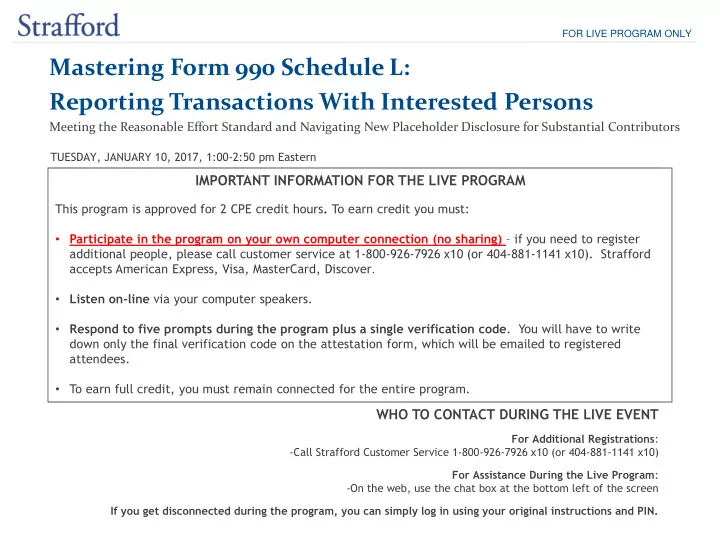
FOR LIVE PROGRAM ONLY Mastering Form 990 Schedule L: Reporting Transactions With Interested Persons Meeting the Reasonable Effort Standard and Navigating New Placeholder Disclosure for Substantial Contributors TUESDAY, JANUARY 10, 2017,


slide-1
SLIDE 1

WHO TO CONTACT DURING THE LIVE EVENT

For Additional Registrations:

  • Call Strafford Customer Service 1-800-926-7926 x10 (or 404-881-1141 x10)

For Assistance During the Live Program:

  • On the web, use the chat box at the bottom left of the screen

If you get disconnected during the program, you can simply log in using your original instructions and PIN.

IMPORTANT INFORMATION FOR THE LIVE PROGRAM

This program is approved for 2 CPE credit hours. To earn credit you must:

  • Participate in the program on your own computer connection (no sharing) – if you need to register

additional people, please call customer service at 1-800-926-7926 x10 (or 404-881-1141 x10). Strafford accepts American Express, Visa, MasterCard, Discover.

  • Listen on-line via your computer speakers.
  • Respond to five prompts during the program plus a single verification code. You will have to write

down only the final verification code on the attestation form, which will be emailed to registered attendees.

  • To earn full credit, you must remain connected for the entire program.

Mastering Form 990 Schedule L: Reporting Transactions With Interested Persons

Meeting the Reasonable Effort Standard and Navigating New Placeholder Disclosure for Substantial Contributors

TUESDAY, JANUARY 10, 2017, 1:00-2:50 pm Eastern

FOR LIVE PROGRAM ONLY

slide-2
SLIDE 2

Tips for Optimal Quality

Sound Quality When listening via your computer speakers, please note that the quality

  • f your sound will vary depending on the speed and quality of your internet

connection. If the sound quality is not satisfactory, please e-mail sound@straffordpub.com immediately so we can address the problem.

FOR LIVE PROGRAM ONLY

slide-3
SLIDE 3
  • Jan. 10, 2017

Mastering Form 990 Schedule L

Frank Giardini, Principal, Tax Services Grant Thornton, Philadelphia frank.giardini@us.gt.com Michele Melchior, Tax Director Grant Thornton, Charlotte, N.C. michele.melchior@us.gt.com Jennifer Becker Harris, CPA, Principal Clark Nuber, Bellevue, Wash. jharris@clarknuber.com

slide-4
SLIDE 4

Notice

ANY TAX ADVICE IN THIS COMMUNICATION IS NOT INTENDED OR WRITTEN BY THE SPEAKERS’ FIRMS TO BE USED, AND CANNOT BE USED, BY A CLIENT OR ANY OTHER PERSON OR ENTITY FOR THE PURPOSE OF (i) AVOIDING PENALTIES THAT MAY BE IMPOSED ON ANY TAXPAYER OR (ii) PROMOTING, MARKETING OR RECOMMENDING TO ANOTHER PARTY ANY MATTERS ADDRESSED HEREIN.

You (and your employees, representatives, or agents) may disclose to any and all persons, without limitation, the tax treatment or tax structure, or both, of any transaction described in the associated materials we provide to you, including, but not limited to, any tax opinions, memoranda, or other tax analyses contained in those materials. The information contained herein is of a general nature and based on authorities that are subject to change. Applicability of the information to specific situations should be determined through consultation with your tax adviser.

slide-5
SLIDE 5

Mastering Form 990 Schedule L: Reporting Transactions With Interested Persons

PRESENTERS Frank Giardini, Principal – Grant Thornton, LLP Jennifer Becker Harris, Shareholder– Clark Nuber Michele Melchior, Director – Grant Thornton, LLP

slide-6
SLIDE 6

Agenda

  • Organization Governance, Policy and Form 990
  • Purpose of Schedule L
  • Governance and board independence
  • Conflicts of Interest Policy
  • Reporting and Documentation
  • Schedule L
  • 2014 changes to interested persons
  • 2016 guidance (substantial contributors)
  • Parts I – IV: A practical over-view
  • Circling back: Board Member Independence
  • Questions

6

slide-7
SLIDE 7

Organization Governance, Policy and Form 990

7

slide-8
SLIDE 8

Governance and Form 990

Purpose of Schedule L

  • 1. Provide information on certain financial transactions or

arrangements between the exempt organization and "Disqualified Individuals".

  • 2. Used to determine whether a member of the exempt
  • rganization's governing body or "Board" is independent

8

slide-9
SLIDE 9

Governance and Form 990

Disqualified Person under IRC § 4958 include:

  • 1. Current or former officers, trustees, directors and key employees
  • 2. Create a Founder of Exempt Organizations
  • 3. Substantial Contributor ($5,000 or more contributions per year)
  • 4. A family member of any individual described above
  • 5. A 35% controlled entity of one or more individuals/or organization described

above.

  • NOTE: A more detailed discussion of the application of IRC § 4958 will be made

later in the presentation

9

slide-10
SLIDE 10

Governance and Form 990

Observations:

  • While certain policies may not be required by the Internal Revenue

Code, the IRS has the authority to ask all of these questions.

  • IRS sees a link between governance and tax compliance
  • Answers contrary to conventional wisdom will likely create a

negative impression

  • Many questions require additional disclosures, explanations, and

descriptions on Schedule O

10

slide-11
SLIDE 11

Governance & Policy – Form 990 Board Member Independence

  • Form 990 asks about 'voting' members and how many were

'independent'

  • Lack of Independence of voting members is caused by:
  • Compensation for services (as employee or officer)
  • Compensation for service (as independent contractor)
  • The member or his/her family member being disclosed on Schedule L of this or a

related organization

11

slide-12
SLIDE 12

Governance & Policy – Form 990 Conflict of Interest

  • Form 990 asks about your conflict of interest (COI) policy
  • Applicable to: Officers, Directors & Trustees, Key Employees
  • Is it written?
  • Is there annual disclosure?
  • Closely tied to Schedule L

Key disclosure that is required in response to yes answer at 12c MUST read instructions for REQUIRED Schedule O disclosure elements

  • Who COI policy covers
  • How potential conflicts are monitored and disclosed
  • Who is charged with review of and determining whether a conflict exists when a question exists, and
  • What restrictions are effected in decision making when a conflict is determined to be present

12

slide-13
SLIDE 13

Governance & Policy – Form 990 Conflict of Interest

Policy content:

  • Define conflicts of interest (COI)
  • Identify who is covered (by class)
  • Facilitate how to identify a COI (monitoring / questionnaires)
  • Specify procedures to manage COI if identified
  • Requires sufficient disclosures as to governing individual's or key employee's as well as family

members' businesses and employment interest that may be related to the exempt organization

Does your policy properly encompass the areas on Schedule L?

  • Excess benefits
  • Loans
  • Grants or assistance
  • Business Transactions including employment relationships

13

slide-14
SLIDE 14

Governance & Policy – Form 990 Conflict of Interest

What causes a conflict of interest?

  • Person in authority (Officer, Director/Trustee, Key Employee or other

manager) may benefit financially from the decision

  • includes indirect benefits (family member / businesses / etc.)
  • does not include competing duties to the same organization or another
  • rganization (such as serving on the board of both organizations) as long

as it does not involve a material financial interest that could benefit the person

14

slide-15
SLIDE 15

Governance & Policy – Form 990 Reporting and Documentation

Policy enforcement:

  • Who is responsible?
  • Everyone!
  • Self reporting
  • Education is key
  • Responsible parties for data gathering:
  • Board: Governance committee (best), Executive committee or similar
  • Management: Compliance officer, internal audit, other….
  • Other interested persons per Schedule L: Joint effort
  • Also consider review of internal data (trial balance, loans,

compensation, grants, contributions…..) – who will handle this?

15

slide-16
SLIDE 16

Governance & Policy – Form 990 Reporting and Documentation

Policy enforcement:

  • Use of a COI questionnaire:
  • Annual disclosure and sign off
  • Be sure include schedule L disclosure areas
  • Use to meet the Form 990 'reasonable efforts' requirement
  • Timing of the COI questionnaire?
  • New board members and employees
  • End of year (think retrospectively as well as prospectively)

There were changes in 2014 to the definition of interested person Has your COI questionnaire been updated?

16

slide-17
SLIDE 17

Governance & Policy – Form 990 Reporting and Documentation

COI questionnaire & Schedule L 'Reasonable Efforts':

  • Form 990 requires a 'reasonable' level of effort to obtain information on

conflicts for Schedule L purposes

  • Reasonable Efforts:
  • Distribute a questionnaire to all interested persons (including those who 'may'

be interested persons)

  • Include pertinent definitions and instructions explaining potential types of

transactions & listing who is considered an interested person

  • Request disclosure and description from such persons describing the

transaction

  • Provide a place for name, title, date and signature
  • If these 'reasonable efforts' are followed, then even if there is a

transaction that should have been mentioned, but the interested person does not report it, the organization is clear

17

slide-18
SLIDE 18

Schedule L Interested Persons - 2014 Changes

18

slide-19
SLIDE 19
  • Schedule L is all about
  • In 2014 the definitions of interested persons for Parts II – IV

were harmonized for consistency

  • For example: All four parts now include 'substantial

contributors' as interested persons Before we dive into Schedule L details…….

Schedule L – Transactions with Interested Persons

19

slide-20
SLIDE 20

Form 990 – Part IV: Scoping questions NOT changed

In 2014, Schedule L definitions and persons identified as Interested Persons changed, however

  • As of this presentation, neither the 2014, 2015 nor 2016 Form 990, Part

IV questions have been updated to thus align

  • This presents a quandary – what to do?
  • The instructional guidance references carefully reviewing Schedule L

instructions Let's review the questions….

20

slide-21
SLIDE 21

Form 990 – Part IV: Scoping questions NOT changed

Scoping questions on Form 990, Part IV, were not updated*: Excess Benefits:

  • No changes to schedule L for this section
  • Note: A 'yes' answer here could have serious consequences!

* 2016 Form 990 – instructions reference Schedule L although the questions don't align

21

slide-22
SLIDE 22

Form 990 – Part IV: Scoping questions NOT changed

Scoping questions on Form 990, Part IV, were not updated*: Loans:

  • Highest compensated employees and disqualified persons are no longer

considered 'interested persons' for Schedule L, but still in the questions

  • Substantial contributors (among others) are missing from the question

* 2016 Form 990 – instructions reference Schedule L although the questions don't align

22

slide-23
SLIDE 23

Form 990 – Part IV: Scoping questions NOT changed

Scoping questions on Form 990, Part IV, were not updated*: Grants or other assistance:

  • No significant changes necessary

* 2016 Form 990 – instructions reference Schedule L although the questions don't align

23

slide-24
SLIDE 24

Form 990 – Part IV: Scoping questions NOT changed

Scoping questions on Form 990, Part IV, were not updated*:

Business transactions:

  • An entity with overlapping officer, director, and trustee should be removed from question

28c.

  • Substantial contributors (among others) are missing from the question

*2016 Form 990 – instructions reference Schedule L although the questions don't align

24

slide-25
SLIDE 25

Transactions with Interested Persons

Categories of “Interested Persons” in Parts II-IV are much broader than Part I’s “Disqualified Persons” 2014 Form’s change to FIVE PRIMARY categories of “Interested Persons” across Parts II-IV still leaves and presents Need to understand (and properly apply) IRC section 4958 definition of “Disqualified Person” (Part I) Need to understand exceptions and definitions in Parts II-IV Completion of each Part impacts who on the governing body at last day

  • f tax year is independent for Part VI, Line 1b purposes

25

slide-26
SLIDE 26

Schedule L – Transactions with Interested Persons

  • Four substantive parts followed by “blank lines” in Part V

where any additional explanation(s) may be provided

  • Each part reaches specific transactions (with nuanced

differences as to who is an Interested Person) in the following realms

Part I: Excess Benefit Transactions with Interested Persons Part II: Loans to and from Interested Persons Part III: Grants or Assistance to Interested Persons Part IV: Business transactions involving interested persons

26

slide-27
SLIDE 27

Dollar Thresholds and Time Periods

  • Dollar thresholds are in place only for Part IV
  • For Parts I, II, and III there are no de minimis amounts by which

reporting is avoided

  • Part I contemplates reporting of excess benefit

transactions uncovered after prior 990’s filing date

  • Part II is date specific (loans outstanding on last

day of the tax year)

  • Parts III and IV disclose transactions occurring

any time in tax year

27

slide-28
SLIDE 28

Harmonization – Five Primary Categories of Interested Persons for Parts II through IV

28

Party Who Is … Part II Part III Part IV

  • 1. A person who holds status on Form 990, Part VII,

Section A as a current or former Trustee/Director, Officer, or Key Employee (hereafter, TDOKE)

Yes Yes Yes

  • 2. A creator or founder of the filer

Yes Yes Yes

  • 3. A substantial contributor (for Sched L, >$5,000

donor who is required to be reported on current Form 990’s Schedule B)

Yes Yes Yes

  • 4. A family member of an individual with status as

an interested person via 1-3 preceding

Yes Yes Yes

  • 5. A 35-percent controlled entity of one or more of

the individuals or organizations captured as interested persons via 1-4 preceding

Yes Yes Yes

slide-29
SLIDE 29
slide-30
SLIDE 30

Schedule L - Interested Persons

Interested Person definitions

30

slide-31
SLIDE 31

Schedule L - Interested Persons Category 1

Current or Former Officer, Director, Trustee, or Key Employee

  • If reported in Form 990 Part VII

For Part IV only: For management company transactions – include such former persons even if not required to be currently listed

31

slide-32
SLIDE 32

Schedule L - Interested Persons Category 2

Creator or Founder of the organization

  • (new as of 2014)
  • Includes sponsoring organization of a VEBA

32

slide-33
SLIDE 33

Schedule L – Interested Persons Category 3

Substantial Contributors

  • New as of 2014 for Parts II - IV
  • For Schedule L, parts II – IV purposes, defined as:
  • Individual or organization that made contributions during the tax year, and
  • Which aggregated $5,000 or more, and
  • Is required to be reported on Schedule B
  • May also include an employer that contributes to a VEBA

Note: Part I includes Substantial Contributor, but as defined under §507(d)(2)(A)

33

slide-34
SLIDE 34

Schedule L – Interested Persons Category 3 – 2016 Guidance

Substantial Contributors – reporting transactions The issue:

  • Name of contributors on schedule B are not open for public

disclosure

  • 2014 and 2015 instructions for schedule L did not provide relief from

disclosing names if there was a reportable transaction

  • Organizations and practitioners were operating without clear

guidance

  • New for 2016 – Guidance has been issued!

34

slide-35
SLIDE 35

Schedule L – Interested Persons Category 4

Family Member of any Category 1 – 3 person

  • Spouse
  • Ancestors
  • Brothers and sisters (full and half) & their spouses
  • Children (natural and adopted) & their spouses
  • Grandchildren and great grandchildren & their spouses

This definition applies throughout Form 990, unless otherwise specified

35

slide-36
SLIDE 36

Schedule L – Interested Persons Category 5

36

35% Controlled entity of any Category 1 – 4 person or entity

Ownership, directly or indirectly, by the given parties in preceding categories aggregates to more than 35 percent of:

  • Owned voting power in a corporation
  • Profits interest in a partnership
  • Beneficial interest in a trust or estate

This definition alleviates much of the prior required reporting between two not-for-profit corporations with overlapping control (but not entirely – see circumstances and exceptions to follow).

slide-37
SLIDE 37

Schedule L – Interested Persons

Other unique definitions (not harmonized):

  • For Part I only (not changed) – Disqualified Person (discussed shortly)
  • For Part III only (not changed) - a member of the organization's grant

selection committee

  • Part III only (not changed) - an employee (or child of an employee) of a

substantial contributor or of a 35% controlled entity of such persons

37

slide-38
SLIDE 38

Schedule L – Interested Persons

Other changes as of 2014:

  • Clarified interested persons excludes sec. 501(c)(3)
  • rganizations, exempt organizations with same tax-

exempt status, or governmental unit or instrumentality

  • Harmonized the reasonable effort instructions (discussed

earlier)

  • Part IV exception added to exclude business transactions

between the organization and a publicly-traded company in the ordinary course of its business, on the same terms as it generally offers to the public

38

slide-39
SLIDE 39

Schedule L – Interested Persons

What was removed:

  • Highest compensated employees and §4958 disqualified persons

(Part II)

  • Entity of which a current or former officer, director, trustee, or key

employee, or any family member thereof, was serving as a (Part IV)

  • Director, officer, or trustee; or
  • Partner, member, or shareholder with a direct or indirect
  • wnership interest in excess of 5% in a professional corporation or

entity treated as a partnership

  • Non-stock organizations more than 35% controlled by other

interested persons (Part IV)

39

slide-40
SLIDE 40

Schedule L Interested Persons

40

Interested Person Exclusions:

The previously noted Interested Person categories do NOT reach entities who are

  • Exempt under 501(c)(3) or a foreign organization for which the filing
  • rganization has made a reasonable judgment (or has an opinion of

counsel) that the foreign organization is described in Section 501(c)(3)

  • Exempt under the same section as the filing organization (for example, a

501(c)(4) with respect to another 501(c)(4) organization)

  • A governmental unit or instrumentality
slide-41
SLIDE 41

Schedule L Interested Persons – Disqualified Persons

Part I – Excess Benefits:

  • Interested Person (no change)
  • Disqualified Person under §4958*
  • Person in position to exercise substantial influence over the affairs of the
  • rganization at any time during a 5 year period (ending on date of the

transaction)

  • i.e. voting board members, CEO, President, COO, CFO, Treasurer
  • Family members of aforementioned
  • 35% controlled entities of aforementioned
  • Donors / donor advisors to donor advised funds
  • Investment advisor of a donor advised fund sponsoring organization
  • Supporting organization of a supported organization

*Definitions under §4958 are complex – Appendix G of Form 990 provides a more in- depth discussion

41

slide-42
SLIDE 42

Schedule L Interested Persons – Disqualified Persons

Others who may be Disqualified Persons

  • Organization founders
  • Substantial Contributors (up to 5 years)
  • Persons whose compensation is based on the organization's revenue over which

he/she has control

  • Key Employees
  • Persons with a controlling interest in an entity that is a DP
  • Others - facts and circumstances

42

slide-43
SLIDE 43

Schedule L Interested Persons – Disqualified Persons

Not Disqualified Persons

  • Tax exempt §501(c)(3) organizations
  • Transactions between two §501(c)(4) organizations
  • The Form 990 instructions at Appendix G summarize the Regulations’

provisions as to employees who do NOT need be tested for power to exercise substantial influence over the affairs of the organization, as follows: Compensation levels of

  • 2010 and 2011: $110,000
  • 2012-2014: $115,000
  • 2015: $120,000 (2016 not yet published)
  • But above only applies IF the employee
  • Did NOT hold executive or voting powers by which those with such powers are

automatically considered to have substantial influence;

  • Is NOT a family member of a disqualified person; and
  • Is NOT a substantial contributor (under the private foundation rules)

43

slide-44
SLIDE 44

Schedule L Interested Persons – Disqualified Persons

2ND Tier DP status reaches …

  • Family members (a glossary term following) of those in 1st Tier status (that is,
  • f those that have “substantial influence”)
  • 35 percent controlled entities (a glossary term following) of those in 1st Tier

status and their family members

44

NOTE: For filers who are supported organizations of a 509(a)(3) supporting organization AND for filers who are sponsoring

  • rganizations of donor-advised funds, specific transactions are

prohibited via EBT characterization and for such purposes unique Disqualified Person categories apply.

slide-45
SLIDE 45

Schedule L Transactions with Interested Persons Parts I – IV: A Practical Overview

45

slide-46
SLIDE 46

Flow of the Schedule L Disclosures

46

Determine Interested Persons Perform Reasonable Efforts to Acquire Information Analyze Data for Disclosures in the Following Order: 1) Excess Benefit Transactions (Part I) 2) Loans (Part II) 3) Grants (Part III) 4) Business Transactions (Part IV) Verify Facts of Potential Disclosures Report Necessary Disclosures & Understand Risks Notify the Interested Persons of Disclosures Document Process & Findings

slide-47
SLIDE 47

Schedule L

47

Part I – Excess Benefit Transactions Parts II-IV – Sunshine Disclosures Part V – Additional Disclosure

slide-48
SLIDE 48

Part I – Excess Benefit Transactions

Applies to tax-deductible organizations, social welfare and Qualified Nonprofit Health Insurance Issuers (501(c)(3), 501(c)(4) and 501(c)(29)

  • rganizations, respectively).
  • Any transaction with a disqualified person in which the disqualified person gets

more from the exempt organization than they give the amount back – i.e., tipping

  • f the financial scales in favor of the disqualified person
  • The amount that inures to the benefit of the disqualified person over and above

fair market value is considered excess benefit

48

Can apply to current or previous periods (it is disclosed when discovered)

slide-49
SLIDE 49

Part I - Reporting

Each excess benefit transaction is reported regardless of amount

  • Line 1(a): Must name the disqualified person (but no need to disclose how or

why they fall into that status [aside from description on Line 1(b)]

  • Line 1(b): Reports relationship of the disqualified person to the filer, for

example, officer (of the filer) or family member of director or 35% controlled entity

  • Line 1(c): Description of the transaction—can be cursory; for example

“compensation package”

  • Line 1(d): Check-the-box if correction has been made
  • Part V: Name any organization manager(s) who participated in the

transaction (this includes ‘approving’ it) knowing that it was an excess benefit transaction.

49

slide-50
SLIDE 50

Part I - Examples

Excess Benefit Transactions Value of economic benefit received from organization exceeds value of consideration given by the disqualified person

  • Examples:
  • Compensation that exceeds fair market value of services
  • Benefits or perks not included in an approved compensation

package

  • Not approved by appropriate persons
  • Advances without an accountable plan
  • Evaluate entire compensation package for fair market value
  • Likely also an Intermediate Sanction violation!

50

slide-51
SLIDE 51

Part I – Additional Tips

  • Consult an exempt organization tax advisor to:
  • Address definitions;
  • Form 4720 reporting;
  • Reporting ramifications; and
  • Protecting organization managers!
  • Special rules apply for donor advised funds and supporting
  • rganizations
  • See additional information in Appendix G of the Form 990 instructions

51

slide-52
SLIDE 52

Part II – Loans

  • Part II casts “sunshine” on facts of loans with interested persons (no

value judgment)

  • Only are disclosed if loan is outstanding at year-end
  • Core form trigger question and Schedule, Part II header have not

been updated for 2014 instruction change (errors are marked in red)

52

slide-53
SLIDE 53

Part II - Reporting

Loans: both to and from interested persons that are outstanding at year- end

(a) – debtor or creditor on the loan should be named unless a substantial contributor (b) – identify the relationship between the organization the interested person (ie, director, key employee, 35% controlled entity, spouse of director) (c) – purpose of loan (can be brief) (d)-(f) – provide the flow of funds, original principal amount and balance due at year- end (g) - Is there a written contract? (i) - Approved by board or committee?

53

slide-54
SLIDE 54

Schedule L, Part II-IV – Substantial Contributor Guidance

Substantial Contributors – reporting transactions 2016 instructions do provide guidance!

  • If interested person status is only as a substantial contributor, a family member of a

substantial contributor, a 35% controlled entity of a substantial contributor, or an employee of a substantial contributor or 35% controlled entity of a substantial contributor:

  • In column (a)- Name of interested person: “substantial contributor” or “related to

substantial contributor” (no names - to protect contributor).

  • In column (b)- Relationship to organization:
  • "substantial contributor" in (a) = "substantial contributor" in (b)
  • "related to substantial contributor" in (a) = describe without names in (b), for

example: “child of substantial contributor.” Note: If the person (or entity) has Interested Person status in a capacity other than as a Substantial Contributor (i.e. family member or a TODKE), then proceed with normal disclosure (the substantial contributor reporting would not apply).

54

slide-55
SLIDE 55
slide-56
SLIDE 56

Part II - Examples

Jane Smith was hired as Executive Director of ABC Charity in 2016 and as part of the agreement she was provided with a relocation loan to move her family from New York to

  • Chicago. At year end the loan balance was $10,000.

Substantial Contributor Example: In 2014, Sara Jones loaned $240,000 to ABC Charity to help it finance a piece of property adjacent to the If you own or have signature authority

  • ver a foreign financial account an FBAR filing may be required. The requirement extends

to companies you own and nonprofits you may represent as an employee or volunteer.

  • rganization’s building. In 2016, Sarah’s daughter Kayla Jones Wright was a substantial

contributor to the organization by donating $500,000 and is reported on Schedule B of the

  • rganization’s Form 990.

56

slide-57
SLIDE 57

Part II – Additional Tips

Loans that occurred during the reporting year and paid off by year-end may need to be disclosed as a business transaction in Part IV of Schedule L Examples: Physician loans, Relocation loans, Board member loans, Advances (not under an accountable plan) Exceptions: Ordinary course of business loans and accruals (A/R or A/P

  • f the hospital, compensation, pledges), tax-exempt bonds of the

hospital held by the interested person if bought on the same terms as

  • ffered to the public, accountable plan advances

57

slide-58
SLIDE 58

Part III – Grants or Assistance

Grants or assistance to interested persons during the reporting year Reminder, the interested person definition adds additional people

  • Members of grant selection committees and
  • Employees (or child of an employee) of a substantial contributor, or of a 35%

controlled entity of such person … with conditions

Examples: Scholarships, fellowships, study grants, internships, prizes,

  • etc. (Should correspond to Schedule I and F data and disclosures)

No dollar threshold for reporting

58

slide-59
SLIDE 59

Part III - Reporting

Grants or assistance to interested persons

(a) – name of person who was provided the grant/assistance unless a substantial contributor (b) – identify the relationship between the organization the interested person (ie, director, key employee, 35% controlled entity, spouse of director) (c) – Amount of assistance provided for the year (d) – Type of assistance (travel, scholarships, disaster assistance) (e) – Purpose of providing the assistance Schools: The disclosure treatment differs for organizations categorized as schools. May group transactions by “type” of financial assistance and aggregate the amounts in column (c). Columns (a) and (b) are left blank. Caution: do not report information prohibited by the Family Educational Rights Privacy Act (FERPA)

59

slide-60
SLIDE 60

Part III – Reporting Exceptions

  • Reported excess business transaction or a loan (Schedule L, Part I or II)
  • There is no gift element and it should be a business transaction (watch
  • ut for compensation)
  • Gifts to employees of a substantial contributor if awarded on an
  • bjective nondiscriminatory basis
  • If interested person is part of the charitable class the organization

serves as part its mission (Caution: this exception does not cover all

  • grants. If for travel, study or similar purpose still need to disclose

Section 4945(g)(3))

60

slide-61
SLIDE 61

Part IV – Business Transactions

61

Business transactions with interested persons: sales, exchanges, leases, furnishing goods or services, or transfers of income or assets (exchange transactions) Can be a direct or indirect transaction Reminder, interested person definition adds an additional category: Certain management companies (owned >35% by prior serving officers, directors, or key employees) (Caution: this is

a different definition than “Former” in Form 990, Part VII)

Provide detail for transactions that occurred during the tax year.

slide-62
SLIDE 62

Part IV – Reporting Thresholds

  • Compensation paid to an interested person whose interested person

status derives from being a family member of a trustee/director,

  • fficer, or key employee is > $10,000
  • Any one business transaction with an interested person in which the

total payment (for that one transaction) exceeds the larger of $10,000 or one percent of filer’s total revenues

  • Total of all transactions between the filer and one interested person
  • ver the course of the reporting year aggregates to >$100,000
  • Joint ventures where the organization and interested person both

invest and profits or capital interest of each >10% at some point during the tax year

62

slide-63
SLIDE 63

Part IV - Reporting

Business transactions with interested persons

(a) – name of interested person involved transaction except for substantial contributors (b) – identify the relationship between the organization the interested person (ie, director, key employee, 35% controlled entity, spouse of director) (c) – Amount of transaction during the year (d) – Description of the transaction (employment, independent contractor, rental of property, sale of asset etc.) (e) – Indicate if the interested person is sharing in revenues

May aggregate multiple transactions with the same interested person. If this option is chosen, indicate the various types of transactions in column (d) May rely on a reasonable efforts process such as an annual questionnaire

63

slide-64
SLIDE 64

Part IV - Exceptions

64

Compensation reported in Core Form Part VII-A

1

Deposits into bank accounts (and withdrawals) enjoy what is an ordinary course of business exception

2

Charging of membership dues is always omitted

3

Invested amounts (but not fees for the investment) are not to be reported

4

Transactions with a publicly traded company in ordinary course of that business’s undertakings on same terms available to the public enjoys an ordinary course of business exception

5

slide-65
SLIDE 65

Part IV - Example

University Xcel has a $150,000 contract with FoodTruck, Inc. to provide cafe services on campus. FoodTruck, Inc. is 100% owned by Paula King. Paula donated $10,000 to the University during the year and was required to be listed as a donor on Schedule B.

  • Paula is a 'substantial contributor' and FoodTruck, Inc. is a 35% controlled entity of a

substantial contributor, which makes both of them 'interested persons.' The reportable transaction was with FoodTruck, Inc.

65

slide-66
SLIDE 66

Part IV - Example

Example of a business transaction – reportable on Schedule L:

  • A Key Employee’s child, Sue Ellen, is employed by Wellness Hospital Organization as a

nurse (she was hired through the normal course of the organization's employment with no favoritism shown for the Key Employee) and is compensated $60,000.

  • Because Sue Ellen is a family member of a Key Employee, she must be reported on

Schedule L.

66

slide-67
SLIDE 67

Flow of the Schedule L Disclosures

67

Determine Interested Persons Perform Reasonable Efforts to Acquire Information Analyze Data for Disclosures in the Following Order: 1) Excess Benefit Transactions (Part I) 2) Loans (Part II) 3) Grants (Part III) 4) Business Transactions (Part IV) Verify Facts of Potential Disclosures Report Necessary Disclosures & Understand Risks Notify the Interested Persons of Disclosures Document Process & Findings

slide-68
SLIDE 68

Schedule L – Recommendations

  • Review reasonable efforts questionnaires for potential reportable

transactions.

  • If questionnaires didn’t go to every interested person. Consider alternative

processes for reasonable efforts for those individuals.

  • General ledger and other queries in financial records (loans, grants etc)
  • Discussions with key executives that may be privy to transactions with interested persons

especially substantial contributors, their businesses and families.

  • Alternative communication to substantial contributors
  • Review the noted conflicts and work from Part I down to Part IV to

determine if a reporting is necessary.

  • If the transaction is disclosed in Part II-IV, may want to verify documentation that the transaction

was properly reviewed to not be considered an excess benefit transaction.

  • Consider the amount of disclosure provided. Schedule L will not be redacted, therefore do not

include SSN, EIN, names of substantial contributors. May want to be brief in descriptions.

  • Exempt organizations have been audited due to disclosures in Schedule L. SHOULD NOT STOP

YOU FROM REPORTING THE TRANSACTION.

  • If a public charity, consider if the “special rule” can apply to limit amount of

substantial contributors. (Schedule B and Schedule A, Part II)

68

slide-69
SLIDE 69

Schedule L – Documentation and Consistency

Schedule L disclosures should be consistent with documented board minutes, conflict of interest questionnaires, reasonable efforts findings and Form 990 filing. Consider Trigger Questions in Part IV:

  • Loans reported on the Balance Sheet with Interested Persons
  • Grants data reported in Schedule I or Schedule F with Interested Persons

Business Transactions with Interested Persons May Be Hiding in Plain Sight:

  • Listing of independent contractors (Form 990, Part VII, Section B)
  • Delegation of management duties (Form 990, Part VI, Line 3)
  • Transactions with related non-501(c)(3) organizations that have more than

35% board overlap (Schedule R)

  • Financial statement disclosures with related parties.

69

slide-70
SLIDE 70

Circling back: Board Member Independence

70

slide-71
SLIDE 71

Back to Form 990 Part VI – Section A (Core) Board Independence

  • Line 1a and 1b
  • How to count the total number of governing body

members on line 1a with the power to vote

  • If governing members do not have same right, need to explain

in Schedule O

  • How to count the number of independent board members
  • n line 1b
  • Let's review the requirements

71

slide-72
SLIDE 72

Line 1a and 1b Board Members

  • Count as of the last day of the tax year
  • Understand the factors that do and do not impact

independence

  • Need to seek information from board members on family

members, participation in 35% controlled entities and relevant transactions

  • Need to explore related organizations’ structure and
  • perations to determine if there are Schedule L-type

transactions on their part that would impair filer’s board members’ independence

  • Understand exceptions by which independence of voting board

members is NOT impaired

72

slide-73
SLIDE 73

Impairments to Independence

Four statements must be true at all times during the year

73

Did not receive compensation as an officer or other employee from the filing organization, a related organization, or unrelated organization which would trigger a Schedule J disclosure

1

Did not receive independent contractor compensation of greater than $10,000 from the filing

  • rganization or related organizations

2

No direct or indirect transactions with a voting member or member of their family which is reportable on Schedule L

3

There are no transactions involving the voting member or his or her family with a related

  • rganization, whether taxable or tax-exempt (whether directly or indirectly through affiliation

with another organization) of a type and amount that would be reportable on Schedule L if required to be filed by the related organization

4

slide-74
SLIDE 74

In Summary

  • 1. Educate your officers, directors and key employees as to IRS

requirements for Schedule L and IRS Intermediate Sanctions.

  • 2. Have a sound COI policy and disclosure process with your
  • fficers, directors and key employees.
  • 3. Make sure that your COI disclosure process is enforced with

annual disclosure reporting by all required individuals.

  • 4. Establish an internal process to make sure that the COI

disclosure information is utilized and review to mitigate COI issues and IRS Intermediate Sanction exposure.

  • 5. Your internal process should be designed to allow for easy and

complete Schedule L reporting.

74

slide-75
SLIDE 75

Schedule L Transactions Additional Examples

75

slide-76
SLIDE 76

Schedule L – Transactions with Interested Persons Example

Example of a business transaction which is reportable on Schedule L and will impair board member independence:

  • Two board members of NFP Org (James Smith and Sharon Long) together own 40% of a

partnership, Property Source, which holds and rents buildings and other real estate. The other 60% is owned by NFP Org pays fair market value rent to the Property Source in the amount of $125,000 during the fiscal year for the use of a building.

  • The interested persons include the board members and Property Source, a >35% owned entity.

Both James and Sharon will not be considered 'independent'

  • Although not required, consider additional explanation in Part V for column D to explain

compliance with the organization's conflict of interest policy.

76

slide-77
SLIDE 77

Schedule L – Transactions with Interested Persons Example

A few examples of business transactions – independence is not impaired:

  • Board member’s spouse is a physician at MRI, LLC but does not have any ownership.

The hospital transacts business with MRI, LLC exceeding $100,000 during the fiscal year.

  • A board member’s brother (or other family member) owns more than 35% interest in

a law firm. The hospital pays the law firm $75,000 during the year for legal services. Because 1% of the organization's revenues exceed $100,000, and the amount for services is less than $100,000, no disclosure is required.

  • A board member is an employee of XYZ Corporation (but not an owner) which

transacts more than $100,000 of business with the hospital during the year.

77

slide-78
SLIDE 78

Schedule L – Transactions with Interested Persons Example

Example of a Loan which is reportable on Schedule L:

  • Wellness Hospital provided a Physician recruitment loan to a new physician,

Mary Hodson. The physician's spouse is the CFO of the hospital, Brian

  • Hodson. The physician is a family member of an interested person, the

board member.

78

slide-79
SLIDE 79

Resources

Detailed Form 990 Questionnaire created by Clark Nuber and Eve Borenstein - https://clarknuber.com/form-990-questionnaire/ AICPA Letter to the IRS regarding Schedule L - https://www.aicpa.org/Advocacy/Tax/DownloadableDocuments/AICPA- Comment-Letter-Form-990-Schedule-L-2016-05-11.pdf IRS’s FAQ on reasonable efforts - https://www.irs.gov/charities-non- profits/exempt-organizations-annual-reporting-requirements-form-990- part-vi-and-schedule-l-use-reasonable-effort-to-obtain-information

79