Mastering Form 990 Schedule G: Reporting Fundraising and Gaming - - PowerPoint PPT Presentation

mastering form 990 schedule g reporting fundraising and
SMART_READER_LITE
LIVE PREVIEW

Mastering Form 990 Schedule G: Reporting Fundraising and Gaming - - PowerPoint PPT Presentation

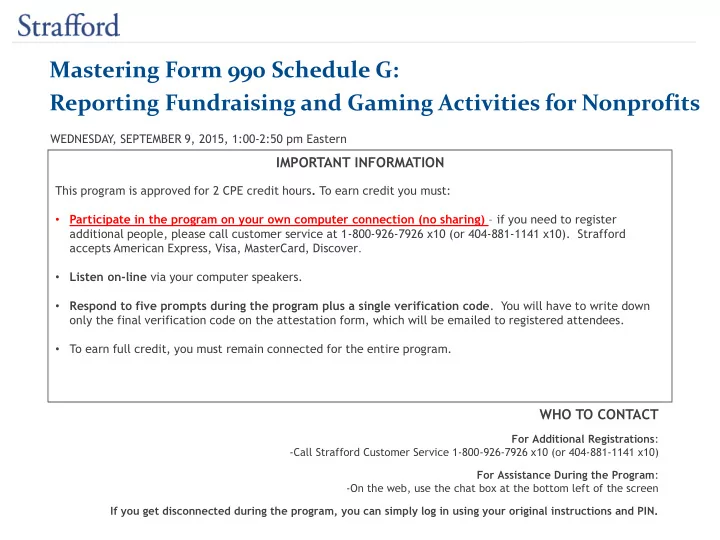
Mastering Form 990 Schedule G: Reporting Fundraising and Gaming Activities for Nonprofits WEDNESDAY , SEPTEMBER 9, 2015, 1:00-2:50 pm Eastern IMPORTANT INFORMATION This program is approved for 2 CPE credit hours . To earn credit you must:


slide-1
SLIDE 1

WHO TO CONTACT

For Additional Registrations:

  • Call Strafford Customer Service 1-800-926-7926 x10 (or 404-881-1141 x10)

For Assistance During the Program:

  • On the web, use the chat box at the bottom left of the screen

If you get disconnected during the program, you can simply log in using your original instructions and PIN.

IMPORTANT INFORMATION

This program is approved for 2 CPE credit hours. To earn credit you must:

  • Participate in the program on your own computer connection (no sharing) – if you need to register

additional people, please call customer service at 1-800-926-7926 x10 (or 404-881-1141 x10). Strafford accepts American Express, Visa, MasterCard, Discover.

  • Listen on-line via your computer speakers.
  • Respond to five prompts during the program plus a single verification code. You will have to write down
  • nly the final verification code on the attestation form, which will be emailed to registered attendees.
  • To earn full credit, you must remain connected for the entire program.

Mastering Form 990 Schedule G: Reporting Fundraising and Gaming Activities for Nonprofits

WEDNESDAY , SEPTEMBER 9, 2015, 1:00-2:50 pm Eastern

slide-2
SLIDE 2

Tips for Optimal Quality

Sound Quality When listening via your computer speakers, please note that the quality

  • f your sound will vary depending on the speed and quality of your internet

connection. If the sound quality is not satisfactory, please e-mail sound@straffordpub.com immediately so we can address the problem. Viewing Quality To maximize your screen, press the F11 key on your keyboard. To exit full screen, press the F11 key again.

FOR LIVE EVENT ONLY

slide-3
SLIDE 3
  • Sept. 9, 2015

Mastering Form 990 Schedule G

Yigit Uctum Wegner CPAs yigit.uctum@wegnercpas.com David Odahl Wegner CPAs david.odahl@wegnercpas.com

slide-4
SLIDE 4

Notice

ANY TAX ADVICE IN THIS COMMUNICATION IS NOT INTENDED OR WRITTEN BY THE SPEAKERS’ FIRMS TO BE USED, AND CANNOT BE USED, BY A CLIENT OR ANY OTHER PERSON OR ENTITY FOR THE PURPOSE OF (i) AVOIDING PENALTIES THAT MAY BE IMPOSED ON ANY TAXPAYER OR (ii) PROMOTING, MARKETING OR RECOMMENDING TO ANOTHER PARTY ANY MATTERS ADDRESSED HEREIN.

You (and your employees, representatives, or agents) may disclose to any and all persons, without limitation, the tax treatment or tax structure, or both, of any transaction described in the associated materials we provide to you, including, but not limited to, any tax opinions, memoranda, or other tax analyses contained in those materials. The information contained herein is of a general nature and based on authorities that are subject to change. Applicability of the information to specific situations should be determined through consultation with your tax adviser.

slide-5
SLIDE 5

Mastering Form 990 Schedule G: Reporting Fundraising & Gaming Activities for Nonprofits

Presented by: Yigit Uctum, CPA, CFE, MBA, Senior Manager & David Odahl, CPA, Quality Control Manager

slide-6
SLIDE 6

6

Outline

  • What activities qualify as fundraising events that

must be reported on Schedule G

– Fundraising activities – Fundraising events – Gaming

  • Detailed exploration into Schedule G by activity
  • UBTI issues with fundraising and gaming

activities

  • Other information reporting obligations
slide-7
SLIDE 7

7

slide-8
SLIDE 8

8

Fundraising Activities

  • Conducting fundraising campaigns
  • Conducting fundraising events
  • Recruiting volunteers
  • Participating or conducting training for improving

fundraising techniques

  • Other solicitation activities
  • Hiring professional fundraisers
  • Do not include exempt purpose related activities
slide-9
SLIDE 9

9

Professional Fundraising Services

  • Services requiring the exercise of professional

judgment or discretion

  • Planning, managing, preparation of materials,

provision of advice and consulting regarding solicitation of contributions, and direct solicitation

  • f contributions
  • Generally does not include services provided by

employees

  • Does not include purely ministerial tasks (e.g.,

printing, mailing services, or depositing contributions)

slide-10
SLIDE 10

10

Fundraising Events

  • Primary purpose is to raise funds for the
  • rganization by selling goods or services for

more than their direct cost

  • Not regularly carried on
  • Attendee/participant typically receives a direct

benefit

  • Include dinners and dances, door-to-door sales
  • f merchandise, concerts, carnivals, sports

events, auctions, casino nights, and similar events

slide-11
SLIDE 11

11

What is not a fundraising event?

  • Conduct of trade or business that is regularly

carried on

  • Activities substantially related to the

accomplishment of the organization's exempt purposes

  • Solicitation campaigns that generate only

contributions, sales or gifts of goods or services from the organization of only nominal value

  • Events that substantially further the
  • rganization's exempt purpose even if they also

raise funds

slide-12
SLIDE 12

12

Gaming

  • Gaming generally involves a chance component

to win

  • As a general rule, if the prizes to be awarded

have more than a nominal value and a participant pays a minimum amount to be entered in the event, the resulting income is treated as being from gaming activities

  • In all cases, wagers and similar payments are

never treated as a charitable contribution, regardless of whether the participant wins or loses

slide-13
SLIDE 13

13

Gaming and Other Similar Activities

  • Sweepstakes
  • Contest
  • Raffle
  • Bingo, card games such as poker, casino

nights, scratch-offs, slot machines, and

  • ther video games
slide-14
SLIDE 14

14

slide-15
SLIDE 15

15

Schedule G, Part I: Fundraising Activities

  • Complete if the organization reported a total of

more than $15,000 of expenses for professional fundraising services on Form 990, Part IX, lines 6 and 11(e)

  • Trigger question: Form 990, Part IV, line 17
  • Not required for Form 990-EZ filers
slide-16
SLIDE 16

16

Schedule G, Part I, Line 1

  • Check applicable boxes a through g for each type
  • f fundraising activity used by the organization

and its professional fundraisers

  • If contributions are reported on Form 990, Part

VIII, line1, the corresponding boxes on Schedule G, Part I, line 1 representing the source of those contributions should be checked

slide-17
SLIDE 17

17

Schedule G, Part I, Line 2a

  • Check "Yes" if at any time during the tax year the
  • rganization had an agreement with another

person or entity in connection with professional fundraising services

  • Includes both written and oral agreements
  • Does not include officers, directors, trustees, or

employees who conduct professional fundraising services solely in their capacity as an officer, director, trustee, or employee

slide-18
SLIDE 18

18

Schedule G, Part I, Line 2b

  • Complete if "Yes" is checked on Schedule G,

Part I, Line 2a

  • List the ten highest paid individuals or entities

who were each to be compensated at least $5,000 during the tax year for professional fundraising services

slide-19
SLIDE 19

19

Ten Highest Paid Fundraisers

  • Name and business address of individual or

entity

  • Type(s) of fundraising activities
  • Whether the fundraiser has custody or control of

contributions

  • Gross receipts from activity
  • Amount paid to or retained by fundraiser
  • Amount paid to or retained by the organization
slide-20
SLIDE 20

20

Custody or Control

  • Possession of funds or the authority to deposit,

direct the use of, or use the funds

  • Describe the custody or control arrangement in

Part IV of Schedule G

slide-21
SLIDE 21

21

Gross Receipts from Activity

  • Gross receipts that the organization collected or

the fundraiser collected on behalf of the

  • rganization
  • A professional fundraiser can deliver services

during the tax year and the expense be properly reported on line 2b, column (v) but have no corresponding gross receipts reported in column (iv)

slide-22
SLIDE 22

22

Amount Paid to or Retained by Fundraiser

  • Fees paid to or fees withheld by the fundraiser
  • Additional reporting in Part IV of Schedule G if

agreement provides for payment for services and also payment for expense reimbursements such as printing, paper, envelopes, postage, mailing list rental, and equipment rental

  • If agreement does not distinguish between

payment for services and reimbursement of expenses, report the gross amount paid to or withheld by the fundraiser

slide-23
SLIDE 23

23

Amount Paid to or Retained by Organization

  • Subtract column (v) from column (iv)
  • This number is often scrutinized by the public
  • United Cancer Council, Inc. v. Commissioner
slide-24
SLIDE 24

24

Schedule G, Part I, Line 3

  • List all states in which the organization is

registered or licensed to solicit contributions or has been notified it is exempt from registration or licensing

  • List each state separately
slide-25
SLIDE 25

25

Schedule G, Part II: Fundraising Events

  • Complete if the organization reported more

than $15,000 total gross receipts (contributions and gross income) from fundraising events on Form 990, Part VIII, lines 1c and 8a

  • Trigger question: Form 990, Part IV, line 18
  • Complete if the organization reported more

than $15,000 total gross receipts from fundraising events on Form 990-EZ, Part I, line 6b and in the parentheses for line 6b

slide-26
SLIDE 26

26

  • List only events with gross receipts greater than

$5,000

  • The amounts from Schedule G, Part II, lines 3,

10, and 11 of column (d) will not equal the amounts reported on Form 990, Part VIII, lines 8a, 8b, and column (A) of line 8c if the

  • rganization had fundraising events with gross

receipts of $5,000 of less

  • Do not include gaming activities in Part II even if

the gaming activity is held at a fundraising event Schedule G, Part II: Fundraising Events

slide-27
SLIDE 27

27

  • List the two largest events as measured by

gross receipts in columns (a) and (b)

  • In column (c), enter the total number of other

events with gross receipts greater than $5,000 each and report the aggregate revenue and expenses from these events

  • If no events other than those listed in columns

(a) and (b) exceeded the $5,000 threshold, enter "None" in column (c) Schedule G, Part II: Fundraising Events

slide-28
SLIDE 28

28

Noncash Contributions and Prizes

  • The value of noncash contributions received

by the organization should be included in the amounts for gross receipts and contributions

  • The fair market value of noncash prizes

awarded should be included as direct expenses

  • Noncash contributions do not include volunteer

services or donated use of materials, facilities, or equipment

slide-29
SLIDE 29

29

Recordkeeping

  • How much did each donor pay?
  • What was the fair market value of the goods and

services each donor received in return for the payment?

  • What did it cost for the organization to conduct

the event?

  • The fair market value of attending the event and

the organization's cost for conducting the event will normally not be the same

slide-30
SLIDE 30

30

Schedule G, Part III: Gaming

  • Complete if the organization reported more than

$15,000 of gross income from gaming activities

  • n Form 990, Part VIII, line 9a
  • Trigger question: Form 990, Part IV, line 19
  • Complete if the organization reported more than

$15,000 of gross income from gaming activities

  • n Form 990-EZ, Part I, line 6a
slide-31
SLIDE 31

31

Schedule G, Part III: Gaming

  • Complete Part III for each type of gaming

conducted (there is no monetary threshold in connection with the reporting of discrete gaming activities)

  • The amounts from Schedule G, Part III, lines 1,

7, and 8 of column (d) must equal the amounts reported on Form 990, Part VIII, lines 9a, 9b, and column (A) of line 9c

slide-32
SLIDE 32

32

Schedule G, Part III: Gaming

  • Treat all bingo as a single event for column (a)
  • Treat all pull tabs as a single event for column

(b)

  • Include in column (c) all other types of gaming

not included in column (a) or (b)

slide-33
SLIDE 33

33

Revenue

  • Report gross income from gaming activities

without reduction for cash or noncash prizes, cost of goods sold, compensation, fees, or other expenses

  • Report contributions received from gaming

activities on Form 990, Part VIII, line 1f, not on line 1c or line 9a

slide-34
SLIDE 34

34

Direct Expenses

  • The fair market value of noncash prizes

awarded should be included as direct expenses

  • The organization should retain in its records a

schedule providing an itemized list of all other direct expenses not included on Schedule G, Part III, lines 2 through 4

  • The itemized list should include labor costs and

wages, the employer's share of employment taxes, and any excise taxes

slide-35
SLIDE 35

35

Volunteer Labor

  • A volunteer is a person who serves the
  • rganization without compensation
  • Compensation includes tips and noncash benefits
  • Check "Yes" on Schedule G, Part III, Line 6 if

substantially all of the organization's work is performed by volunteers

  • The percentage is determined by dividing the

number of volunteers used for each type of gaming by the total number of workers, both paid and unpaid, used for that type of gaming

slide-36
SLIDE 36

36

Gaming Activities with Nonmembers

  • Social clubs (section 501(c)(7)) and fraternal

societies (sections 501(c)(8) and 501(c)(10))

  • The exempt function of these organizations

includes providing social and recreational activities for members and their bona fide guests

  • Membership is determined by the organization's

governing documents and applicable law

slide-37
SLIDE 37

37

Gaming Manager Information

  • The person(s) who has overall supervision and

management of the organization's gaming

  • peration
  • Responsibilities include recordkeeping, money

counting, hiring and firing workers, and making bank deposits for the gaming operation

  • If the gaming manager is a director, officer, or

employee of the organization, report only the portion of that person's compensation allocable to gaming management

slide-38
SLIDE 38

38

slide-39
SLIDE 39

39

Unrelated Business Income

  • The activity must be considered a trade or

business

  • The activity must be regularly carried on
  • The activity must not be substantially related to

the organization’s exempt purpose

slide-40
SLIDE 40

40

Exemptions from Unrelated Business Income Tax as it Relates to Gaming

  • Certain bingo games
  • Activities conducted with substantially all

volunteer labor

  • Qualified public entertainment activities
  • Games of chance conducted in North Dakota
slide-41
SLIDE 41

41

Bingo Games Exemption

  • Must meet the definition of bingo
  • Wagers should be made, winners should be

determined, and prizes should be disbursed in the presence of all players

  • Conducted where no commercial competition

exists

  • Legal under state and local law
slide-42
SLIDE 42

42

Volunteer Labor Exemption

  • Substantially all (unofficial guideline of 85% or

more) of the work must be performed by unpaid volunteers

  • Tips and non cash benefits are generally

considered compensation

  • If the event is held at a for profit facility, the

employees of that facility are not considered as volunteers

  • To rely on the volunteer labor exclusion to exclude

gaming from unrelated trade or business, an

  • rganization should maintain accurate records

reflecting the number of hours worked by compensated and volunteer workers

slide-43
SLIDE 43

43

Qualified Public Entertainment Activities

“Public entertainment activity” is one traditionally conducted at a fair or exposition promoting agriculture and education, including any activity whose purpose is designed to attract the public to fairs or expositions or to promote the breeding of animals or the development of products or equipment. A “qualifying organization” is an organization exempt under section 501(c)(3), section 501(c)(4), or section 501(c)(5) that regularly conducts an agricultural and educational fair or exposition as one of its substantial exempt purposes.

slide-44
SLIDE 44

44

Qualified Public Entertainment Activities and Unrelated Trade or Business Exclusion To qualify for the exclusion, a public entertainment activity must be conducted by a qualifying organization either:

  • In conjunction with an international, national, state,

regional, or local fair or exposition;

  • In accordance with provisions of state law that permit
  • nly qualifying organizations (or an agency, instrumen-

tality, or political subdivision of the state) to conduct the activity; or

  • In accordance with provisions of state law that permit a

qualifying organization to be granted a license to conduct the activity for 20 days or less on payment to the state of a lower percentage of the revenue from the licensed activity than is required from non-qualifying

  • rganizations.
slide-45
SLIDE 45

45

slide-46
SLIDE 46

46

Federal Regulation of Fundraising

  • Internal Revenue Service
  • United States Postal Service
  • Federal Trade Commission
  • Federal Election Commission
slide-47
SLIDE 47

47

State Regulation of Fundraising

  • Most states have some form of a charitable solicitation

act

  • These acts typically define terms such as charitable
  • rganization, solicit, solicitation, contribution,

professional fundraiser, and paid solicitor

  • Organizations must comply with the charitable

solicitation act, if any, in effect in the state in which they are principally located as well as the law in each state in which they are soliciting funds

  • Registration and filing requirements
  • National Association of State Charity Officials

(www.nasconet.org)

slide-48
SLIDE 48

48

Federal and State Regulation of Gaming

  • Federal tax law generally consists of the IRS

instructions and the exception from treatment as unrelated business income for qualified bingo games

  • IRS Publication 3079, Tax-exempt Organizations

and Gaming

  • Many states and localities have gaming laws the

identify the types of organizations that are allowed to conduct gaming activities and the conditions pursuant to which the games may be conducted

slide-49
SLIDE 49

49

Reporting Winnings

  • Unless the winnings are from poker, keno,

bingo, or slot machines, report a payment of winnings, including raffle prizes, when the amount paid is $600 or more and at least 300 times the amount of the wager

  • Form W-2G, Certain Gambling Winnings
  • Form 5754, Statement by Person(s)

Receiving Gambling Winnings

slide-50
SLIDE 50

50

Withholding Income Tax

  • Regular gambling withholding at 25%

(33.33% for certain noncash payments)

  • Backup withholding at 28%
slide-51
SLIDE 51

51

Regular Income Tax Withholding

Withhold income tax from a payment of winnings when the proceeds are more than $5,000 and the wager was placed in:

  • A sweepstakes, wagering pool, lottery, raffle,
  • r poker tournament; or
  • Any other wagering transactions, if such

proceeds are at least 300 times the amount wagered

slide-52
SLIDE 52

52

Exceptions to Regular Income Tax Withholding

  • Do not withhold income tax on winnings from

bingo, keno, or slot machines no matter what the amount of winnings

  • Income tax does not need to be withheld on

winnings from a poker tournament as long as the winnings are reported on Form W2-G

slide-53
SLIDE 53

53

Backup Withholding

Withhold 28% of gambling winnings (including winnings from bingo, keno, slot machines, and poker tournaments) when:

  • The winner does not furnish a correct taxpayer

identification number

  • 25% has not been withheld
  • The winnings are at least $600 and at least 300

times the wager (or the winnings are at least $1,200 from bingo or slot machines or $1,500 from keno or more than $5,000 from a poker tournament)

slide-54
SLIDE 54

54

IRS Examination Practices

  • What types of gaming activities does the organization

conduct?

  • Who conducts the activities?
  • Who owns the facility where the gaming is conducted?
  • How are the games advertised?
  • Who supplied the gaming equipment and/or supplies?
  • How long has the gaming been conducted?
  • What is the size and extent of the gaming activity (on

an income, expense, and time basis)?

  • Has the manner in which the games have been

conducted changed over time?

slide-55
SLIDE 55

55

Compliance Tasks

  • Inventory the methods the organization uses to

solicit contributions and grants

  • Determine whether the organization has or will

be paying more than $15,000 for professional fundraising services

  • Determine whether the organization has or will

be receiving more than $15,000 in revenue from fundraising events

  • Ascertain whether the organization is in

compliance with the appropriate state charitable solicitation act(s)

slide-56
SLIDE 56

56

Compliance Tasks

  • Determine if, under state law, the organization is

using the services of a professional fundraiser, professional solicitor, and/or professional fundraising consultant

  • If the organization is using one or more of these

services, determine if it has the appropriate contract(s) in relation to state law requirements

  • If one or more of these contracts is in place,

determine if the organization has contracted with an insider

slide-57
SLIDE 57

57

Compliance Tasks

  • If one or more of these contracts is in place,

determine whether one or more fundraisers is to be compensated by the organization in the amount of $5,000 or more

  • Ascertain whether the organization is in

compliance with the various ways in which fundraising is regulated under federal tax law

  • Determine whether the organization has or will

be receiving more than $15,000 in revenue from gaming

slide-58
SLIDE 58

58

Compliance Tasks

  • If the organization is engaged in a gaming

activity, determine if it is being properly treated as an unrelated or a related business

  • If the organization is engaged in gaming,

determine whether it is in compliance with state

  • r local law
  • If the organization is engaged in gaming,

become prepared to answer the questions that an IRS agent is likely to ask in the context of an examination

slide-59
SLIDE 59

Thank you!

Yigit Uctum, CPA, CFE, MBA, Senior Manager Wisconsin: 608.442.1965 New York: 212.551.1724 yigit.uctum@wegnercpas.com David Odahl, CPA, Quality Control Manager Wisconsin: 608.442.1944 david.odahl@wegnercpas.com

wegnercpas.com/blog facebook.com/WegnerCPAs linkedin.com/company/WegnerCPAs twitter.com/WegnerCPAs google.com/+WegnerCPAs

Wisconsin

2110 Luann Lane Madison, WI 53713

New York

230 Park Avenue 10th Floor New York, NY 10146

Washington D.C.

400 North Washington Street Second Floor Alexandria, VA 22314