& skills Medical Appraisers Annual Conference John McKinlay BA - - PowerPoint PPT Presentation

skills medical appraisers annual conference john mckinlay
SMART_READER_LITE
LIVE PREVIEW

& skills Medical Appraisers Annual Conference John McKinlay BA - - PowerPoint PPT Presentation

Organisational Development, Leadership & Learning O.D.L.L. & skills Medical Appraisers Annual Conference John McKinlay BA MBA LLM NES Westport, 102 Westport Edinburgh. EH3 9DR If you would persuade, you must appeal to interest


slide-1
SLIDE 1

Organisational Development, Leadership & Learning O.D.L.L.

NES Westport, 102 Westport

  • Edinburgh. EH3 9DR

John McKinlay BA MBA LLM
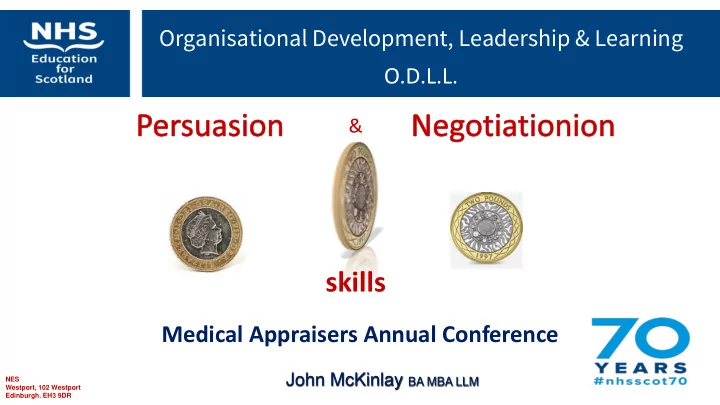
Medical Appraisers Annual Conference

&

skills

slide-2
SLIDE 2

“If you would persuade, you must appeal to interest rather than intellect.”

Benjamin Franklin

slide-3
SLIDE 3

How do you persuade someone?

Provide your top 3 tips

slide-4
SLIDE 4

First Impression

See =100% Know

  • 1. Body language
  • 2. Voice
  • 3. Words.
slide-5
SLIDE 5

What are the key steps to delivering a persuasive message?

slide-6
SLIDE 6

Persuasion

1. Objective 2. Audience 3. Proposal 4. How it works 5. Benefits 6. Next Step.

Classical Approach

  • 1. Introduction
  • 2. Facts
  • 3. Proof
  • 4. Refute
  • 5. Conclude

Five Phase Structure

  • 1. Rapport
  • 2. Background Information
  • 3. Problem Identification
  • 4. Implications
  • 5. Benefits

Rackman & Carlisle

Six Steps to Benefits

slide-7
SLIDE 7

The new equipment will allow the unit to detect a number of kidney ailments. So what? Faster. Earlier. So what? So what? Bingo! So what? So we can treat them before it becomes serious. Which will save £100,000 a year and help us meet one of the HEAT targets.

Step 5: Benefits

slide-8
SLIDE 8

Persuasion Techniques

Similarity Praise

  • 1. Liking
slide-9
SLIDE 9

Feeling part of a group

  • 2. Social Proof
slide-10
SLIDE 10

To help conserve resources, save energy and reduce the amount of detergent related pollutants released into the environment, we would ask hotel guests to reuse their towels Thank you

slide-11
SLIDE 11

26%

The majority of our guests re-use their towels thereby contributing to the reduction of CO2 emissions into the

  • environment. Please reuse your towels.

Thank you

slide-12
SLIDE 12

33%

The majority of our guests using this room re-use their towels thereby contributing to the reduction of CO2 emissions into the environment. Please reuse your towels. Thank you

slide-13
SLIDE 13

3% 30%

  • 3. Choice
slide-14
SLIDE 14

“You could save £200 per year if you insulate your home.” “You could lose £200 per year if you don’t insulate your home.”

  • 4. Loss Language
slide-15
SLIDE 15
  • 5. The ‘Yes’ principle

Yes Yes Yes £200,000 £218,000

slide-16
SLIDE 16

What have we learned?

  • 1. It starts with you.
  • 2. Focus on the benefits to them.
  • 3. Use as many persuasive techniques as possible
slide-17
SLIDE 17

? ? ? ? ? ? ? ? ? ? ? ? ?

John McKinlay BA MBA LLM

slide-18
SLIDE 18

“A kind word goes far, a kind word and a gun goes even further” Al Capone

John McKinlay BA MBA LLM

Scottish Medical Appraiser’s Conference

slide-19
SLIDE 19

Competitive / adversarial Cooperative / collaborative “A kind word goes far, a kind word and a gun goes even further”

Al Capone

Where does the best deal/agreement come from?

  • 1. gun
  • 2. kind word
slide-20
SLIDE 20

Negotiate over

  • 1. Time and location
  • 2. Agenda
  • 3. Proposed learning plan
  • 4. Nature & extent of further development
  • 5. Interpretation of data
slide-21
SLIDE 21

Why do we negotiate? We need each other.

slide-22
SLIDE 22

How do you negotiate?

  • Co-operative
  • Competitive
slide-23
SLIDE 23

REFLECT

Red / Blue card game

slide-24
SLIDE 24

BLUE and RED Card Game RULES:

  • Each player is given a number of red & blue card
  • Each player then chooses to play either a blue or red card. These are revealed

simultaneously.

  • Each player is awarded a score according to the combination of cards revealed.

BLUE - BLUE = +4 POINTS EACH RED - RED = - 4 POINTS EACH RED - BLUE = RED WINS 8 POINTS BLUE LOSES 8 POINTS

OBJECTIVE - TO MAXIMISE YOUR POSITIVE SCORES

slide-25
SLIDE 25

Win - Win (Both win) Lose - Win (A loses, B wins) Win - Lose (A wins, B loses) Lose - Lose (Both lose) BLUE RED BLUE RED

PLAYER B PLAYER A

slide-26
SLIDE 26

BLUE and RED Card Game RULES:

  • Each player is given a number of red & blue card
  • Each player then chooses to play either a blue or red card. These are revealed

simultaneously.

  • Each player is awarded a score according to the combination of cards revealed.

BLUE - BLUE = +4 POINTS EACH RED - RED = - 4 POINTS EACH RED - BLUE = RED WINS 8 POINTS BLUE LOSES 8 POINTS

OBJECTIVE - TO MAXIMISE YOUR POSITIVE SCORES

slide-27
SLIDE 27

Winning Losing

Agreement

Negotiation is not about

slide-28
SLIDE 28
  • I want
  • I need
  • I must have
  • I want
  • I need
  • I must have

Positional negotiations

Potential outcomes:

  • One party wins at the other’s expensive
  • Both parties walk away
slide-29
SLIDE 29
  • The unit wants an additional £20,000 to purchase a

piece of equipment.

  • The organisation says it can’t afford it.

Scenario

Positions:

What are you going to do?

slide-30
SLIDE 30
  • The unit wants an additional £20,000 to

purchase a piece of equipment.

  • The organisation says it can’t afford it.

What are you going to do?

Scenario

Organisation Unit

Positions:

  • Reach an impasse
  • Reach an impasse
  • Impose
  • Capitulate / resist
  • Rob Peter to pay Paul
  • Reduce their demand – i.e. 2nd hand
slide-31
SLIDE 31

Ask question/s “Judge a man by his questions, rather than his answers”

Voltaire

What are you going to do?

slide-32
SLIDE 32
  • The unit wants an additional £20,000 to

purchase a piece of equipment.

  • The organisation says it can’t afford it.

What are you going to do?

Scenario

Organisation Unit

Positions:

Interests

slide-33
SLIDE 33
  • The unit wants an additional £20,000 to

purchase a piece of equipment.

  • The organisation says it can’t afford it.

What are you going to do?

Scenario

Organisation Unit

Positions:

  • If we make an exception, we will

have to make more exception

  • Current equipment breaks down
  • Govt is about to cut our budget
  • Maintenance costs average £3,000 p.a.
  • Causes patient appointments to be

cancelled - not meet our target

Solution

slide-34
SLIDE 34

Creative thinking: Bismarck, the nineteenth century, German Chancellor and ex-army officer challenged Rudolf Virchow (the German pathologist and liberal politician) to a duel. As the challenged party Virchow (who was not a duellist) had the choice of weapons. Tradition decreed that Bismarck would then select one of the weapons, the other being taken up by Virchow. Putting yourself in Virchow’s position, what would you do?

Play to your strengths

slide-35
SLIDE 35
  • The unit wants an additional £20,000 to

purchase a piece of equipment.

  • The organisation says it can’t afford it.

What are you going to do?

Scenario

Organisation Unit

Positions:

  • If we make an exception, we will

have to make more exception

  • Current equipment breaks down
  • Govt is about to cut our budget
  • Maintenance costs average £3,000 p.a.
  • Causes patient appointments to be

cancelled - not meet our target

Solution

slide-36
SLIDE 36
  • The unit wants an additional £20,000 to

purchase a piece of equipment.

  • The organisation says it can’t afford it.

What are you going to do?

Scenario

Organisation Unit

Positions:

  • If we make an exception, we will

have to make more exception

  • Current equipment breaks down
  • Govt is about to cut our budget
  • Maintenance costs average £3,000 p.a.
  • Causes patient appointments to be

cancelled - not meet our target

Hire Purchase

slide-37
SLIDE 37

What have we learned?

  • 1. Negotiation is not about winning or losing -

reaching agreement.

  • 2. Interests and not positions.
  • 3. Asking question
slide-38
SLIDE 38

? ? ? ? ? ? ? ? ? ? ? ? ?

John McKinlay BA MBA LLM

slide-39
SLIDE 39
slide-40
SLIDE 40

NHS Education for Scotland