Main Q&A (Analyst Meeting on Sales Strategy) Questioner No. 1 - - PDF document

main q a analyst meeting on sales strategy questioner no
SMART_READER_LITE
LIVE PREVIEW

Main Q&A (Analyst Meeting on Sales Strategy) Questioner No. 1 - - PDF document

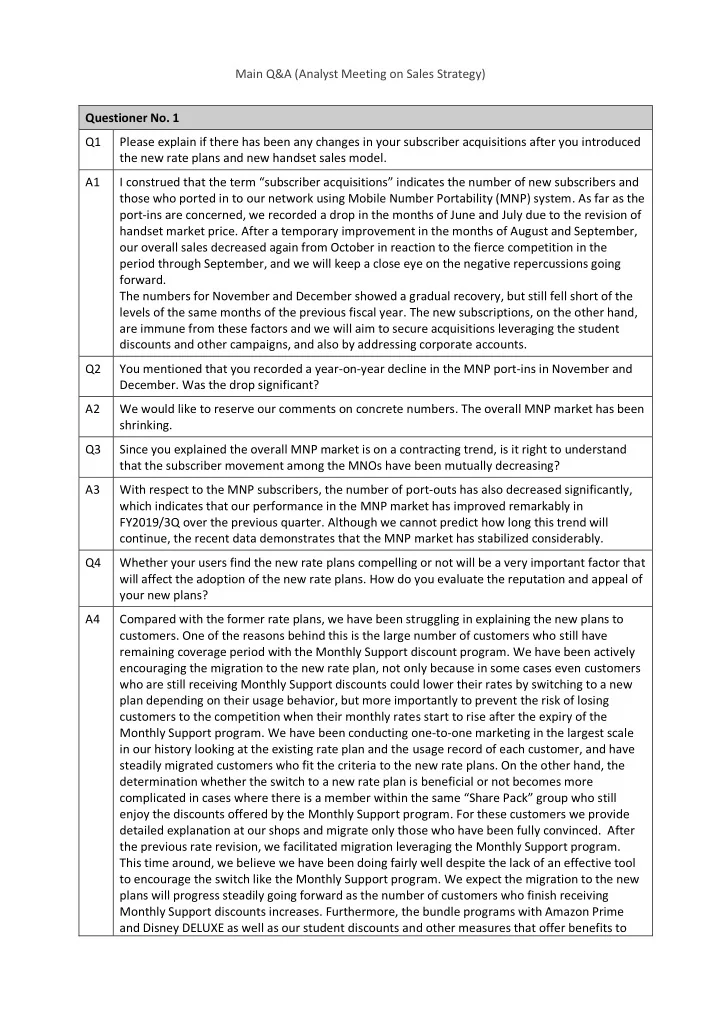
Main Q&A (Analyst Meeting on Sales Strategy) Questioner No. 1 Q1 Please explain if there has been any changes in your subscriber acquisitions after you introduced the new rate plans and new handset sales model. A1 I construed that the term


slide-1
SLIDE 1

Main Q&A (Analyst Meeting on Sales Strategy) Questioner No. 1 Q1 Please explain if there has been any changes in your subscriber acquisitions after you introduced the new rate plans and new handset sales model. A1 I construed that the term “subscriber acquisitions” indicates the number of new subscribers and those who ported in to our network using Mobile Number Portability (MNP) system. As far as the port-ins are concerned, we recorded a drop in the months of June and July due to the revision of handset market price. After a temporary improvement in the months of August and September,

  • ur overall sales decreased again from October in reaction to the fierce competition in the

period through September, and we will keep a close eye on the negative repercussions going forward. The numbers for November and December showed a gradual recovery, but still fell short of the levels of the same months of the previous fiscal year. The new subscriptions, on the other hand, are immune from these factors and we will aim to secure acquisitions leveraging the student discounts and other campaigns, and also by addressing corporate accounts. Q2 You mentioned that you recorded a year-on-year decline in the MNP port-ins in November and

  • December. Was the drop significant?

A2 We would like to reserve our comments on concrete numbers. The overall MNP market has been shrinking. Q3 Since you explained the overall MNP market is on a contracting trend, is it right to understand that the subscriber movement among the MNOs have been mutually decreasing? A3 With respect to the MNP subscribers, the number of port-outs has also decreased significantly, which indicates that our performance in the MNP market has improved remarkably in FY2019/3Q over the previous quarter. Although we cannot predict how long this trend will continue, the recent data demonstrates that the MNP market has stabilized considerably. Q4 Whether your users find the new rate plans compelling or not will be a very important factor that will affect the adoption of the new rate plans. How do you evaluate the reputation and appeal of your new plans? A4 Compared with the former rate plans, we have been struggling in explaining the new plans to

  • customers. One of the reasons behind this is the large number of customers who still have

remaining coverage period with the Monthly Support discount program. We have been actively encouraging the migration to the new rate plan, not only because in some cases even customers who are still receiving Monthly Support discounts could lower their rates by switching to a new plan depending on their usage behavior, but more importantly to prevent the risk of losing customers to the competition when their monthly rates start to rise after the expiry of the Monthly Support program. We have been conducting one-to-one marketing in the largest scale in our history looking at the existing rate plan and the usage record of each customer, and have steadily migrated customers who fit the criteria to the new rate plans. On the other hand, the determination whether the switch to a new rate plan is beneficial or not becomes more complicated in cases where there is a member within the same “Share Pack” group who still enjoy the discounts offered by the Monthly Support program. For these customers we provide detailed explanation at our shops and migrate only those who have been fully convinced. After the previous rate revision, we facilitated migration leveraging the Monthly Support program. This time around, we believe we have been doing fairly well despite the lack of an effective tool to encourage the switch like the Monthly Support program. We expect the migration to the new plans will progress steadily going forward as the number of customers who finish receiving Monthly Support discounts increases. Furthermore, the bundle programs with Amazon Prime and Disney DELUXE as well as our student discounts and other measures that offer benefits to

slide-2
SLIDE 2

customers are expected stimulate the migration because these benefits are contingent on the subscription to the new rate plans. Q5 Some media articles reported that DOCOMO’s new plans are not reasonable at all, which created a general perception that your rates are not inexpensive. Don’t you think you should more actively compare your new rates with the plans of other carriers to properly communicate the affordability of your new rate plans? A5 We thought we have thoroughly communicated to the media presenting a rate comparison table, but it seems that we could not properly get the message through. We will continue to engage ourselves in PR activities. Q6 I believe selling-related expenses before deducting the commissions used to finance handset discounts recorded a year-on-year decline. How do you foresee the long-term trend of this expense item going forward? A6 Traditionally, selling-related expenses moved almost in tandem with the actual sales of handsets, particularly the sales of smartphones and tablets for the retention of subscription contracts. Since we have already stopped receiving new applications to the Monthly Support program, selling-related expenses will likely incur in a way that reflects our ordinary sales activities. As we can no longer expect a huge expansion in the smartphone market, the volume of handsets sold is projected to decrease in the future, thus we do not anticipate a large amount of selling-related expenses in the magnitude we saw in the past. In our face-to-face sales channel, the expenses items that I alluded to earlier have begun to decrease while other items have started to rise. Selling-related expenses account for only 1/3 of the total expenses we pay for the various procedures performed by docomo Shops, and about half when the expenses paid for acceptance of handset repair are included in the calculation. The physical channel will face a capacity issue if the products and services they are required to handle increases too much, so we must further increase the procedures that can be completed via our online channel. On the other hand, many customers want to touch and feel the actual products and services at

  • shops. We therefore need to achieve a well-balanced channel mix taking into account the trends
  • f such demands.

Securing shop staffs is another challenge given the general shortage of workers in Japan. When we think about the circumstances of our agent resellers, we must further promote digitalization to enhance our operational efficiency and productivity. The physical channel will follow the path

  • f contraction if their role was limited to only handset sales, but this will not necessarily be the

case due to the aforementioned reasons. Q7 Can I assume that your selling-related expenses are generally on a slight downtrend when all costs incurred in relation to handset sales are included? A7 That is correct. Questioner No. 2 Q1 Once things stabilize after your introduction of new rate plans and Rakuten’s market entry, on which axis do you think the MNOs will compete against one another from 2020 onwards? I personally believe finance/payment and commerce services will play an interesting role. We have recently seen a drastic business integration between Yahoo Japan and LINE under the leadership

  • f SoftBank and there are speculations in the market as to when KDDI will ally with Rakuten.

Although we cannot tell how the alliances of other carriers will unfold in the future, in the event non-telecommunications businesses become the main battlefield, how do you plan counter the competition? A1 5G will undoubtedly become a major factor affecting the state of competition in the next 10

  • years. Korea and China already commenced commercial 5G services in July and October,

respectively, and we have engaged ourselves in a frequent exchange of information with KT and China Mobile.

slide-3
SLIDE 3

While we anticipate that each carrier will roll out various measures upon the launch of 5G service, the expansion of area coverage is not an easy task. In addition to network quality, rate plans and product lineup will also become the factors of competition. What is different from the age of 4G is that we do not have visibility if there will be any disruptive innovation like the emergence of smartphones. We thus believe one of the important axes of competition will be the ability to offer services through smartphones together with other peripheral devices while working in parallel on the buildout of network coverage. Further, we have poured a lot of resources in finance/payment businesses so we can prevail in the market. What distinguishes DOCOMO from other players is that we basically intend to refrain from measures that burns cash for the purpose of launching large-scale campaigns or cultivating new merchants just to secure locations where our service is available. We have a solid customer base who use our mobile phones, which gives us advantage in terms of continued use of service. Although this is a challenging business, we will strive to catch up with the competition by making active investments for data utilization, etc. For the near term, we believe it is important to execute measures that will encourage customers to use our services as a regular means of payment for their everyday purchases even after the government’s subsidy program expires. Questioner No.3 Q1 How sensitive are DOCOMO’s customers about the necessity of aligning your rates with those of second brands, etc.? I do not think you have lowered your rates to a level comparable to Y!mobile or UQ Mobile. Do you see the need of matching your rates with the second brands? A1 Regarding your question about the need of lowering our rates, we have executed rate reductions

  • ver the years as part of our various customer return measures. With the introduction of the new

rate plans this year, we carried out a major revision for the first time in five years after rolling out the “Kake-hodai & Pake-aeru” plans in June 2014. In the period prior to the latest major revision, we added various offers and campaigns to our existing plans one after another, which made our rate structure complicated and difficult to understand for our customers. In addition, we heard voices of criticism against our rates from various corners of society. For these reasons, we made a bold decision to revise and simplify our rate structure this time around. This will have a negative impact on our revenues for the short term. However, because we believe it is difficult to drive our future growth only with telecommunications business, we must increase the revenues from

  • ther sources while defending our customer base to ensure the mid-to-long term growth of the
  • Company. Some MVNOs offer SIM-only services using second-hand handsets at prices even

cheaper than the rates of the second brands. Because communications services are now made available in a broad range of service formats, it is difficult to determine where to set our focus. MVNOs started offering data services bundled with voice communications in 2015, which resulted in a certain number of subscriber outflows from MNOs. To compete against such MVNOs, our competitors established Y!mobile and UQ Mobile positioning them as a bulwark to defend their customers. We, in contrast, operate our business with a single brand. While appealing the benefits that we can offer as an MNO, we have responded to the demands of customers who want to save their spend through “docomo with” and other discount programs. We simplified our structure with the launch of the new rate plans this year, and we will continually look into how to respond to the voices of customers. The MVNOs seem to have regained their vigor to some extent following the implementation of the new regulation that require the separation of handset sales from communication charges. We will closely observe the trends in the market and review our rates as appropriate. Questioner No. 4 Q1 Please share with us your projections concerning Rakuten’s moves and the measures you can possibly take to counter them. Unless you make the necessary preparations from now, you will not be able to respond when they make their announcement. Have you considered many different scenarios? A1 That is exactly what we have been doing, but we cannot disclose the details concerning the preparations that we have made as that will reveal our strategy.

slide-4
SLIDE 4

Q2 What are the strengths of DOCOMO vis-à-vis Rakuten? A2 To be honest, it is difficult to precisely predict the moves of Rakuten, but we know for sure that their network coverage and quality are insufficient. A start like this will leave a negative impression, which must have given Rakuten a lot of difficulty. It is rumored that Rakuten will make a bold decision on their rates in order to eliminate the negative image. Recently, what was considered to be Rakuten’s rate table was leaked to the internet, but Rakuten denied that it was something officially announced by Rakuten. In the logical course of things, we can anticipate that Rakuten will use Rakuten Mobile’s existing rates as a baseline and combine it with various campaigns and point offers. If they think they do not have to make any profits from their mobile communications services, they may choose to cross-sell other services, which is a field that they excel in. However, as we mentioned earlier, the rate is not the only factor of competition. We cannot clearly explain how we plan to respond before Rakuten unveils their concrete rate

  • plans. However, in mobile business, the elements that determines the competition include the

network, rate plans, handsets and after-sales support, and we will compete against them making full use of our strengths in all these aspects. We will also establish a win-win relationship with various partners sharing our assets, thereby expanding the size of transactions to compete favorably against them. Q3 The rate plans circulated on the internet recently that were considered to be Rakuten’s appeared to be conceivable if they represented the rates after applying certain campaign discounts. If they truly set their rates at that level, do you plan to match your rates? A3 We believe it is necessary to look at the balance with network quality rather than focusing solely

  • n the rates.

Q4 Many people believe there are no meaningful differences in the network quality of the three MNOs, and a good number of people expect Rakuten’s will not be so different either. I do not think consumers will realize the difference unless you go as far as creating and airing a parody commercial film that compares the network speeds. What are your thoughts? A4 That depends on the moves of Rakuten. Q5 I understand that Smart life business and Other businesses have been growing, recording an increase in segment profits. But I am concerned that your total operating profit will hit a ceiling at a level below 1 trillion yen as the government or the Ministry of Internal Affairs and Communications (MIC) will criticize if your profit increases too much. Do you foresee such risks? For example, do you foresee the possibility of having to spin off your Smart life segment just like DOCOMO and NTT Data were divested from NTT in the past? You may also be able to pursue the

  • ption of fending off criticism by separating the telecommunications business from other

businesses that are achieving growth. Have you discussed these matters internally? A5 Nothing bars us from generating profits in excess of 1 trillion yen. However, we hear voices that the rates offered by MNOs are still expensive from the perspective of consumers. As we mentioned earlier, customer returns should be provided amid the competition with other players and need to be executed on an ongoing basis. Regarding the Smart life business and Other businesses, how we divide our business segments is an issue that requires further consideration. The growth of Smart life business has indeed begun to level off after we successfully expanded

  • ur customer base to a suitable scale commensurate the overall market size. As we have also

made investments in new domains, we would like to grow revenues by offering new services in combination with 5G, etc. Questioner No. 5 Q1 I believe the MIC’s criticism complaining that you are making too much profit will not subside in the next fiscal year or so. Should I assume that you are planning to maintain your telecommunications revenues flat but instead secure growth in non-telecommunications business in the next decade, the era of 5G? A1 Whether we have a flat growth or not will be affected also by the competitive environment. We are not sure if the MIC has had deliberations envisaging the communication charges in the age of

  • 5G. One of the key properties of the 5G service for consumers is the high-speed and large-

capacity transmission capability, and we will aim to achieve upsells by combining this with live images, cloud-based games and other services. The revenues from such services will be

slide-5
SLIDE 5

determined by the considerations we can seek for the satisfaction we deliver to our customers, so we do not think we need to hesitate about expanding our revenues from these new offerings. Meanwhile, we will be required to offer services at reasonable rates for smartphones that will function as a life infrastructure, so we will also consider preparing easy-to-use rate plans for low- usage customers. While we cannot tell if there will be a bipolarization of user segments, we intend to respond properly to the needs of each segment. The total smartphone users of the three Japanese carriers alone amount to over 100 million. Unlike the enterprise and IoT markets, because we cannot expect a huge increase in the number

  • f consumer users, we would like to provide services integrating those developed in-house as

well as by our partners. As our partners will be able to expect customer referral from us, we believe this will lead to an expansion of business for both parties. We have been making investments in finance/payment services, i.e., the entry point to various other offerings, to keep abreast with the competition. Questioner No. 6 Q1 You commented that 5G will determine your competitiveness in the next decade, but what kind

  • f world should we anticipate in ten years from now? Do you think consumers will still account

for the large bulk of your revenues, or do you think the income from enterprise clients will take up a significant proportion of your revenues? A1 5G’s unique properties of low latency and massive device connectivity offer great potential in the enterprise business. Overseas carriers attach a strong focus on this point, and DOCOMO also employs a similar strategy to combine AI with our 5G offerings. Through our 5G Open Partner Program, which is currently participated by over 3,000 entities, we have developed over 200 use

  • cases. We believe 5G will drive innovation through the integration of new techniques and
  • solutions. Accordingly, we would like to devise new revenue models which, unlike our

conventional model, are not split between communications and the services. Q2 What are your thoughts about overseas business? Should we not expect a lot from overseas business as you do not have any intention to roll out 5G networks outside Japan? A2 Investing in carrier business is not included in our scope of our options, because we learned from the overseas investments we pursued in the past that we cannot necessarily capitalize on the insights and business model accumulated in Japan. However, the spheres of business of our enterprise clients are not confined to Japan, and we would like to assist companies that are active in markets outside Japan supporting their roaming and other needs. For IoT applications, we are being consulted about the development of a platform for connectivity management using the network of local carriers in each market, which is a point of discussion that is indispensable in enterprise business. Although we do not have a particularly strong global footprint or a rich base

  • f global human talents, we have a long track record of working together with various NTT Group

affiliates in overseas markets. We do not intend to unreasonably push forward businesses

  • utside Japan, but we will address opportunities where we can make use of our resources. For

example, overseas carriers do not have the concept or mechanism of membership services, and we have started rolling out our “d POINT” program in some markets outside Japan. Questioner No. 7 Q1 According to market consensus, DOCOMO is not forecast to recover to its previous profit level. I am sure that there are many things beyond your control, but in your view, Mr. Tsujigami, is there anything about your latent power that the market has overlooked? A1 As we transform the Company, we must first secure from outside the resources and human talents that we lack, or make up for the missing pieces through alliances or other means. There are several things that our partners expect for DOCOMO and one of them is 5G. We believe we are highly appreciated for our area buildout and network construction prowess and our attitude to accommodate the requests of enterprises. There are also strong expectations for our “Top Gun” sales approach, in which a team comprising our R&D engineers and other staff visit clients and carry out applied development in an expeditious manner. In addition, we also aim to expand sales and enhance customer loyalty by working together with our partners in digital marketing leveraging our membership base. We believe the potential offered by these opportunities will become more visible once commercial 5G service is launched.

slide-6
SLIDE 6