Analyst Meeting Q&A (Earnings Release for the Fiscal Year Ended - - PDF document

analyst meeting q a earnings release for the fiscal year
SMART_READER_LITE
LIVE PREVIEW

Analyst Meeting Q&A (Earnings Release for the Fiscal Year Ended - - PDF document

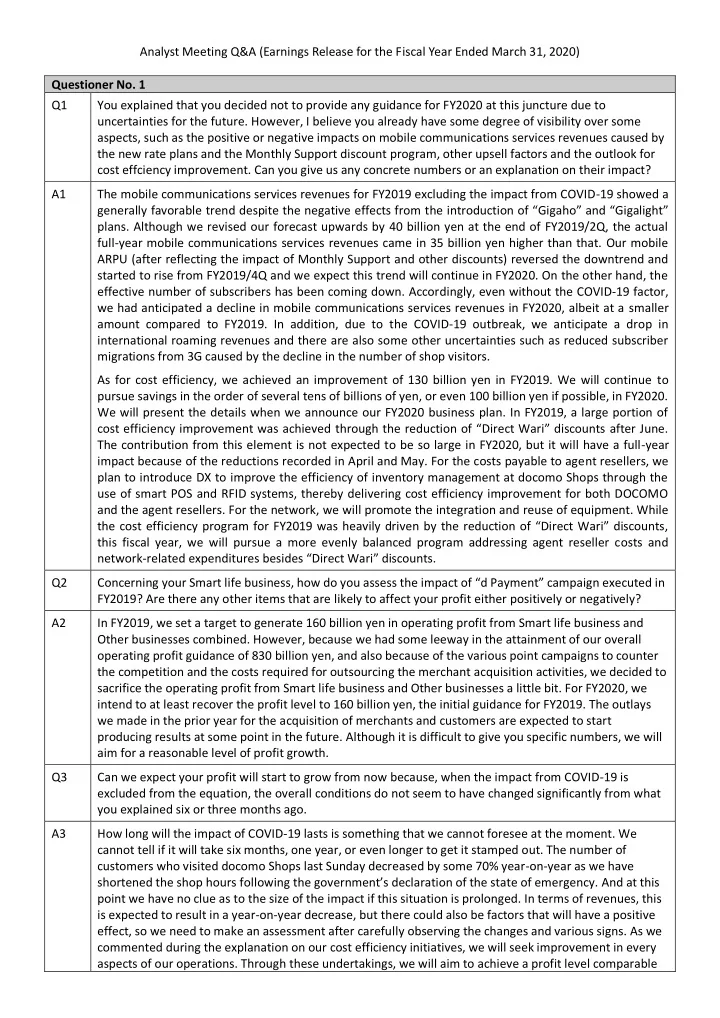
Analyst Meeting Q&A (Earnings Release for the Fiscal Year Ended March 31, 2020) Questioner No. 1 Q1 You explained that you decided not to provide any guidance for FY2020 at this juncture due to uncertainties for the future. However, I


slide-1
SLIDE 1

Analyst Meeting Q&A (Earnings Release for the Fiscal Year Ended March 31, 2020) Questioner No. 1 Q1 You explained that you decided not to provide any guidance for FY2020 at this juncture due to uncertainties for the future. However, I believe you already have some degree of visibility over some aspects, such as the positive or negative impacts on mobile communications services revenues caused by the new rate plans and the Monthly Support discount program, other upsell factors and the outlook for cost effciency improvement. Can you give us any concrete numbers or an explanation on their impact? A1 The mobile communications services revenues for FY2019 excluding the impact from COVID-19 showed a generally favorable trend despite the negative effects from the introduction of “Gigaho” and “Gigalight”

  • plans. Although we revised our forecast upwards by 40 billion yen at the end of FY2019/2Q, the actual

full-year mobile communications services revenues came in 35 billion yen higher than that. Our mobile ARPU (after reflecting the impact of Monthly Support and other discounts) reversed the downtrend and started to rise from FY2019/4Q and we expect this trend will continue in FY2020. On the other hand, the effective number of subscribers has been coming down. Accordingly, even without the COVID-19 factor, we had anticipated a decline in mobile communications services revenues in FY2020, albeit at a smaller amount compared to FY2019. In addition, due to the COVID-19 outbreak, we anticipate a drop in international roaming revenues and there are also some other uncertainties such as reduced subscriber migrations from 3G caused by the decline in the number of shop visitors. As for cost efficiency, we achieved an improvement of 130 billion yen in FY2019. We will continue to pursue savings in the order of several tens of billions of yen, or even 100 billion yen if possible, in FY2020. We will present the details when we announce our FY2020 business plan. In FY2019, a large portion of cost efficiency improvement was achieved through the reduction of “Direct Wari” discounts after June. The contribution from this element is not expected to be so large in FY2020, but it will have a full-year impact because of the reductions recorded in April and May. For the costs payable to agent resellers, we plan to introduce DX to improve the efficiency of inventory management at docomo Shops through the use of smart POS and RFID systems, thereby delivering cost efficiency improvement for both DOCOMO and the agent resellers. For the network, we will promote the integration and reuse of equipment. While the cost efficiency program for FY2019 was heavily driven by the reduction of “Direct Wari” discounts, this fiscal year, we will pursue a more evenly balanced program addressing agent reseller costs and network-related expenditures besides “Direct Wari” discounts. Q2 Concerning your Smart life business, how do you assess the impact of “d Payment” campaign executed in FY2019? Are there any other items that are likely to affect your profit either positively or negatively? A2 In FY2019, we set a target to generate 160 billion yen in operating profit from Smart life business and Other businesses combined. However, because we had some leeway in the attainment of our overall

  • perating profit guidance of 830 billion yen, and also because of the various point campaigns to counter

the competition and the costs required for outsourcing the merchant acquisition activities, we decided to sacrifice the operating profit from Smart life business and Other businesses a little bit. For FY2020, we intend to at least recover the profit level to 160 billion yen, the initial guidance for FY2019. The outlays we made in the prior year for the acquisition of merchants and customers are expected to start producing results at some point in the future. Although it is difficult to give you specific numbers, we will aim for a reasonable level of profit growth. Q3 Can we expect your profit will start to grow from now because, when the impact from COVID-19 is excluded from the equation, the overall conditions do not seem to have changed significantly from what you explained six or three months ago. A3 How long will the impact of COVID-19 lasts is something that we cannot foresee at the moment. We cannot tell if it will take six months, one year, or even longer to get it stamped out. The number of customers who visited docomo Shops last Sunday decreased by some 70% year-on-year as we have shortened the shop hours following the government’s declaration of the state of emergency. And at this point we have no clue as to the size of the impact if this situation is prolonged. In terms of revenues, this is expected to result in a year-on-year decrease, but there could also be factors that will have a positive effect, so we need to make an assessment after carefully observing the changes and various signs. As we commented during the explanation on our cost efficiency initiatives, we will seek improvement in every aspects of our operations. Through these undertakings, we will aim to achieve a profit level comparable

slide-2
SLIDE 2

to FY2019. At this point of time, however, it is difficult to present our plans in absolute numbers. Q4 I guess it would have been difficult for you to give a guidance of a dividend increase without making any disclosure of sales and profit forecasts, but I believe that you have a basic policy to aim for continual dividend increase. I also believe you will push forward the liquidation of handset installment receivables and credit card receivables with a plan to use the proceeds mainly for shareholder returns. Since you did not make any announcement concerning share repurchase and the dividend level was kept unchanged, can you share with us your views on future shareholder returns? Is there a possibility that you will revise your shareholder return measures for this year when you provide the full-year guidance once the prospects of business becomes more visible? A4 We just presented our dividend plan without making any announcement on our full-year outlook, and we are sorry that we were not able to plan a dividend hike this time. Under the current circumstances, our total dividend payment based on a dividend per share of 120 yen will amount to 390 billion yen. We can maintain the same level of dividend as last year because we already have cash on hand in a slight excess

  • f that amount, and also because we do not foresee a negative cash flow for FY2020, and please take this

as our minimum commitment. Share repurchase can be done anytime through a tender offer conducted in tandem with the liquidation of receivables. We did not make any comment on the prospects for share repurchase because we have not yet made any disclosures concerning our financial guidance. The preparation for handset installment receivables liquidation is not yet finished, it will only happen in FY2020/2Q or beyond if we decide on its execution. For this reason, we refrained from making any comments on future share repurchases at this juncture. Questioner No. 2 Q1 I would like to confirm the trend of mobile communications services revenues excluding the COVID-19

  • impact. You explained that the FY2019/4Q mobile ARPU recorded an increase over the previous quarter

and this uptrend is likely to continue. Can you elaborate on this point? As it is expected that you will continue to see a modest progress in the migration of subscribers to the new rate plans, a moderation of Monthly Support impact, customers’ migration from 3G and upsells in FY2020, what is your projection concerning the mobile ARPU after applying discounts? A1 We commented earlier that the reversal of the downtrend of mobile ARPU after discounts will likely continue into FY2020. We made that statement from the expectation that mobile ARPU will show a gradual increase after hitting a bottom in FY2019/3Q. It is still in a negative territory when presented in a year-on-year comparison. However, if the COVID-19 impact is taken out of the calculation, mobile ARPU after applying discounts is projected to reverse its downtrend in FY2020/2Q or 3Q compared to the same period in FY2019 at the latest, and we anticipate that the full-year ARPU for FY2020 will rise to a level higher than the full-year data for FY2019. On the other hand, docomo Hikari ARPU is expected to rise further in line with the growth of subscriptions. Our earlier comment regarding the projected decline in mobile communications services revenues in FY2020 is mainly driven by a decrease in the number of subscriptions; but we anticipated that the downtrend of mobile ARPU (after discounts) will come to an inflection point. Again, however, mobile ARPU including the impact of COVID-19 is totally unpredictable. We had originally expected an ARPU increase of approximately 100 yen due to the effects of customers’

  • migration. While we do not believe the positive effects from the migration will halve because of COVID-

19, if this turns out to be the case, it will translate into a reduction of 50 yen. The revenues from international roaming could also go down to nearly zero. This implies that mobile ARPU could be affected by several tens of yen. Q2 You mentioned that the FY2020 mobile ARPU (after discounts) was expected to reverse its downtrend in the second or third quarter if the impact of COVID-19 is not taken into consideration. Does that reflect the changes in the calculation method, e.g., the adoption of future cost method for the packet interconnection charges for MVNOs and the compliance with regulations calling for a reduction of wholesale charges for voice calls? A2 The impact of COVID-19 was not factored in the calculation, however, the risks relating to regulatory compliance and impact from countering the competition arise almost every year. A reasonable level of risks is already factored in our projections for mobile communications services revenues. (Note:

slide-3
SLIDE 3

Wholesale revenues from MVNOs are not included in the mobile ARPU calculation). Q3 Regarding your cash flow, you commented that you have not yet completed the preparations for the liquidation of handset installment receivables. Would you carry out liquidation once you finish the necessary preparations? Or would you rather take a wait-and-see approach this fiscal year given the uncertainties in the business outlook? A3 Unless there is a significantly large investment deal, we can sufficiently manage our business with the cash on hand and the free cash flow generated from our operations. If we are to liquidate the handset installment receivables, that will be done in conjunction with share repurchase, but we have not decided when to carry out the repurchase program. In FY2019/4Q, we executed the liquidation of credit card receivables and succeeded in off-balancing and increasing our free cash flow. Given this experience, what is left is only the completion of administrative work. Preparations for handset installment receivables liquidation is scheduled to complete in FY2020/2Q, but we cannot give you a clear comment on whether

  • r when it will be executed.

Q4 Don’t you have any concerns about finding buyers in light of the current situation of the financial market? A4 That is also included in our scope of studies. But we do not think we need to worry because the receivables are free of any creditworthiness issues. Questioner No. 3 Q1 Please let us know if you expect to see any impact from COVID-19 on your costs. A1 COVID-19 could potentially affect our costs in many different ways, such as a decrease in commissions payable to agent resellers due to a decline in sales, slower-than-expected generation of general expenses resulting from a delay in the implementation of various measures and a decrease in depreciation associated with the decline in capital expenditures. In any event, most of these are not a true decline in expenses; it is just a deferral of costs to subsequent periods, so they cannot be considered cost reduction in a positive sense. We do not foresee any factors that will result in a rise in costs. Q2 Do your 5G subscriber targets of 2.5 million in FY2020 and 20 million in FY2023 include both consumers and enterprise accounts? If so, do they include module subscriptions as well? A2 The 5G subscriber targets include both consumer and enterprise accounts, and communications modules are included in these numbers. The total number of 5G subscriptions currently stands at approximately 40,000. The release of standard model handsets scheduled for the second half of the year is expected to accelerate the adoption of the service, but we need to carefully examine the impact of COVID-19 going forward. Questioner No. 4 Q1 Please comment on the impact from COVID-19 with respect to the traffic growth after April. In particular, can you share with us your views on how it has affected your data communications traffic and mobile communications revenues, as well as its impact on the competitive landscape such as Mobile Number Portability (MNP) customer acquisitions. A1 During the presentation, we touched upon COVID-19’s impact on voice and data traffic after late March and the declaration of state of emergency in April. As far as voice is concerned, we have seen a month-

  • n-month increase in traffic of about 5-6% since late March, which we believe was caused by the growth

in voice communication demand especially among business users as a result of the promotion of

  • teleworking. However, this has not resulted in a sharp increase in the number of “Kake-hodai” flat rate

voice service subscriptions, and we have not seen a remarkable expansion of voice revenues, either. It seems mainly the voice traffic of the existing subscribers of “Kake-hodai” plans recorded an increase. Data communications has been faring 5-6% higher than the previous month since January following the launch of the “Gigaho Zouryou Campaign”, but it has not shown a significant increase after late March and the declaration of the state of emergency. That is why we included a description of “slightly up” in the presentation slides. The COVID-19 impact on mobile data communications has been insignificant.

slide-4
SLIDE 4

As for MNP, though we have devised creative handset sales methods following the implementation of the revised Telecommunication Business Act in October 2019, we have seen a considerable drop in the absolute number of MNP port-outs and port-ins. We therefore have an impression that COVID-19 does not have an effect to activate the MNP subscriber movements. Q2 Rakuten expanded its roaming data allowance from previously 2GB to 5GB in conjunction with the launch

  • f commercial service. Has there been any impact from Rakuten in your recent performance including

this decision? Also, have you changed your views of Rakuten’s competitiveness as a result of their decision to expand the roaming allowance to 5GB? A2 We were a bit surprised by Rakuten’s announcement of Version 2.0 on April 8 made on the day of their commercial service launch, through which they expanded the roaming capacity to 5GB and relaxed the speed restriction to 1MB/second that is applied to users who have used up the 5GB roaming allowance. While we have to carefully observe future developments (such as the number of port-outs from DOCOMO, Rakuten’s next product lineup and the prospects for the commencement of 5G service), the impact on our business hitherto has been insignificant, which might have been affected by the spread of COVID-19 and other factors. For now, we believe we are well positioned to counter them by properly continuing the measures that we have addressed so far, i.e., our new rate plans, network and after-sales support, etc. Questioner No. 5 Q1 In your presentation, you stated that FY2020 will be the start year for growth in a new era. Is there any change to your ambition to achieve profit growth from this fiscal year onwards? Or, is there any change to your direction, e.g., prioritizing investments over profits to drive your future growth? A1 While we have not disclosed our guidance for FY2020 due to the uncertainties caused by COVID-19, our policy for future profit growth remains unchanged; we are determined to make FY2019 the bottom year

  • f our profit and achieve recovery thereafter.

This fiscal year, the start year of a new decade of the 2020s, is expected to become a milestone in many

  • respects. Our finance/payment business has already acquired a large member base, and we have entered

a phase to start monetizing through digital marketing. We explained FY2020 is positioned as the start year for growth in a new era of the 2020s, as we will aim for further expansion taking the opportunity of

  • ur 5G launch. There is no change to our ambition for profit recovery that we declared in the past.

Q2 You achieved a strong growth in free cash flow in FY2019 with your working capital showing a huge

  • improvement. Can you elaborate on the reasons behind this together with your plans for the liquidation
  • f credit card receivables?

A2 Free cash flow as of March 31, 2020 came in much higher than our initial forecast of 530 billion yen. Aside from the sale of our stake in Sumitomo Mitsui Card, which had been included in the plan from the beginning, the outstanding handset installment receivables decreased by more than 50 billion yen compared to our initial projections, and we liquidated credit card receivables worth 50 billion yen, which was not factored in our initial plan. Further, the larger-than-expected reduction of inventory was also instrumental for shirking our working capital. The suppression of inventory assets was achieved partly as a result of our inventory reduction project conducted in collaboration with the Procurement and Supply Department, and also because of the delay in the supply of handset/devices due to the impact of COVID- 19. Q3 How do you foresee your free cash flow generation for FY2020, taking into consideration such factors as the trend of handset installment receivables in light of your handset sales, additional liquidation of credit card receivables and further reduction of inventory assets? A3 Further reduction of inventory assets will be difficult as we do not have any concrete plans at the

  • moment. There is a possibility for a slight reduction in handset installment receivables in FY2020, but it

would be difficult to seek a decrease as sizable as in FY2019. The credit card receivables have been rising, and their liquidation will be studied together with share repurchase. We will not rule out the possibility of executing liquidation of handset installment/credit card receivables in a scale corresponding to our share repurchase program, but we do not think this can be explicitly stated in our business plan when we

slide-5
SLIDE 5

announce our FY2020 guidance. Questioner No. 6 Q1 This is a question pertaining to your recent capital expenditures trend and prospects for this fiscal year. Has the impact from COVID-19 been caused by the late supply of network equipment, or the delay in your construction schedule? If you witness any delay in the progress of CAPEX due to COVID-19 despite initially anticipating an annual CAPEX comparable to FY2019, will you accelerate the outlays once the spread of COVID-19 infections starts to settle down? A1 We have not seen a significant delay so far. However, if the impact of COVID-19 prolongs and start affecting the supply of equipment and construction schedule, it could potentially cause a delay in the base station rollout especially in the second half of the year. This could potentially affect our CAPEX by several tens of billions of yen, and our annual CAPEX may end up lower than 570 billion yen. We will give you guidance once we have a clear view on the outlook. While it is all up to the degree of the delay, we will try to make up for any delay in the CAPEX progress once the spread of COVID-19 virus subsides. Q2 I guess one of the reasons behind the smaller-than-expected increase in mobile data traffic is the data

  • ffload to fixed broadband (Wi-Fi). Have you seen any increase in the number of docomo Hikari optical-

fiber broadband subscriptions recently? A2 We cannot track the trend of fixed line traffic with docomo Hikari, but according to what we hear from NTT, the overall traffic carried by optical-fiber circuits seems to be growing. Our sales performance was more strongly affected by the shortened store hours, and we have not been able to translate the heightened demand into increased docomo Hikari sales subscriptions. While it all depends on the scale and duration of COVID-19 impact, COVID-19 has hitherto had a net negative impact on our sales. Questioner No. 7 Q1 I had anticipated that you will suffer a decline in mobile data communications traffic due to offloads to Wi-Fi as many people are now refraining from going out and working from home. As you indicated a slightly upward impact on mobile data communications in your presentation, can you explain the reasons behind the growth? Has there been incremental usage from enterprise clients? A1 We are tracking the overall traffic trends, which is difficult to distinguish between consumers and

  • enterprises. However, the number of employees of our enterprise client who are working remotely has

definitely been growing, and for consumers we have launched the “Gigaho Zouryou Campaign” and free provision of 50GB of data to users aged 25 and younger. We believe these measures have resulted in a slight increase in our mobile data traffic. Q2 There is a general trend in society to accelerate teleworking including the reinforcement of VPN, etc. Have you noticed any changes in the inquiries from your enterprise clients as they prepare for the future? A2 As part of our sales activities to enterprise customers, we have been offering trial usage of telework and remote conferencing systems, and the number of inquiries has also been rising. But in some cases, we have not been able to respond to the inquiries due to the limitation of our sales staff and system engineers physically visiting customers. Customers also have to make certain preparations, such as VPN circuits, etc., to actually start using the service, but the preparation in some cases takes a very long time due to issues relating to facilities and other factors. This is a widely seen problem that is not unique to

  • DOCOMO. However, we believe we can make progress in responding to these requirements as the

situation evolves. Q3 I heard the adoption of smartphones has so far been slow among the enterprise segment. Do you think the current circumstances will help facilitate the adoption? A3 We have certainly witnessed such developments because today’s smartphones and tablets are capable of fulfilling a wide range of requirements. Some municipalities are looking into the introduction of tele- study, or remote classes and there are some requests to use tablet-based systems not only in universities but also in elementary and middle schools.