Main Q&A (Analyst Meeting after the Results for FY2018/3Q) - - PDF document

main q a analyst meeting after the results for fy2018 3q
SMART_READER_LITE
LIVE PREVIEW

Main Q&A (Analyst Meeting after the Results for FY2018/3Q) - - PDF document

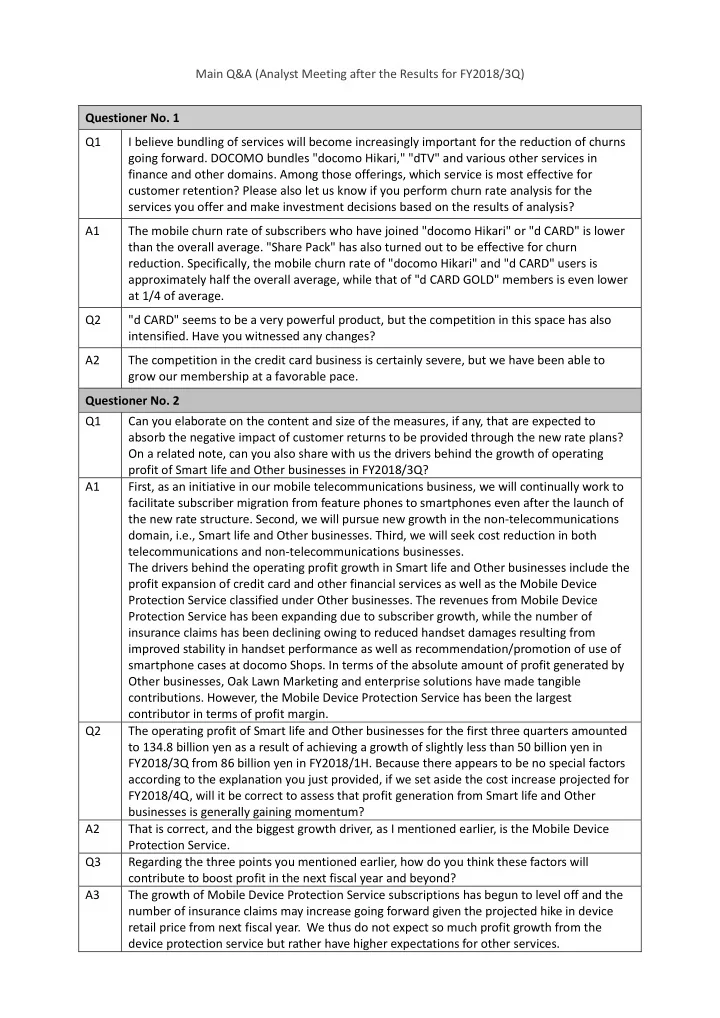
Main Q&A (Analyst Meeting after the Results for FY2018/3Q) Questioner No. 1 Q1 I believe bundling of services will become increasingly important for the reduction of churns going forward. DOCOMO bundles "docomo Hikari,"


slide-1
SLIDE 1

Main Q&A (Analyst Meeting after the Results for FY2018/3Q) Questioner No. 1 Q1 I believe bundling of services will become increasingly important for the reduction of churns going forward. DOCOMO bundles "docomo Hikari," "dTV" and various other services in finance and other domains. Among those offerings, which service is most effective for customer retention? Please also let us know if you perform churn rate analysis for the services you offer and make investment decisions based on the results of analysis? A1 The mobile churn rate of subscribers who have joined "docomo Hikari" or "d CARD" is lower than the overall average. "Share Pack" has also turned out to be effective for churn

  • reduction. Specifically, the mobile churn rate of "docomo Hikari" and "d CARD" users is

approximately half the overall average, while that of "d CARD GOLD" members is even lower at 1/4 of average. Q2 "d CARD" seems to be a very powerful product, but the competition in this space has also

  • intensified. Have you witnessed any changes?

A2 The competition in the credit card business is certainly severe, but we have been able to grow our membership at a favorable pace. Questioner No. 2 Q1 Can you elaborate on the content and size of the measures, if any, that are expected to absorb the negative impact of customer returns to be provided through the new rate plans? On a related note, can you also share with us the drivers behind the growth of operating profit of Smart life and Other businesses in FY2018/3Q? A1 First, as an initiative in our mobile telecommunications business, we will continually work to facilitate subscriber migration from feature phones to smartphones even after the launch of the new rate structure. Second, we will pursue new growth in the non-telecommunications domain, i.e., Smart life and Other businesses. Third, we will seek cost reduction in both telecommunications and non-telecommunications businesses. The drivers behind the operating profit growth in Smart life and Other businesses include the profit expansion of credit card and other financial services as well as the Mobile Device Protection Service classified under Other businesses. The revenues from Mobile Device Protection Service has been expanding due to subscriber growth, while the number of insurance claims has been declining owing to reduced handset damages resulting from improved stability in handset performance as well as recommendation/promotion of use of smartphone cases at docomo Shops. In terms of the absolute amount of profit generated by Other businesses, Oak Lawn Marketing and enterprise solutions have made tangible

  • contributions. However, the Mobile Device Protection Service has been the largest

contributor in terms of profit margin. Q2 The operating profit of Smart life and Other businesses for the first three quarters amounted to 134.8 billion yen as a result of achieving a growth of slightly less than 50 billion yen in FY2018/3Q from 86 billion yen in FY2018/1H. Because there appears to be no special factors according to the explanation you just provided, if we set aside the cost increase projected for FY2018/4Q, will it be correct to assess that profit generation from Smart life and Other businesses is generally gaining momentum? A2 That is correct, and the biggest growth driver, as I mentioned earlier, is the Mobile Device Protection Service. Q3 Regarding the three points you mentioned earlier, how do you think these factors will contribute to boost profit in the next fiscal year and beyond? A3 The growth of Mobile Device Protection Service subscriptions has begun to level off and the number of insurance claims may increase going forward given the projected hike in device retail price from next fiscal year. We thus do not expect so much profit growth from the device protection service but rather have higher expectations for other services.

slide-2
SLIDE 2

Q4 I do not think your subscriber migration efforts will produce results anytime soon, but what are your expectations for the cost-cutting initiatives? A4 We will tackle cost reduction on an ongoing basis. We set a sizable cost reduction target of 120 billion yen for the current fiscal year. At this juncture, we cannot give you a definitive guidance as to whether we can execute a comparable size of cost reduction in the next fiscal year, but we would like to pursue a similar amount of reduction to the extent possible. Q5 When you announced the results for FY2018/1H, you mentioned that you will accelerate shareholder returns. Were you alluding to the most recent 600 billion-yen share repurchase from your parent NTT, or did you have anything else in your mind when you made that statement? A5 That particular comment referred to our medium-term ambition, and the latest round of share repurchase is not the end of our journey. We will continually look into the possibility of both dividend increase and share repurchase. Both tender offer and open market purchase have their own merits and demerits. This time around, we carried out our program through tender offer, but we will consider combining the two approaches for our future repurchases. Q6 Please explain your dividend policy for the next fiscal year. Can we expect that you will aim for sustained dividend increase? A6 We cannot make a definitive commitment on a dividend increase for the next fiscal year, but as you rightly pointed out, we will aim for a sustained increase of dividends. Although we plan to lower our rates during the next fiscal year, we expect to receive proceeds from the planned sale of our stake in Sumitomo Mitsui Card Company, which will allow us to secure free cash flow comparable to this year unless something very unusual happens. This will provide us with sufficient capacity to execute both dividend increase and share repurchase. Questioner No. 3 Q1 You explained that you have already spent 50 billion yen out of the total 80 billion-yen budget for new growth investment for FY2018 in the first three quarters. Can you comment on the quarterly breakdown of the 50 billion yen and the details concerning the destination of the investment. Are you planning to continue investments for new growth in the next fiscal year as well? Also, do you expect the 80 billion-yen investment made during this fiscal year will begin to bear fruit as early as next year? A1 To give you a breakdown on the investments made in the first three quarters of the year, we spent approximately 20 billion yen for 5G-related investments, approximately 20 billion yen for FinTech, video and AI-related services, and 10 billion yen for reinforcement of our customer channels, e.g., omni-channel development and smartphone classes, etc. We believe these investments can be recovered once 5G takes off and use of FinTech and other services

  • proliferate. We are currently contemplating a comparable investment budget for the next

fiscal year. At this point of time, we cannot predict how much of the 80 billion-yen investment made during the current fiscal year can be recovered in the next fiscal year. Questioner No. 4 Q1 The spectrum allocation for 5G is scheduled in the spring of 2019. Do you think there will be a crucial difference between the cases of being able to receive two slots or just one slot in the sub-6 radio frequency bands (3.7GHz and 4.5GHz)? Is it right to assume that DOCOMO is very eager to receive the allocation of two slots? A1 Altogether six slots (each with a bandwidth of 100MHz) are planned for allocation in the sub- 6 bands. I interpreted that your question was about the spectrum acquisition strategy of each

  • carrier. The actual number of 5G users is projected to be insignificant in the early stage

immediately after the service launch, but it will gradually increase over time. In addition, DOCOMO accommodates a larger number of users in the same amount of spectrum compared to the competition, so we would like to receive as much spectrum as possible. Q2 You developed a plan to spend 1 trillion yen for 5G over a period of five years. Do you have any plans to invest aggressively to provide 5G connectivity in rural areas from early on?

slide-3
SLIDE 3

A2 As we mentioned on a number of occasions, one of the principal objectives of making 5G investments is to provide a solution to the capacity shortage of our existing network. The

  • ther is to respond to the demand for services that are uniquely available with 5G. If there is

real demand for service, we will roll out coverage even in rural areas. It does not mean, however, that we will ignore profitability in terms of building coverage. Q3 If you can wait a little longer, there will be additional rounds of allocation, so maybe you do not need to be pessimistic even if you end up receiving only one slot in the first allocation so long as you have a reasonable plan. What do you think? A3 In that context, we do not think the outcome of allocation will have any fatal impact on our

  • business. However, the number of 5G users is expected to increase gradually over time, and

5G is a more cost-efficient system for us. Just like we are facilitating the migration of subscribers from 3G to 4G at present, we will eventually have to migrate our customers to 5G from conventional systems. For these reasons, it is better to secure a larger amount of spectrum for 5G. Q4 How should I think about your approach to local 5G networks? I recall that you failed in local WiMAX businesses in the past. Do you have an ambition to actively pursue local 5G? A4 We are currently conducting various discussions internally. Naturally, the local 5G will have its

  • wn use, so we think that nationwide carriers should be subject to spectrum allocation. We

are not in a position to comment on the future developments in the regulatory or policy arrangements. Questioner No. 5 Q1 You explained that the contraction of working capital could be a means for you to improve your balance sheet and generate free cash flow. How much progress have you achieved in putting this into practice? Also, over what time frame do you plan to execute the program? A1 As we have stated from before, we are looking into the possibility of securitizing our installment receivables and credit card receivables. Even if we securitize the receivables, there will be no place to use the money if there are no financing needs; therefore, we will match the timing of its execution to the financing demand. We are not that much in a rush, but we would like to get prepared ahead of time. The rating agencies have indicated that even if these items are removed from the balance sheet, they will still be deemed as interest-bearing

  • liabilities. But for investors we believe securitization is a positive development, so we would

like to execute this initiative. We hear that no Japanese companies have succeeded in taking these items off the balance sheet using IFRS, but there are precedents with the Japanese accounting standard. Although it has turned out to be more difficult than expected, we intend to tackle this challenge. Q2 In the 5G spectrum allocation process, "operator's contribution for the economic value of spectrum" is said to become an element for evaluation. Can you give us an update on the current situation? A2 That policy will not be applied to the spectrum allocation scheduled towards the end of the current fiscal year. At this point of time, we have no idea how sizable operator's contribution will be. Questioner No. 6 Q1 You explained that the number of net additional subscriptions acquired in FY2018/3Q was 450,000. Can you give us a breakdown of MVNO and DOCOMO brand subscriptions? A1 Our net additions for FY2018/3Q as reported by TCA was 470,000. The number of DOCOMO brand subscriptions (excluding communication modules) recorded a small number of net

  • losses. We would like to reserve our comments regarding the number of MVNO net additions.

The number of modules increased by approximately 300,000. Q2 Please explain the progress of capital outlays. Because the progress through the first three quarters was slow, I believe you will end up spending a large amount in the fourth quarter. Please also share with us the CAPEX prospects for FY2019. A2 Capital spending has so far been behind the schedule due to a revision of some construction processes at DOCOMO as well as a delay in the construction of our subsidiary's logistics center and other factors, but the full-year capital expenditures forecast remains unchanged.

slide-4
SLIDE 4

Q3 You plan to launch 5G services on a pre-commercial basis this year. If you have a plan to implement traffic countermeasures during the current or next fiscal year in view of pre- commercial services, please let us know. A3 We are currently making preparations for the launch of pre-commercial and full-commercial services of 5G. The incremental CAPEX that we announced in the middle of the year include the investments required for the pre-commercial service. We will continue capital investments in a similar manner in the next fiscal year and beyond if deemed necessary. Questioner No. 7 Q1 I believe the market environment surrounding MVNOs will become harsher after you introduce the new rate structure. Do you intend to review your relationship with MVNOs? Please explain your strategy. A1 We have hitherto responded to the requests of MVNOs, considering them an important customer for us. Going forward, we would like to aim for a prosperous coexistence by adding new features and lowering our interconnection fee by cutting down our own network costs. Q2 From the perspective of prosperous coexistence, the price difference has been one of the largest differentiation factors for MVNOs so far. What do you think will be the largest source

  • f competitiveness of MVNOs in the future?

A2 MVNOs already account for approximately 10% of the mobile telecommunications market in terms of the number of subscriptions, hence the number of MVNO subscribers may not increase at the same pace in the future. We used the phrase "prosperous coexistence" to express our wishes that they can continue their business operations within a certain market. Questioner No. 8 Q1 When you roll out the new rate plans based on the separation model, what do you think about the provision of reward points or cash rebates for other-than-telecommunications charges, which I do not think is prohibited? A1 According to our interpretation, the separation model is defined as a scheme in which the same rate is applied also to SIM-only customers without accompanying handset purchase. So long as this principle is not violated, we believe implementation of various initiatives should be permitted. A certain degree of handset subsidy may remain, because there are opinions suggesting that it is unrealistic to completely eliminate handset subsidies in light of the prevailing market conditions. However, this is an issue that will be deliberated within the

  • verall regulatory framework. Once the regulations are defined we will respond properly. The

regulations are currently reviewed primarily by a study group under the Ministry of Internal Affairs and Communications, etc. Q2 I do not think the study group has deliberated any ban on discounts, except for the discounts

  • n communication service charges. Also, you mentioned during your FY2018/3Q results

presentation that you provided handset discounts during the year-end holiday season on a scale comparable to the previous year. Can we expect you will continue this practice going forward? A2 This is something that was not covered in the Ministry's urgent proposal, but we cannot rule

  • ut the possibility of this matter being picked up for deliberation after the urgent proposal.

Regarding handset discounts, it depends on how customers' complaints and sense of unfairness are perceived. For example, selling a handset that costs 100,000 yen at a retail price of 0 yen will probably be considered unfair, but it will be too extreme if telecommunications service providers were completely banned from offering any discounts, for example, of merely 1 yen. We wrote a public comment suggesting to permit discounts in scenarios where a positive impact on network operations can be expected, such as those aimed for migrating subscribers to smartphones. Q3 This is a question regarding your 400 billion-yen customer return measures. Your competitors include limited-time campaigns that offer discounts on service charges in the amount of customer returns. Do you also include such amounts in your estimated customer returns? A3 If the campaign in question that provides discounts on communication fees is announced as part of the new rate plan, as with the case of the "Welcome Sumaho Wari" program that we are currently promoting, such amounts will be included in the estimated amount of customer

slide-5
SLIDE 5
  • returns. On the other hand, expenditures such as advertisement and promotion fees are not

included in the calculation of customer returns. Questioner No.9 Q1 I believe you performed an evaluation on your existing rate plans. Your competitors have realized a semi-separation model by offering the "Pitatto Plan," "Flat Plan" and various other plans in return for selling handsets in a standard way. When I simulate the monthly fees of DOCOMO users based on the assumption that the handset price was paid in one lump sum, your rates are overwhelmingly cheaper compared to the competitions'. So why do you need to reduce your rates further with the introduction of the new rate scheme when your rates are already significantly lower? Also, once the market switches to the separation model and paying a higher amount for handsets become the new norm, it will make sense to lower your service charges from the current level. In that event, your rates will appear to be considerably cheaper compared to those of the competition. On the contrary, if you set the rates higher, it will bring about a net positive impact on your profits. Do you plan to design the scheme in a way that you will have net positive impact on profit after the Monthly Support program is terminated? Or, will you seek further reduction from a level that is already less expensive compared to your rivals? Please share with us your assessment on your existing rates. A1 In a word, our current rates are very complicated and difficult to understand for customers. Simplification is the primary objective of the rate revision this time around. As you pointed

  • ut, simplification and revision of rate levels are essentially two independent matters.

However, in the current complicated rate structure, discounts are heavily skewed toward certain user segments. Various factors, e.g., the length of subscription, the number of mobile contracts bundled in the "Share Pack", come into play when discounts are applied. As a consequence, some users enjoy reduced rates, while others, such as individual users without any family bundles or "d CARD" subscription, who use the same handset for a long period of time without the application of Monthly Support discounts, end up paying a relatively higher service fee. Considering these circumstances, we thought that a simplification of the structure was necessary. Upon simplification, hypothetically, if we were to completely normalize the rate and apply it to all customers across the board, roughly half of the users would end up paying higher and the remaining half lower. We are currently discussing whether this is truly desirable when there is a general dissatisfaction about the mobile rates which are perceived to be expensive. Also, as we mentioned during the results presentation, we would like to defend our customer base from the new entrant joining this business. To secure our customer base and at the same time have customers actually perceive a reduction of rates, we need to lower the overall average. It does not mean, however, that we will lower the rates for every single customer. We aim to have the majority of customers appreciate that their rates have been lowered. Questioner No. 10 Q1 If the same service charges are applied to SIM-only subscribers under the separation model, does that mean the same rate structure will be applied to SIM-only subscribers and you will leave it to the discretion of each user whether to choose a SIM-only plan or not? If that is the case, essentially there will be no changes from the arrangement under the current rate

  • structure. Is my understanding correct?

A1 If the customer purchases the handset at our carrier shop, there will be no changes. However, the arrangement for users who bring in a handset purchased elsewhere will be different. Q2 If the number of users choosing the latter option does not increase so much, I do not foresee a significant change from today. Am I right? A2 We think that will be the case. Q3 The total amount of transactions processed with your finance/payment services has been

  • growing. Please give us a breakdown of the components driving the growth.

A3 The credit card business accounts for roughly 80% of the total transactions handled with our finance/payment business, which is driven mainly by the use of VISA and MASTER CARDs for

  • shopping. The total volume of "d Payment" transactions has also been expanding.
slide-6
SLIDE 6

Q4 Can you give us the breakdown of "d CARD" usage between payment of DOCOMO's monthly telecommunications bill and other payments? A4 The total amount of transactions handled with our finance/payment services recorded a year-

  • n-year growth of 20%, but the growth regarding payment of DOCOMO's telecommunication

bill is lower than that. The use of credit card for shopping is expanding. Q5 Is it correct to understand that the usage per card member is expanding? A5 That is correct. Questioner No. 11 Q1 I would like to hear more details about the services that you handle to curb churns. You mentioned that the subscription to "d CARD" or "Share Pack" resulted in improved churn

  • rates. Can you give us some more details as to the percentage of "Share Pack" subscribers

who also own a "d CARD?" A1 While we cannot provide you with concrete numbers, generally, when the number of services (e.g., "d CARD," "docomo Hikari," "Share Pack", etc.) subscribed by the same user is larger, the effect of preventing cancellation of the mobile contract becomes stronger. Q2 For example, when a user subscribes to "d CARD" and "Share Pack" individually, I believe each service has the effect to reduce churns. But when the user signs up for both, does the effect multiply lowering the churn rate to 1/4 of the overall average? A2 Things are not that simple. Q3 Under a hypothetical scenario that you will NOT introduce a new rate structure in the coming spring, how do you think your mobile ARPU will perform in FY2018/4Q and subsequent periods? A3 The mobile ARPU has shown a slight decline as a result of the customer return measures we implemented in the past. If we do not include the planned rate revisions into consideration, because the impact of the customer return measures launched in FY2018 will have a full-year impact from FY2019 onwards, the impact caused by the introduction of "Basic Pack" and "Basic Share Pack" is therefore projected to expand over time from currently approximately 30 yen a month to around 40-50 yen. On the other hand, the impact from the "Simple Plan," "Ultra Pack" and other programs that had been rolled out in the previous fiscal year is not likely to expand significantly from the current level. Q4 In a natural scenario excluding the impact of the planned rate revisions, how do you foresee the future ARPU trends? A4 Due to the expanded uptake of "Basic Pack" and "Basic Share Pack," the ARPU will likely be negatively affected by another 20-30 yen. Questioner No. 12 Q1 You explained that the timing of introduction of the new rate structure is expected around

  • April. What is this time lag for? I believe you have already nearly finalized the design of the

revised rate structure. What other works do you need to complete in the period until April? A1 This time around, we are planning on a complete renewal of our rate structure and this will require a long lead time to prepare our systems and backyard operations. We have not yet completed the design of all rate levels. It takes a considerable amount of time for us to decide

  • n the details of the scheme and prepare our systems, etc.

Q2 I believe the introduction of the separation model will induce changes to the position and roles of your agent resellers. What kind of changes do you foresee with respect to the size of your agent resellers and the amount of sales commissions that you pay to them in a few years from now when the new scheme achieves broad penetration. A2 Under the commission scheme up to last year, we paid larger amounts of commissions to agent resellers that registered large volume of sales. We altered this practice over the last 12 months, and shifted gears to the direction of paying commission for retaining long-term customers or sale of value-added services to expand the revenue per customer. We believe this shift will accelerate further with the introduction of the separation model. As such, the agent resellers are not necessarily positioned as a place of product sales. Rather, we attach stronger emphasis on their ability to retain customers and provide proper explanation of

slide-7
SLIDE 7

services to gain the understanding of customers. We will support the agent resellers who fulfill these responsibilities. Q3 If that is the case, I construed that you will pay higher commissions for activities that contribute to increasing DOCOMO's revenues. Because the total budget of commissions payable to the agent resellers will remain unchanged, am I right to assume that this will result in larger revenue growth for DOCOMO? Or, because there are still a large number of agent resellers that generate profit primarily from product sales, do you anticipate an improvement

  • n the cost front by reducing the number of such agent resellers while the revenues remain

flat? A3 The two scenarios you mentioned are extreme cases. In reality we believe we will end up somewhere in the middle of the two scenarios. We have already started the transition and we are encouraging the agent resellers to follow this direction when we visit them in our route sales activities, etc., to make sure that they do not get left behind. The agent resellers are one

  • f our most important marketing channels through which we can get in touch with

customers, so we intend to provide all necessary support that will allow them to maximize the sales of our services. Questioner No. 13 Q1 Regarding the regulations, can you let us know timings of law enactment, promulgation of ministerial ordinance and guidelines vis-à-vis your announcement of the new rate plans? Because it is rumored that the issuance of ministerial ordinance and guidelines may take some time, I thought the interpretation of the separation model could potentially change depending on the timing of their issuance. Please share with us your thoughts on this. A1 First, let us comment on the current time schedule. The revised Telecommunications Business Act will be enacted if it passes the current diet session, based on which the ministerial

  • rdinance will be developed and guidelines will be published. If things progress smoothly, it is

generally anticipated that the revised law will be enforced around autumn of this year. By the time when the ministerial ordinance is developed, most of the details are usually finalized. Furthermore, this time around, the overall concept and the central philosophy of the revised law have been decided from early on in the form of an urgent proposal. We have therefore promoted the design of the new rates while keeping an eye on the content of the urgent

  • proposal. While we cannot totally rule out the possibility of further modification, we believe

we can design a rate structure that accommodates the regulatory requirements to a large extent. Q2 If the introduction of the separation model reignites another round of discount battles amongst carriers, don't you foresee a risk of a similar debate repeated again after implementing the separation model? Or, if competition in the market intensifies by the entry

  • f a new player and once the new guidelines are implemented in autumn, do you think the

discussion on the regulatory framework will settle down and the industry will return to normal? A2 Although this is only my personal view, we experienced a similar debate a few years ago. Back then, we certainly heard opinions predicting the recurrence of a similar discussion in the

  • future. What is different this time from the previous round is that the separation of service

charges and handset prices will be stipulated by law. While we need to wait until the details are announced, the separation will be defined in one way or another in the form of law. Accordingly, at least the discounts on handset prices contingent on the subscription of communication service will be deemed illegal, which I believe is a huge advancement compared to the previous round of discussion. I cannot comment on any details beyond that as they are for future study. Questioner No. 14 Q1 The total transactions processed with your finance/payment services, shown on slide no. 13, appears to be increasing but the revenues from Smart life and Other businesses combined have not grown at a comparable pace. What is the take rate of finance/payment transactions? Please also let us know how the increase in finance/payment transactions has impacted the revenues and profit from Smart life and Other businesses?

slide-8
SLIDE 8

A1 The credit card business accounts for the largest proportion of the transactions processed with our finance/payment offerings. The credit card revenues consist of customers' annual membership fee and the commission revenues linked with credit usage, and our revenues have grown in line with the expansion of customers' usage. However, the revenue growth has been slower compared to the growth of total transaction because of the membership fee element. To your point concerning the position of finance/payment business in the overall Smart life and Other businesses category, as you pointed out, the revenue growth of Smart life business in the first three quarters of FY2018 was stagnant compared to the same period of the previous fiscal year. The major reason behind this was the impact from the sale of Radish- boya stake. When we single out the finance/payment category, we recorded a favorable increase in both revenue and profit. The profit from finance/payment solutions, in particular, has been growing at a rate comparable to the overall growth of Smart life and Other businesses. Q2 The total transactions processed with your finance/payment services amounted to over 3 trillion yen in FY2017, and I believe it will reach to slightly less than 4 trillion yen this fiscal

  • year. If it continues to expand at a similar pace to 4 trillion and then to 5 trillion yen, this will

grow into one of the most sizable payment business in the Japanese market. How do you plan to utilize and monetize the payment data you possess? A2 In terms of monetization of payment data, as we further promote cashless solutions with our

  • nline payment and barcode payment services, etc., customer's purchase log data containing

when and for what a customer spent money is expected to become a very effective tool for

  • marketing. We therefore will monetize this data asset by using it in digital marketing for

customer referral or product recommendation, etc. The idea is to further increase the

  • pportunities of marketing.

Questioner No. 15 Q1 This is a question for confirmation regarding the impact of customer return measures of maximum 400 billion yen. When you use the term "maximum," does it imply that there are elements of volatility that could affect the total amount of 400 billion yen? Or, does it mean that you foresee an impact on the 400 billion-yen customer return measures per annum at some point in the future as customers are gradually integrated into the separation model

  • ver time after its introduction was defined in the law?

A1 The latter is correct. Questioner No. 16 Q1 Was the integration of NTT Plala as your subsidiary a predetermined policy? Or was it decided based on a strong request from NTT Communications? Please explain the background that lead to this conclusion. Can we also expect similar acquisitions based on reasonable judgement to take place for the reorganization of NTT Group business? A1 DOCOMO is basically positioned as the consumer arm within the NTT Group, and when you look at NTT Plala's business portfolio, "Hikari TV" and other consumer services that we sell account for the bulk of their business. There were opinions suggesting DOCOMO's takeover of Plala's business would produce better synergies. Further, DOCOMO has put a lot of effort in video-related businesses and Plala has a large number of employees who own know-how in the video/imagery domain. We believe we can further reinforce our video offerings by co- working in terms of these resources, so we think this acquisition was a positive development for both sides. Q2 Can I assume that DOCOMO does not have a negative view about generating over 1 trillion yen in operating profit this fiscal year? A2 We do not see any problem in particular in achieving more than 1 trillion yen in operating profit. Questioner No. 17 Q1 I understand that you are promoting the development of 5G use cases in collaboration with various partners. Among the various projects, have you found any services that takes full advantage of 5G's unique properties and offer clear visibility for the path to mass market

slide-9
SLIDE 9

deployment and monetization? Also, when will the service content be available? Will it be after the launch of release 16? Please share with us your plans about service content and timing of launch. A1 The distinctive features of 5G include high-speed and large capacity transmission, low latency and massive device connectivity. The high-speed and large-capacity transmission component can provide a useful solution for both enterprise and consumer applications. The low latency and massive device connectivity properties will be more useful for enterprises. At present, we are conducting verification trials for 5G with partners active in various domains. We have identified applications and usage scenarios suited for each partner, which will be unveiled when we launch its commercial service in the spring of 2020. For consumer services, on the

  • ther hand, we do not plan to offer something special with 5G. Rather, we are starting off by

contemplating services that can be offered leveraging the high-speed and large capacity transmission of 4G network, when propagation conditions are favorable, such as video and imagery services.