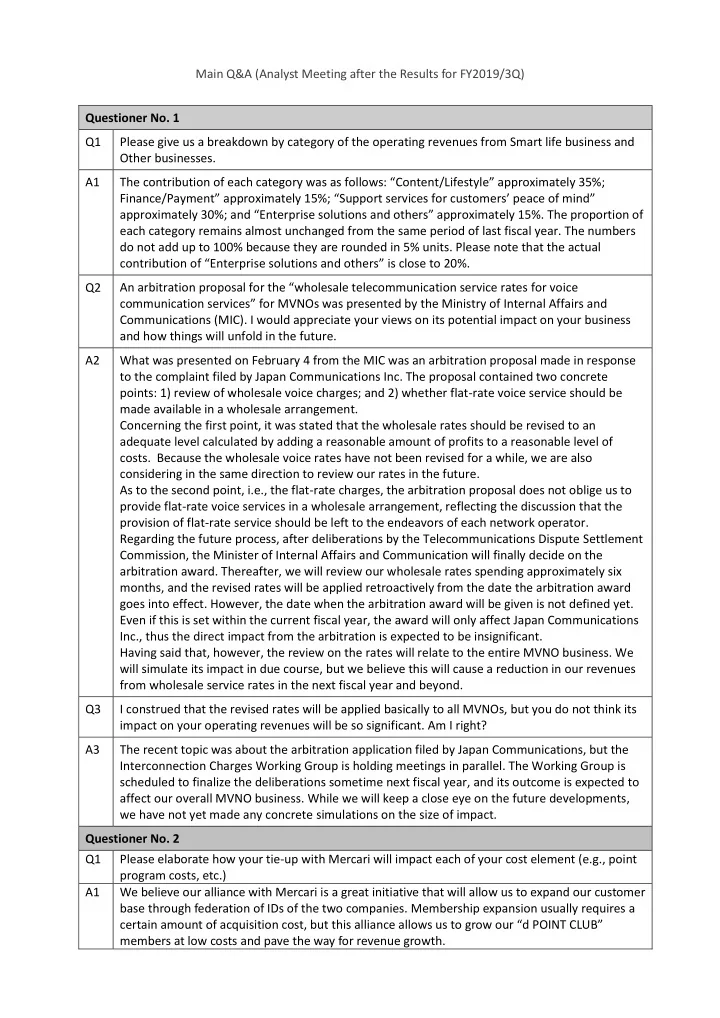
Main Q&A (Analyst Meeting after the Results for FY2019/3Q) - - PDF document

main q a analyst meeting after the results for fy2019 3q
SMART_READER_LITE
LIVE PREVIEW

Main Q&A (Analyst Meeting after the Results for FY2019/3Q) - - PDF document

Main Q&A (Analyst Meeting after the Results for FY2019/3Q) Questioner No. 1 Q1 Please give us a breakdown by category of the operating revenues from Smart life business and Other businesses. A1 The contribution of each category was as


slide-1
SLIDE 1

Main Q&A (Analyst Meeting after the Results for FY2019/3Q) Questioner No. 1 Q1 Please give us a breakdown by category of the operating revenues from Smart life business and Other businesses. A1 The contribution of each category was as follows: “Content/Lifestyle” approximately 35%; Finance/Payment” approximately 15%; “Support services for customers’ peace of mind” approximately 30%; and “Enterprise solutions and others” approximately 15%. The proportion of each category remains almost unchanged from the same period of last fiscal year. The numbers do not add up to 100% because they are rounded in 5% units. Please note that the actual contribution of “Enterprise solutions and others” is close to 20%. Q2 An arbitration proposal for the “wholesale telecommunication service rates for voice communication services” for MVNOs was presented by the Ministry of Internal Affairs and Communications (MIC). I would appreciate your views on its potential impact on your business and how things will unfold in the future. A2 What was presented on February 4 from the MIC was an arbitration proposal made in response to the complaint filed by Japan Communications Inc. The proposal contained two concrete points: 1) review of wholesale voice charges; and 2) whether flat-rate voice service should be made available in a wholesale arrangement. Concerning the first point, it was stated that the wholesale rates should be revised to an adequate level calculated by adding a reasonable amount of profits to a reasonable level of

  • costs. Because the wholesale voice rates have not been revised for a while, we are also

considering in the same direction to review our rates in the future. As to the second point, i.e., the flat-rate charges, the arbitration proposal does not oblige us to provide flat-rate voice services in a wholesale arrangement, reflecting the discussion that the provision of flat-rate service should be left to the endeavors of each network operator. Regarding the future process, after deliberations by the Telecommunications Dispute Settlement Commission, the Minister of Internal Affairs and Communication will finally decide on the arbitration award. Thereafter, we will review our wholesale rates spending approximately six months, and the revised rates will be applied retroactively from the date the arbitration award goes into effect. However, the date when the arbitration award will be given is not defined yet. Even if this is set within the current fiscal year, the award will only affect Japan Communications Inc., thus the direct impact from the arbitration is expected to be insignificant. Having said that, however, the review on the rates will relate to the entire MVNO business. We will simulate its impact in due course, but we believe this will cause a reduction in our revenues from wholesale service rates in the next fiscal year and beyond. Q3 I construed that the revised rates will be applied basically to all MVNOs, but you do not think its impact on your operating revenues will be so significant. Am I right? A3 The recent topic was about the arbitration application filed by Japan Communications, but the Interconnection Charges Working Group is holding meetings in parallel. The Working Group is scheduled to finalize the deliberations sometime next fiscal year, and its outcome is expected to affect our overall MVNO business. While we will keep a close eye on the future developments, we have not yet made any concrete simulations on the size of impact. Questioner No. 2 Q1 Please elaborate how your tie-up with Mercari will impact each of your cost element (e.g., point program costs, etc.) A1 We believe our alliance with Mercari is a great initiative that will allow us to expand our customer base through federation of IDs of the two companies. Membership expansion usually requires a certain amount of acquisition cost, but this alliance allows us to grow our “d POINT CLUB” members at low costs and pave the way for revenue growth.

slide-2
SLIDE 2

We are also planning to jointly cultivate merchants and allow mutual use of “d Payment” and “Merpay” to save on the cost for merchant acquisition. While we may need to spend some expenses for campaigns and other promotions at the outset, we believe the profits from this project will expand over the medium term. Q2 During the results presentation, you explained that your telecommunications services revenues for both the three months and the nine months ended December 31 fared higher than your expectations, but the upsides are projected to become gradually smaller toward the end of the fiscal year. Please explain which expense items are expected to increase, and by how much, in the

  • future. I assume that your telecommunications services revenues will show an increase higher

than your projections in the next fiscal year, which will allow you to generate a certain level of profits in the natural course of business. Please let us know if you have any plans to further increase your outlays for any particular item, including the point program for which you have already increased your spending this year. A2 For the current fiscal year, on the revenues side, the negative impact from the new rate plans is expected to expand further in the fourth quarter. On the expenses side, we expect to incur a certain amount of expenses in relation to the point program and the handset discounts aimed at facilitating users’ migration to smartphones. We intend to use expenses in a way that will lead to lowering the financial burdens and expanding our revenues in the future, e.g., bringing forward the write-off of certain assets, etc., to the extent we are able to achieve our full-year operating profit target of 830 billion yen. As we mentioned during the recent results presentation, the operating profit for this fiscal year is likely to make a landing close to the consensus figure. We are not so optimistic about the performance for next fiscal year, because we anticipate a decrease of several tens of billions of yen in mobile communications services revenues. We will strive to make up for this decline through cost efficiency improvement and growth of profit from Smart life business, thereby delivering a year-on-year increase in the overall operating profit. Q3 When you unveiled your initial plans for this fiscal year, you provided us with an explanation about the negative revenue impact from the new rate plans, including the positive effects from the reduction of Monthly Support discounts. Can you give a similar breakdown concerning the projected revenue decrease of several tens of billions of yen for the next fiscal year? A3 The revenue decrease projected for the next fiscal year will be caused primarily by the new rate

  • plans. The net revenue impact after taking into consideration the positive effects from the

reduction of Monthly Support discounts is estimated to be several tens of billions of yen, and we will endeavor to recover this by promoting subscriber migration to smartphones and upselling. However, we have been struggling a little bit in our upsell activities and the number of subscriber acquisitions fell short of our plan in the period after October, when the competition driven by cash rebates quieted down following the implementation of the new regulation. The number of subscribers we acquire in the months of February and March will impact our revenue growth in the next fiscal year, but there are some elements of concern in our ARPU and subscriber acquisition performance. Q4 By calculation, I believe the positive impact from the reduced Monthly Support discounts will amount to over 200 billion yen. Are there any changes to this estimate? A4 Although there are some customers who switch to a new rate plan without receiving all the Monthly Support discounts they are entitled to, the majority of customers use up the discounts that are spread over 24 months, which means the profit uplift from the Monthly Support factor kicks in almost without any deviation from our calculation. As for the concrete amount, the negative revenue impact from the new rate plans is estimated to be two-hundred and several tens of billion yen, while the sum of the positive impact from the reduced Monthly Support discount and the negative impact from the docomo with program is estimated to be approximately two hundred and several tens of billion yen. The variance between the two, i.e., several tens of billions of yen, is the estimated net negative impact on our revenues. Questioner No. 3

slide-3
SLIDE 3

Q1 When I look at the key factors behind the changes in your cumulative operating profit for the first three quarters of FY2019, mobile communications services revenues recorded a year-on-year decrease of 68.8 billion yen. On the other hand, during the results presentation to analysts, you mentioned that the negative revenue impact from the new rate plans was approximately 90 billion yen. Therefore, the variance between the two numbers of 20+ billion yen represents a revenue increase. You explained the factors that contributed to this increase included upsells within both the old rate plans and the new rate plans, and the favorable performance of voice

  • revenues. Please give us the proportion of contribution of each factor to the incremental

revenues of 20+ billion yen. A1 We explained earlier that the net impact calculated by offsetting the positive impact from the termination of Monthly Support program from the negative impact caused by “Gigaho” and “Gigalight” plans was slightly less than 100 billion yen, or approximately 90 billion yen. The gap between this number and the drop of mobile communications services revenues basically represents the impact of upsells and subscriber migration to smartphones. We had initially expected a greater revenue contribution from the improvement of churns, but this effect will probably manifest itself further down the road. Q2 When you compare the contribution of upsells from the old plan to the new plan versus the upsells within the old rate plan, which is making a greater contribution to the incremental revenues? A2 Only the upsells to the new rate plans are accounted for. Q3 You mentioned that your voice revenues have been trending favorably. Does it mean you achieved an increase in voice ARPU? Or did you record an increase in overall voice revenues? A3 Both are growing. Because the new “Gigaho” and “Gigalight” packages do not accompany the unlimited voice calling service of “Kake-hodai,” the percentage of users who do not sign up for the “Kake-hodai” or “Kake-hodai Light” plans are increasing. The voice calls placed by these users are providing us with solid voice revenues. This might have been affected by the frequent

  • ccurrence of typhoons and other disasters last year, and the absolute amount of such revenues

is insignificant, but the trend remains strong. Q4 Does the ARPU before applying discounts show a different trend? A4 Incremental revenues like this are recorded in the ARPU before discounts. Q5 Does that mean you are achieving a revenue growth in the ARPU before discounts as well? A5 It has been higher than our expectations. But when we single out the voice portion, it has been recording a year-on-year decline, so we are not achieving an increase in revenues. Q6 Regarding your cost of equipment sold for the three-month period of FY2019/3Q, the sum of handset subsidies deducted from the equipment sales revenues and commissions payable to agent resellers has not decreased so much compared to the same period of last fiscal year. Is this mainly attributable to the increase in expenses required for the migration of 3G users to 4G? A6 We significantly reduced the amount appropriated for “Direct Wari” discounts over the same period of last fiscal year, but the commencement of “Sumaho Okaeshi” trade-in program has had a negative impact on the profitability of handset sales business. The accounting treatment of inventory in the distribution channel also had a slight impact. Q7 How many 3G subscribers migrated to 4G in FY2019/3Q? A7 We migrated approximately 1 million subscribers in FY2019/1H and our target for FY2019/2H is 1.2 million. The number of contract changes from FOMA (3G) to Xi (4G), which also includes non- handset subscriptions, was approximately 1.4 million for FY2019/1H. The number per quarter is therefore roughly 700,000. Questioner No. 4 Q1 I expect you will have launched the 5G commercial service by the time you announce your FY2019 full-year results. Can you share with us what kind of discussions are made internally with respect to the pricing strategy of your 5G service? A1 The prices are currently under review and we will finalize the details toward its announcement. The procurement costs of the handsets are not yet decided, either. Although the prices are not

slide-4
SLIDE 4

yet fixed, whenever a new system is rolled out, we assume the first-generation handset models are relatively expensive. We will determine the prices and the sales method from now onwards. Q2 Previously, you mentioned that you will approach the MIC to request a lift on the 20,000-yen handset subsidy ceiling for the 5G handsets. What is the likelihood of this becoming reality? A2 Under the circumstances, it appears difficult to obtain a special exemption for 5G handsets, but we intend to continue our dialogue with the MIC. Q3 I believe Rakuten will shortly announce their rate plans. Can you comment on your current level

  • f readiness to counter Rakuten’s market entry? Please give us your assessment from the

viewpoints of your rates, point strategy and network, etc. A3 We will design our 5G rates after observing Rakuten’s market entry. Rakuten has not made any announcements pertaining to its 5G coverage, and we have an advantage over Rakuten in the breadth of area coverage when compared by the 4G LTE network. We therefore expect that Rakuten will try to compete on prices, but for now, we have no intention to set our rates on par with Rakuten’s. Adhering to this basic policy, we will make the necessary preparations keeping an eye on Rakuten’s rates. Questioner No. 5 Q1 You mentioned that the “Sumaho Okaeshi Program” has negatively affected your handset sales

  • profitability. Can you give us more details pertaining to the accounting treatment of this trade-in

program and its future outlook? A1 For “Sumaho Okaeshi Program,” we carry out an accounting treatment in which we estimate the decrease in revenues caused by the waiver of handset installment payments of up to 12 months and the projected recovery of costs from the resale of handsets to be traded in. While we do not disclose the concrete amount, the estimated waiver of handset installments are deducted from equipment sales revenues, and the projected recovery of costs from the trade-in handsets are subtracted from the cost of equipment sold. The differential between these two numbers is not as sizable as tens of billions of yen. We will study whether we can disclose more details at the time of our FY2019 full-year results announcement or other occasions during the next fiscal year. Q2 Was the revenue impact from the “Sumaho Okaeshi Program” beyond your expectations? A2 No, it was not beyond our assumptions. We have factored its impact in our plans from the beginning, and the actual impact was nearly in line with our projections. Q3 Regarding your business alliance with Mercari, it seems that the grouping of mobile operators and internet companies in the payment business landscape has been established. How do you plan to differentiate yourselves from the three competitors including Rakuten in terms of your strategy and other aspects? A3 We assume that not only DOCOMO but also Z Holdings and Rakuten are aiming to expand their

  • wn membership base. Rakuten has been expanding their membership base and transaction

volume primarily through its credit card business. Z Holdings will have a very large membership base when the IDs of Yahoo and LINE are added. We are aware that the integration process will start only in or after October next year due to the review by the Fair Trade Commission and other factors, but we are sure they will steadily move forward with the preparations. We, on the other hand, have an ambition to grow our “d POINT CLUB” members to over 100 million from currently approximately 73.5 million. We recognize that Rakuten is ahead and a quite formidable competitor in the credit card business, but our “d CARD” member count and transactions are also growing at a steady pace and we will continue our endeavors to catch up with their scale. In the QR code payment business, various surveys indicate that PayPay is by far the market leader in terms of the number of merchants and monthly active users. “d Payment” is in the second tier. Although PayPay has a lead, we plan to further increase the number of users and transactions while properly controlling the acquisition of merchants and execution of campaigns. We are aware of the strengths of the competition. Although we are not the No.1 player in these services, we still hold a very good position. We believe we can compete favorably against these players by steadily and speedily expanding the ecosystem of our members and partners. Q4 I noticed that there are slight differences in the approach taken by each player, but as far as DOCOMO is concerned, in broad terms, I construed that you are pursuing a strategy to prioritize

slide-5
SLIDE 5

the upsells to your existing mobile phone subscribers, and at the same time open up your ecosystem to keep abreast of the competition. Is my understanding correct? A4 There are many ways to look at it, but we, like Rakuten, are also earnestly working on the expansion of our “d POINT” program. We believe this program gives us a strong advantage, as this serves as a driver for providing points to users through campaigns or discounts in coordination with the mobile phone business. Questioner No. 6 Q1 I would like to ask about your strategy for non-telecommunications business. You have a loose alliance with players like Mercari, but Z Holdings and SoftBank have made investments committing on a capital relationship. Are you proactively looking into the option to adopt a strategy of acquiring major companies investing hundreds of billions of yen? A1 If you are asking whether we are actively exploring such opportunities, the answer is yes. We are actively performing studies. However, to avoid any misunderstanding, we have not had any discussion on a capital alliance with Mercari. Q2 If there is an opportunity, would you execute an acquisition even if it requires several hundreds

  • f billions of yen to acquire the target?

A2 Yes, we will. Q3 I would also like to ask about your point strategy as a telecommunications operator. The expenses incurred in relation to the PayPay business under the SoftBank group is consolidated in a black box and we cannot see how the expenses of the payment business are affecting their core

  • business. When I look at KDDI’s quarterly point issuance, I have an impression that they issue a

large amount of points in periods when they enjoy healthy profit generation to consume the

  • budget. If you are projecting a decline in mobile communications services revenues in the order
  • f tens of billions of yen for the next fiscal year, your cost environment will become severer and

your point issuance will likely come down. This makes your service less attractive from the viewpoint of users, which may result in reduced usage. This does not appear to be a sustainable model for business. Are you willing to spend costs as adequate even when your profits are on a downtrend, or will you stop allocating costs when you do not have leeway in profit generation? Please elaborate on your future plans. A3 In our structure, the majority of points are issued under our telecommunications business and costs are likewise borne by the telecommunications business, but a big portion of the actual point usage happens under the Smart life business. Although we execute campaigns from time to time, our point issuance is basically maintained stable. We issue points taking into consideration the level of profit generation to some extent, but we generally make a decision with a medium- term perspective without being affected so much by short-term trends. For the current fiscal year, we have rolled out campaigns not only because of the favorable pace of profit generation, but also because we believe this is an important moment in light of the Government’s cashless payment promotion campaign and the offerings of other companies. This make-or-break situation may continue into the next fiscal year. Accordingly, although I mentioned that we will aim to make up for the projected decrease in mobile communications services revenues with the contributions from Smart life business and cost efficiency improvement, we might as well take a somewhat bold step if we judge the payment business is at a critical moment that will determine its fate. Questioner No. 7 Q1 You aim to expand your customer base leveraging the alliance with Mercari. Of the total 14.5 million monthly users of Mercari and the 6 million users of Merpay, have you identified the number of users who do not overlap with your own customers? Can you also give us a quantitative assessment of the collaboration undertakings with Mercari that you have been promoting at docomo Shops? A1 Roughly speaking, the percentage of the overlapping users are almost identical to the market share distribution of the three mobile carriers. Mercari’s services are broadly used regardless of the mobile carrier customers have a contract with. A trial service in which we furnish packaging for the merchandise that changed hands through Mercari and deliver them on behalf of customers is currently in progress at three docomo Shops, and we plan to make this service

slide-6
SLIDE 6

available at greater number of stores in the future. The service is well accepted by the customers, but we would like to reserve any further comments regarding its quantitative assessment because the service is still in a trial phase. Q2 You mentioned that the number of upsells within the new rate plans has been trending lower than your expectations. Which particular segment(s) are underperforming? And how do you plan to turn around this situation? A2 For the upsells within the new rate plans, it is important to increase the adoption of “Gigaho” and increase the usage to over 3GB in the case of “Gigalight.” From the revenue perspective, it is especially important to boost customers’ usage to over 3GB, but the actual usage has been faring approximately 1-2% lower than our expectations. This is not because we failed to acquire new high-ARPU users, but because the vast majority of the new users are migrators from existing plans, and the plans selected by these users as well as their actual usage post migration turned

  • ut lower compared to our initial assumptions. This is merely the performance compared to our

target, and the target might have been stretched in the first place. The various campaigns that we rolled out in December, such as “Gigaho Zouryou Campaign,” “Amazon Prime Comes with DOCOMO‘s plans” and “Disney DELUXE Set Wari,” are beginning to produce tangible results. On the contrary, the “Gigaho Zouryou Campaign” also causes a negative revenue impact resulting from the reduction in the number of users of the 1GB data top-up service, so we would like to give more thought on the most effective measure(s) to improve our overall profitability. Q3 Of the various campaigns you launched, which is producing the largest effect? A3 It is difficult to pinpoint the most effective measure because the “Gigaho Zouryou Campaign” is applied automatically without requiring users to make an application for the service, and also because the execution periods of various campaigns are overlapping with each other. However, in terms of volume, “Amazon Prime Comes with DOCOMO’s Plans” has a greater impact than “Disney DELUXE Set Discount”. Questioner No. 8 Q1 This is a question about the cost effectiveness of your “d POINT” program. You issue a huge amount of points, but it seems that other partners are taking advantage of you. You continue to award points to Lawson despite their decision to form an alliance with KDDI. How much return do you seek from the point program? Do you have a strict formula or assumptions in place? Has the amount of returns increased over time? A1 We do have certain assumptions and we are executing programs taking into consideration the profitability and effects of each measure. The vast majority of points are issued under our telecommunications business. We issue these points with the aim of acquiring customers through improved customer satisfaction, so we basically believe we are recovering the returns within the telecommunications business. Because many customers use the points they earned at stores that support “d Payment,” the merchants can benefit from the visits by customers to whom we collectively issue over 180 billion points per annum. For this benefit, many retailers have chosen to become our merchant, despite having to pay commissions to us as we do not provide a waiver on payment commissions like our competitors. The retailers also appreciate that

  • ur customers feature high rate of repeated and continuous use of service. For your information,

in our accounting treatment, the points provided to customers based on the use of telecommunication services are deducted from our mobile communications services revenues. On the other hand, the points issued as part of other campaigns are recorded as expenses as

  • pposed to revenue deduction, and the vast majority of such points are classified as expenses of

Smart life business. The cost effectiveness is measured by the expansion of revenues generated by “d Payment,” etc. Despite the increase in the point-related expenditures in the second half of this year, we are not incurring huge amount of losses in the order of tens of billions of yen like

  • ther companies because we charge commission fees to the merchants. Going forward, we

intend to recover the costs in the overall finance/payment business including “d CARD.” Q2 Is it correct to understand that 180 billion points represent your ordinary level of point issuance per year, and it does not include the points issued for campaigns?

slide-7
SLIDE 7

A2 180 billion points represent the total amount of points issued in one year, including the points issued as a limited-time offer. Previously, the points issued for campaigns accounted for roughly 30% of the total points issued, but its proportion has recently risen to approximately 40%. Q3 Do you expect the percentage of campaign points will increase over the long term? A3 We cannot comment on the long-term trend, but for the near term, we expect to see a gradual increase of points issued for campaigns because the period between the second half of FY2019 and first half of FY2020 is deemed to be an important period that will determine the fate of our payment business. We have also seen an increase in the amount of points issued by the merchants, for which merchants are purchasing the points from us. While we cannot comment

  • n the details because in some cases we provide volume discounts, the merchants purchase the

points at a rate higher than 1 yen per point, which implies that we can expect to earn gross margin as the amount of points issued by merchants grows in the future. Please note that the points issued by the merchants are also included in the annual issuance of 180 billion points. Q4 Let me ask about your thoughts on ARPU. Given that you are projecting a decrease in revenues of some tens of billions of yen in the next fiscal year, I believe you are anticipating a reversal in the trend of ARPU before discounts. When do you think that will happen? In addition, I assume that you provided a price reduction in the range between slightly above 10% and 15% with the introduction of the new rate plans, but do you think you can get away with the price-cut you provided this time around when you take into consideration the LDP President election scheduled for 2021? Don’t you foresee the need of starting to make preparation in 2020 for another round of price reduction in the future? What kind of strategy do you think you can take? A4 I think it will be difficult to achieve a turnaround in ARPU before discounts during the next fiscal

  • year. We might be able to reverse the downtrend of ARPU after applying Monthly Support and
  • ther discounts at some point next fiscal year, but this is just my intuitive comment without the

backing of any numerical evidence. Q5 Can we expect the turnaround of ARPU before discounts to happen in around FY2021? A5 To reverse the downtrend in the ARPU before discounts, we need to more than offset the negative impact from “Gigaho” and “Gigalight” rate plans by boosting our revenues through subscriber migration and upsells, but it will be difficult to achieve this even in FY2021. But one of the positive aspects that we can have expectations for is the incremental revenues brought about by the new 5G rate plans. The rates will eventually come down as a result of competition, but we expect a certain degree of uplift in the initial phase. While this will be determined by the state of competition, if the 5G rates are set at relatively higher levels across the industry, we can have expectations for 5G because it will generate more traffic. There are uncertainties, on the other hand, such as Rakuten’s market entry and the arbitration proposal for the wholesale voice rates for MVNOs. There might be some factors that are unpredictable upon the development of our initial plans for FY2020 but could dilute our revenues. Questioner No.9 Q1 Regarding your capital expenditures for 5G, you expressed your willingness to fully take advantage of the 5G tax incentives proposed by the government if the scheme is introduced. I know that the details are yet to be announced, but what is your position on this matter? If you utilize the tax incentives, do you think your annual capex—which you previously mentioned will not likely increase significantly—will start to climb again? Do you intend to capture the tax benefits for 5G investments without changing your annual CAPEX by suppressing other spend, such as 4G-related investments and maintenance costs? A1 As you pointed out, the details are not made public yet. We intend to take full advantage of the tax incentive scheme if it is made available. However, we expect the incentives will be contingent upon various conditions and the actual benefit will be smaller than our initial expectations. With respect to our overall construction plan, we declared to roll out 10,000 5G base stations within FY2021, which represents a pace significantly faster than what we committed with the base station deployment plan submitted to the MIC. Even in the event we decide to accelerate the roll-out of 5G, we do not intend to significantly change our 5G investment plan of a cumulative 1 trillion yen for the first five years. With request to our CAPEX for FY2020 and beyond, as a result

  • f our hearings on our regional offices and branches, we learned that there is a request for 4G
slide-8
SLIDE 8

coverage expansion in addition to the build-out of 5G. If we executed everything to accommodate all these requests, our annual CAPEX will end up much higher than the 570 billion yen mark. We will control our CAPEX so that the total amount will not exceed 570 billion yen per annum, striking a proper balance between 4G and 5G investments. Q2 Am I right to conclude that you do not have any plans to increase your 5G investments significantly? A2 There might be a slight increase, but we do not foresee a significant change. Q3 Regarding your “d POINT” program, what is the percentage of points issued by other companies

  • ut of the total 180 billion points issued?

A3 Currently, less than 10%. Q4 Is the proportion of points issued by other companies rising at a fast pace? A4 Yes, it is increasing at a remarkable pace. The “d POINTs” issued by other companies can be awarded to users without any cost burden on us, so we would like to increase its proportion further in the future. Questioner No. 10 Q1 You touched upon your status of studies on M&A. If you want to procure the funds required for such acquisitions from outside, you have a number of options such as debt or liquidation of installments receivables, or you can also use your free cash flow. When this is all taken into consideration, do you still position shareholder returns, including dividends and share repurchase, an important issue on your corporate agenda? A1 The execution of the liquidation of receivables is currently under study, and we plan to liquidate some 50 billion yen worth of receivables around the end of March as a trial. If this goes successfully, we will consider implementing a larger scale program in FY2020 or beyond. The proceeds from the liquidation will be used for growth investments and share repurchases. In my capacity as a person in charge of the Company’s financials, I believe using the proceeds to finance share repurchase is a very sound way of using money, because growth investments always accompany uncertainties about their success. Because we are virtually net debt-free, our balance sheet carries some 1,400 billion yen worth of zero-interest installment receivables and credit card receivables that are financed at a capital cost of 5-6%, which implies a huge negative spread. The most visible and easy-to-understand effect of the liquidation of receivables is the elimination of this negative spread. Growth investments can be financed by our free cash flows to some extent, and if necessary, we can raise debts at an interest rate close to 0%, which will likely be lower in costs compared to receivables liquidation. For shareholder returns, we are currently executing a 300-billion yen share repurchase program through market purchase. Historically, we repurchased shares using tender offer and market purchase at a ratio of 2:1, carrying out market purchase after a tender offer. When we repurchased shares worth approximately 600 billion yen through tender offer in FY2018, the program did not produce so much impact to buoy our share price because it was announced simultaneously with our 400 billion-yen customer return initiative. Given the liquidity of our shares in the market, the maximum amount we can practically purchase from the market is considered to be about 300 billion yen per annum. We thus believe the size of 600 billion yen for tender offer and 300 billion yen for market purchase would be the upper limit that we can

  • pursue. For the future, we will look into the execution of smaller size repurchases through market

purchase over a shorter cycle. Of the various performance indicators, such as revenues and expenses, free cash flow is delivering the best performance so far. The free cash flow projection for March 31, 2020 is expected to drop by approximately 100 billion yen compared to the level a year ago. However, we recorded a net positive cash flow in the third quarter despite having to make payments that are usually due in January because of the year-end holidays. We do not have any concerns about the funds to finance shareholder returns, because we can leverage the proceeds from the liquidation

  • f receivables and compression of handset inventories and other measures. We basically believe

growth investments should be financed by debt. Questioner No. 11

slide-9
SLIDE 9

Q1 What is the level of voice communication usage of your MVNO users? Please give us a comparative data on MOU, etc., between MVNO and DOCOMO users. Please also share with us the attributes of DOCOMO users who have signed up for flat-rate voice services. A1 Due to the availability of various voice communication applications that can be used over data connections, we understand that MVNO users are using our services primarily for data

  • communications. In fact, we have barely received requests for a reduction of wholesale voice

rates hitherto. The company that filed an arbitration request this time around seems to have a desire to offer flat-rate voice service to their customers, but the demand for voice communications in the overall MVNO market appears to be limited. We would like to reserve comments on the status of individual companies. Q2 What kind of users are using your flat-rate voice services? A2 In our former rate plan, “Kake-hodai and Pake-aeru,” flat-rate voice service was included as a standard offer, so a lot of beginner smartphone users signed up for the service based on the recommendations of docomo Shop staffs. Q3 Is the amount of capital expenditures allocated for each year decided at your own discretion and not by NTT? You mentioned earlier that you do not foresee a significant rise in your annual CAPEX even if you bring forward the investments to take advantage of the tax incentive program, but can you give us a concrete indication concerning the projected increase in percentage? A3 At present, we plan to make 5G-related capital investments in accordance with the roll-out plan that we submitted to the MIC, spending a cumulative 1 trillion yen over a five year period. Some 3,200 organizations have already participated in our 5G Open Partner Program, and the actual pace of roll-out will change depending on the coverage needs raised by these partners. It is therefore difficult to comment on the projected increase before observing these trends for another 1-2 years. We cannot tell how much our 5G CAPEX will increase at this point of time also because the equipment costs are getting less expensive compared to the time when we launched 3G and 4G systems, which will likely result in a reduction in the cost per base station. Questioner No. 12 Q1 Regarding your capital expenditures for telecommunications business, you mentioned that the areas where the 5G tax incentives can be applied could be limited. Can you share with us your views on the conditions that may be attached, such as what would be excluded from the scope of application? Also, will it be possible for you to flexibly change the allocation of investments after

  • btaining knowledge about where the incentives can be applied?

A1 According to the information that has been announced, the tax incentives will be awarded to the portion of construction that will be brought forward compared to the initial rollout plan filed with the MIC by each operator. We are not aware of any further details that are currently being

  • reviewed. Our policy remains unchanged, and we will respond flexibly and adjust our capital

expenditures. Q2 With respect to your full-year cost efficiency improvement target of 130 billion yen, a disproportionately large amount is allocated for the fourth quarter. Is this in line with your plan? Are you seeing faster- or slower-than-expected progress in any cost item? A2 Some 60% of the cost efficiency improvement planned for this fiscal year will be achieved through the reduction of commissions payable to agent resellers, i.e., the “Direct Wari” discounts

  • ffered to the purchasers of handsets. This item accounts for roughly 80% of the sale-related cost

efficiency improvement planned for this year, and we are making favorable progress in reducing

  • this. We spent a substantial amount for the “Direct Wari” discount program in the fourth quarter
  • f last fiscal year, so its suppression makes a large contribution to improving our cost efficiency

this year. Further, for the remaining amount of efficiency improvement, we expect to deliver the targets for the fourth quarter via sales-related cost efficiency improvement as planned.