Litchi Orchard Management at Calebasse in the North 22th June 2018 - - PowerPoint PPT Presentation

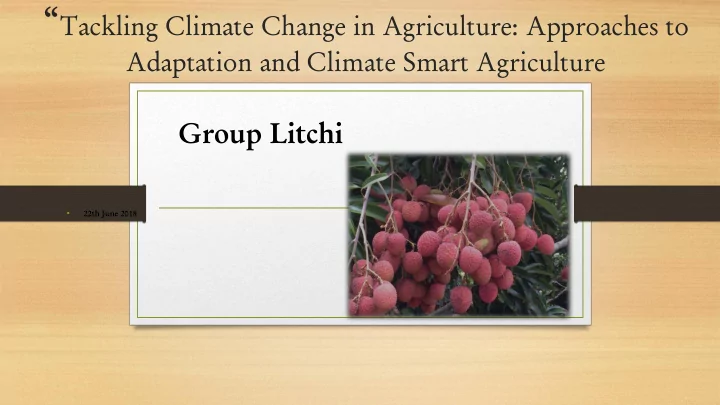
litchi orchard
SMART_READER_LITE
LIVE PREVIEW

Litchi Orchard Management at Calebasse in the North 22th June 2018 - - PowerPoint PPT Presentation

Tackling Climate Change in Agriculture: Approaches to Adaptation and Climate Smart Agriculture Group Litchi 22th June 2018 System of Interest Litchi Orchard Management at Calebasse in the North 22th June 2018 Sustainable


slide-1
SLIDE 1

“Tackling Climate Change in Agriculture: Approaches to

Adaptation and Climate Smart Agriculture

Group Litchi

  • 22th June 2018
slide-2
SLIDE 2

Litchi Orchard Management at Calebasse in the North

22th June 2018

System of Interest

slide-3
SLIDE 3

Sustainable Development Goal

  • To increase productivity and income over a

period of five years

slide-4
SLIDE 4

Litchi Production in Mauritius

  • Litchi first reported in Mauritius in 1763
  • Litchi introduced during the French colony (1715-1810) from

China

  • In 1929, during the British colony, varieties Sun Yat

Sen,Green, Rose scented and Kafri were brought from India

  • First litchi export to London in 1934 till 1939
  • Export of litchi gain economic importance as from 1969
  • From 1984 to 1990, 120 tonnes of litchi were exported

annually

  • After 1990 the export continued to rise
slide-5
SLIDE 5
  • Main variety - Tai So
  • 346 litchi orchards covering a total area of 423 ha
  • Fruit harvest season – early Nov. to early Jan.
  • Export market: 250 to 300 tonnes annually
  • Premium price for early season litchi
  • Shift from backyard to intensive system of production
  • ver last decade
  • Potential for regular bearing instead of every 2 yrs –

through timely pruning, fertilization and irrigation

  • 2017 ----- 70%
slide-6
SLIDE 6

Climate Hazards the System might be exposed to

  • Cyclone
  • Heavy rainfall
  • Drought / extended dry spells
  • High temperature
  • Erratic rainfall
slide-7
SLIDE 7

Adaptation Measures

POLICY

  • Soft loans
  • Freight rebate scheme (FRS)
  • MauriGap certification
  • Development of a supply chain for processed litchi products
  • Agricultural risk insurance
slide-8
SLIDE 8

How do policy measures answer our goal?

  • Policy measures will provide the necessary financial support (compensation and

incentives) to help growers of the cooperative to face extreme climatic events (e.g FRS)

  • MauriGap: Guarantee - Safe food and fetching premium litchi price i.e. higher grower

income

  • Processing - Added value of litchi products for higher income and extended product

availability to consumers

slide-9
SLIDE 9

Adaptation Measures

TECHNICAL

  • Technical information dissemination (media, publication, SMS disease

alert, Meteo, APMIS)

  • Pest and Disease Management
  • Timely fertilizer application
slide-10
SLIDE 10

How do technical measures answer our goal?

  • Early warning system will contribute to decision making
  • Proper cultural practices, including timely fertilization will ensure annual fruit

bearing and therefore contribute to sustained productivity

slide-11
SLIDE 11

Adaptation Measures

RESEARCH

  • Introduction of new varieties
  • Extend the shelf-life for export
  • Decrease post-harvest losses
slide-12
SLIDE 12

How do research measures answer our goal?

  • Introduction of early varieties to avoid the cyclonic season/heavy rainfall for a

resilient system

  • Tolerance of varieties to high temperature, pest & disease for a greater fruit

yield and revenue

  • Eco-friendly technology to extend the shelf-life of litchi products and extend

period for product marketing

slide-13
SLIDE 13

Adaptation Measures

CAPACITY BUILDING

  • Water management
  • Tree management
  • Agro-processing
  • Setting up of a model farm
  • Flower induction techniques
slide-14
SLIDE 14

How do capacity building measures answer

  • ur goal?
  • Empower growers to improve flowering, fruit set, and quality product
  • Improve water use and fertilizer efficiency
  • Create opportunity for value addition through processing
  • Increase grower awareness about new production practices and increase production

skills

slide-15
SLIDE 15

Mitigation Potential

  • Reduction in GHG through:
  • 1. The judicious use of fertilizers, and pesticides (IPM)
  • 2. Mulching,
  • 3. Increase in the carbon sink capacity (healthy canopy development),
slide-16
SLIDE 16

“Tackling Climate Change in Agriculture: Approaches to

Adaptation and Climate Smart Agriculture

Litchi Group

  • Keshav
  • Patricia
  • Satish
  • Yogeeta
  • Giantee
  • Rajiv

22th June 2018

Thank you for your attention!