RURAL DEVELOPMENT PLAN ! Ehlanzeni District Municipality ! ! ! - - PowerPoint PPT Presentation

rural development plan
SMART_READER_LITE
LIVE PREVIEW

RURAL DEVELOPMENT PLAN ! Ehlanzeni District Municipality ! ! ! - - PowerPoint PPT Presentation

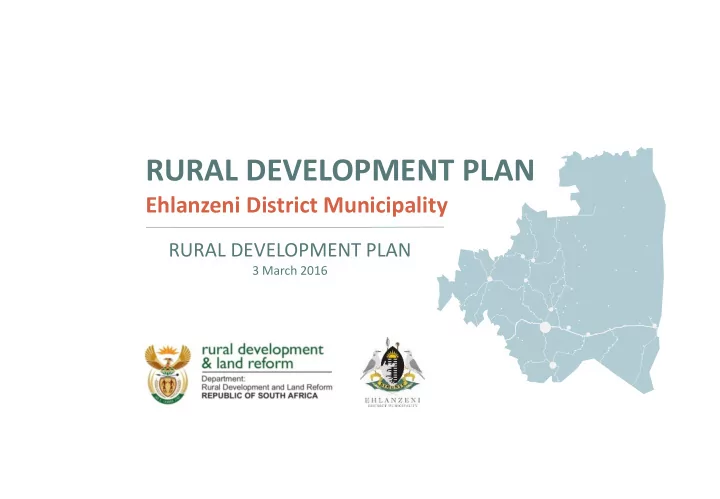
RURAL DEVELOPMENT PLAN ! Ehlanzeni District Municipality ! ! ! ! ! ! ! RURAL DEVELOPMENT PLAN ! ! ! ! ! ! ! ! ! ! ! ! ! 3 March 2016 ! ! ! ! ! ! ! ! ! ! ! ! ! ! ! ! ! ! ! ! ! ! ! ! ! ! ! ! ! ! !


slide-1
SLIDE 1 ! !

!

! ! !

! ! ! ! ! ! ! ! ! ! ! ! ! ! ! ! ! ! ! ! ! !

!

!

!

!

! ! ! ! ! ! ! ! ! ! ! ! !

!

! ! ! ! ! ! ! ! ! ! ! !

!

! ! ! ! ! ! !

!

! ! ! ! ! ! ! ! ! ! ! ! ! ! ! ! ! ! ! ! ! ! ! ! ! ! ! ! ! !

RURAL DEVELOPMENT PLAN

Ehlanzeni District Municipality

RURAL DEVELOPMENT PLAN

3 March 2016

slide-2
SLIDE 2

Vision & Development Objectives

slide-3
SLIDE 3

Vision

“To ensure sustainable livelihoods for those households residing in the rural areas of the Ehlanzeni District Municipality”.

  • This vision places people – rather than resources, facilities or organizations – as the focus of concern and action,

emphasizing that development must be participatory and improvements must be sustainable.

  • In this sense the term “livelihood” is seen as including:
  • capabilities, knowledge and skills;
  • assets and resources; and
  • activities and actions required for a means of living.
  • A “sustainable livelihood”:
  • can cope with and recover from stress and shocks,
  • maintain and enhance its capabilities and assets,
  • and provide sustainable livelihood opportunities for the next generation;
  • and which contributes net benefits to other livelihoods in the short and long term.
  • In line with this vision, efforts should focus on empowering the poor to build their own opportunities.
slide-4
SLIDE 4

Development objectives

Improve foods security and household income

  • Implement measures to ensure households migrate from subsistence agriculture to that of a commercial kind.
  • Improvement in ecological situation
  • Develop sustainable food quality
  • Improve Households income

Develop rural business and community organizations

  • Harnass the power of BIG Business to incubate business acumen as part of the agri-park concept
  • Develop a number of business in each local municipality every year
  • Assist increasing self-sustaining small business up to 5 members per entity
  • Attract youths and agricultural graduates to setup rural business
  • Develop operational and self-sustaining cooperatives
  • Expand business through incubating at least 20 new ventures per annum

Provide flexible training and education

  • Public /Private partnerships to provide training in the agricultural and toursim sectors
  • Advance small business through regular mentoring
  • Do rural community business developmental via monthly workshops
  • Create entrepreneurial skills development by group practical exercises every month.

Provide cost effective infrastructure without sacrificing quality of services

  • Prioirtise spending on capital projects that will enable some of the projects in this plan
  • Assist in providing rural infrastructure in every local municipality
  • Create cost-effective and excellent working environment
  • Deliver quality construction at local cost within budget limits

Economic sector development to create jobs for especially youths, women and people with disabilities.

  • Create temporal and permanent jobs for artisan workers
  • To empower youths to appreciate and implement agricultural related projects
slide-5
SLIDE 5

Functional areas

slide-6
SLIDE 6

Functional areas

The Department of Rural Development and Land Reform - Guidelines for the Development of Rural Development Plans: The RDP should be focused on homogeneous functional areas identified according to factors such as unique environmental and climatic conditions, land ownership profile (communal land areas), and rural areas of high population concentration or unique settlement functions and spatial distribution”. Furthermore, the RDP is seen as a “regional spatial development framework”, and therefore the plan is not compiled for the entire district municipality, but rather for certain regions in the district..

slide-7
SLIDE 7

Functional areas

  • 1. Pockets of poverty.
  • 2. Topography.
  • 3. Protected areas
  • 4. Key economic drivers
slide-8
SLIDE 8

Functional areas

 Funct ctional al area 1 comprises of most of the Bushbuckridge Municipal Area with local nodes located in Bushbuckridge (Dwarsloop area), Acornhoek, Mkhuhlu and Thulamahase. The bulk

  • f the population reside in areas under the management of

traditional atuhorities. The bulk of the municipal area is located on land with a medium to high suitability for agriculture, although limited commercial agriculture can be found in the area. Some subsistence agriculture can be found in and around commonage

  • areas. The area is bordered on the eastern side by the Kruger

National Park Opportunities in this functional area include:

  • The proposed agri-hub located in Mkhuhlu
  • The proposed tourism node around Injaka dam
  • Activities related to the tourism value chain – but with
  • pportunities outside the functional area (e.g. people from the

functional area working in lodges located in the Kruger National Park or even closes such as Mala Mala Game Reserve

  • Forestry activities are located on the western side of the

functional area. Opportunities linked to the forestry sector include:

slide-9
SLIDE 9

Functional areas

 Funct ctional al area 2 is located on the eastern side of Mbombela Local Municipality and includes the municipal node Hazyview and local nodes Swalala, Kabokweni, and Kanyamazane. The major opportunity in this area comes from the commercial agriculture (specifically fruit and citrus grown around the Hazyview area. This area should also be linked with the agri-park concept and specifically the agri-hub located in Mkhuhlu. The area also exhibits medium to high potential for agriculture.  Funct ctional al area 3 is located in the Nkomazi Municipal area. The economy

  • f the area is mostly driven by the sugarcane industry with TSB Sugar RSA

Limited a dominant player in this area. Nodes located on the N4 Maputo corridor include Malelane (the administrative node in the area) and Komatipoort – the gateway to Mozambique. Local nodes in the area include the Buffelspruit/Schoemandsal area, Kwazibukwane as well as the Madadeni area. Opportunities in this functional area include the following:

  • Domestic forest use opportunities.
  • Tourism opportunities located around Sibayeni
  • Agriculture value chain opportunities linked to the sugar cane

industry, and

  • Agricltural opportunities linked to growing vegetables in the

Madadeni area.

  • Opportunities linked to the SEZ in Komatipoort
slide-10
SLIDE 10

Functional areas

  • Fun

Functional ar area ea 4 4 is located within the Thaba Chweu Municipal Area. The biggest “rural poor community” within this area is Leroro. Opportunities exist in and around the Lydenburg area for limited agriculture as well as fish production (linking to the Dullstroom area as well as other fly fishing areas). In addition the Sabie, Graskop, Pelgrimsrest area is known for it tourism – although this has declined significantly in the past couple of years.

  • Fun

Functional ar area ea 5 5 is located in the Baberton area.

Functional Areas Rural, poor communities

! ( ! ( ! ( ! ( ! ( ! ( ! ( ! ( ! ( ! ( ! ( ! ( ! ( ! ( ! ( ! ( ! ( ! ( ! ( ! ( ! ( ! ( ! ( ! ( ! ( ! ( ! ( ! ( ! ( ! ( ! ( ! ( ! ( ! ( ! ( ! ( ! ( ! ( ! ( ! ( ! ( ! ( ! ( ! ( ! ( ! ( ! ( ! ( ! ( ! ( ! ( ! ( ! ( ! ( ! ( ! ( ! ( ! ( ! ( ! ( ! ( ! ( ! ( ! ( ! ( ! ( ! ( ! ( ! ( ! ( ! ( ! ( ! ( ! ( ! ( ! ( ! ( ! ( ! ( ! ( ! ( ! ( ! ( ! ( ! ( ! ( ! ( ! ( ! ( ! ( ! ( ! ( ! ( ! ( ! ( ! ( ! (

Functional area 3 Functional area 4 Functional area 1 Functional area 2 Functional Area 5

Rolle Avoca Numbi Asbes Sabie Afsaal Nkuhlu Ireagh Gqweta Marite Impala Lomati Eureka Karino Broham Skukuza Mkhuhlu Tonetti Reserve Jambila Schagen Alkmaar Mayfern Matsulu Luphisa Ngodini Gutshwa Plaston Voetpad Afgrond Vermont Mac-Mac Brondal Matshaye Tenbosch Sibayeni Boulders Malelane Legogote eMahusha Marathon Montrose Barretts Ngodwana Hazyview Vaalhoek Timbavati Tshokwane Acornhoek Magnesite Barberton Noordkaap Gatehouse Yaverland Nelspruit Kiepersol Malieveld Sibthorpe Rosehaugh Klipsteen Lydenburg Musandzeni Cottondale Numbi Gate Elandshoek Kaapsehoop Brooklands Rietvallei Schalksrus Rooiuitsig Mauchsberg Klipspruit Krugerspos Nhlanguleni Komatipoort Weltevreden KaNyamazane White River Hendriksdal Buffelsvlei Hectorspruit Louw's Creek Maartenshoop Bushbuckridge One Tree Hill Krokodilpoort Pilgrims Rest Revolver Creek
slide-11
SLIDE 11

Rural Development Plan

slide-12
SLIDE 12

The Concept

The Agri-park concept.

The Department of Rural Development and Land Reform has been allocated R6bn over the next three years for Agri_park projects across South Africa and will draw in financial contributions from other departments and the private sector. The plan dovetails with the Department of Trade and Industry’s focus on agro-processing to create jobs and boost exports, with some of the planned agri-parks linked with the department’s special economic zones. Although the Agri-Park consept has been launched recently, it has major implications on the development of the Rural Development Plan, especially linked to the vision and development objectives of the

  • plan. Some of the key definitions of the agri-park concept is highlighted below.

Agrip Agripark rk (AP AP) The agripark is a system innovation of agro-production, processing, logistics, marketing and training and extension services located in District Municipalities. As a network it enables a market-driven combination and integration of various agricultural activities and rural transformation services. Rur Rural Urb rban Mark rketi ting Ce Centr tre (RU RUMC) RUMCs are located on the periphery of large urban areas, these facilities provide market intelligence assist farmers, processors in managing a nexus of contracts. With large warehousing and cold storage facilities to enable market management. Both FPSU’s and Agri-hubs provide inputs to the RUMC. Agriparks share RUMCs. A RUMC should have a reach of between 150km - 250km.

slide-13
SLIDE 13

Ag Agri ri-Hubs (AH AH) Agri-hubs are located in central places in a District Municipality, preferably places both sufficient, physical and social infrastructure to accommodate; storage/warehousing facilities; agri-processing facilities; packaging facilities; logistics hubs; agricultural technology demonstration parks; accommodation for extension support training; housing and recreational facilities for labourers. Agri-hubs receive primary inputs form FPSU’s for processing, value adding and packaging which is through-put into the Rural Urban Market Centres or exported directly to markets. Mkhuhlu has been earmarked as the Agrihub (or at least one of them) for the Ehlanzeni Agri-park. Location parameters:  centrality and accessibility  available infrastructure  close to logistics brokerage networks (transport networks)  has a reach of between 60km and 120km Farm armer Productio ion Sup Suppo port Units nits (FPS FPSU). Are centres (more than one per district) of agricultural input supplies, extension support, mechanization support, local logistics support, primary produce collection, and through-put to Agri-hubs. The FPSUs have limited sorting, packaging, storage, processing for local markets with through-put of excess product to Agri-hubs. Parameters:  10 – 30 Km reach depending on density from where agricultural activity takes place. Lo Logis istics Br Brok

  • kerage

The Concept

slide-14
SLIDE 14

Commodities

  • Mac

Macada damia ia nuts nuts: The Barberton area has the biggest Macadamia planting outside of Australia, and are probably amongst the most favourable places on earth to cultivate this very high-value crop. Highly recommended for this district

  • Vegetable

les: The district is competitive in Tomatoes, Green Bean, Pepper, Potatoes, and strong commercial potential also exists for Cabbage, Carrot, Cucumber, Green mealie, Lettuce, Onion, Pumpkin, Phaseolus bean and Sweet potato.

  • Ag

Agroforestry ry: : Various tree species (including drought-tolerant indigenous trees and shrubs) tailored to the area can be planted to produce wood (for timber, energy or craft), food (including honey, indigenous fruits e.g. marula, etc.), fodder to increase animal carrying capacity, medicinal plant material, environmental functions, etc. Require little capital, skills, effort or water. Highly suitable for marginal land where no other crop can be grown, or animal enterprise can be cost efficiently established. Important guard against possible future food security and climate change impacts, and income generation potential for the poorest of the poor.

  • Sug

Sugar cane ane: Favourable climate in the southeast and ample support from the commodity organisation (SASA) and local Miller (TSB) available, however, water for irrigation are limited.

  • Pou
  • ult

ltry: Viable due to size of local market and relative proximity to major feedstock sourcing areas.

  • Liv

Livestock: Cattle plays an important role in the District Municipality with around 170 000 head of cattle distributed in the three areas of Bushbuckridge (80 000), Nsikasi area (20 000) and Nkomazi (70 000)

The Concept

slide-15
SLIDE 15

Value chains

Macadamia nuts Shell/husk Fuel Fertizer Mulch Kernel Macadamia butter Macadamia nuts Macadamia oil Salad oil Animal feed Soap, sunscreen, shampoo

Macadamia nu nuts:

Vegetable farms Produce Markets Processors Paste Sauces Preparations Canning Freezing Exports Wholesale/retail

Vegetables: Agr groforestr try:

  • Incorporating tree production on

smallholder farms used for agriculture (small timber growers);

  • roadside fuel wood to tourists;
  • small-scale sawmillers;
  • medicinal plant vendors;
  • woodcarvers; and
  • wild fruit sellers.
slide-16
SLIDE 16

Research and biotechnology Input suppliers

Sugarcane farmers Sugar millers and refineries Sugar by products e.g. molasses Raw or refined sugar Export market Local market Foodstuffs or beverages wholesalers Retailers Consumers

Value chains

Pou

  • ultry

ry: Sug Sugarcane:

Commercial production Small scale production Abattoirs Live broiler meat market Processors and packers Further processors Import Export Retailers Consumers Feed companies Breeders Hawkers and retailers

slide-17
SLIDE 17
slide-18
SLIDE 18

Cattle farming & FMD:

  • FM

FMD D in infected ar area: The foot and mouth disease has been identified in this area due to the presence of the FMD carrier buffalo. Keeping of livestock in this area should be discouraged as far as possible. If cattle are resident in this area, it should be identified with official (ZAF) green ear tags. Movement of livestock is only allowed from areas where at least 50% of the dip tanks and cattle herd have been inspected during the last month, and only if the animals originate form a herd that was fully vaccinated during the last vaccinated campaign. Cattle must be vaccinated every 4 months.

  • FM

FMD D pr protection zone with ith vac accination: This zone has been established to protect the health status of the animals. Cattle in this zone should be vaccinated every four months (first six vaccinations per annum per farmer are free – thereafter R600 per head of cattle). All cattle in this zone should be identified with official green ZAF ear tags. Movement of livestock is only allowed from areas where at least 50% of the dip tanks and cattle herd have been inspected during the last month, and only if the animals originate form a herd that was fully vaccinated during the last vaccinated campaign. Routine mouth examinations shall be performed and recorded on at least 10 randomly selected cattle.

  • FM

FMD D pr protection zone with ithout vacc accination: No vaccination is practised in this area. However, strict movement control of animals and products is still applicable. Cattle in this area should be identified with official ZAF pink ear

  • tags. Inspection of cattle must be done every 14 days. Movement of livestock is only allowed from areas where

at least 50% of the dip tanks and cattle herd have been inspected during the last month, and only if the animals

  • riginate form a herd that was fully vaccinated during the last vaccinated campaign. Routine mouth examinations

shall be performed and recorded on at least 10 randomly selected cattle.

slide-19
SLIDE 19

Rural Development Plan

The Frameworks (Where)

slide-20
SLIDE 20

Noda Nodal hi hierarchy

P

Urban node

! P First order activity node

Second order activity node Tertiary node Rural nodes/Service delivery centers

! P Agri-Hub (AH)

O Farmer Production Support

Units (FPSU) Logistics - road Logistics - railway Rivers Surface water Development boundary Existing developed areas Future development area Existing initiatives Conservation Areas High/Medium Potential Agriculture

Areas to

  • pr

prot

  • tect

Agri gri-park log

  • gistics

Sp Spatial de development pa pattern rn Oppor pportunities/i /interv rventions Land Land us use con

  • ntrols

Func Functional ar area 1: 1: Rural development framework

Existing Large scale farmers (LSH) Existing Small holder farmers (SHF) Existing Plantations Foot and mouth disease control lines

slide-21
SLIDE 21

Re Re-thinking the pos positioning of

  • f the New For
  • rest Aba

Abattoir

 Currently DARDLEA is in the process of planning a new abattoir

  • ir loc
  • cated at

at New Forest. This initiative started before the proposed agri-park

  • initiatives. With the agri-hub proposed in the Mkhuhlu area, it would make more sense to have the abattoir move to become part of the

agri-hub development at Mkhuhlu. An ab abattoi

  • ir loc

located at at Mkh khuhlu lu is accessible (trough the proposed logistics corridors and Farmer Production Support Units) not only for small holder farmers in Bushbuckridge, but also for cattle farmers in the Kabokweni area.  The proposed abattoir need to facilitate the process for small holder farmers. Farmers lack cold storage facilities and transport facilities that large scale cattle farmers can readily access. A small holder farmer needs to be paid for the animal once it is delivered to the abattoir. Requirements for this type of abattoir include the following:

  • feedlots to accommodate cattle,
  • inspectors that can grade the meat, and reward the smallholder farmer accordingly,
  • facilities for the slaughtering of animals,
  • cold storage facilities, and
  • distribution network to provide meat to butcheries and other markets.
  • Grazing camps. At the moment, most cattle roam free in the villages of Bushbuckridge. Various traditional leaders have expressed interest or

the requirements to have grazing camps. This could be an opportunity to link these camps with the farmer production support units.

slide-22
SLIDE 22

Livestock Tourism Vegetables Citrus Vegetables Agroforestry Tourism Agroforestry Vegetables Citrus Vegetables

Furniture Compost manufacturing Essential oils/cosmetics Nut oil production

Abattoir

Noda Nodal hi hierarchy

P

Urban node

! P First order activity node

Second order activity node Tertiary node Rural nodes/Service delivery centers

! P Agri-Hub (AH)

O Farmer Production Support

Units (FPSU) Logistics - road Logistics - railway Rivers Surface water Development boundary Existing developed areas Future development area Existing initiatives Conservation Areas High/Medium Potential Agriculture

Areas to

  • pr

prot

  • tect

Agri gri-park log

  • gistics

Spa Spatial de development pa pattern rn Oppor pportunities/i /interv rventions Land Land use use con

  • ntrols

Func Functional ar area 1: 1: Rural development framework

Existing Large scale farmers (LSH) Existing Small holder farmers (SHF) Existing Plantations Foot and mouth disease control lines

Livestock Livestock Livestock

slide-23
SLIDE 23

! P

! P

! P

! P

! O ! O ! O ! O ! O

Manyeleti Game Reserve Bosbokrand Nature Reserve Blyderivierspoort Nature Reserve Blyderivierspoort Nature Reserve Blyderivierspoort Nature Reserve Buffelshoek Private Nature Reserve Sabie Sands Private Nature Reserve Timbavati Private Nature Reserve Kruger National Park Kruger National Park Kruger National Park

Khokhovela Acornhoek Dwarsloop A Agincourt/Ireagh Lillydale/Justicia/Somerset Hazyview Bushbuckridge Mkhuhlu Alexandria-A/Marite-A Casteel Thulamahashe Kildare Hluvukani

Noda Nodal hi hierarchy

P

Urban node

! P First order activity node

Second order activity node Tertiary node Rural nodes/Service delivery centers

! P Agri-Hub (AH)

O Farmer Production Support

Units (FPSU) Logistics - road Logistics - railway Rivers Surface water Development boundary Existing developed areas Future development area Commodities/activities Conservation Areas

Areas to

  • pr

prot

  • tect

Agri gri-park log

  • gistics

Sp Spatial de development pa pattern rn Oppor pportunities/i /interv rventions Land Land us use con

  • ntrols

Func Functional ar area 1: 1: Rural development framework

Existing Large scale farmers (LSH) Existing Small holder farmers (SHF) Existing Plantations

Own wnership

Municipal Private State Unkown

Traditional authority areas

Traditional authority areas

slide-24
SLIDE 24

Commodities grown in the area include:

  • Vegetables
  • Bananas (specific to the

farm recapitalisation project to the north of Swalala)

  • Sugar cane (on the farm

Bellevue to the east of Kabokweni).

! P

! O

Mthethomusha Nature Reserve Kruger National Park

Kanyamazane Msogwaba Swalala Kabokweni

FMD infected zone FMD protection zone without vaccination FMD protection zone with vaccination FMD protection zone with vaccination

Abattoir

Noda Nodal hi hierarchy

P

Urban node

! P First order activity node

Second order activity node Tertiary node Rural nodes/Service delivery centers

! P Agri-Hub (AH)

O Farmer Production Support

Units (FPSU) Logistics - road Logistics - railway Rivers Surface water Development boundary Existing developed areas Future development area Existing initiatives Conservation Areas High/Medium Potential Agriculture

Areas to

  • pr

prot

  • tect

Agri gri-park log

  • gistics

Spa Spatial de development pa pattern rn Oppor pportunities/i /interv rventions Land Land us use con

  • ntrols

Func Functional ar area 2: 2: Rural development framework

Existing Large scale farmers (LSH) Existing Small holder farmers (SHF) Existing Plantations Foot and mouth disease control lines

slide-25
SLIDE 25

Vegetables Sugarcane Furniture manufacturing (Mangageni) Sugarcane (Richtershoek) Vegetables Sugarcane

Abattoir

Noda Nodal hi hierarchy

P

Urban node

! P First order activity node

Second order activity node Tertiary node Rural nodes/Service delivery centers

! P Agri-Hub (AH)

O Farmer Production Support

Units (FPSU) Logistics - road Logistics - railway Rivers Surface water Development boundary Existing developed areas Future development area Existing initiatives Conservation Areas High/Medium Potential Agriculture

Areas to

  • pr

prot

  • tect

Agri gri-park log

  • gistics

Spa Spatial de development pa pattern rn Oppor pportunities/i /interv rventions Land Land use use con

  • ntrols

Func Functional ar area 3: 3: Rural development framework

Existing Large scale farmers (LSH) Existing Small holder farmers (SHF) Existing Plantations Foot and mouth disease control lines

Livestock Livestock Products from

  • cean economy

(Mozambique) Livestock

slide-26
SLIDE 26

Noda Nodal hi hierarchy

P

Urban node

! P First order activity node

Second order activity node Tertiary node Rural nodes/Service delivery centers

! P Agri-Hub (AH)

O Farmer Production Support

Units (FPSU) Logistics - road Logistics - railway Rivers Surface water Development boundary Existing developed areas Future development area Commodities/activities Conservation Areas

Areas to

  • pr

prot

  • tect

Agri gri-park log

  • gistics

Sp Spatial de development pa pattern rn Oppor pportunities/i /interv rventions Land Land us use con

  • ntrols

Func Functional ar area 3: 3: Rural development framework

Existing Large scale farmers (LSH) Existing Small holder farmers (SHF) Existing Plantations

Own wnership

Municipal Private State Unkown

Traditional authority areas

Traditional authority areas Foot and mouth disease control lines

slide-27
SLIDE 27

Vegetables Sugarcane Nectarines Trout farming Nectarines, livestock Maize, poultry, vegetables

Noda Nodal hi hierarchy

P

Urban node

! P First order activity node

Second order activity node Tertiary node Rural nodes/Service delivery centers

! P Agri-Hub (AH)

O Farmer Production Support

Units (FPSU) Logistics - road Logistics - railway Rivers Surface water Development boundary Existing developed areas Future development area Existing initiatives Conservation Areas High/Medium Potential Agriculture

Areas to

  • pr

prot

  • tect

Agri gri-park log

  • gistics

Sp Spatial de development pa pattern rn Oppor pportunities/i /interv rventions Land Land us use con

  • ntrols

Func Functional ar area 4: 4: Rural development framework

Existing Large scale farmers (LSH) Existing Small holder farmers (SHF) Existing Plantations Foot and mouth disease control lines

slide-28
SLIDE 28

Spo Sport and and Ad Adventure Tou

  • urism

sm op

  • pportunities:

The towns of Graskop, Sabie and Pelgrims Rest as well as the areas in between typically dedicated to growing timber are some of South Africa’s prime Mountainbike destinations. Annual mountain bike events include:  MTN Sabie (February)  Komatiland Forest-2-Falls (May)  Spar Sabie Experience (December) These events attract around 20 000 – 30 000 tourists to the area every year. Opportunities in this category should be based on the model currently yielding massive community benefits in the Kwazulu Natal region – the Sani2C. The event was founded on a development model that sees communities along the route being paid to host the race events. In recent years, more than 23 community organisations benefitted from the R5.2 million (South African Rand) that was raised. Throughout the year, the race

  • rganisers employ local labour in route development as well as for a tree planting initiative. They also build sidewalks along the

route to ensure the safety of competitors during the event and pedestrians throughout the year. Total manpower involved in the event is almost 2000. Agri Agri-park rel elated pr proposa sals: Two farmer production support units are proposed for this functional region:  Leroro Farmer Production Support Unit. This FPSU will provide support for small holder farmers in the Leroro area. Commodities supported by this FPSU include maize, poultry and vegetables.  Lydenburg Farer Production Support Unit. This FPSU support small holder farmers and community property associations in the Coromandel area (nectarines, peaches and livestock) as well as the Boomplaas area supporting nectarines

slide-29
SLIDE 29

Proactive Land Acquisition Strategy (PLAS) Middleton

Livestock (PLAS) Hermansburg Vegetables, macadamia, litchi & broiler (Restitution) OORSCHOT Rose geranium Lemons (PLAS) Bellevue Sugarcane (PLAS) Camelot Sugarcane (PLAS)

Noda Nodal hi hierarchy

P

Urban node

! P First order activity node

Second order activity node Tertiary node Rural nodes/Service delivery centers

! P Agri-Hub (AH)

O Farmer Production Support

Units (FPSU) Logistics - road Logistics - railway Rivers Surface water Development boundary Existing developed areas Future development area Existing initiatives Conservation Areas High/Medium Potential Agriculture

Areas to

  • pr

prot

  • tect

Agri gri-park log

  • gistics

Sp Spatial de development pa pattern rn Oppor pportunities/i /interv rventions Land Land us use con

  • ntrols

Func Functional ar area 5: 5: Rural development framework

Existing Large scale farmers (LSH) Existing Small holder farmers (SHF) Existing Plantations

Esperado Sugarcane (PLAS)

slide-30
SLIDE 30

Agri Agri-park rel elated pr proposa sals: Two farmer production support units are proposed for this functional region:  Emjindini Farmer Production Support Unit. This FPSU will provide support for communities linked to some of the PLAS initiatives in the area. Commodities supported by this FPSU include vegetables, sugarcane, livestock, rose geranium, lemons and poultry.  A second farmer production support unit is proposed that will support the communities in the Sheba mine/Louieville

  • area. Two PLAS initiatives in the area (on the farms Camelot and Esperado) support sugarcane, which should be the focus
  • f this FPSU.

Tourism opp

  • pportunities:

Similar to Functional Region 4, a number of tourism opportunities can be harness in this region to provide economic development to the local communities.  The current Barberton MTN/Nissan/Advendurance mountainbike race held in January attracts thousands of tourists to the area. The main benefits of this race does however not directly translate to disadvantaged communities. A workshops should be held with the race organisers to see how communities can be involved in the race.  The area also has some of the oldest geological formations in South Africa. The “Geotrail” provides unique opportunities for tourists to view these formations.  A number of 4x4 trails can be found in the area including some that runs through Eureka City  Hiking trails also abound in the Barberton area. The Primrose hiking trail is rated as one of the finest in the country.  Traditional games held at the Emjindini Trust area.  IDP and LED projects related to the manufacturing of jewellery by the local community.

slide-31
SLIDE 31
slide-32
SLIDE 32

Rural Development Plan

The Strategy (How)

slide-33
SLIDE 33

Agricultural development

  • Food Security and Nutrition. The emphasis here is the actual production of crops, and animals as well as

animal products

  • Production. The emphasis in this thrust is the economic value addition that arises by rural communities

engaging in cash crop production

  • Farm Produce Storage Facilities. The agri-hub will play a key part in achieving this strategic trust, but of vital

importance is the ability of farmers (and of the FPSU) to make use of the rail facilities to transport good to the Mkhuhlu and Komatipoort agri-hubs

  • Access to markets as off-set point for local farmers. The agri-hubs located in the production zones are a

critical element as they will absorb the rural produce and eliminate the pressure for the rural communities to source for markets independently.

  • Vegetation and Reforestation – no immediate benefits, but sustainable in terms of agroforestry
  • pportunities over the long term.

The Strategy

slide-34
SLIDE 34

Rural Infrastructure Development

  • Roads, Transport and Communication. In communities this thrust is vital as there is need to bring in inputs and

take out the produce timeously. Communication means when cut means that there is no possibility of becoming part of the outside world. Communities that are cut off from the outside world remain poor and underdeveloped.

  • Agriculture related infrastructure requirements. Focus should be places on infrastructure required to unlock

the economic opportunities offered by the agri-park initiative. The recapitalisation of key farms or the refurbishment of certain irrigation schemes are vital in ensuring that small farmers have access to infrastructure and services such as water that is necessary to ensure crop production.

  • Sanitation Waste Disposal Management. This thrust focuses on health and health issues in the communities.

Sanitation and waste disposal management ensures that the environment remains self-sustaining. This benefits not only the present generations but even those to come.

  • Rural Housing Development.
  • Rural Financial Institutions. The absence of a distinct rural economy means that the rural communities have to

rely on the same financial institutions that fund other urban and established businesses. This has an unfair leverage on the rural communities because they normally do not satisfy the requirements for capital or funding by these commercial institutions. What is required are unique and innovative models of finance for the rural

  • people. These models cannot be prescribed in one way or the other but arise from the general need of the

rural population for particular type of funding. Thus for instance rural banks will not arise as a matter of policy but as a solution to the quest for such facilities.

The Strategy

slide-35
SLIDE 35

Education and Skills Development

  • Skills development centres aligned to opportunities. Different areas exhibits different economic opportunities.

Skills development centres should be matched with these opportunities. Examples include a skills development centre focusing on imparting skills in the tourism value chain close to

  • Rural Libraries. These should become the resource centres. This implies they must be well resourced with the

latest technologies to allow villagers to research on issues of interest. The manpower manning these libraries need to be people with understanding able to assist in the search for relevant information. The libraries should be encouraged and supported by the relevant authorities. Ideally the libraries need to be Centres for Information not only for children but for development-oriented adults as well.

  • Brainstorming Ideas and freewheeling. Communities will be encouraged to solve their challenges by

contributing ideas. The process should result in the generation of creative ideas and solutions through intensive group discussion. Analysis, discussion or criticism of the aired ideas is allowed when the brainstorming session is over and evaluation session begins.

  • New Venture Bootstrapping. The process involves the rural business men and women starting their ventures

with little capital of their own. From this little operating base, the rural entrepreneurs will build their business to become possible giants that will compete in the world. The idea of bootstrapping will eliminate the need for venture capital or hand-outs. The rural businesses will be able to maintain control over all business decisions. Because the entrepreneur carries ALL the risk of the business this may encourage the entrepreneurs to work extra hard to ensure the venture does not fail. Only assistance of nonfinancial nature is given to those willing to engage in business.

  • Best Practices and Benchmarking. Benchmarking is the process of measuring products, services and processes

against those of organisations known to be leaders in one or more aspects of their operations. It provides necessary insights to help understand how your organisation compares with similar organisations, even if they are in a different business or have a different group of customers.

The Strategy

slide-36
SLIDE 36

Rural Business Incubation

  • Small Business Development and Management Support. This thrusts recognises that the SME sector in the

rural areas is still in its infancy. This therefore calls for the direct intervention by the responsible authorities in giving SMEs business development and support. Such support need not be for a short term but must be stretched until the SME is able to stand on its own.

  • Community Property Associations. This element looks at safeguarding community property. The promotion of

community property associations not only ensures physical safety of property but results in an awareness that the current legacy is passed on to future generations only of property is maintained.

  • Special Purpose Vehicles for Project Development. The legal form of the Special Purpose Vehicle may be a

trust and for rural communities this may be the best form or arrangement. The SPV is an entity created by transferring assets to the SPV to carry out some specific purpose or circumscribed activity or a series of such

  • transactions. The formation of SPV is highly recommended especially for complicated projects such as the

Inyaka Dam in Bushbuckridge as well as the Kruger-Malalane Junction.

  • Community Development Trusts (Public Private Community partnerships – PPCPs ).

As a variation to the SPV idea, the community development trusts may be formed. Such trusts are superior to the SPV in that they are comprised mainly of locals.

The Strategy

slide-37
SLIDE 37

Rural Economic Sector Development and Support

  • Tourism: Arts and Craft, Culture and Traditional Medicines. Tourism as a sector has the potential to bring

about an economic turnaround for many local communities

  • Health: Wellness Farms, Production of Herbs. This thrust focuses on health. The emphasis is in the promotion
  • f wellness even in the rural communities.
  • Manufacturing: Agro processing. The focus on agro-processing is at a small scale, because venturing into full

scale agro-processing will put the project out of scope of the rural communities. Again the benchmarking Report provides ample examples of small scale agro-processing ventures successful elsewhere in the world, and these can be adapted for South Africa.

  • Sustainable/Renewable environmental management. Like the conservation thrust, the issues of renewable

environmental management is not a profit making zone. As a result appropriate government departments have to be Renewable Environmental involved. People have to be made aware of the benefits of management this type of management. Usually it is more ‘expensive’ to use the environmentally-friendly management practices, but in the long term the benefits are immeasurable.

  • Mining Value Addition. Value addition in mining is a highly contested area, considering that most of the

processes are highly technical and capital intensive. To some extent some value addition can be introduced whereas the rural communities will benefit but this is very limited in nature to such things as supplying protective clothing, supplying consumables, routine security on the mine, minor refurbishments of buildings

The Strategy

slide-38
SLIDE 38

Rural Development Plan

Implementation

slide-39
SLIDE 39

# Action Responsibility Timeframe

1 Align gnmen ent of

  • f muni

unicipal strat rategic pl plans 1.1. Revi eview municipal sp spatial dev evel elop

  • pmen

ent frameworks to align with the development plans for focus area 1, 2 and 3. Typically the municipal SDF is reviewed in 5 year cycles. The principle of an Agri-Park, with supporting agri-hubs and farmer productions support units and logistics corridors is relatively new – and does not form part of most of the municipal SDF’s. While many projects have been identified as part of the IDP and SDF, these also do not necessarily form part of the SDF or the capital expenditure framework. While the target dates for the SDF revision below is noted, it is proposed that amendments be made to these documents to include the proposals of the Rural Development Plans.  Nkomazi 2010 - Overdue  Bushbuckrdge 2010 - Overdue  Mobmbela 2012 – Due 2017  Thaba Chweu 2014 – Due 2019  Umjinji 2009 - Overdue All municipalities 2016 2. 2. Dev evel elop

  • pmen

ent of

  • f prec

ecinct plans for agri ri-hub ubs and farmer prod roduction

  • ns su

supp pport rt un

  • units. This rural development plan proposes agri-hubs and farmer

production support units at various nodes in the three functional areas. There is a need for more details plans to be developed for each of the following areas:  Region 1: Mkhuhlu, Casteel, Alexandria A, Mildare, Hluvukani, Thulumahashe  Region 2: Kabokweni  Region 3: Komatipoort, Schoemansdal, Mandaneni These precinct plans should clearly indicate the proposed location of each of the agri-hubs and farmer productions support units, together with cadastral boundaries and property descriptions that can feed into the business plans for the agri-park concept. Bushbuckridge, Mbombela, Nkomazi local municipalities, and Dept. of Rural Development and Land Reform, DARDLEA 2016-2017 2. 2. Incl clude Rural ral Devel velop

  • pmen

ent Pl Plans in in Muni nici cipal Land Use Sc Schem

  • emes. Many of the proposals included in the Rural Development Plan occur in areas

that are either not part of an existing town planning scheme, or in areas that are currently being included in SPLUMA complaint land use

  • schemes. Areas that have until now not been zoned, can be included in the land use scheme with the accompanying correct zoning. SPLUMA

allows a municipality to amend its land use scheme by rezoning any land considered necessary by the municipality to achieve the DEVELOPMENT GOALS AND OBJECTIVES OF THE Spatial Development Framework (which in this case includes the Rural Development Plans). In addition, most of the land affected by the rural Development Plan proposals belongs to the State – thereby making such as rezoning easier. All municipalities 2017 1.4. Agree eemen ents with trad raditional authori

  • rities. A key principle of the plan is that land suitable for small holder farming in and around communities be

used as such, and not be allocated for other land uses. To this end, once the precinct plans are finalised, it will be necessary to obtain the commitment from traditional councils that these pockets f land will be protected and used only for the purposes highlighted in the Rural Development Plan, the precinct plan and the land use scheme. All municipalities 2017

slide-40
SLIDE 40

# Action Responsibility Timeframe

2. 2. Align gnmen ent of

  • f cur

curre rent nt ini nitiatives ves to to supp uppor

  • rt the

he Rur Rural Deve velop

  • pmen

ent Plan 2.1. Proje rojects aroun round Cast stee eel FPSU SU RADP - Farm Zoeknog 500 KT, Casteel, Bushbuckridge. Revising the business plan to remove coffee plantation in the current business plan. DRDLR LED Projects: Allandale Citrus Farm Bushbuckridge LM 2.2. Proje rojects aroun round Thul hulumahashe FPS RADP - New forest 234 KU. Business plan development stage. DRDLR LED Projects: New Forest And Dingleydale Irrigation Scheme. Business plan process aimed at vegetable commodities. Bushbuckridge LM Champagne Citrus Farm restitution project – supporting citrus and mango commodities. Bushbuckridge LM 2.3. Proje rojects aroun round Hluv uvuka kani FPS, S, and nd in in suppor upport of

  • f the

he ho hospi spitality funct unction

  • n

Andover Game Reserve, Manyeleti Game Reserve, Integrated Tourism Node (Thulani), Sabi Sands Lodge development project Bushbuckridge LM 2.4. Proje rojects aroun round Alexandri ria FPS and nd Mkhu khuhl hlu agri gri-hu hub Aquaculture projects around Hazyview and Sandfort, compost manufacturing from waste (Nkambeni & Sandfort), cosmetics form essential oils (Hazyview), furniture production (Hazyview), informal trade management programme (Numbi & Mahushu), Job linkage centre at Hazyview & Swalala, Juice extraction at Hazyview, Macadamia nut and oil production (phased development at Hazyview), Organic vegetable production (Hazyview and Swalala), SMME retail development (Hazyview and Swalala), Sabie-Hoxane Irrigation Scheme (Hoxani) LED projects

  • f

Bushbuckridge and Mbombela Local Municipalities. Lisbon restitution project in support of citrus commodities. DRDLR 2.5. Proj rojects arou round Ka Kabo boke kewni ni FPS Aquaculture at Tekwane and White River, Furniture producti (Kabokweni), Informal Trade Management Programme (Gutshwakop, Newscom and Zwelisha), juice extraction at White River, Macadamia nut and oil production at White River, production of essential oil from citrus peel at White River. LED projects

  • f

Mbombela Local Municipality. South African Renaissance - Bellevue A2 520 Jt And Bellevue B 519 Jt, Sugarcane commodities. PLAS 2.6. Proje rojects aroun round Schoe choemansd sdal FPSU SU Magogeni Furniture Manufacturing Project, Nkomazi LM 2.7. Proje rojects aroun round Mand ndaden eni FPSU SU Cotton Project Mgobodzi – to explore cotton production, Mangweni Manufacturing & Distribution Complex, Mzinti precast project and bakery, Sibange Vegetable Irrigation Scheme – provide facilities for development of business opportunities, Upgrading of sugarcane irrigation systems – Mbongozi, Blue Dot, Langeloop, Vlakbult, Ntunda. Nkomazi LM

slide-41
SLIDE 41

# Action Responsibility Timeframe 3. 3. Implementation of priority projects 3.1. Finalisation

  • n of
  • f agri-park busines

ess plan. This study has already commenced and has identified vegetables, sugarcane, agroforestry and poultry. Priority actions include the following:

  • Confirm the placement of agri-hubs and farmer production support units as proposed in this rural development plan.
  • Obtain the buy-in of Transnet for the use of rail as a mean of transporting produce from the Farmer production support units to the

agri-hubs.

  • Confirm the commodities to be supported by each farmer productions support unit and agri-hub and ensure that enabling

infrastructure development is prioritised to unlock the necessary potential.

  • Meet and discuss with key private sector role-players in the sugarcane industry (TCB Sugar), forestry industry, and vegetable and fruit

growers the agri-park initiative. Obtain where possible commitments from these role-players to support the initiative. DARDLEA, Dept. of Economic Affairs, DRDLR, Transnet, Local Municipalities. 2. 2. Value Add ddition

  • n for
  • r Organic Fer
  • ertiliser. This project revolves around the Development of an Organic Fertilizer Plant to manufacture seaweed organic

fertilizer, with the seaweed coming from Mozambique. The project will strengthen international business and the Maputo Development Corridor

  • initiative. The actual organic fertiliser plant will not employ vast amounts of the locals but will produce an output which can be accessed by a larger

majority of the rural population. Most people will be absorbed in the agriculture value chain once more as they utilise the fertiliser from the Organic Fertiliser Plant. The illustration below also shows the expected beneficiaries in the organic fertiliser value chain. Ehlazeni District Municipality, Dept.

  • f

Economic Affairs, Local Municipalities. 2. 2. Bu Busines ess pl plan for

  • r skills devel

elop

  • pmen

ent ce centre focu cused ed on

  • n the tou
  • urism value ch

chain loc

  • cated

ed at at Hluvukani. Role players include Department of Tourism, SANPARKS and the management of the Kruger National Park, Timbavati Private Nature Reserve, Buffelshoek Nature Reserve, Sabie Sands Nature Reserve, Mayeloti Game Reserve. The focus of the business plan should be on what skills can be thought to rural communities bordering these nature reserves that can enhance their ability to obtain work in the tourism sector. Examples include anti-poaching tracking and skills, catering and hospitality etc. Bushbuckridge Local Municipality, SANPARKS, Private Nature Reserves. 2. 2. For

  • res

estry and ref efor

  • res

estation

  • n. This is one of the red-flagged projects in the District strategy, implying that over the next 10 years or so, project benefits

may take time to be realized. Naturally timber takes longer to mature, up to 25 years for some trees. This project can also be carried out in any locality in the District. However critical to the whole project is the issue of land availability. Land in this case is required in hundreds of thousands of

  • hectares. In addition it is critical to note that the growing of timber requires meticulous attention to conservation management practices and a lot of

patience. DAFF, Local Municipalities. 2. 2. Tou

  • urism and Hos
  • spitality Managem

emen ent- Kruger er-Malel elane Junction

  • n. This project will support Malelane Railway Station for unique “tourism and

hospitality” destination. This will focus on all activities that supports human feelings, mental drills and soul mending, reflecting in “body, mind and soul” uplifting. This project will impact more in Nkomazi but benefits will extend to other municipalities such as Bushbuckridge, Umjindi, Mbombela as well as Thaba Chweu. Tourism tends to affect all sectors of the economy and hence the range of job creating activities is unlimited. Nkomazi Local Municipality, SANPARKS. 2. 2. Inyaka Dam Pr Project

  • ct. This project based in Bushbuckridge should bring benefits to the local area by concentrating on projects to transform Inyaka dam

into a tourism and hospitality destination. Possible sub-projects include tree camping, honey farming, mushroom farming, a waterfront, art and music school, community workshops, film school, academy for environmental management, a lodge model farm and B&B, hotel and accommodation. Bushbuckridge Local Municipality, SANPARKS.
slide-42
SLIDE 42

Rural Development Plan

Monitoring implementation of the plan.

slide-43
SLIDE 43

Deve velop

  • pmen

ent Obj Objec ective ve Perf erformanc nce Indi ndicator

  • rs

Re Resp spon

  • nsi

sible e stake kehol

  • lder

er (To To monitor

  • r/c

/complet ete e task sk) Stakeholder’s role Prop ropos

  • sed

ed Timef eframe Impro rove e food

  • od

security and nd ho house usehol

  • ld

incom ncome Successful completion of Ehlanzeni Agri-Park business plan. DRDLR Consider the requirements for each component

  • f the Agri-hub, in line with the commodities

and initiatives highlighted in this report. Workshop requirements with community

  • rganisations. Complete business plan and

budget. 2016 Successful completion of Mkhuhlu Agri-Hub DRDLR Conduct feasibility study, plan, tender and construct Agri-hub 2017-2020 Successful completion of Komatiepoort Agri-hub DRDLR Conduct feasibility study, plan, tender and construct Agri-hub 2017-2020 Successful completion of FPSU at Casteel, Thulamahase, Hluvukani, Kildare, Alexandria-A, Kabokweni, Schoemansdal, Madadeni, Lydenburg, Leroro, Emjindini, Sheba/Louieville DRDLR Conduct feasibility study, plan, tender and construct Agri-hub 2017-2020 Number of emerging farmers Department of Agriculture Compile register of emerging and small holder farmers, update and report on progress annually 2016 onwards How many hectares of arable land successfully acquired for rural farming? DRDLR (Land acquisition) Acquisition of farms 2017 onwards Number of operational co-operatives Department of Agriculture Compile register of co-operatives, update and report on progress annually 2016 onwards Number of food security projects Department of Agriculture Compile register of number of food security projects, update and report on progress annually 2016 onwards Number of cash crops projects Department of Agriculture Compile register of number of cash crops projects, update and report on progress annually 2016 onwards Number of reforestation and tree planting DAFF Register umber of trees planted per community, update and report on progress 2016 onwards Increase in average annual household income Ehlanzeni District Municipality Conduct sample socio-economic survey on 2 year intervals to monitor average household income. 2017, 2019, 2021 Agriculture sector GDP (Increase in GDP, GVA) Department of Agriculture Report on GVA per region, per annum. Annually Agriculture sector Employment Department of Agriculture Report on employment in the agricultural sector per region, per annum. Annually Agro-processing GDP Department of Agriculture Report on GVA per region, per annum. Annually Agro-processing Employment Department of Agriculture Report on employment in the agricultural sector per region, per annum. Annually Signed MOU's with private sector agreeing to buy produce from Agri-Hubs Drafting of MOU and identifying relevant companies within the private sector. Organise meetings between private sector companies and community based organisations (e.g. Bushbuckridge Primary and Secondary Co-

  • peratives), identify needs from private sector

Monitor the number of SMME’s and whether the SMME’s are successful and challenges Monitor the number of SMME’s and whether the SMME’s are successful and challenges

slide-44
SLIDE 44

Deve velop

  • pmen

ent Obj Objec ective ve Perf erformanc nce Indi ndicator

  • rs

Re Resp spon

  • nsi

sible e stake kehol

  • lder

er (To To monitor

  • r/c

/complet ete e task sk) Stakeholder’s role Prop ropos

  • sed

ed Timef eframe Deve velop

  • p rura

ural bus busines ess and nd co communi unity

  • rga

rgani nization

  • ns

Signed MOU's with private sector agreeing to buy produce from Agri-Hubs Department of Agriculture and DRDLR Drafting of MOU and identifying relevant companies within the private sector. Organise meetings between private sector companies and community based organisations (e.g. Bushbuckridge Primary and Secondary Co-

  • peratives), identify needs from private sector

and match with commodities at Agri-hubs and communities. 2017 Signed MOU's with private sector agreeing to fund and staff tourism development centre at Hluvukani in support of skills development Mpumalanga Tourism and Parks Agency Drafting of MOU and identifying relevant companies/ private parks within the Kruger National Park. Organise meetings between role- players and develop business plan 2017 Number of registered SMMEs DRDLR (Recap), Mega, Dept., of Economic Development Monitor the number of SMME’s and whether the SMME’s are successful and challenges encountered Annually Number of registered co-operatives DRDLR (Recap), Mega, Dept., of Economic Development Monitor the number of SMME’s and whether the SMME’s are successful and challenges encountered Annually Overall GDP (Increase in GDP, GVA) DRDLR (Recap), Mega, Dept., of Economic Development Monitor and report on the overall increase in GVA produced by SMME's, co-operatives and

  • ther community organisations on an annual

basis. Annually Number of direct permanent employment DRDLR (Recap), Mega, Dept., of Economic Development Monitor and report on number of people employed by SMME's, co-operatives and other community organisations on an annual basis. Annually Number of direct temporary employment DRDLR (Recap), Mega, Dept., of Economic Development Monitor and report on number of people employed by SMME's, co-operatives and other community organisations on an annual basis. Annually How many Community Property Associations DRDLR (Recap), Mega, Dept., of Economic Development Monitor and report on the number of CPA's and new registrations per annum Annually Number of Special Purpose Vehicles DRDLR (Recap), Mega, Dept., of Economic Development Monitor and report on the number of SPV's and new registrations per annum Number Community Development Trusts DRDLR (Recap), Mega, Dept., of Economic Development Monitor and report on the number of Community Development Trusts and new registrations per annum Successful implementation and roll out of mentoring and skills development facilities programmes and assets at FPSUs DRDLR, Dept. of Agriculture, Narysec Determine what skills are required at each FPSU (related to key commodities). Determine skills gaps between existing skills and what would be required by small farmers to be competitive. Develop skills development programmes. Determine facilities requirements at each FPSU. Implement and monitor 2017 onwards

slide-45
SLIDE 45

Deve velop

  • pmen

ent Obj Objec ective ve Perf erformanc nce Indi ndicator

  • rs

Re Resp spon

  • nsi

sible e stake kehol

  • lder

er (To To monitor

  • r/c

/complet ete e task sk) Stakeholder’s role Prop ropos

  • sed

ed Timef eframe Prov rovide e flexible e trai raini ning g and nd educ ducation

  • n

Successful implementation and roll out of mentoring and skills development facilities programmes and assets at FPSUs DRDLR, Dept. of Agriculture, Narysec Determine what skills are required at each FPSU (related to key commodities). Determine skills gaps between existing skills and what would be required by small farmers to be competitive. Develop skills development programmes. Determine facilities requirements at each FPSU. Implement and monitor 2017 onwards Value of mentoring related projects executed successfully DRDLR, Dept. of Agriculture, Narysec Quantify and report on the value of mentoring projects executed per annum. Including the number of small holder farmers that benefited from such projects 2017 onwards How many mind mapping and brainstorming of ideas DRDLR, Dept. of Agriculture, Narysec Quantify and report on the number of mapping and brainstorming activities, . Including the number of small holder farmers that benefited from such projects 2017 onwards Number of successful and productive incubators for rural development DRDLR, Dept. of Agriculture, Narysec Identify and report on the number of rural development incubators per annum 2017 onwards New businesses created and bootstrapped DRDLR (Recap), Mega, Dept., of Economic Development Monitor and report on the number of new business created per annum Best practices and successful benchmarking DRDLR, Mega, Dept., of Economic Development Conduct benchmarking study erven two years across participating District Municipalities. Identify best practises. Conduct workshops and brainstorming activities that communicate best practises to small holder and emerging farmers. 2018, 2020, 2022 onwards Prov rovide e co cost st effec ective ve inf nfra rast structure re withou

  • ut

sacri rificing g qua quality of serv ervices Number of infrastructure projects directly linked to Agri-park related projects DRDLR, CogTA, Municipalities, DWAS, Roads Agency, District Municipality etc. Evaluate existing projects and prioritise those within proximity of FPSU and Agri-hubs (where possible). 2016 Development of agricultural related infrastructure at Agri-hubs and FPSUs DRDLR, CogTA, Municipalities, DWAS, Roads Agency, District Municipality etc. Identify infrastructure requirements at each FPSU and Agri-hub ( as key input into business plan mentioned earlier). Prioritise spending on these projects. 2016 onwards Number of VIP toilets build successfully DWAS, Municipalities Audit and report on number of VIP toilets constructed annually Annually Number of water closets toilets DWAS, Municipalities Audit and report on number of water closets toilets constructed annually Annually Kilometre of tarred roads in rural areas Roads Agencies, Municipalities, District Municipality Audit and report on km of roads and value thereof tarred annually Annually Successful rural transport system executed Roads Agencies, Municipalities, District Municipality Audit and report on number of transport systems executed annually Annually Number of rural radio stations for communication Department of Communications. Report on number of radio stations in rural areas Annually Report on number of waste treatment plants in

slide-46
SLIDE 46

Deve velop

  • pmen

ent Obj Objec ective ve Perf erformanc nce Indi ndicator

  • rs

Re Resp spon

  • nsi

sible e stake kehol

  • lder

er (To To monitor

  • r/c

/complet ete e task sk) Stakeholder’s role Prop ropos

  • sed

ed Timef eframe Prov rovide e co cost st effec ective ve inf nfra rast structure re withou

  • ut

sacri rificing g qua quality of serv ervices Number of infrastructure projects directly linked to Agri-park related projects DRDLR, CogTA, Municipalities, DWAS, Roads Agency, District Municipality etc. Evaluate existing projects and prioritise those within proximity of FPSU and Agri-hubs (where possible). 2016 Development of agricultural related infrastructure at Agri-hubs and FPSUs DRDLR, CogTA, Municipalities, DWAS, Roads Agency, District Municipality etc. Identify infrastructure requirements at each FPSU and Agri-hub ( as key input into business plan mentioned earlier). Prioritise spending on these projects. 2016 onwards Number of VIP toilets build successfully DWAS, Municipalities Audit and report on number of VIP toilets constructed annually Annually Number of water closets toilets DWAS, Municipalities Audit and report on number of water closets toilets constructed annually Annually Kilometre of tarred roads in rural areas Roads Agencies, Municipalities, District Municipality Audit and report on km of roads and value thereof tarred annually Annually Successful rural transport system executed Roads Agencies, Municipalities, District Municipality Audit and report on number of transport systems executed annually Annually Number of rural radio stations for communication Department of Communications. Report on number of radio stations in rural areas Annually Number of waste treatment plants DWAS, Municipalities Report on number of waste treatment plants in rural areas against backlog in these areas Annually Number of RDP housing projects completed at a density of less than 15 units per hectare (low density) Human Settlements, Housing Development Agency Number of stands per area at this density Annually Number of RDP housing projects completed at a density of more than 15 units per hectare (low density) Human Settlements, Housing Development Agency Number of stands per area at this density Annually Eco conom

  • mic

c sector

  • r

de devel velop

  • pment

nt to cr crea eate jobs s for

  • r

espec ecially youths, s, wom

  • men

en and nd pe people e with di disabilities es. Increase in Agricultural GDP in Mbombela, Bushbuckridge and Nkomazi Municipalities Department of Agriculture Report on GVA per region, per annum. Annually Increase in the number of people employed in the agricultural sector Department of Agriculture Report on employment in the agricultural sector per region, per annum. Annually Successful development of Inyaka Dam project BBR Municipality Implement and develop project 2018 Number of tourists visiting Inyaka Dam BBR Municipality Monitor and report on the number of tourists visiting the inyaka Dam per annum Annually Development of Hluvukani tourism development centre BBR Municipality, Mpumalanga Tourism and Parks Agency Implement and develop project 2020 Number of people trained at Hluvukani in tourism related economic sector BBR Municipality Monitor and report on the number of people trained at the Hluvukani centre Annually Completion of Tourism and Hospitality Management - Kruger-Malelane Junction Nkomazi Municipality, Mpumalanga Tourism and Parks Agency Implement and develop project 2020

slide-47
SLIDE 47

Thank You!

slide-48
SLIDE 48
slide-49
SLIDE 49

! P

! O

Mthethomusha Nature Reserve Kruger National Park

Kanyamazane Msogwaba Swalala Kabokweni

slide-50
SLIDE 50